Quantum Matter
Quantum matter is matter whose observable behavior is organized by quantum states, particle statistics, coherence, entanglement, topology, and collective excitations. The subject asks how microscopic electrons and nuclei give rise to bands, quasiparticles, ordered phases, transport coefficients, and experimentally identifiable material behavior.
The central problem is not simply to solve a larger Schrödinger equation. A useful theory must identify the relevant degrees of freedom at the scale of an experiment, preserve the symmetries and conservation laws that constrain them, and quantify what was neglected. The same microscopic ingredients can support a metal, magnet, superconductor, Mott insulator, topological phase, or nonequilibrium state because organization matters as much as composition.
This volume develops the quantum mechanics of solids, lattices, electronic structure, phonons, transport, magnetism, superconductivity, topology, mesoscopic systems, disorder, strong correlations, low-dimensional materials, probes, and computational models. General many-body formalism remains in Many-Body and Quantum Statistical Mechanics; this volume specializes that language to materials and condensed phases.
Helpful background. Identical Particles and Second Quantization supply exchange and occupation-number language; Many-Body and Quantum Statistical Mechanics and Symmetry, Angular Momentum, and Spin supply the broader organizing frameworks.
Electronic-structure starting route
Section titled “Electronic-structure starting route”A controlled starting chain runs from crystal geometry through the reciprocal lattice and Brillouin zones to Bloch’s theorem, band interpretation, and effective mass. For the magnetic-field specialization, first establish minimal coupling in wave mechanics, then derive the canonical Landau levels, and only then continue to Landau levels in solids. The wider volume map includes articles at different stages of development. Empty chapter scaffolds identify unwritten gateways; use the substantive articles linked in each subject path.
What Is Quantum Matter?
Section titled “What Is Quantum Matter?”What Is Quantum Matter? owns the precise definition, diagnostic hierarchy, and boundary with the narrower research label quantum materials. At its broadest, quantum matter includes any material whose macroscopic properties cannot be explained without quantum mechanics. That category includes ordinary metals, semiconductors, band insulators, magnets, and crystals as well as systems more often called quantum materials, such as unconventional superconductors, topological materials, frustrated magnets, and moiré structures.
The phrase quantum material is useful but not a sharply defined phase label. In current research it usually signals that several quantum ingredients are unusually visible, tunable, or entangled with one another:
- strong electronic correlations;
- competing orders or proximity to a quantum phase transition;
- nontrivial band geometry or topology;
- reduced dimensionality;
- frustration;
- spin–orbit coupling;
- coherent collective behavior;
- an enhanced response to fields, pressure, strain, disorder, or interfaces.
A material does not become quantum only when it is cold, exotic, or technologically useful. Copper conducts because electrons obey Fermi statistics and occupy delocalized states. Silicon has a band gap because a periodic quantum Hamiltonian organizes electron states into allowed and forbidden energy ranges. A crystal carries sound through quantized normal modes whose particle description is the phonon. The distinction is therefore one of emphasis: quantum matter names the field; quantum materials often names systems in which quantum organization is especially consequential.
Why Ordinary Matter Is Already Quantum
Section titled “Why Ordinary Matter Is Already Quantum”Three facts make a classical account insufficient even before interactions become strong.
Fermionic filling
Section titled “Fermionic filling”Electrons are indistinguishable fermions. Their many-electron state is antisymmetric under exchange, and each one-particle mode can be occupied at most once per internal state. At zero temperature, noninteracting electrons fill available modes up to the chemical potential. A Fermi surface exists when that chemical potential intersects a band; completely filled bands separated from empty bands instead give a band insulator. The filling pattern then controls low-temperature heat capacity, compressibility, screening, and transport phase space.
The canonical exchange and occupation-number language lives in Identical Particles and Exchange Symmetry and Creation, Annihilation, and Second Quantization. Here those ideas are applied to crystalline and material settings.
Wave interference in a lattice
Section titled “Wave interference in a lattice”A crystal potential is periodic rather than uniform. Electron waves scattered from equivalent cells interfere coherently. Discrete translation symmetry labels states by crystal momentum and permits energy gaps at Bragg planes. Bands therefore arise from quantum interference constrained by lattice symmetry, not from a classical distribution of orbital energies.
Quantized collective motion
Section titled “Quantized collective motion”The nuclei in a crystal do not vibrate independently. Their displacements are coupled, so the harmonic problem diagonalizes into collective normal modes. Quantization assigns an energy to each mode quantum. These phonons carry energy and crystal momentum, scatter electrons and photons, and can mediate effective attraction between electrons.
The generic oscillator and collective-mode structures are developed in Quantum Harmonic Oscillator and Collective Modes. Phonons adds the lattice geometry, material force constants, thermodynamics, and probe interpretation.
The Organizing Hamiltonian
Section titled “The Organizing Hamiltonian”A nonrelativistic microscopic model for electrons at positions and nuclei at positions begins with
In SI units, the leading Coulomb terms are
collects effects such as spin–orbit coupling in solids, Darwin terms, and magnetic interactions at the required accuracy. represents applied electromagnetic fields, strain, pressure, contacts, drives, or measurement couplings. In a real calculation, core electrons may be replaced by pseudopotentials and the electromagnetic environment may screen the bare Coulomb interaction.
This expression is fundamental but rarely the best direct starting point. Its Hilbert space is enormous, the electron and nuclear time scales differ, the interaction is long ranged, and an experiment usually probes only a narrow range of energy, momentum, and frequency.
A first controlled reduction
Section titled “A first controlled reduction”When nuclei are sufficiently heavy and nonadiabatic transitions are negligible on the scale of interest, the Born–Oppenheimer separation treats as parameters in an electronic problem:
This is an approximation, not a declaration that nuclei are motionless. Expanding the nuclear potential energy about an equilibrium structure produces lattice vibrations, and expanding the electronic Hamiltonian in nuclear displacement produces electron–phonon coupling. Near degeneracies, conical intersections, light nuclei, or ultrafast motion can invalidate a naive adiabatic separation.
A low-energy mode description
Section titled “A low-energy mode description”Choose localized orbitals, Bloch bands, atomic multiplets, or another mode basis labeled collectively by . A broad class of effective Hamiltonians then has the form
The indices may contain cell, orbital, sublattice, layer, spin, valley, or band labels. can describe phonons, photons, magnons, or other collective coordinates. The parameters are not arbitrary decorations: they must be derived, fitted, or inferred with a stated domain of validity.
The general algebra of this expression belongs to Many-Particle Hamiltonians. The logic of projection, downfolding, and omitted-scale estimates belongs to Effective Hamiltonians and Scale Separation.
Scales, Degrees of Freedom, and Effective Descriptions
Section titled “Scales, Degrees of Freedom, and Effective Descriptions”No single representation is optimal for every question. The correct effective variables depend on the observable and resolution.
| Scale or regime | Useful degrees of freedom | Typical questions |
|---|---|---|
| atomic and local | orbitals, multiplets, crystal-field levels | Which local states survive at low energy? |
| unit cell and band | Bloch states, band indices, Wannier orbitals | Where are gaps, crossings, and Fermi surfaces? |
| collective | phonons, magnons, plasmons, order-parameter modes | Which coherent excitations propagate? |
| long wavelength | densities, currents, phases, hydrodynamic fields | How does matter transport conserved quantities? |
| boundary and device | channels, contacts, scattering matrices | What is transmitted, reflected, or quantized? |
| critical and emergent | scaling operators, fractionalized fields, gauge variables | Which infrared structures are universal? |
Three tests keep an effective description honest:
- Scale test: Are the discarded excitations separated by an energy, length, or time scale?
- Symmetry test: Does the reduced theory preserve the exact symmetries and represent intentionally broken symmetries correctly?
- Observable test: Does the retained operator set couple to the measurement being predicted?
A low-energy Hamiltonian can be accurate for thermodynamics and fail for core-level spectroscopy. A single-band model can reproduce a Fermi surface while missing optical transitions involving remote bands. A quasiparticle picture can describe sharp spectral peaks while failing near a broad incoherent continuum. Validity attaches to a model–state–observable–scale tuple, not to a Hamiltonian name alone.
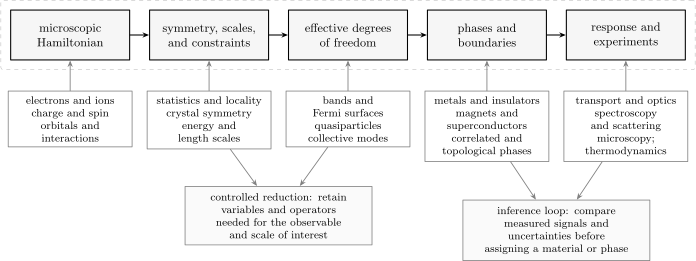
Quantum-matter reasoning is a chain of controlled reductions and empirical tests. Microscopic composition does not by itself identify a phase; symmetry, scale separation, interactions, and measured response determine which effective description is justified.
From Translation Symmetry to Bands
Section titled “From Translation Symmetry to Bands”Suppose a one-electron Hamiltonian has a periodic potential,
for every Bravais-lattice vector . The translation operator commutes with . Because lattice translations form an abelian group, simultaneous energy and translation eigenstates may be chosen:
In position space, use the convention
The translation eigenvalue equation then becomes
Therefore
This is Bloch’s theorem. The label is crystal momentum, and is a band index. If is a reciprocal-lattice vector, then , so and carry the same translation eigenvalues. A primitive cell of reciprocal space, commonly the first Brillouin zone, contains one representative of each equivalence class.
Bloch’s theorem is a symmetry statement. Its one-particle form does not require a weak periodic potential or a particular orbital basis; it applies to any symmetry-compatible linear one-particle problem. An interacting many-body Hamiltonian instead has total crystal-momentum sectors, and its eigenstates or excitations need not reduce to occupied independent-electron Bloch orbitals.
The abstract translation machinery is developed in Translations and Momentum and Translation-Invariant Hamiltonians. Crystals and Lattices begins the full crystalline application by separating the translation group, cell, and physical motif; Reciprocal Lattice constructs the phase-invariant dual lattice, Brillouin Zones selects symmetry-adapted representatives, and Bloch’s Theorem constructs the states carrying those translation characters.
From Interactions to Emergence
Section titled “From Interactions to Emergence”Interactions do more than shift one-particle energies. They correlate occupations, redistribute spectral weight, create collective order, and can change which degrees of freedom are meaningful.
Weakly dressed particles
Section titled “Weakly dressed particles”If interactions deform a noninteracting state continuously and produce long-lived poles in a Green function, electron-like or hole-like quasiparticles can survive with renormalized energy, velocity, charge response, and lifetime. This is the setting of Fermi-liquid theory, but it is not universal.
Broken symmetry
Section titled “Broken symmetry”An ordered phase can select one state from a symmetry-related family. A ferromagnet develops a spontaneous magnetization, a crystal breaks continuous translations to a discrete subgroup, and a conventional superconductor develops phase-coherent pairing. The thermodynamic limit and order of limits matter. Finite systems may show strong correlations and near-degenerate states without possessing a literally symmetry-broken exact ground state.
Interaction-driven insulation
Section titled “Interaction-driven insulation”A partially filled independent-electron band suggests metallic behavior, yet strong repulsion can suppress charge motion and produce a Mott insulator. The low-energy theory may then be organized by spins or orbitals rather than mobile charge. This is a canonical warning against identifying a material with its bare band filling.
Topological organization
Section titled “Topological organization”Some phases are distinguished by quantized invariants, protected boundary phenomena, or long-range entanglement rather than by a local order parameter. The relevant protection assumptions must be named: a gap, symmetry, dimensionality, charge conservation, or interaction class may be essential. Closing a gap or breaking a protecting symmetry can remove the distinction.
The generic theory of phases and quantum criticality lives in Phases of Matter in Many-Body QM and Quantum Phase Transitions. The geometry of Berry phase, Berry curvature, and Chern number lives in Berry Phase, Berry Curvature, and Chern Numbers. Enter Topological Quantum Matter to choose the appropriate band, Hall, superconducting, semimetal, interacting, boundary, transition, or computation branch. Topology in Quantum Matter supplies the phase logic, while Chern Numbers in Band Theory applies the geometry to occupied projectors, Hall response, and computation.
Quasiparticles and Collective Modes
Section titled “Quasiparticles and Collective Modes”A quasiparticle is an excitation that behaves approximately like a particle over some range of energy and momentum. A collective mode is a coherent oscillation involving many microscopic degrees of freedom. The categories overlap: a quantized collective mode such as a phonon or magnon is also treated as a quasiparticle.
For an electron-like excitation, a retarded Green function may be written schematically as
The spectral function is
Near an isolated, weakly damped pole,
is the coherent spectral weight. In the displayed convention, is the Lorentzian full width at half maximum in energy, so the corresponding population-lifetime scale is . Other width conventions must be translated explicitly. represents incoherent background. A sharply defined dispersion is justified when the linewidth is small compared with the relevant energy separation. Broad spectra, continua, or vanishing residue warn that particle language may be inadequate.
Collective modes are constrained by conservation laws and symmetry. Broken continuous symmetry can produce gapless Goldstone modes; long-range Coulomb interactions can shift a neutral density mode into a plasma mode; coupling between modes produces avoided crossings and hybrid excitations. The canonical general treatments are Quasiparticles Overview and Collective Modes.
Response Is How Matter Becomes Observable
Section titled “Response Is How Matter Becomes Observable”A Hamiltonian is not measured directly. Experiments couple a perturbing field to an operator and record a response. For a perturbation
linear response gives
with
This formula is only a starting point. A prediction also requires the correct current, density, spin, dipole, stress, or tunneling operator; geometry and boundary conditions; matrix elements; temperature and preparation; instrumental resolution; and a convention for Fourier transforms and signs.
| Probe | Leading theoretical object | What it can constrain |
|---|---|---|
| angle-resolved photoemission | occupied removal spectral function with matrix elements | dispersions, Fermi surfaces, linewidths, gaps |
| scanning tunneling spectroscopy | local spectral density and tunneling matrix element | local gaps, impurity states, spatial inhomogeneity |
| Raman and optical spectroscopy | symmetry-resolved inelastic light-scattering response | phonons, magnons, electronic continua, resonance, and symmetry |
| terahertz and infrared probes | complex conductivity, dielectric response, or sheet conductance | carrier relaxation, gaps, stiffness, polar phonons, and polaritons |
| neutron scattering | nuclear and magnetic structure factors | bulk structure, spin, lattice motion, and continua |
| X-ray scattering | electron-density, resonant-tensor, coherent, or energy-loss cross section | crystal, charge, orbital, strain, and collective dynamics |
| dc and Hall transport | conductivity and thermoelectric tensors | relaxation, carrier response, symmetry, topology |
| thermodynamics | free-energy derivatives | entropy, heat capacity, compressibility, susceptibilities |
No probe is a photograph of a wavefunction. Each measures a correlation or response function filtered by matrix elements and resolution. Agreement across complementary probes is generally stronger evidence than a visually appealing match to one spectrum.
The canonical response formalism is Kubo Formula and Correlation Functions Overview. What Is a Green Function? owns the resolvent and propagator foundations.
Three Worked Anchors
Section titled “Three Worked Anchors”These compact models show the recurring chain from microscopic variables to modes, dispersions, and low-energy interpretation. Their full specialist treatments belong to the linked subject pages; here the point is to expose the common logic.
Anchor 1: a nearest-neighbor tight-binding chain
Section titled “Anchor 1: a nearest-neighbor tight-binding chain”Consider one spinless orbital per site on a periodic chain of sites and spacing :
Use the lattice Fourier transform
Substitution gives
where
The group velocity is
Near the band bottom at for ,
Matching the quadratic term to gives
The model illustrates five ideas at once: localized orbitals can form delocalized bands; translation symmetry diagonalizes hopping; the bandwidth is ; velocity is a band derivative; and an effective mass is a local curvature, not an intrinsic mass valid across the band.
In the thermodynamic limit, the density of states per site is
Its integrable divergences at the band edges are one-dimensional van Hove singularities. Spin degeneracy would multiply the state count by two unless lifted. Density of States owns the normalization ledger, dimensional threshold laws, critical-point classification, and experimental interpretation.
Anchor 2: an acoustic lattice vibration
Section titled “Anchor 2: an acoustic lattice vibration”Take identical masses connected by springs of constant :
The classical equation for a normal-mode ansatz is
Therefore
For ,
The gapless mode expresses the absence of a restoring force for uniform translation: costs no spring energy. For a finite unpinned chain, the exactly uniform coordinate is the free center of mass and is separated from the oscillator modes. Quantization promotes each nonzero- independent normal mode to a harmonic oscillator,
Pinning or boundary conditions can instead give the uniform coordinate a nonzero frequency, in which case it joins the oscillator sum with the modified spectrum.
The phonon is the quantum of a collective displacement field, not a particular atom carrying a packet of vibrational energy by itself.
Anchor 3: superexchange from a two-site Hubbard model
Section titled “Anchor 3: superexchange from a two-site Hubbard model”Consider two sites at half filling:
For , the low-energy subspace has one electron per site. A hop leaves that subspace and creates one empty site and one doubly occupied site at energy cost . Second-order virtual hopping lowers the spin-singlet energy but not the triplet energy. To leading order,
Define the dimensionless spin operator
so its eigenvalues are measured in units of . Within the singly occupied subspace the effective Hamiltonian can be written
Thus repulsive charge physics generates antiferromagnetic spin exchange. The low-energy variable is spin even though the microscopic process is electron hopping. The conclusion is controlled only when is small enough and the one-electron-per-site subspace is appropriate. The full Hubbard model and its regimes live in Hubbard Model.
Map of the Volume
Section titled “Map of the Volume”The Quantum Matter Overview is the compact routing gateway for this volume. Quantum Matter Map owns the detailed scale, representation, probe, computation, and inverse-problem map. The planned chapters follow the inference chain rather than a catalog of compounds; each chapter gateway owns its local dependency and branch routing.
| Chapter | Organizing question |
|---|---|
| Overview | What counts as quantum matter, and how should models be read? |
| Lattices, reciprocal space, and Bloch electrons | How does crystalline translation organize wavefunctions and momentum? |
| Band theory and electronic structure | How do orbitals, symmetry, filling, and interactions shape electronic states? |
| Lattice vibrations and collective modes | How are ionic and electronic collective motions constructed and measured? |
| Transport, response, and optics | How do fields drive charge, heat, spin, polarization, and optical response? |
| Magnetism and Spin Systems | How do local moments, itinerant electrons, exchange, and frustration produce magnetic phases? |
| Superfluidity and superconductivity | How do pairing, phase stiffness, gauge response, and vortices organize coherent matter? |
| Topological quantum matter | Which bulk structures and protection conditions imply robust response or boundary phenomena? |
| Mesoscopic and nanoscale quantum physics | How do coherence, contacts, interference, and finite size govern devices? |
| Disorder, localization, and nonequilibrium matter | How do randomness, driving, and isolation alter transport and phases? |
| Strong correlations and emergence | What replaces independent particles when kinetic and interaction scales compete? |
| Moiré, low-dimensional, and engineered materials | How do geometry, stacking, confinement, and interfaces create tunable quantum systems? |
| Probes, devices, and experiments | Which correlation function does each instrument actually measure? |
| Computational quantum matter | Which approximations and numerical methods answer which material questions? |
| Quantum Matter Frontiers and Open Problems | How should fast-moving claims be frozen, evidence-bounded, and routed without duplicating their stable physics owners? |
| Quantum Matter Reference and Data | Which canonical owner, compact reference handle, convention block, provenance record, and reuse limit belong to a quantum-matter lookup? |
This order is not compulsory. The subject is highly connected, so readers should use a route matched to their objective.
Electronic-Structure Reading Path
Section titled “Electronic-Structure Reading Path”The current electronic-structure path is Crystals and Lattices → Reciprocal Lattice → Brillouin Zones → Bloch’s Theorem → Band Theory and Electronic Structure → Band Theory Overview → Effective Mass → Minimal Coupling in Wave Mechanics → Landau Levels → Landau Levels in Solids.
Subject Reading Paths
Section titled “Subject Reading Paths”The How to Use This Volume guide explains how to choose among the specialist paths below. Check the scope, prerequisites, and editorial status of each article.
Solid-state foundations
Section titled “Solid-state foundations”Begin with the Condensed Matter Roadmap and Math Needed for Quantum Matter. Then use the progression Crystals and Lattices → Reciprocal Lattice and Brillouin Zones → Bloch’s Theorem → Band Theory and Electronic Structure → Phonons and Transport, Response, and Optics.
This path is suitable for an undergraduate solid-state course.
Electronic structure and semiconductors
Section titled “Electronic structure and semiconductors”Enter through the Band Theory and Electronic Structure gateway to declare the band description, filling, gap or crossing question, target observable, and validity window. Use the Band Theory Overview for the detailed band-to-many-body dictionary, then study Bloch states, nearly free electrons, tight-binding models, density of states, Fermi surfaces, metals, insulators, semiconductors, and semimetals, effective mass, holes, doping, junctions, and optical transitions. Keep separate the exact interacting state, an independent-electron band structure, and experimentally dressed quasiparticle bands.
Low-dimensional and engineered matter
Section titled “Low-dimensional and engineered matter”Begin with Low-Dimensional Quantum Matter for the distinction between geometric and effective dimension, confinement and crossover criteria, dimensional state counting, infrared fluctuations, and the evidence needed to establish a one- or two-dimensional regime. Then use Two-Dimensional Materials for atomically thin crystals, environmental screening, valleys, excitons, and platform-level device control. Continue to Graphene for the engineered Dirac platform, Transition-Metal Dichalcogenides for spin–valley-locked semiconductors and exciton hierarchies, and van der Waals Heterostructures for stack assembly, alignment, gates, proximity, and vertical-device evidence. Moiré Superlattices then develops the emergent cell, mini Brillouin zone, miniband, filling, and interaction scales; Twisted Bilayer Graphene follows that framework through the continuum model and its correlated, superconducting, and topological experimental record. Flat Bands separates energy flatness from projector geometry across platforms, and Correlated Insulators in Moiré Systems distinguishes filling commensurability from Mott-like, generalized Wigner, flavor-ordered, topological, and disorder-driven mechanisms. Moiré Superconductivity then organizes the evidence for pairing and phase coherence, the available tuning axes, competing microscopic mechanisms, and gate-defined Josephson probes. Moiré Topology separates topological minibands, Chern ferromagnets, quantum anomalous Hall transport, and fractional Chern order.
2D Magnets and Ferroelectrics then develops finite-temperature order, layer parity, sliding polarization, and coupled ferroic response. Engineered Heterostructures compares semiconductor–superconductor, magnetic–topological, oxide, and cavity–material interfaces through a common transfer, loss, and evidence ledger. Artificial Lattices and Designer Matter compares quantum-dot, optical, photonic, polaritonic, circuit, and atomically assembled lattices through a common Hamiltonian-validation protocol.
Transport and response
Section titled “Transport and response”Use the Transport, Response, and Optics gateway to choose among bulk, kinetic, correlation, coherent-terminal, optical, dielectric, thermoelectric, noise, and nonlinear descriptions by regime. Begin with Drude Theory for the one-fluid relaxation-time benchmark. Continue to Boltzmann Transport for band-resolved distributions, collision operators, electrical and thermal response, and conservation-aware computation. Then use Transport Coefficients Preview and Kubo Formula for conserved-current dynamics, orders of limits, and exact linear response.
Magnetism and strong correlations
Section titled “Magnetism and strong correlations”Enter Magnetism and Spin Systems first to distinguish moment formation, field response, spontaneous order, collective excitations, itinerant or impurity physics, and magnetic textures.
Prepare with Spin and Spinors, Heisenberg Model, Hubbard Model, and Magnons. Then use What Are Strong Correlations? to audit interaction scales and evidence, Mott Insulators for the phase diagnosis, Hubbard Physics in Materials for the crystal-to-model workflow, and the t–J Model for projected doped-Mott and cuprate reductions before continuing to local moments, itinerant magnetism, exchange, RKKY coupling, frustration, the Kondo Effect, Kondo Lattices, Heavy Fermions, Quantum Criticality, Non-Fermi Liquids, Strange Metals, Quantum Spin Liquids, Fractionalization, and Emergent Gauge Fields.
Superconductivity
Section titled “Superconductivity”The prerequisite chain joins Fermi–Dirac Statistics, Lattice Vibrations and Collective Modes, Transport, Response, and Optics, and Spontaneous Symmetry Breaking. The superconductivity branch then runs from Superfluidity and Superconductivity through London Theory, Ginzburg–Landau Theory, Vortices, BCS Theory, Bogoliubov Quasiparticles, the Josephson Effect, and Unconventional Superconductivity.
Topology
Section titled “Topology”Prepare with the Adiabatic Theorem, Berry Phase, Berry Curvature, Chern Numbers, and Landau Levels. Use Topology in Quantum Matter to organize gapped deformations and protection, then Chern Numbers in Band Theory for the clean band invariant, Integer Quantum Hall Effect for integer plateaus, Fractional Quantum Hall Effect for interaction-driven topological order, Anyons and Braiding for fusion spaces and operational braid protocols, and Topological Insulators for time-reversal-protected band topology.
Experiments and computation
Section titled “Experiments and computation”Start from the observable rather than the favored model. Identify the probe operator and resolution, then choose the smallest theory that can predict the measured quantity. Use exact diagonalization, tight-binding calculations, response functions, first-principles input, tensor networks, Monte Carlo, or nonequilibrium methods only after stating their assumptions and validation targets.
What to Know First
Section titled “What to Know First”The minimum undergraduate preparation is:
- linear algebra and eigenvalue problems;
- wave mechanics and the harmonic oscillator;
- identical particles and Fermi–Dirac statistics;
- Fourier series and transforms;
- elementary statistical mechanics;
- perturbation theory;
- angular momentum and spin;
- electromagnetism.
Graduate work additionally uses:
- second quantization and Wick’s theorem;
- Green functions and spectral representations;
- linear response and fluctuation–dissipation relations;
- group representations and crystal symmetry;
- Berry geometry and topological invariants;
- variational methods and effective Hamiltonians;
- numerical linear algebra and finite-size scaling;
- renormalization and field-theory language.
Missing one prerequisite should not prevent orientation. Use the Required and Helpful background notes on each article to isolate the smallest gap. The Condensed Matter Roadmap and Math Needed for Quantum Matter crosswalk provide staged preparation.
Canonical-Home Boundaries
Section titled “Canonical-Home Boundaries”This volume applies several structures whose general derivations already have canonical homes.
| Topic | Canonical home | Role here |
|---|---|---|
| indistinguishability and exchange | Composite Systems and Entanglement | electron filling, bands, magnetism |
| Fock space and second quantization | Second Quantization | lattice and band Hamiltonians |
| ensembles and thermodynamic limits | Many-Body and Quantum Statistical Mechanics | finite-temperature material phases |
| general correlation and response theory | Kubo Formula | conductivity, optics, scattering |
| abstract Green functions | Dynamics and Formulations | spectral functions and quasiparticles |
| abstract symmetry and Berry geometry | Symmetry, Angular Momentum, and Spin | crystalline and topological applications |
| single-particle Landau problem | Landau Levels | quantum Hall matter |
| integer Hall plateaus, edges, and metrology | Integer Quantum Hall Effect | canonical material-response home |
| fractional Hall fluids, quasiparticles, and edges | Fractional Quantum Hall Effect | canonical interacting Hall home |
| approximation and downfolding logic | Effective Hamiltonians | material-specific low-energy models |
| generic open-system dynamics | Measurement and Open Systems | driven, dissipative, and device settings |
| generic many-body versus material versus field-theory ownership | Many-Body Boundaries and QFT Bridges | material-specific effective theories, observable matching, and evidence |
The reverse boundary is equally important. Material-specific band topology, transport mechanisms, superconducting phenomenology, probe matrix elements, disorder in solids, and comparison among material models belong here rather than in the abstract prerequisite volumes.
Conventions
Section titled “Conventions”Conventions for Quantum Matter is the canonical domain contract for lattice embeddings, Fourier phases, Bloch gauges, Berry and Hall signs, electromagnetic coupling, spectral normalization, and transport limits. Unless a page states otherwise:
- denotes the magnitude of the electron charge, so .
- Bold lowercase symbols such as and denote vectors.
- denotes a Bravais-lattice vector; denotes a basis position within a unit cell.
- Primitive real-space vectors and reciprocal vectors satisfy
- denotes a reciprocal-lattice vector.
- is normally a band index, an orbital or sublattice label, and a spin label.
- Crystal momentum is represented in a specified Brillouin zone and is equivalent modulo .
- For unit cells, the default lattice transform is
- The Brillouin-zone sum becomes
- The Fermi energy means the zero-temperature chemical potential when that limit is unambiguous. At finite temperature the term chemical potential is preferred.
- Retarded response uses the Fourier convention unless stated otherwise.
- Berry connection and curvature signs must be declared locally because conventions differ across communities.
- Hall signs must state the carrier-charge convention, magnetic-field orientation, coordinate orientation, and tensor index order.
- SI units are used for dimensional formulas unless atomic, natural, or condensed-matter units are explicitly introduced.
This ledger summarizes conventions for the quantum-matter route. Any page that changes a gauge, basis, normalization, conductivity, or Brillouin-zone convention must state that change locally.
Evidence and Model Discipline
Section titled “Evidence and Model Discipline”A trustworthy quantum-matter claim identifies at least five layers:
- Material and preparation: composition, structure, dimensionality, disorder, strain, pressure, field, temperature, and history.
- Measurement: probe, geometry, calibration, resolution, background model, and uncertainty.
- Observed feature: peak, gap, scaling law, quantized plateau, symmetry pattern, or correlation length.
- Inference model: the Hamiltonian, response function, matrix element, and approximation connecting feature to claim.
- Alternatives and robustness: competing explanations and the changes under which the conclusion survives.
A toy model is valuable when it isolates a mechanism or universality class. It is not automatically a faithful description of a named compound. Conversely, a first-principles calculation is not exact merely because it starts from atomic species: exchange-correlation approximations, pseudopotentials, basis convergence, structural input, temperature, and many-body corrections remain consequential.
Claims should be labeled by their epistemic status:
- standard result: reproduced across methods or experiments with understood assumptions;
- controlled approximation: supported by a small parameter, theorem, or convergence study;
- phenomenological model: empirically useful within a stated regime;
- material assignment: an inference combining model and measurement;
- active research: plausible but contested or incomplete;
- speculation: a proposed mechanism or phase lacking decisive evidence.
Topology, fractionalization, unconventional pairing, strange metallicity, and quantum spin-liquid assignments require especially careful separation between suggestive signatures and discriminating evidence.
Common Mistakes
Section titled “Common Mistakes”Calling every low-temperature effect quantum
Section titled “Calling every low-temperature effect quantum”Low temperature can expose quantum coherence, but temperature alone does not identify the mechanism. A classical structural transition can occur at low temperature, and a quantum band effect can remain visible at room temperature.
Treating a model as a material
Section titled “Treating a model as a material”The Hubbard, Heisenberg, Bardeen–Cooper–Schrieffer, Haldane, and Kitaev Hamiltonians define theoretical structures. A material realizes them only approximately and may contain additional orbitals, interactions, disorder, phonons, and three-dimensional couplings.
Confusing crystal momentum with mechanical momentum
Section titled “Confusing crystal momentum with mechanical momentum”Crystal momentum labels representations of discrete translations and is conserved modulo reciprocal-lattice vectors. It is not generally equal to or to the expectation value of canonical momentum.
Reading a band plot as the exact spectrum
Section titled “Reading a band plot as the exact spectrum”A plotted band may be a Kohn–Sham eigenvalue, a tight-binding energy, a quasiparticle pole, or a fitted dispersion. These objects need not coincide, particularly for unoccupied states, strong interactions, broad excitations, or surface-sensitive probes.
Assuming every spectral peak is a particle
Section titled “Assuming every spectral peak is a particle”A narrow peak can justify a quasiparticle description. A continuum, threshold singularity, matrix-element zero, or collective response can produce structures that do not correspond to a stable particle.
Equating zero resistance with superconductivity
Section titled “Equating zero resistance with superconductivity”Superconductivity includes equilibrium electromagnetic response, notably the Meissner effect and phase stiffness. A highly conducting or perfectly momentum-conserving system need not be a superconductor.
Calling a state topological without naming protection
Section titled “Calling a state topological without naming protection”A topological claim must identify the invariant or long-range structure, the gap or mobility gap, the relevant symmetry if any, and the allowed deformations. Edge-like signals alone are rarely decisive.
Ignoring order of limits
Section titled “Ignoring order of limits”The thermodynamic, zero-frequency, zero-wavevector, zero-temperature, clean, and long-time limits need not commute. Transport coefficients and symmetry-breaking statements are incomplete without the limit prescription.
Exercises
Section titled “Exercises”Exercise 1: reciprocal-lattice equivalence
Section titled “Exercise 1: reciprocal-lattice equivalence”Show that and give the same eigenvalue under every Bravais-lattice translation when is reciprocal. Explain what remains different about a chosen Bloch basis.
Solution
By definition, for some integer and every Bravais vector . Therefore
The two labels describe the same character of the translation group. Their cell-periodic factors are related by a reciprocal-space gauge transformation,
up to band mixing within degeneracies and other gauge choices. Thus translation eigenvalues agree, while basis representatives and their phases need not be identical.
Exercise 2: curvature and effective mass
Section titled “Exercise 2: curvature and effective mass”For with , find the effective mass near and near . Interpret the sign.
Solution
The inverse effective mass in one dimension is
Since
one obtains
The negative curvature near the band maximum means an applied force changes the electron wave-packet velocity as though its band mass were negative. Rewriting the nearly filled band in terms of missing electrons gives positively charged hole excitations with a positive effective mass.
Exercise 3: state counting in the tight-binding band
Section titled “Exercise 3: state counting in the tight-binding band”Verify that
contains one state per site when integrated over the band. Why do its edge divergences not imply infinitely many states?
Solution
Set , so and for . Then
The singularities behave as near an edge. They are unbounded but integrable, so any finite energy interval contains a finite number of states.
Exercise 4: acoustic sum rule in the chain
Section titled “Exercise 4: acoustic sum rule in the chain”Explain directly from the spring Hamiltonian why . Then derive the sound speed from the exact dispersion.
Solution
For a uniform displacement , every difference vanishes. The potential energy is unchanged, so there is no restoring force and the mode has zero frequency.
For small ,
Thus
The sound speed is . A substrate or onsite pinning term would break continuous displacement invariance and open a gap.
Exercise 5: choosing an effective description
Section titled “Exercise 5: choosing an effective description”A material has one partially filled narrow band separated by a large gap from other bands, onsite repulsion comparable to the bandwidth, and a low-temperature antiferromagnetic response. Which degrees of freedom should be retained first, and what evidence would be needed before calling it a Mott insulator?
Solution
A defensible first model retains the isolated band, spin, hopping, and at least the dominant local interaction. A one-band Hubbard-like description is plausible because remote bands are energetically separated, but its parameters and omitted nonlocal interactions must be checked.
Antiferromagnetism alone does not establish Mott insulation. One should distinguish a correlation-driven gap from a band or Slater gap using filling, spectral-weight transfer, temperature dependence, optical conductivity, charge response, and comparison with realistic band structure. The insulating state should persist in a regime where independent-electron filling would predict a metal, and the interaction-based model should account for both charge and spin scales.
Exercise 6: probe–observable matching
Section titled “Exercise 6: probe–observable matching”For each claim below, name a primary observable and at least one complementary check:
- a bulk superconducting phase;
- a sharp electron-like quasiparticle;
- a two-dimensional Chern insulator.
Solution
For bulk superconductivity, equilibrium magnetic screening and flux response are primary; zero resistance, heat-capacity anomalies, phase-sensitive Josephson measurements, and spectroscopic gaps are complementary.
For a sharp electron-like quasiparticle, a narrow dispersing feature in the single-particle spectral function is primary. Its linewidth, temperature dependence, sum-rule consistency, quantum oscillations, or transport lifetime provide complementary checks while accounting for probe matrix elements.
For a Chern insulator, a quantized Hall response at zero net magnetic field together with an insulating bulk is primary. Boundary transport or spectroscopy, gap robustness, symmetry analysis, and a bulk topological invariant calculated for a validated Hamiltonian are complementary. Edge-like conduction without a demonstrated insulating bulk is insufficient.
Connections
Section titled “Connections”- From Quantum Mechanics to Materials follows one material from microscopic electron–ion theory to an observable-specific model through an explicit provenance and approximation ledger; this volume home retains the broad synthesis and worked anchors.
- Choosing a Model for Quantum Matter compares candidate retained descriptions for a declared material observable and routes the chosen family to its canonical owner; this volume home does not duplicate that adequacy decision.
- Quantum Information and Computation owns the operational and systems-level treatment of superconducting, semiconductor, mesoscopic, and topological quantum hardware.
- Condensed Matter Roadmap gives a staged entry from undergraduate quantum mechanics.
- Math Needed for Quantum Matter maps Fourier analysis, group theory, topology, probability, and numerics to their canonical pages.
- Low-Dimensional Quantum Matter develops the energy-scale definition of effective dimension, band-edge threshold laws, infrared fluctuation constraints, and a dimensionality claim ladder.
- Two-Dimensional Materials develops the materials-platform ledger for monolayer stability, nonlocal screening, valleys, excitons, heterostructures, and gates.
- Graphene connects the canonical Dirac model to engineering perturbations, strain pseudogauge fields, substrate control, Hall nomenclature, and moiré coupling.
- Transition-Metal Dichalcogenides connects monolayer polytype and valley structure to spin–orbit response, excitons, moiré bands, and correlation evidence.
- van der Waals Heterostructures connects layer sequence and alignment to interface cleanliness, gate coordinates, proximity self-energies, and vertical tunneling.
- Moiré Superlattices connects reciprocal mismatch and reconstruction to mini Brillouin zones, flat-miniband criteria, tunable interactions, and simulator validation.
- Twisted Bilayer Graphene connects the three-wave continuum model and first magic regime to correlated insulators, superconductivity, valley topology, and an explicit evidence ledger.
- Flat Bands connects destructive interference and spectral flattening to quantum metric, Chern-band constraints, projected interactions, and rigorous ferromagnetism conditions.
- Correlated Insulators in Moiré Systems connects calibrated filling and thermodynamic gaps to Mott-like localization, generalized Wigner order, flavor symmetry, and extended Hubbard models.
- Moiré Superconductivity connects resistive transitions to stiffness, BKT coherence, pairing symmetry, tunable phase diagrams, and Josephson-device tests.
- Moiré Topology connects topological minibands and flavor selection to integer and fractional Hall response, Středa fans, quantum geometry, and competing charge order.
- 2D Magnets and Ferroelectrics connects finite-temperature order and layer parity to sliding polarization, multiferroicity, and spin–valley–lattice response.
- Engineered Heterostructures connects transferred pairing, exchange, charge reconstruction, and light–matter coupling to interface-specific loss budgets and phase claims.
- Artificial Lattices and Designer Matter connects programmable graphs to calibrated Hamiltonians, prepared states, finite-size evidence, flat bands, and topology across simulator platforms.
- Quantum Materials by Design connects target observables to multiobjective screening, stability, synthesis, out-of-distribution validation, reproducibility, and an explicit evidence ladder.
- How Quantum Matter Is Measured connects raw records to calibrated observables and material claims through explicit resolution, depth, protocol, and uncertainty contracts.
- Transport Measurements connects terminal voltages and currents to defensible resistance, sheet-resistance, resistivity, and conductivity datasets.
- Hall Measurements connects transverse voltage to carrier, magnetic, and quantized-response claims through explicit sign, parity, geometry, and history checks.
- Quantum Oscillations connects inverse-field oscillations to extremal areas, cyclotron masses, quantum lifetimes, Fermi-surface reconstruction, and carefully qualified phase constraints.
- Angle-Resolved Photoemission Spectroscopy connects photoelectron counts to occupied dispersions, Fermi surfaces, orbital selection, self-energies, gaps, and surface-state claims through explicit kinematic and forward-model checks.
- Scanning Tunneling Microscopy and Spectroscopy connects junction current to calibrated topography, local spectra, quasiparticle interference, gap maps, and atom-scale manipulation.
- Neutron Scattering connects detector events to nuclear and magnetic structure, phonons, magnons, continua, and resolution-aware material claims.
- X-Ray Scattering connects photon counts to structural refinement, resonant contrast, charge order, coherent imaging, and inelastic excitations.
- Raman and Optical Spectroscopy connects polarization-resolved scattering to crystal symmetry, phonons, magnons, electronic continua, and thin-layer optical controls.
- Terahertz and Infrared Probes connects power and field records to complex electrodynamics, carrier relaxation, superconducting stiffness, polar modes, and multilayer inversion.
- Pump–Probe Spectroscopy connects repeated optical preparation to time-resolved response, trARPES, coherent phonons, relaxation, and evidence for light-induced states.
- Heat Capacity and Thermodynamics connects calorimeter records to electronic and lattice heat capacity, bulk anomalies, entropy balance, and low-temperature excitation claims.
- Magnetic Susceptibility connects bulk magnetometer records to susceptibility components, demagnetizing-field corrections, magnetic transitions, slow dynamics, and correlated-material claim controls.
- Device Fabrication Concepts connects device intent to contacts, gates, assembly, encapsulation, process-induced disorder, cryogenic packaging, yield, and batch reproducibility.
- Data Interpretation and Pitfalls provides the cross-probe audit for causal alternatives, depth, replication, inhomogeneity, contact artifacts, topological claims, and nonequilibrium memory.
- Drude Theory gives the material relaxation-time benchmark and its experimental failure tests.
- Boltzmann Transport develops the semiclassical distribution and collision-operator treatment of material transport.
- Charge and Spin Density Waves connects finite-wavevector order to nesting tests, Peierls physics, band reconstruction, collective modes, and competition with superconductivity.
- Competing Orders develops coupled-order thermodynamics, bicritical and tetracritical topology, coexistence tests, and cross-material evidence.
- Pair-Density Waves and Exotic Orders develops finite-momentum pairing, induced charge and charge-4e order, composite defects, and phase-sensitive evidence standards.
- Kondo Lattices develops dense local moments, screening–exchange competition, the Doniach heuristic, heavy Fermi liquids, and Kondo-breakdown phase structures.
- Heavy Fermions connects local multiplets to coherent heavy bands, probe-dependent masses and crossover scales, Fermi-volume tests, quantum criticality, and unconventional superconductivity.
- Quantum Criticality develops endpoint calibration, crossover fans, material scaling protocols, entropy and Grüneisen tests, transport anomalies, and magnetic scenarios.
- Non-Fermi Liquids classifies quasiparticle breakdown through self-energy, momentum, transport, and mechanism-aware evidence.
- Strange Metals develops the cross-material evidence ladder for linear- resistivity, Planckian rate estimates, optical and thermodynamic anomalies, and competing mechanisms.
- Quantum Spin Liquids develops frustration, symmetry constraints, deconfined phase families, the Kitaev benchmark, and a status-aware candidate-material ledger.
- Emergent Gauge Fields derives the constraint-to-Gauss-law route and compares compact U(1), , Higgs, confinement, matter coupling, and experimental diagnostics.
- Disorder in Quantum Matter classifies disorder ensembles and connects their correlators to quantum and transport lifetimes, mean free paths, and experimental control parameters.
- Anderson Localization develops interference-driven absence of diffusion, localization lengths, dimensional dependence, mobility-edge logic, and experimental evidence standards.
- Weak Localization derives coherent backscattering, the Cooperon correction, magnetic-field suppression, and spin–orbit-driven weak antilocalization.
- Scaling Theory of Localization develops dimensionless conductance, beta functions, dimensional flow, Anderson criticality, and the nonlinear-sigma-model bridge.
- Anderson Insulators develops gapless localized phases, phonon-assisted hopping, Mott optimization, Coulomb gaps, and mechanism-aware transport tests.
- Mobility Edges develops energy-resolved localization boundaries, three-dimensional criticality, finite-size inference, and direct probes.
- Random Matrix Theory in Quantum Matter develops invariant ensembles, universal spectral correlations, level repulsion, quantum-chaos boundaries, and the tenfold symmetry extension.
- Glasses and Spin Glasses develops frustration, overlap order, replica ideas, aging, and the evidence needed to distinguish collective freezing from ordinary blocking.
- Many-Body Localization is the platform-facing guide to interaction and isolation controls, observable claim ladders, finite-window inference, and current stability boundaries.
- Quantum Thermalization is the platform-facing guide to local equilibration, independently constrained ensembles, ETH, integrability, prethermalization, and open-system controls.
- Quenches is the protocol-facing guide to selective suddenness, finite ramps, energy injection, return measurements, correlation fronts, and pump–probe claims.
- Floquet Quantum Matter is the materials-facing guide to drive calibration, quasienergy spectroscopy, effective-model validation, topological evidence, and usable prethermal lifetimes.
- Driven-Dissipative Matter develops pump–loss ledgers, polariton fluids, open-system transition evidence, and Lindblad–Keldysh model selection.
- Open Quantum Materials connects environmental self-energies and dissipative design to non-Hermitian models, exceptional points, boundary effects, and experimental claim standards.
- Hall Effect develops ordinary, multiband, anomalous, and quantized transverse response with an explicit sign ledger.
- Integer Quantum Hall Effect develops filling, chiral edges, localization, plateau transitions, Chern response, and resistance metrology.
- Fractional Quantum Hall Effect develops Laughlin correlations, fractional charge and statistics, composite fermions, edge modes, and evidence standards for interacting topological order.
- Topological Order develops universal anyon and modular data, genus ground spaces, Abelian matrices, entanglement and thermal response, and phase-identification standards.
- Edge and Surface States compares chiral and helical edges, surface Dirac cones, finite-size hybridization, symmetry robustness, and experimental probes.
- Bulk–Boundary Correspondence connects relative bulk invariants to stable spectral flow, mass-domain-wall channels, anomaly matching, and numerical strip tests.
- Topological Superconductors develops BdG topology, symmetry classes, Majorana boundary and vortex modes, experimental platforms, and claim-audit standards.
- Weyl and Dirac Semimetals develops charged point nodes, Fermi arcs, crystalline Dirac crossings, anomaly-related transport, and a material evidence ledger.
- Symmetry-Protected Topological Phases develops interacting SPT equivalence, projective edge symmetry, anomalous boundaries, stacking, and group-cohomology limits.
- Quantum Dots develops artificial-atom spectra, orbital and charging contributions to addition energies, spin filling, and optical variants.
- Coulomb Blockade develops the orthodox capacitance network, event free energies, tunneling criteria, diamond slopes, and single-electron-transistor principle.
- Single-Electron Devices connects the SET operating point to charge sensitivity, time-resolved detection, pumps, turnstiles, quantized-current metrology, and error accounting.
- Proximity and Andreev Physics connects normal–superconductor scattering to BTK conductance, phase-dependent Andreev levels, hybrid junctions, and Majorana-device evidence.
- Nanostructures for Quantum Technology connects materials and device Hamiltonians to initialization, control, readout, reset, calibrated errors, fabrication yield, and architecture-level evidence.
- Quantum Wells develops one-direction confinement, two-dimensional subbands and density of states, heterostructure matching, and optical transitions.
- Two-Dimensional Electron Gases develops populated-interface Fermi scales, transport and quantum lifetimes, Hall readiness, spin splitting, and oxide-interface caveats.
- Graphene and Dirac Materials connects the honeycomb lattice to valley pseudospin, Berry phase, the Dirac Landau ladder, material diagnostics, and the moiré bridge.
- Quantum Point Contacts develops split-gate bottlenecks, local adiabatic modes, channel and noise diagnostics, charge sensing, bandwidth, and detector backaction.
- Aharonov–Bohm Rings develops open-ring magnetoconductance, flux and area calibration, and harmonics, phase rigidity, and coherence extraction.
- Universal Conductance Fluctuations develops reproducible magnetofingerprints, universal variance, symmetry crossover, field and energy correlations, and disorder averaging.
- Conductance Quantization connects ballistic channel counting to , degeneracy, imperfect transmission, contact resistance, noise, and point-contact experiments.
- Magnetism and Spin Systems routes a declared magnetic state, observable, and evidence target to the appropriate material owner.
- Exchange Interactions derives how statistics, virtual hopping, carrier motion, and itinerant susceptibility produce material spin couplings.
- Ferromagnetism connects spontaneous uniform order to domains, hysteresis, spin waves, Curie behavior, and localized versus itinerant mechanisms.
- Antiferromagnetism develops Néel order, magnetic sublattices, finite-wavevector diagnostics, frustration, quantum fluctuations, and spintronic controls.
- Ferrimagnetism separates unequal opposing sublattices from ferro- and antiferromagnetism and distinguishes magnetization compensation, angular-momentum compensation, and the Curie transition.
- Spin Waves and Magnons turns an ordered magnetic structure and candidate Hamiltonian into probe-weighted spectra, linewidths, and model-validation tests.
- Magnetic Anisotropy connects crystal, shape, interface, strain, and anisotropic-exchange energies to easy directions and texture scales.
- Spintronics connects spin diffusion and injection to magnetoresistive readout, reciprocal charge–spin conversion, spin pumping, torque, and device constraints.
- Skyrmions and Magnetic Textures develops domain walls, vortices, skyrmion topology, stability, emergent fields, dynamics, and experimental proof standards.
- Itinerant Magnetism connects spin-polarized bands and finite-wavevector reconstruction to collective modes, the Stoner continuum, and material diagnostics.
- Stoner Criterion derives the uniform band-electron instability with an explicit density-of-states convention and a sharp ledger of what the criterion cannot predict.
- Many-Body and Quantum Statistical Mechanics supplies ensembles, correlations, quasiparticles, response, phases, and computational many-body language.
- Atomic, Molecular, and Optical Physics treats the atomic and molecular building blocks, spectroscopy, light–matter coupling, and controlled quantum platforms.
- Effective Hamiltonians in Quantum Matter explains projection and scale separation for lattice and band models.
- Berry Phase and Chern Numbers provide the geometric foundations; Chern Numbers in Band Theory supplies the occupied-band and computational implementation.
- Open Quantum Systems supplies the general language for dissipation, reservoirs, and driven devices.
- Why Many-Body QM Leads to QFT explains why fields, propagators, collective modes, and renormalization emerge naturally.
References
Section titled “References”- A. Altland and B. Simons, Condensed Matter Field Theory, 2nd ed., Cambridge University Press, 2010. A graduate reference for field-theoretic methods, disorder, response, topology, and collective phenomena.
- N. W. Ashcroft and N. D. Mermin, Solid State Physics, Holt, Rinehart and Winston, 1976. A standard source for crystal structure, bands, transport, screening, phonons, and magnetism.
- J. Bardeen, L. N. Cooper, and J. R. Schrieffer, “Theory of Superconductivity,” Physical Review 108, 1175–1204 (1957), doi:10.1103/PhysRev.108.1175. The original microscopic theory of conventional pairing and superconducting quasiparticles.
- P. Coleman, Introduction to Many-Body Physics, Cambridge University Press, 2015. Connects quasiparticles, magnetism, superconductivity, path integrals, and strong correlations.
- A. Damascelli, Z. Hussain, and Z.-X. Shen, “Angle-Resolved Photoemission Studies of the Cuprate Superconductors,” Reviews of Modern Physics 75, 473–541 (2003), doi:10.1103/RevModPhys.75.473. Explains how photoemission intensity relates to spectral functions, matrix elements, and experimental resolution.
- F. D. M. Haldane, “Model for a Quantum Hall Effect without Landau Levels,” Physical Review Letters 61, 2015–2018 (1988), doi:10.1103/PhysRevLett.61.2015. Gives a canonical lattice model of a Chern insulator.
- M. Z. Hasan and C. L. Kane, “Colloquium: Topological Insulators,” Reviews of Modern Physics 82, 3045–3067 (2010), doi:10.1103/RevModPhys.82.3045. Introduces band topology, protected boundary states, and experimental signatures.
- M. Imada, A. Fujimori, and Y. Tokura, “Metal-Insulator Transitions,” Reviews of Modern Physics 70, 1039–1263 (1998), doi:10.1103/RevModPhys.70.1039. A foundational review of bandwidth, filling, disorder, and correlation-driven transitions.
- B. Keimer and J. E. Moore, “The Physics of Quantum Materials,” Nature Physics 13, 1045–1055 (2017), doi:10.1038/nphys4302. Reviews the modern quantum-materials landscape and the interplay of correlations, topology, and experimental control.
- C. Kittel, Introduction to Solid State Physics, 8th ed., Wiley, 2004. A compact undergraduate route through crystal and material phenomena.
- W. Kohn, “Nobel Lecture: Electronic Structure of Matter—Wave Functions and Density Functionals,” Reviews of Modern Physics 71, 1253–1266 (1999), doi:10.1103/RevModPhys.71.1253. Provides authoritative context for density-based electronic-structure theory and its conceptual scope.
- P. A. Lee, N. Nagaosa, and X.-G. Wen, “Doping a Mott Insulator: Physics of High-Temperature Superconductivity,” Reviews of Modern Physics 78, 17–85 (2006), doi:10.1103/RevModPhys.78.17. Reviews the strong-correlation framework and unresolved issues in cuprates.
- M. P. Marder, Condensed Matter Physics, 2nd ed., Wiley, 2010. Develops microscopic models, elasticity, electrons, response, and phases with explicit derivations.
- X.-L. Qi and S.-C. Zhang, “Topological Insulators and Superconductors,” Reviews of Modern Physics 83, 1057–1110 (2011), doi:10.1103/RevModPhys.83.1057. Develops effective theories and classifications for topological phases.
- D. J. Thouless, M. Kohmoto, M. P. Nightingale, and M. den Nijs, “Quantized Hall Conductance in a Two-Dimensional Periodic Potential,” Physical Review Letters 49, 405–408 (1982), doi:10.1103/PhysRevLett.49.405. Establishes the Chern-number expression for integer Hall conductance in a periodic system.