Hubbard Physics in Materials
Hubbard physics in a material is the claim that a specified low-energy orbital subspace, with documented hopping and screened interaction matrix elements, captures selected correlated observables over a stated range of energy, temperature, structure, and filling. A compound is not “a Hubbard model” in the literal sense. The model is an effective representation whose basis, parameters, omitted channels, solver, and validation all belong to the result.
This page owns the bridge from crystalline electronic structure to Hubbard-family material models. The Hubbard Model owns the canonical operator algebra, symmetries, exact limits, and generic strong-coupling expansion. Wannier Functions owns the Bloch-frame-to-localized-basis construction, localization and gauge choices, topological obstruction, and band-interpolation error ledger. Tight-Binding Models owns crystalline hopping-Hamiltonian assembly, orbital embeddings, and model validation. Effective Hamiltonians in Quantum Matter owns general projection and error-budget logic. Simulation of Quantum Materials takes a validated periodic, downfolded, or effective model through finite-instance selection, processor encoding, solver choice, observable extraction, and computational verification. Mott Insulators owns the material phase and its experimental diagnosis.
Why the Hubbard Description Is Useful
Section titled “Why the Hubbard Description Is Useful”The minimal Hubbard idea isolates a recurring competition:
- hopping spreads charge through a lattice;
- local repulsion penalizes selected charge configurations;
- virtual charge fluctuations generate lower-energy spin or orbital dynamics;
- changing filling releases mobile carriers into a constrained background.
That economy is its strength. The model supplies controlled limits, common diagnostics, and comparable numerical benchmarks. It can reveal why a partially filled band develops local moments, a narrow coherent scale, spectral-weight transfer, or charge incompressibility.
The same economy is also a warning. A real low-energy Hamiltonian can contain several orbitals per site, ligand states, Hund exchange, pair hopping, intersite repulsion, spin–orbit coupling, phonons, disorder, and retarded interactions. The useful question is not whether those terms exist microscopically; they do. The question is whether their effects on the target observables can be absorbed into a smaller parameter set with a controlled residual.
From Crystal Bands to an Active Subspace
Section titled “From Crystal Bands to an Active Subspace”Begin with a crystal structure and a reference one-electron problem. The reference may be a density-functional calculation, a quasiparticle calculation, or a fitted band model, but its method, exchange-correlation functional, magnetic constraint, spin–orbit treatment, and structural coordinates must be recorded.
Choose an active subspace containing the bands and orbitals intended for the many-body calculation. In localized orbitals , the projected one-body matrix is
Here label cells or correlated sites and label active orbitals. This compact object contains onsite crystal fields, hopping, hybridization inside , and spin–orbit matrix elements if spin is included in the basis.
The interaction is a four-index tensor. For orbitals centered on one correlated site, a representative matrix element is
is not normally the bare Coulomb interaction. It is screened by degrees of freedom excluded from the active low-energy polarization, and it can depend on frequency. Density–density and Hund coupling are reduced summaries of this tensor under specified symmetry and interaction conventions.
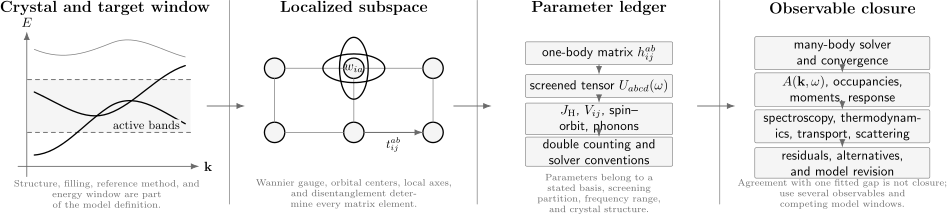
A material Hubbard model is a pipeline, not a single fitted . The crystal and energy window define a localized subspace; that basis defines one- and two-body matrix elements; a many-body solver produces observables; and residuals against several probes determine whether to retain, revise, or reject the model.
Isolated and entangled bands
Section titled “Isolated and entangled bands”An isolated group of bands can be transformed among smooth Bloch gauges without changing its exact projector. Entangled bands require an outer energy window, an inner frozen window when used, trial orbitals, and a disentanglement criterion. Different legitimate choices can produce different orbital spreads, hopping ranges, and interaction tensors while interpolating similar band energies. Unitary gauge changes within a fixed selected subspace are exact basis changes; window and disentanglement choices, hopping and interaction truncations, and parameter fitting belong to separate error entries.
Wannierization Workflows owns the numerical window, trial, disentanglement, localization, full-zone operator-validation, and artifact audit that supplies a candidate localized one-body basis. This page owns the separate physical decision that the resulting active subspace and interaction model are adequate for the correlated material claim.
DMFT for Quantum Materials owns the subsequent executable workflow through impurity solution, lattice and optional charge self-consistency, continuation audits, and bounded observable comparison. This page retains ownership of the correlated-model inputs and the material inference drawn from them.
For this reason, the phrase “the of a material” is incomplete. A report needs at least:
- the crystal structure and reference electronic-structure method;
- the target and disentanglement windows;
- the localized-orbital construction and local coordinate axes;
- the retained one- and two-body matrix elements;
- the screening method and frequency convention;
- the many-body solver, temperature, and double-counting prescription;
- convergence under plausible changes of the orbital window.
Screening and the Meaning of U
Section titled “Screening and the Meaning of U”Separate the total independent-particle polarization into contributions internal and external to the target subspace,
In the constrained random-phase approximation, screening by is withheld because the low-energy solver is intended to treat those processes explicitly. The partially screened interaction is
where is the bare Coulomb kernel and products denote operator composition. Restoring target-space screening gives the fully screened interaction,
This partition explains why a low-energy Hubbard is neither the bare atomic integral nor the fully screened static interaction measured after all low-energy carriers respond. It is a partially screened parameter matched to a particular division of labor between electronic-structure calculation and many-body solver.
Static versus dynamic interactions
Section titled “Static versus dynamic interactions”If varies little over the target energy range, a static approximation may be adequate. Strong frequency dependence means that eliminated screening modes leave retardation. Replacing by alone can miss bandwidth renormalization, satellites, and bosonic shake-off structures. A static low-energy model may still be constructed, but its one-body terms and observables can require additional renormalization.
The numerical value also depends on orbital extent. Enlarging the target window often makes the active orbitals more localized and can increase direct interaction matrix elements, while explicitly retaining ligand states changes which screening processes are excluded. A smaller in one basis does not imply weaker physical correlation than a larger in another basis.
Beyond onsite U
Section titled “Beyond onsite U”Material models may require:
- interorbital repulsion and Hund exchange ;
- spin-flip and pair-hopping terms required by rotational invariance;
- nonlocal density interactions ;
- correlated hopping and longer-range exchange;
- coupling to phonons or other screening modes;
- site-dependent terms at surfaces, interfaces, or disordered environments.
Dropping them is a modeling decision. It should be justified by scale estimates and observable convergence, not by the name “Hubbard.”
Double Counting in DFT-Based Workflows
Section titled “Double Counting in DFT-Based Workflows”Density-functional reference bands already contain an approximate average interaction through their Hartree and exchange-correlation potentials. Adding an explicit local interaction without a subtraction would count part of that physics twice. A schematic working Hamiltonian is
shifts and sometimes reshapes the correlated subspace. Unlike a diagrammatic subtraction between two exactly matched approximations, the usual DFT+ or DFT+DMFT double-counting term has no universally exact form because semilocal density functionals do not expose a unique local diagram subset.
This ambiguity is especially consequential in charge-transfer systems. Moving correlated levels relative to ligand levels changes occupancy, covalency, gap character, and magnetic exchange. A credible calculation therefore reports the double-counting functional or potential, the resulting orbital occupancies and – separation, and sensitivity over a physically motivated range. Charge self-consistency can reduce some inconsistencies, but it does not make the model-window or double-counting choices disappear.
Filling Is a Subspace Statement
Section titled “Filling Is a Subspace Statement”“Half filling” must refer to specified active modes. With spatial orbitals and two spin states per orbital, the local capacity is electrons. Half filling corresponds to
not to every integer formal valence. A ion represented by three orbitals has one electron in six spin-orbital modes; it is at an integer commensurate filling but not at multiorbital half filling. It can still display Mott physics.
Several counts should remain distinct:
| Count | Meaning | Main caution |
|---|---|---|
| formal oxidation state | ionic bookkeeping | ignores covalency and ligand holes |
| active-subspace electron count | electrons represented by the low-energy model | depends on window and projector |
| projected orbital occupancy | expectation value in chosen localized orbitals | need not be integer in an insulator |
| Fermi-volume count | momentum-space count in a metallic regime | may be reconstructed by order or fractionalization |
| dopant concentration | nominal chemical or electrostatic control | need not equal mobile-carrier density |
Hybridization can give noninteger projected occupancy even when the many-body state is incompressible at an integer total filling. Conversely, an integer formal count does not guarantee that a -only model has isolated the correct low-energy charge states. Valence histograms, ligand occupancy, and the character of addition and removal spectra are more informative than a single nominal ion label.
Orbital-selective regimes
Section titled “Orbital-selective regimes”Crystal fields, bandwidth differences, Hund coupling, and hybridization can make orbitals lose coherence at different scales. An orbital-selective Mott description requires orbital-resolved spectra and charge fluctuations in a declared basis. Because orbital labels can mix under local rotations, the physically robust statement concerns a symmetry-defined subspace or eigenvalues of an appropriate local density or self-energy matrix, not an arbitrary diagonal entry.
Strong Coupling and Magnetism
Section titled “Strong Coupling and Magnetism”Near one electron per site in a single isolated orbital, repulsive strong coupling suppresses double occupancy and produces antiferromagnetic kinetic exchange of order . The controlled derivation and its operator conventions live in Effective Hamiltonians in Many-Body Systems.
For a material, that estimate is a baseline rather than a universal exchange formula. Real denominators contain crystal-field and multiplet energies; Hund coupling can favor different intermediate states; ligand-mediated hopping introduces charge-transfer denominators; direct exchange, nonlocal repulsion, and ring exchange may matter; and spin–orbit coupling generates anisotropic exchange and Dzyaloshinskii–Moriya terms. Exchange Interactions owns those mechanisms.
The clean audit is:
- identify the low-energy local multiplet;
- list virtual charge sectors and their excitation energies;
- retain all symmetry-allowed hopping channels;
- derive the spin-orbital operator in the same local basis;
- compare several measured or computed exchanges, not one ordering temperature.
Magnetic order is also not guaranteed by a successful local-moment model. Dimensionality, frustration, competing exchange, and quantum fluctuations determine the ordered state or its absence.
Metal–Insulator Transitions in a Material Model
Section titled “Metal–Insulator Transitions in a Material Model”The one-band ratio is a useful coordinate only after , , filling, and the orbital window are fixed. Pressure can alter hopping, crystal fields, hybridization, and screening simultaneously. A structural transition can change the active subspace itself. Chemical substitution changes disorder and electrostatics in addition to bandwidth or filling.
Accordingly, a material calculation should track a path through a multidimensional parameter space rather than importing a universal one-band critical ratio. At minimum compare:
- quasiparticle weight and scattering rate on the metallic side;
- charge gap or compressibility on the insulating side;
- orbital occupancies and valence fluctuations;
- local moments and ordering tendencies;
- structural and ligand degrees of freedom;
- hysteresis or coexistence when a first-order transition is claimed.
Mott Insulators gives the phase-level evidence and the distinction from Slater, band, Anderson, and charge-transfer limits.
Doping Changes More Than the Chemical Potential
Section titled “Doping Changes More Than the Chemical Potential”A fixed-parameter Hubbard model can be solved away from integer filling by changing its chemical potential. Chemical doping of a solid is less surgical. Substitution can change bond angles, local potentials, impurity scattering, ligand energies, screening, and even the number of active orbitals. Electrostatic gating and intercalation have different electrochemical side effects.
The first validation question is therefore whether one parameter set still interpolates spectra and response across doping. Nonrigid spectral-weight transfer, Fermi-surface reconstruction, pseudogaps, and changing local moments may be intrinsic consequences of the interacting model, but they can also expose a changing Hamiltonian.
At strong coupling, projecting out high-energy double occupancy leads toward a t–J Model. The projection is controlled by a scale hierarchy, not by cuprate vocabulary. A material reduction must also retain longer-range hopping, charge-transfer character, and generated interactions at the accuracy required by the target observable.
Material Case Studies
Section titled “Material Case Studies”SrVO₃: correlated metal, not Mott insulator
Section titled “SrVO₃: correlated metal, not Mott insulator”Cubic has a nominal vanadium configuration and three low-energy orbitals. It is a correlated metal with renormalized quasiparticle bands and incoherent spectral weight, making it a benchmark for Wannier-based DFT+DMFT. A one-band half-filled interpretation is wrong: the orbital degeneracy and filling are different. Quantitative spectra also test surface sensitivity, oxygen vacancies, analytic continuation, nonlocal self-energy, and electron–phonon scattering.
V₂O₃: orbitals and structure at the transition
Section titled “V₂O₃: orbitals and structure at the transition”In , trigonal crystal fields split the manifold into and sectors. Their occupancies, hybridization, and structural evolution participate in the pressure- and composition-dependent transition. Multiorbital DFT+DMFT captures important correlated metallic and insulating trends, but the result cannot be reduced to changing one scalar in a fixed one-band model.
Cuprates: one-band utility after a charge-transfer problem
Section titled “Cuprates: one-band utility after a charge-transfer problem”The copper-oxide planes contain Cu and O states. A multiband – description is natural for charge-transfer spectroscopy, while a downfolded one-band model can organize lower-energy motion when its Zhang–Rice-like reduction and parameter range are justified. Material-dependent longer-range hoppings, apical oxygen, ligand covalency, and screening affect the effective model. Success of one-band numerics at low energy does not make oxygen irrelevant to the parent material.
Molecular salts: the dimer is a modeling choice
Section titled “Molecular salts: the dimer is a modeling choice”In -(BEDT–TTF), molecules form anisotropic layers with strong intradimer hopping. Treating each dimer as one effective site gives a frustrated half-filled model, while a molecule-resolved model retains intradimer charge and additional interactions. The correct choice depends on the energy scale and probe; dielectric or charge-order observables can invalidate a dimer-only reduction that remains useful for lower-energy spin physics.
Sr₂IrO₄: comparable interaction and spin–orbit scales
Section titled “Sr₂IrO₄: comparable interaction and spin–orbit scales”In , crystal fields and strong spin–orbit coupling reorganize the manifold into spin-orbital states before moderate repulsion opens an insulating gap. The effective description is useful but approximate: tetragonal distortion, covalency, intersite hopping, and mixing with states must be tested. This case demonstrates that “Hubbard” need not mean a bare spin-degenerate orbital.
Validation Workflow
Section titled “Validation Workflow”| Stage | Required record | Failure test |
|---|---|---|
| structure and reference bands | coordinates, symmetry, functional, magnetic and spin–orbit constraints | alternate measured structures or reference methods change the active manifold |
| active subspace | projectors, windows, local axes, orbital spreads, interpolation residuals | plausible windows change target observables beyond tolerance |
| interactions | full convention for , , , frequency dependence, screening exclusions | neglected tensor elements or dynamic screening alter the result |
| many-body solution | solver, bath or cluster size, temperature, continuation, convergence | method or continuation dependence exceeds claimed uncertainty |
| observable map | projected operators, matrix elements, resolution, surface or bulk sensitivity | agreement requires unrelated parameter sets for each probe |
| alternatives | structural, Slater, disorder, phonon, and wider-window models | a simpler or better-supported mechanism explains the same data |
A robust material statement survives reasonable changes at every stage. Reproducibility requires archiving numerical structures, orbital projectors or Wannier files, interaction matrices, double-counting values, solver parameters, random seeds where relevant, continuation choices, and postprocessing definitions.
Claim ladder
Section titled “Claim ladder”Use language matched to the closure achieved:
- Hubbard-inspired: a minimal model illustrates a mechanism.
- Material-motivated: hoppings and fillings reflect a compound, but interactions or omitted terms remain fitted.
- Parameter-consistent: one documented model reproduces several observables within uncertainties.
- Mechanism-supported: tuning and alternatives show that the Hubbard interaction is causally central.
- Predictive: parameters fixed independently predict new observables or control-parameter evolution.
“First principles” does not erase approximations in the exchange-correlation functional, subspace choice, screening partition, double counting, impurity solver, analytic continuation, or observable matrix elements. It should identify parameter provenance, not certify exactness.
Common Mistakes
Section titled “Common Mistakes”- Quoting without an orbital basis. Interaction matrix elements change with localization and target window.
- Calling every integer filling half filling. Half filling depends on the number of active spin-orbital modes.
- Using formal valence as projected occupancy. Covalency and ligand holes separate these counts.
- Adding one onsite to a fitted band structure by default. The same projection can generate , , , pair hopping, and retardation.
- Comparing across incompatible models. Both numerator and denominator depend on basis and screening.
- Treating double counting as a harmless constant. Relative ligand and correlated-orbital energies can move enough to change the phase.
- Assuming is the measured exchange. Multiplets, ligands, direct exchange, spin–orbit coupling, and higher orders modify it.
- Calling SrVO₃ a half-filled one-band Mott system. It is a multiorbital correlated metal.
- Using one fitted spectrum as validation. Spectral peaks alone may not constrain filling, moments, thermodynamics, or response.
- Keeping the Hamiltonian fixed under chemical doping without testing it. Disorder, structure, screening, and orbital energies can evolve.
- Presenting solver output without continuation or finite-temperature uncertainty. Real-frequency reconstruction is a separate inverse problem.
Exercises
Section titled “Exercises”1. Basis rotation and interaction truncation
Section titled “1. Basis rotation and interaction truncation”Let two active orbitals transform as
where is unitary. Derive the transformation laws for the one-body matrix and interaction tensor . Explain why rotating the basis and then keeping only two intra-orbital Hubbard parameters generally changes the model.
Solution
Creation operators transform as
Substitution into the one-body term gives
For an interaction written with matrix elements multiplying , the tensor transforms as
Even if the original basis was approximated by intra-orbital density interactions only, a generic rotation produces interorbital density terms, exchange-like terms, and pair hopping. Transforming the full tensor leaves physics invariant; transforming the orbitals and then discarding the generated components does not. A quoted scalar therefore belongs to a basis and a truncation convention.
2. What is half filling?
Section titled “2. What is half filling?”A transition-metal site is represented by three spatial orbitals with spin. Find the local capacity and the electron number at half filling. Classify nominal , , and configurations. Can the non-half-filled integer cases be Mott insulating?
Solution
Three spatial orbitals with two spin states each give six local modes, so the capacity is six electrons. Half filling is
Thus is half filled within the three-orbital model. The and cases are integer commensurate fillings but are not half filled.
Yes. Multiorbital Mott phases can occur at integer fillings other than half filling when interactions make charge addition and removal costly. Their critical scales, local multiplets, and Hund-coupling dependence differ from the half-filled case. Integer filling is a possible condition for incompressibility; “half filled” is not a synonym for “Mott capable.”
3. Restoring target-space screening
Section titled “3. Restoring target-space screening”Given
show that adding polarization from the active subspace yields
and solve for . Why should a low-energy solver not start from the fully screened if it will explicitly generate ?
Solution
After external screening has been resummed into , repeated target-space polarization insertions form
This geometric series obeys the stated Dyson equation. Rearranging gives
and hence
If the solver begins with fully screened and then explicitly produces target-space particle–hole screening, those processes are included twice. cRPA attempts to hand the solver an interaction screened by the rest of the system but not by the active transitions it will calculate.
4. Exchange estimate as a diagnostic
Section titled “4. Exchange estimate as a diagnostic”A one-band fit gives and . Estimate the leading antiferromagnetic exchange in millielectronvolts. Neutron scattering instead suggests . Does the mismatch falsify all Hubbard physics? List at least four checks.
Solution
The leading single-band estimate is
The factor-of-two mismatch falsifies the claim that this lowest-order, one-band parameter set quantitatively explains the measured exchange. It does not by itself falsify every Hubbard-family description.
Checks include: uncertainty and window dependence of and ; longer-range and ligand-mediated hopping; charge-transfer rather than denominators; Hund and multiplet structure; direct exchange; ring exchange and higher orders in ; spin–orbit anisotropy; and whether the experimental fit used a Hamiltonian with the same exchange convention. Several exchange paths and observables should be fit together.
5. Double counting in a charge-transfer material
Section titled “5. Double counting in a charge-transfer material”A DFT+DMFT calculation contains correlated orbitals and explicit ligand bands. Increasing the double-counting potential raises the effective level relative to . Predict qualitatively how the occupancy, ligand-hole weight, and charge-transfer energy may change. Which outputs should accompany a reported spectral gap?
Solution
Raising the level makes occupation of orbitals less favorable. The projected occupancy generally decreases, ligand-hole character in the low-energy configurations can change, and the effective energy required to transfer charge between ligand and metal shifts. The precise direction of a measured gap change depends on hybridization and which addition and removal states define its edges, so it should be computed rather than inferred from an ionic cartoon.
A gap report should include the double-counting value and formula, orbital-resolved occupancies, relative – level alignment, valence histogram, orbital character of both gap edges, and sensitivity over a justified double-counting interval. Otherwise the same nominal can hide qualitatively different charge-transfer physics.
6. Strength of a material claim
Section titled “6. Strength of a material claim”A DFT+DMFT study fixes by matching one photoemission mass enhancement. It then reproduces that same occupied spectrum but overestimates the optical gap, misses the measured magnetic exchange by a factor of three, and does not report window or double-counting sensitivity. Place the result on the claim ladder and design the next validation batch.
Solution
The study is material-motivated, not yet parameter-consistent or predictive. One fitted low-energy feature and its associated spectrum show that the model can represent a selected renormalization, but they do not close independent observables.
The next batch should:
- vary the correlated and ligand-containing windows while recomputing interactions;
- report double-counting and – alignment sensitivity;
- compare occupied and unoccupied spectra with common chemical-potential alignment;
- compute optical response with stated matrix elements and sum-rule cutoffs;
- derive exchange using the same orbital and interaction tensor, including ligand and multiplet channels;
- compare static DFT+, single-site DMFT, and a method with nonlocal correlations where feasible;
- test whether structural, phonon, or disorder alternatives explain the residuals.
Only a common parameter set that improves several independent channels should support a stronger mechanism claim.
Research Status
Section titled “Research Status”Wannier downfolding, constrained screening, multiorbital Hubbard interactions, and DFT+DMFT are established method families. Their controlled statements are conditional: Wannier interpolation can be exact within a chosen band subspace; cRPA defines a specific screening partition; DMFT becomes exact in the large-coordination limit and treats local temporal fluctuations nonperturbatively.
The material pipeline is not exact end to end. Active subspaces are not unique, interactions can be retarded, double counting remains prescription dependent, nonlocal correlations may matter, and real-frequency continuation can be ill conditioned. Current research aims to make these interfaces more reproducible through wider-window models, frequency-dependent interactions, +DMFT and related combinations, improved double counting, charge self-consistency, cluster methods, and cross-code benchmarks. Material claims should distinguish these active methodological questions from the settled algebra of the Hubbard model itself.
Connections
Section titled “Connections”- Simulation of Quantum Materials — finite targets, quantum encodings, state preparation, materials observables, resource multiplication, and validation.
- Hubbard Model — canonical Hamiltonian, conventions, limits, and observables.
- Tight-Binding Models — crystalline orbital embeddings, hopping-Hamiltonian assembly, and model validation.
- Effective Hamiltonians in Quantum Matter — projection, operator dressing, and omitted-scale errors.
- What Are Strong Correlations? — evidence standards and scale-dependent diagnostics.
- Mott Insulators — charge incompressibility, material mechanisms, and tuning.
- t–J Model — projected strong-coupling physics, charge-transfer reduction, and cuprate claim limits.
- Spectral Functions — addition and removal spectra, self-energies, and sum rules.
- Analytic Continuation — uncertainty in reconstructing real-frequency spectra.
- Exchange Interactions — direct, superexchange, itinerant, and spin–orbit-generated couplings.
- Optical Lattices — a more directly calibrated Hubbard realization with different systematics.
- Transition-Metal Dichalcogenides — a tunable moiré-material case where triangular, multiorbital, and topological Hubbard reductions require separate validation.
- Moiré Superlattices — the geometric, miniband, filling, and interaction-scale prerequisites for moiré Hubbard reductions.
- Correlated Insulators in Moiré Systems — extended multi-flavor Hubbard reductions tested against moiré charge gaps, order, transport, and topology.
- Quantum Materials by Design — the wider inverse-design loop in which correlated-model uncertainty, synthesis, and prospective property tests must remain linked.
References
Section titled “References”- J. Hubbard, “Electron correlations in narrow energy bands,” Proceedings of the Royal Society A 276, 238–257 (1963).
- D. P. Arovas, E. Berg, S. A. Kivelson, and S. Raghu, “The Hubbard model,” Annual Review of Condensed Matter Physics 13, 239–274 (2022).
- N. Marzari, A. A. Mostofi, J. R. Yates, I. Souza, and D. Vanderbilt, “Maximally localized Wannier functions: Theory and applications,” Reviews of Modern Physics 84, 1419–1475 (2012).
- A. Marrazzo, S. Beck, E. R. Margine, et al., “Wannier-function software ecosystem for materials simulations,” Reviews of Modern Physics 96, 045008 (2024).
- I. Souza, N. Marzari, and D. Vanderbilt, “Maximally localized Wannier functions for entangled energy bands,” Physical Review B 65, 035109 (2001).
- F. Aryasetiawan, M. Imada, A. Georges, et al., “Frequency-dependent local interactions and low-energy effective models from electronic structure calculations,” Physical Review B 70, 195104 (2004).
- T. Miyake and F. Aryasetiawan, “Screened Coulomb interaction in the maximally localized Wannier basis,” Physical Review B 77, 085122 (2008).
- A. Georges, G. Kotliar, W. Krauth, and M. J. Rozenberg, “Dynamical mean-field theory of strongly correlated fermion systems and the limit of infinite dimensions,” Reviews of Modern Physics 68, 13–125 (1996).
- G. Kotliar, S. Y. Savrasov, K. Haule, et al., “Electronic structure calculations with dynamical mean-field theory,” Reviews of Modern Physics 78, 865–951 (2006).
- V. I. Anisimov, A. I. Poteryaev, M. A. Korotin, A. O. Anokhin, and G. Kotliar, “First-principles calculations of the electronic structure and spectra of strongly correlated systems: Dynamical mean-field theory,” Journal of Physics: Condensed Matter 9, 7359–7367 (1997).
- F. Lechermann, A. Georges, A. Poteryaev, et al., “Dynamical mean-field theory using Wannier functions: A flexible route to electronic structure calculations of strongly correlated materials,” Physical Review B 74, 125120 (2006).
- M. Karolak, G. Ulm, T. O. Wehling, et al., “Double counting in LDA+DMFT—The example of NiO,” Journal of Electron Spectroscopy and Related Phenomena 181, 11–15 (2010).
- J. Zaanen, G. A. Sawatzky, and J. W. Allen, “Band gaps and electronic structure of transition-metal compounds,” Physical Review Letters 55, 418–421 (1985).
- K. Held, G. Keller, V. Eyert, D. Vollhardt, and V. I. Anisimov, “Mott–Hubbard metal–insulator transition in paramagnetic VO: An LDA+DMFT(QMC) study,” Physical Review Letters 86, 5345–5348 (2001).
- I. A. Nekrasov, K. Held, G. Keller, et al., “Momentum-resolved spectral functions of SrVO calculated by LDA+DMFT,” Physical Review B 73, 155112 (2006).
- D. J. Abramovitch, J. Mravlje, J.-J. Zhou, A. Georges, and M. Bernardi, “Respective roles of electron-phonon and electron-electron interactions in the transport and quasiparticle properties of SrVO,” Physical Review Letters 133, 186501 (2024).
- E. Pavarini, I. Dasgupta, T. Saha-Dasgupta, O. Jepsen, and O. K. Andersen, “Band-structure trend in hole-doped cuprates and correlation with ,” Physical Review Letters 87, 047003 (2001).
- P. A. Lee, N. Nagaosa, and X.-G. Wen, “Doping a Mott insulator: Physics of high-temperature superconductivity,” Reviews of Modern Physics 78, 17–85 (2006).
- B. J. Kim, H. Ohsumi, T. Komesu, et al., “Phase-sensitive observation of a spin-orbital Mott state in SrIrO,” Science 323, 1329–1332 (2009).
- R. H. McKenzie, “A strongly correlated electron model for the layered organic superconductors -(BEDT–TTF),” Comments on Condensed Matter Physics 18, 309–337 (1998).
- A. Georges, L. de’ Medici, and J. Mravlje, “Strong correlations from Hund’s coupling,” Annual Review of Condensed Matter Physics 4, 137–178 (2013).
Summary
Section titled “Summary”A material Hubbard model is defined by a crystal structure, active orbital projector, one-body matrix, screened interaction tensor, filling convention, double-counting choice, solver, and observable map. Its , , and occupancy are basis-dependent parameters rather than freestanding material constants. Half filling is determined by active mode count; strong-coupling exchange inherits multiplet and ligand structure; pressure and doping generally move several model coordinates at once. Trust comes from reproducing multiple independent observables with one parameter set, testing plausible orbital windows and omitted terms, reporting continuation and solver uncertainty, and weakening or rejecting the model when a competing description closes the evidence more economically.