Kondo Lattices
A Kondo lattice is a periodic array of localized quantum moments exchange-coupled to itinerant electrons. The same coupling that tends to screen each moment also lets conduction electrons communicate spin information between sites. The low-temperature problem is therefore collective: magnetic order, a coherent heavy Fermi liquid, a Kondo insulator, fractionalized metal, or a more complicated phase can emerge from one microscopic competition.
The phrase does not mean “many independent Kondo impurities.” Translational coherence, Fermi-surface counting, intersite exchange, filling, and lattice symmetry have no analogue in the isolated-impurity fixed point. Those ingredients are precisely what make the lattice problem difficult.
Canonical Scope
Section titled “Canonical Scope”Kondo Effect owns the single-impurity flow, screening crossover, conventions, transport signatures, and screening cloud. RKKY Interaction owns the susceptibility kernel, sign conventions, range functions, and ordering-wavevector selection. Heavy Fermions owns the cross-probe materials diagnosis, effective-mass ledger, coherence temperatures, and superconducting evidence. Quantum Phase Transitions owns general scaling theory.
This page is the canonical home for the dense-lattice theory: its model definitions and controlled limits, Kondo–RKKY competition, the Doniach heuristic, heavy-Fermi-liquid construction, large-versus-small Fermi-volume constraints, and candidate Kondo-breakdown phases. Material-specific critical phenomenology belongs to Quantum Criticality.
Dense Arrays of Local Moments
Section titled “Dense Arrays of Local Moments”Minimal Kondo-lattice model
Section titled “Minimal Kondo-lattice model”For one symmetry-matched conduction channel and one spin- moment per primitive cell, write
is the local Wannier combination that actually hybridizes with the moment, not necessarily a literal atomic orbital. With this Hamiltonian convention, is antiferromagnetic. The local-moment Hilbert space contains exactly one spin state per site and no -shell charge fluctuation.
RKKY exchange is generated perturbatively by itself. When an additional intersite interaction is retained explicitly, the model is more precisely a Kondo–Heisenberg lattice:
may represent superexchange, direct exchange, or a phenomenological residual interaction. Adding it and also adding an RKKY interaction computed from the same conduction band can double count the same process. A model statement should say which contribution represents.
Relation to the periodic Anderson model
Section titled “Relation to the periodic Anderson model”The periodic Anderson model retains a correlated orbital, its Coulomb repulsion, and hybridization with conduction orbitals. The Kondo lattice follows only in a local-moment regime where virtual empty and doubly occupied states can be removed. Schrieffer–Wolff Transformation owns that projection and its exchange and potential-scattering coefficients.
The reduction loses real low-energy valence fluctuations. It becomes unreliable when the occupation is far from an integer, a charge excitation approaches the retained scales, or several atomic multiplets and conduction channels remain active. Mixed-valence compounds may still be heavy fermions, but a spin-only Kondo lattice is then not a complete microscopic model.
Model ledger
Section titled “Model ledger”| Ingredient | Minimal choice | What changing it can do |
|---|---|---|
| Local degree of freedom | One spin- per cell | Higher multiplets, non-Kramers doublets, or multipolar moments change screening channels and order |
| Conduction sector | One broad band | Multiple orbitals create momentum-selective hybridization and several Fermi sheets |
| Kondo exchange | Onsite, isotropic, | Anisotropy, form factors, or several channels can produce underscreening or overscreening |
| Intersite coupling | Generated RKKY or explicit | Frustration and competing ordering wavevectors can suppress simple magnetism |
| Filling | Generic metal | Commensurate total filling can permit a Kondo insulator |
| Translation symmetry | Perfect lattice | Substitution and disorder create distributions of local scales and Griffiths-like effects |
The filling must be stated. “One moment per site” does not imply one conduction electron per site, and the strong-coupling physics can differ sharply between dilute conduction filling, a generic metal, and the commensurate insulating case.
Why the Lattice Is Not Independent Impurities
Section titled “Why the Lattice Is Not Independent Impurities”Three effects appear as soon as the moments are dense.
Intersite correlations
Section titled “Intersite correlations”Conduction-electron propagation between sites generates RKKY interactions at second order in . Their sign and ordering wavevector depend on the full susceptibility matrix, not simply on nearest-neighbor distance. Direct or superexchange may reinforce or frustrate that tendency.
Coherent multiple scattering
Section titled “Coherent multiple scattering”In a periodic lattice, scattering from equivalent sites can reorganize into Bloch-like bands. The low-temperature heavy state is coherent in momentum space even though its microscopic origin includes local spin flips. A broad resistivity maximum or an optical hybridization onset therefore need not equal the impurity ; Heavy Fermions gives the operational scale ledger.
Fermi-volume constraints
Section titled “Fermi-volume constraints”If the ground state is an ordinary translation-invariant Fermi liquid, a local spin- per primitive cell contributes to the Luttinger count. This global statement cannot be obtained by solving one impurity and multiplying its free energy by the number of sites.
Nozières emphasized an apparent exhaustion puzzle at low conduction filling: only a fraction of order of conduction states lies in a narrow thermal shell around the Fermi energy, apparently too few to assign one independent screening electron to every moment. The resolution is not simple electron bookkeeping. Kondo screening is an extended many-body correlation, and the lattice can develop distinct local-screening and coherence scales. Large- and dynamical mean-field studies indeed find regimes with , but the ratio is not universal.
Strong-Coupling Check
Section titled “Strong-Coupling Check”The atomic limit gives a useful benchmark. On one site with exactly one conduction electron,
The singlet and triplet energies are
At conduction filling and , the zeroth-order ground state is a product of onsite singlets. Removing or adding one conduction electron leaves a site whose conduction spin is zero, costing before hopping corrections. The atomic particle–hole cost is therefore , and finite hopping turns this into a dispersive Kondo-insulator problem.
Away from , empty or doubly occupied conduction sites leave moments unscreened in this simple limit. Their motion and residual interactions can favor magnetism or other correlated states. “Large ” alone does not prove a paramagnetic heavy Fermi liquid at every filling.
Kondo Screening Versus RKKY Order
Section titled “Kondo Screening Versus RKKY Order”Let be the conduction density of states per spin at the Fermi energy and define
With the same one-loop convention used on the impurity pages, the two schematic scales behave as
is an electronic cutoff. and absorb convention, band, geometry, and channel factors. The exponential Kondo scale is very small at weak exchange, while the RKKY scale is algebraic. This is why intersite magnetism is expected to dominate sufficiently weak even though the same antiferromagnetic generates both tendencies.
The competition is not literally “a local singlet on each site versus one fixed Néel state.” RKKY exchange can select ferromagnetism, incommensurate order, frustration, a spin glass in a disordered system, or a nonmagnetic valence-bond state. Kondo correlations can also survive dynamically inside an ordered phase.
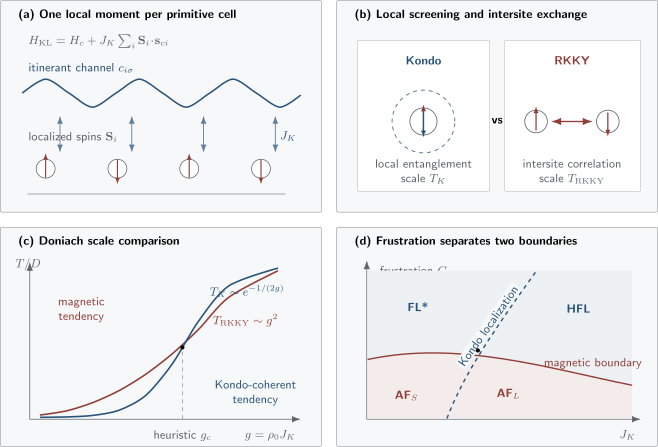
Four levels of description. (a) A local moment occupies every primitive cell and couples to a symmetry-matched conduction channel. (b) The same low-energy problem contains local Kondo correlations and intersite exchange. (c) The Doniach crossing compares an exponential with an algebraic but does not calculate a universal critical coupling. (d) Frustration can separate magnetic ordering from Kondo localization, allowing small- and large-Fermi-surface antiferromagnets (AF, AF), a fractionalized Fermi liquid (FL*), and a heavy Fermi liquid (HFL). The topology is schematic.
The Doniach Diagram
Section titled “The Doniach Diagram”The standard one-axis diagram varies while holding the band, filling, dimensionality, crystal-field structure, and frustration fixed. It places an RKKY-dominated magnetic regime at weak coupling and a Kondo-screened paramagnet at stronger coupling. The crossing of the two estimated scales identifies a region where neither weak-coupling approximation is reliable.
That crossing is an organizing heuristic, not a derivation of a quantum critical point. In particular:
- the numerical crossing moves exponentially when the convention or density-of-states normalization changes;
- the ordering scale depends on the largest eigenvalue of a momentum- and orbital-resolved interaction, not one scalar ;
- magnetic order can be first order, preempted by superconductivity, or split from Fermi-surface reconstruction;
- geometric frustration can suppress order without strengthening local Kondo screening;
- valence fluctuations can invalidate the spin-only model before the nominal crossing;
- disorder can broaden a clean transition into a distribution of local scales.
The diagram also suppresses phases in which magnetism and Kondo coherence coexist. An antiferromagnetic heavy Fermi liquid is perfectly possible: the heavy bands form first and are then reconstructed by a magnetic ordering wavevector. Conversely, magnetic order can coexist with a small Fermi surface when the moments remain localized.
Heavy Fermi Liquid
Section titled “Heavy Fermi Liquid”A paramagnetic heavy Fermi liquid has no ordinary symmetry-breaking order parameter. It is a Landau Fermi liquid whose charged quasiparticles incorporate the local-moment degrees of freedom and whose Fermi volume is correspondingly large.
Abrikosov-fermion representation
Section titled “Abrikosov-fermion representation”Represent a physical spin- by auxiliary fermions,
The constraint removes the empty and doubly occupied auxiliary states. The representation has a local gauge redundancy:
The auxiliary fermion is a spinon, not the microscopic charged electron of the periodic Anderson model.
Large-N saddle
Section titled “Large-N saddle”Generalize the spin index to and impose . A hybridization-channel decoupling introduces
For a uniform saddle, the quadratic part has the structure
enforces the constraint on average, and can arise from a decoupled intersite exchange channel. Diagonalization produces the narrow hybridized bands discussed on Heavy Fermions.
Under the gauge redundancy,
Thus is not a gauge-invariant Landau order parameter. A nonzero saddle value is useful shorthand for a Higgs-like coherent regime in which spin and charge sectors are locked, but Elitzur’s theorem forbids interpreting as a directly measurable local expectation value in the exact gauge theory. Fermi volume, spectral poles, thermodynamics, and response functions are physical diagnostics.
The large- construction is controlled as with appropriately scaled couplings. It is not quantitatively controlled at physical , and static mean field suppresses important gauge, magnetic, and spatial fluctuations.
Large Fermi volume
Section titled “Large Fermi volume”Define the signed Fermi-volume fraction per spin by
For spin- moments and conduction electrons per primitive cell,
Oshikawa’s flux-insertion argument establishes the large count nonperturbatively when the Kondo lattice is an ordinary translation-invariant Fermi liquid. The result does not require assigning a static charged electron to each moment. Heavy Fermions owns the multiband experimental caveats.
At a suitable even total filling, the hybridized bands can be completely filled below a gap, producing a Kondo insulator rather than a metal. Whether that insulator is topological requires additional band inversion and symmetry information; Kondo screening alone does not decide the topological index.
Kondo Breakdown
Section titled “Kondo Breakdown”Kondo breakdown denotes a zero-temperature loss of the heavy-Fermi-liquid organization in which the local moments contribute to the charged Fermi surface. The phrase is used in several related ways and should be qualified:
- collapse of the large- hybridization saddle ;
- disappearance of a low-energy Kondo resonance or coherence scale;
- transition from a large to a small charged Fermi surface;
- localization of charge in a periodic Anderson description;
- a locally critical quantum transition with critical Kondo entanglement.
These statements coincide in some theoretical constructions but are not logically identical in every model.
Phase vocabulary
Section titled “Phase vocabulary”| Phase | Magnetic translation symmetry | Charged Fermi surface | Local-moment sector |
|---|---|---|---|
| HFL or P | Preserved | Large | Incorporated into heavy quasiparticles |
| AF | Broken | Large before folding | Kondo-entangled and magnetically ordered |
| AF | Broken | Small before folding | Magnetically ordered and not part of the charged count |
| FL* or P | Preserved | Small | Fractionalized, with topological order or an emergent gauge sector |
The labels refer to an unfolded conceptual count. In an antiferromagnet, unit-cell enlargement can make large and small volumes equivalent modulo filled bands. Distinguishing AF from AF may then require Fermi-surface topology, quasiparticle character, or an intervening transition rather than volume alone.
Why a symmetric small Fermi surface is nontrivial
Section titled “Why a symmetric small Fermi surface is nontrivial”With one spin- moment per primitive cell, a completely featureless symmetric local-moment background is forbidden by Lieb–Schultz–Mattis–Oshikawa–Hastings constraints. If translation is preserved and the charged Fermi surface counts only , the missing local-moment contribution must be carried by additional low-energy or topological structure.
A fractionalized Fermi liquid, FL*, supplies that structure: conduction electrons form a small charged Fermi surface while the local moments form a spin liquid with neutral spinons and an emergent gauge field. Its generalized Luttinger relation includes the topological sector. FL* is a theoretically consistent phase, not a synonym for any experimentally observed small Fermi surface.
Possible transition routes
Section titled “Possible transition routes”The one-axis Doniach picture suggests a direct magnetic-to-HFL transition, but an extended phase space permits several routes:
- Itinerant spin-density-wave route: HFL AF. Kondo coherence survives; the heavy Fermi surface is folded and reconstructed by magnetic order.
- Direct Kondo-destruction route: AF HFL. Magnetic order disappears as the Kondo scale collapses, so order-parameter and Fermi-surface criticality coincide.
- Two-step magnetic route: AF AF HFL. Kondo delocalization occurs inside the ordered phase, followed by a separate magnetic transition.
- Fractionalized route: AF FL* HFL, or a direct FL* HFL transition when frustration suppresses order.
Whether a direct continuous transition exists depends on dimension, symmetry, gauge dynamics, Fermi-surface geometry, and the microscopic model. Large-, extended dynamical mean-field theory, and special sign-problem-free lattice models demonstrate particular routes; none proves a universal phase diagram for all heavy-fermion materials.
Evidence expected from a breakdown theory
Section titled “Evidence expected from a breakdown theory”A breakdown claim becomes stronger when several consequences share one vanishing scale:
- a zero-temperature change between large and small Fermi-surface counts after magnetic folding is included;
- collapse of a coherent quasiparticle residue or low-energy hybridization feature;
- an additional crossover scale tending to zero at the transition;
- critical local-spin dynamics beyond a pure long-wavelength order-parameter theory;
- thermodynamic and transport singularities consistent with the same tuning point;
- recovery of internally consistent phases on both sides.
A Hall crossover or a changed oscillation frequency alone is insufficient. Lifshitz transitions, metamagnetic crossovers, valence changes, disorder, and ordinary antiferromagnetic reconstruction can imitate parts of this list.
Some locally critical theories predict frequency-over-temperature scaling of the form
The exponent and scaling function are framework and material dependent. Observing an approximate collapse over a finite window does not, by itself, identify the microscopic fixed point.
Methods and Controlled Limits
Section titled “Methods and Controlled Limits”| Method | Main strength | Central limitation |
|---|---|---|
| Strong-coupling expansion | Controlled around local singlets when | Generic filling leaves mobile unscreened degrees of freedom |
| Large- saddle and fluctuations | Analytic heavy bands, coherence scales, and gauge structure | Physical can have strong magnetic and gauge corrections |
| DMFT | Nonperturbative local dynamics and lattice coherence | Single-site form omits nonlocal spatial correlations |
| Extended DMFT | Treats dynamical Kondo and intersite-bosonic competition self-consistently | Mapping and self-consistency are controlled only in selected limits |
| Quantum Monte Carlo | Unbiased when a sign-free formulation exists | Generic frustrated, doped, or multiorbital models have a sign problem |
| DMRG and tensor networks | High precision in one dimension and narrow cylinders | A one-dimensional Kondo lattice is a Luttinger liquid, not a higher-dimensional HFL |
Agreement between methods in a shared limit is more persuasive than a visually similar phase diagram produced from unrelated approximations.
Common Mistakes
Section titled “Common Mistakes”- Replacing a dense lattice by a sum of single-impurity free energies below the coherence scale.
- Adding an explicit and a conduction-derived RKKY term without checking double counting.
- Treating the Doniach crossing as a universal critical coupling or proof of continuity.
- Calling the slave-boson amplitude a directly observable symmetry-breaking order parameter.
- Equating every small Fermi surface with Kondo breakdown while ignoring magnetic folding and Lifshitz transitions.
- Proposing a translation-symmetric small-Fermi-surface metal without accounting for the local-moment anomaly through fractionalization or other low-energy structure.
- Assuming the large- saddle is controlled for physical spin- simply because its bands resemble experiment.
- Using “Kondo destruction” to mean that all finite-frequency local Kondo correlations vanish.
Exercises
Section titled “Exercises”1. Atomic-limit Kondo insulator
Section titled “1. Atomic-limit Kondo insulator”At , , and , determine the ground-state energy for sites. Then compute the cost of creating one empty and one doubly occupied conduction site while keeping the total conduction number fixed.
Solution
Each site forms a local singlet with energy , so
An empty conduction site has , so its exchange energy is zero. A doubly occupied single conduction orbital is a spin singlet and also has . Relative to two onsite Kondo singlets, the particle–hole pair therefore costs
Finite hopping broadens the particle and hole states and reduces the gap. The result is an atomic-limit benchmark, not the exact finite-bandwidth Kondo-insulator gap.
2. Doniach-scale estimate
Section titled “2. Doniach-scale estimate”Set . Compare and at (a) and (b) . Which tendency is larger in each case?
Solution
For ,
The RKKY estimate is larger.
For ,
The Kondo estimate is larger. The apparent reversal illustrates the heuristic crossing, but unknown prefactors and the breakdown of both estimates near the crossing prevent a quantitative prediction of .
3. Gauge charge of the hybridization field
Section titled “3. Gauge charge of the hybridization field”Under , determine how must transform so that is invariant. Why is not an ordinary order parameter?
Solution
The bilinear transforms as
Therefore
carries the auxiliary gauge charge, so its phase can be changed by a local redundancy. Elitzur’s theorem forbids a gauge-noninvariant local expectation value in the exact theory. A nonzero mean-field saddle diagnoses a Higgs-like coherent regime, while physical evidence must be expressed through gauge-invariant spectra, Fermi volume, thermodynamics, or response.
4. Large and small counts
Section titled “4. Large and small counts”A spin-degenerate Kondo lattice has conduction electrons and one spin- moment per primitive cell. Compute for a small Fermi surface and for an HFL, ignoring filled bands.
Solution
The small count is
The HFL count includes one local moment:
The difference is one half of a Brillouin-zone volume per spin. If antiferromagnetism doubles the real-space unit cell, that distinction can be hidden modulo filled bands, so an unfolded count is not automatically an experimental discriminator.
5. Can the small-Fermi-surface paramagnet be ordinary?
Section titled “5. Can the small-Fermi-surface paramagnet be ordinary?”Suppose one spin- moment occupies each primitive cell, translation and spin rotation are unbroken, and the charged Fermi surface counts only . Can the remaining moment sector be a unique, fully gapped, short-range-entangled paramagnet?
Solution
Not under those assumptions. The half-odd-integer moment per primitive cell carries a Lieb–Schultz–Mattis–Oshikawa–Hastings anomaly. A unique, symmetric, fully gapped, short-range-entangled state cannot absorb it.
At least one assumption must change. The moment sector may break translation or spin symmetry, remain gapless, or possess topological order. FL* uses the last two possibilities: neutral fractionalized excitations and an emergent gauge sector account for the missing local-moment contribution while the charged Fermi surface remains small.
6. Breakdown or ordinary reconstruction?
Section titled “6. Breakdown or ordinary reconstruction?”A field-tuned antiferromagnet shows a jump in one quantum-oscillation frequency at the critical field, but neutron diffraction also shows that the magnetic unit cell disappears there. No independent hybridization scale is resolved. Does this establish Kondo breakdown? Name three further tests.
Solution
No. Removing the magnetic supercell unfolds the Brillouin zone and can change oscillation frequencies even if Kondo coherence survives. A simultaneous Lifshitz transition is another alternative.
Useful further tests include:
- compare calculated AF and AF orbit sets, including magnetic breakdown and field-dependent visibility;
- track a Hall or thermoelectric crossover to lower temperature and test whether its width extrapolates to zero;
- look for collapse of a low-energy hybridization or quasiparticle-residue scale in spectroscopy;
- test for local dynamical criticality and a common scale in thermodynamics;
- search for an intermediate AF or AF phase under a second tuning parameter.
Kondo breakdown is a joint statement about entanglement, Fermi count, and low-energy scales, not a synonym for any reconstructed orbit.
Research Status
Section titled “Research Status”The Kondo-lattice and Kondo–Heisenberg Hamiltonians, perturbative generation of RKKY exchange, strong-coupling singlet limit, heavy-Fermi-liquid Fermi-volume count, and large- organization are standard. The Doniach diagram remains a useful qualitative map when its fixed assumptions are stated.
The lattice coherence scale is model and filling dependent. FL* is a theoretically consistent phase with precise topological requirements, but identifying it in a specific material is difficult. Kondo-destruction critical points occur in controlled impurity and extended-DMFT constructions and have substantial experimental motivation; their prevalence, critical field theories in finite dimensions, and relation to superconductivity remain active research.
Connections
Section titled “Connections”- Kondo Effect — impurity screening, running exchange, , and local Fermi-liquid physics.
- Kondo Model Preview — the single-impurity exchange Hamiltonian and controlled fixed-point limits.
- RKKY Interaction — sign-complete conduction-mediated exchange and ordering-wavevector selection.
- Heavy Fermions — the experimental ledger for coherence, effective mass, Fermi surfaces, criticality, and superconductivity.
- Fractionalization — the general sector, gauge-redundancy, and evidence criteria needed before interpreting a small symmetric Fermi surface as FL*.
- Fermi-Liquid Theory Preview — Landau quasiparticles, response, stability, and lifetime scaling.
- Antiferromagnetism — local-moment and itinerant order, magnetic unit cells, and reconstruction.
- Spectral Functions — poles, residues, continua, and experimental line shapes.
- Quantum Phase Transitions — zero-temperature scaling and crossover fans.
- Quantum Criticality — tuning protocols, material scaling tests, transport anomalies, and magnetic endpoint evidence.
- Competing Orders — coupled-order thermodynamics and the evidence needed to separate microscopic coexistence from phase separation in Kondo materials.
- Non-Fermi Liquids — quasiparticle-failure diagnostics and the distinction among Kondo destruction, critical bosons, fractionalization, disorder, and local criticality.
- Mean-Field Theory — saddle points, self-consistency, and fluctuation checks.
References
Section titled “References”- S. Doniach, “The Kondo lattice and weak antiferromagnetism,” Physica B+C 91, 231–234 (1977).
- P. Coleman, “1/ expansion for the Kondo lattice,” Physical Review B 28, 5255–5262 (1983).
- N. Read and D. M. Newns, “On the solution of the Coqblin–Schrieffer Hamiltonian by the large- expansion technique,” Journal of Physics C: Solid State Physics 16, 3273–3295 (1983).
- P. Nozières, “Impuretés magnétiques et effet Kondo,” Annales de Physique 10, 19–35 (1985).
- P. Nozières, “Some comments on Kondo lattices and the Mott transition,” European Physical Journal B 6, 447–457 (1998).
- S. Burdin, A. Georges, and D. R. Grempel, “Coherence scale of the Kondo lattice,” Physical Review Letters 85, 1048–1051 (2000).
- M. Oshikawa, “Topological approach to Luttinger’s theorem and the Fermi surface of a Kondo lattice,” Physical Review Letters 84, 3370–3373 (2000).
- P. Coleman, C. Pépin, Q. Si, and R. Ramazashvili, “How do Fermi liquids get heavy and die?” Journal of Physics: Condensed Matter 13, R723–R738 (2001).
- Q. Si, S. Rabello, K. Ingersent, and J. L. Smith, “Locally critical quantum phase transitions in strongly correlated metals,” Nature 413, 804–808 (2001).
- T. Senthil, S. Sachdev, and M. Vojta, “Fractionalized Fermi liquids,” Physical Review Letters 90, 216403 (2003).
- T. Senthil, M. Vojta, and S. Sachdev, “Weak magnetism and non-Fermi liquids near heavy-fermion critical points,” Physical Review B 69, 035111 (2004).
- H. v. Löhneysen, A. Rosch, M. Vojta, and P. Wölfle, “Fermi-liquid instabilities at magnetic quantum phase transitions,” Reviews of Modern Physics 79, 1015–1075 (2007).
- P. Gegenwart, Q. Si, and F. Steglich, “Quantum criticality in heavy-fermion metals,” Nature Physics 4, 186–197 (2008).
- Q. Si and F. Steglich, “Heavy fermions and quantum phase transitions,” Science 329, 1161–1166 (2010).
- Q. Si and S. Paschen, “Quantum phase transitions in heavy fermion metals and Kondo insulators,” physica status solidi (b) 250, 425–438 (2013).
- S. Paschen and Q. Si, “Quantum phases driven by strong correlations,” Nature Reviews Physics 3, 9–26 (2021).
Summary
Section titled “Summary”A Kondo lattice is a dense, translation-coherent quantum problem in which onsite screening and intersite exchange arise from the same low-energy degrees of freedom. The Doniach comparison explains why algebraic RKKY tendencies dominate very weak exchange while the exponential Kondo scale can win at stronger coupling, but its crossing is not a universal phase boundary. A conventional heavy Fermi liquid incorporates the local moments into a large charged Fermi surface; large- hybridization is a useful gauge-redundant construction of that state, not a directly observable order parameter. Losing this organization can produce magnetic small-Fermi-surface phases, fractionalized metals, or Kondo-destruction criticality. Distinguishing those possibilities requires symmetry, topology, Fermi count, and a shared low-energy scale—not one changed orbit or one schematic diagram.