Quantum Spin Liquids
A quantum spin liquid is a magnetic quantum phase that preserves the relevant ordinary symmetries while evading a short-range-entangled product-state description. Its spins remain strongly correlated, and its low-energy organization is typically expressed through fractionalized excitations, emergent gauge structure, or, for a gapped liquid in two dimensions, intrinsic topological order.
The name does not mean that individual spins fluctuate independently or that the phase is a thermal liquid. It refers to a many-body ground state and its low-temperature regime. Nor is absence of a magnetic Bragg peak enough: a trivial quantum paramagnet, a valence-bond solid, a spin glass, disorder-broadened excitations, a one-dimensional critical magnet, or a system whose ordering temperature lies below the measurement window can all look magnetically quiet.
Usage varies at the dimensional boundary. The antiferromagnetic spin- chain is often called a gapless spin liquid because it preserves spin rotation and has fractional spinons. Its criticality and fractionalization are nevertheless specifically one-dimensional. This page uses quantum spin liquid primarily for candidate deconfined phases in two- and three-dimensional materials and links to Heisenberg Chain for the exact one-dimensional benchmark.
For materials, the claim should therefore be built in layers:
- establish localized magnetic degrees of freedom and their interaction scale;
- exclude conventional order, structural symmetry breaking, and freezing well below that scale;
- identify a coherent fractionalized or emergent-gauge account of dynamics and thermodynamics;
- test phase-specific predictions under field, pressure, disorder, isotope, and sample variation.
No single broad continuum or missing transition substitutes for this ledger.
Canonical Scope
Section titled “Canonical Scope”This page is the canonical home for quantum spin liquids as material phases. It owns:
- the distinction between a spin liquid and other nonmagnetic or disordered states;
- the roles of frustration, quantum fluctuations, and symmetry constraints;
- a phase-level taxonomy of spinons, gauge fields, gaps, and chiral response;
- the Kitaev spin liquid as an exactly solvable benchmark and material design principle;
- experimental claim standards and comparative candidate status.
Neighboring pages retain the general formalism. Topological Order Preview develops local indistinguishability, loop algebra, and the toric-code benchmark. Topological Order owns anyon data, modular matrices, topological entanglement, and chiral thermal response. Anyons and Braiding owns exchange statistics and braid operations. Heisenberg Model owns the standard exchange Hamiltonian, and Structure Factors fixes scattering normalizations and experimental forward models.
What a Spin Liquid Is Not
Section titled “What a Spin Liquid Is Not”A missing order parameter is only an exclusion
Section titled “A missing order parameter is only an exclusion”For a candidate ordering wavevector , define the finite-size magnetic estimator
Magnetic long-range order requires a nonzero thermodynamic limit of this quantity, with finite-size and domain effects treated consistently. Neutron diffraction, magnetic susceptibility, nuclear magnetic resonance, and muon spin rotation probe different consequences of order. Their null results become persuasive only when their time windows, volume fractions, moment sensitivity, and structural backgrounds agree.
The following alternatives must be tested separately.
| Alternative | Why order may be absent | Discriminating evidence |
|---|---|---|
| trivial quantum paramagnet | spins form local singlets or are quenched by a large single-ion term | finite correlation length, ordinary triplet excitations, adiabatic path to a product state |
| valence-bond solid | spin rotation is preserved but lattice translation or rotation breaks | superlattice peaks, bond anisotropy, degenerate symmetry-related patterns |
| spin glass | random moments freeze without periodic order | history dependence, aging, frequency-dependent cusp, nonzero frozen component |
| low-dimensional critical magnet | fluctuations forbid order while correlations remain algebraic | dimensional crossover and field-theory fingerprints, no two-dimensional topological sector |
| weakly ordered magnet | ordered moment or transition scale is very small | sharper low-energy mode, critical anomaly, improved-resolution diffraction or local probes |
| disorder-dominated random singlet | broad bond distribution forms singlets over many scales | sample dependence, local inhomogeneity, broad relaxation-rate distribution |
Glasses and Spin Glasses owns the freezing, aging, and disorder protocols. Antiferromagnetism owns the ordered benchmark, including small-moment and frustrated antiferromagnets.
A finite-temperature regime is not automatically a phase
Section titled “A finite-temperature regime is not automatically a phase”Experiments operate at . A material with exchange scale and ordering temperature can show a broad correlated-paramagnet regime,
whose dynamics resemble a spin liquid even though its ground state orders. This proximate spin-liquid regime can be scientifically important, as in several Kitaev materials, but it should not be relabeled a zero-temperature spin-liquid phase.
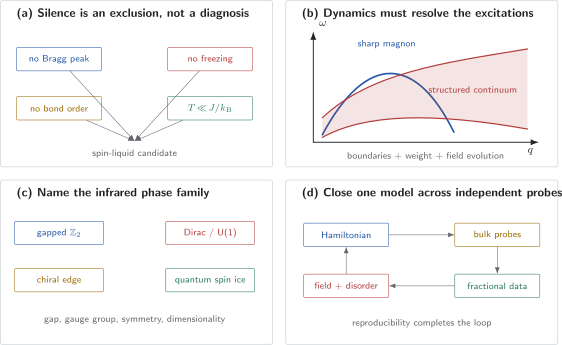
A spin-liquid claim begins by excluding ordinary order and freezing, then adds dynamical evidence, phase-specific fractionalization or gauge structure, and perturbation controls. A broad continuum is stronger than a missing Bragg peak but can still be produced by disorder or conventional multiparticle states.
Frustration and Quantum Fluctuations
Section titled “Frustration and Quantum Fluctuations”Frustration creates competition, not a theorem
Section titled “Frustration creates competition, not a theorem”For antiferromagnetic exchange,
On a triangle with all , no collinear arrangement satisfies every bond. Kagome and pyrochlore lattices extend this geometric competition; further-neighbor or ring exchanges can generate frustration even on simpler lattices. Quantum fluctuations are strongest for small spin, low coordination, competing interactions, and low dimension.
Frustration suppresses simple order and produces many low-energy configurations, but it can also select a noncollinear magnet, a valence-bond crystal, a nematic state, or a glass. The ratio is therefore a useful frustration index only when a Curie–Weiss fit is valid and is actually measured. A large ratio does not diagnose entanglement or fractionalization.
Resonating valence bonds
Section titled “Resonating valence bonds”A singlet on sites is
A resonating-valence-bond state superposes many singlet coverings instead of choosing one static pattern. The superposition may be short-range and gapped, algebraic and gapless, chiral, or unstable to valence-bond order. “RVB” names a construction principle, not one phase.
Lieb–Schultz–Mattis–Oshikawa–Hastings constraints
Section titled “Lieb–Schultz–Mattis–Oshikawa–Hastings constraints”For a translation-invariant short-range spin system with an odd number of spin- moments per primitive cell and the needed spin symmetry, a unique, gapped, symmetric, short-range-entangled ground state is excluded. The infrared alternatives include:
- spontaneous symmetry breaking;
- gapless excitations;
- a gapped phase with topological order.
This is a structural constraint, not proof that a particular Hamiltonian is a spin liquid. Real spin–orbit-coupled crystals may preserve less than full spin rotation, and nonsymmorphic or other crystalline symmetries can modify the filling constraint. The microscopic symmetry representation per primitive cell must be audited before invoking the theorem.
Spinons and Emergent Gauge Structure
Section titled “Spinons and Emergent Gauge Structure”Partons are a representation
Section titled “Partons are a representation”A common fermionic parton representation is
The enlarged variables have a local redundancy. At minimum,
leaves the spin operator invariant. More complete formulations expose an SU(2) gauge redundancy before a mean-field ansatz reduces the invariant gauge group. The gauge field is not an extra microscopic force inserted by hand; it enforces the local redundancy and can acquire its own long-distance dynamics.
A mean-field spinon band is not yet a physical excitation. Gauge fluctuations can confine the partons, drive symmetry breaking, or qualitatively change their spectrum. Fractionalization is physical only when gauge-invariant observables and the stability of a deconfined phase support it.
What a local spin probe creates
Section titled “What a local spin probe creates”A local spin operator carries integer spin overall. In a phase with spin- spinons, it typically creates two or more fractional excitations, so the dynamic response occupies a continuum of total energies and momenta. This is why neutron or Raman continua are natural signatures.
The converse fails. Two magnons, damped paramagnons, phonons, random singlets, and spatially broadened crystal-field transitions also form continua. A convincing fractionalization claim predicts continuum boundaries, polarization, momentum dependence, temperature transfer of spectral weight, and field evolution from one microscopic Hamiltonian.
Gapped and Gapless Families
Section titled “Gapped and Gapless Families”| Phase family | Low-energy content | Characteristic structure | Central vulnerability |
|---|---|---|---|
| gapped liquid | spinons, visons, and their bound state | finite bulk gap, four topological sectors on a torus in the ideal two-dimensional limit | impurities can fill the gap and hide activated laws |
| Dirac spin liquid | gapless spinons near nodal points coupled to a gauge field | power-law response and symmetry-constrained nodes | monopoles or allowed masses can confine or order the state |
| spinon Fermi-surface liquid | a surface of neutral spinons coupled to U(1) gauge fluctuations | large low-energy density of states, unusual heat and field response | gauge fluctuations destroy ordinary quasiparticle transport; disorder can mimic power laws |
| quantum spin ice | emergent U(1) photon plus electric and magnetic gauge charges in three dimensions | pinch-point structure modified by quantum dynamics and a low-energy photon scale | crystal-field disorder and dipolar interactions complicate the minimal model |
| chiral spin liquid | gapped anyons and a chiral neutral edge | broken time reversal and quantized thermal response in the ideal limit | phonon Hall effects and edge equilibration obscure the signal |
Gapped liquids
Section titled “Gapped liquids”In a gapped two-dimensional spin liquid, local correlations can decay exponentially even though the state is long-range entangled. Topology-dependent ground sectors, deconfined anyons, and a universal entanglement correction distinguish it from a trivial dimer paramagnet. These universal data are developed in Topological Order; a material experiment normally sees only projections of them.
A spin gap extracted from Knight shift, relaxation, heat capacity, or neutron scattering must identify which excitation and momentum is gapped. Defect spins can add low-energy spectral weight without closing the intrinsic kagome-layer gap. Conversely, an apparent activation law can arise from a finite field, a bottleneck, or limited resolution.
Gapless liquids
Section titled “Gapless liquids”Gapless spin liquids need not possess intrinsic topological order in exactly the same fully gapped sense, but they can still have stable emergent gauge structure and fractionalized excitations. Their power laws depend on dimension, symmetry, and gauge dynamics. A linear heat-capacity term in an electrical insulator is suggestive of neutral gapless matter, yet nuclear Schottky terms, disorder, two-level systems, and phonons must be removed before assigning a spinon density of states.
The low-temperature longitudinal thermal conductivity is often extrapolated as
A nonzero can support mobile gapless neutral carriers, but boundary-limited phonons and sample cracks make the extrapolation delicate. A vanishing intercept does not rule out gapless spinons if they are strongly scattered or localized.
The Kitaev Spin-Liquid Benchmark
Section titled “The Kitaev Spin-Liquid Benchmark”Bond-directional exchange
Section titled “Bond-directional exchange”The honeycomb Kitaev Hamiltonian couples one spin component on each bond type,
Despite strong interactions, the model is exactly solvable. Writing each spin with four Majoranas,
turns the Hamiltonian into itinerant Majoranas moving in a static gauge background. On an oriented bond, is conserved, and the plaquette product labels a gauge-flux sector.
At the isotropic point the zero-field Majorana spectrum is gapless. Sufficient exchange anisotropy produces a gapped Abelian phase. A weak time-reversal-breaking perturbation with all three field components gaps the cones and yields a non-Abelian Ising topological phase with chiral central charge . Its ideal two-dimensional edge therefore carries half of the thermal conductance quantum. The general relation and its equilibration caveats live in Topological Order.
From exact model to crystal
Section titled “From exact model to crystal”Spin–orbit-entangled ions in edge-sharing octahedra can generate dominant bond-directional exchange, making honeycomb iridates and -RuCl important Kitaev-material platforms. Real Hamiltonians also contain Heisenberg exchange, symmetric off-diagonal terms, further-neighbor coupling, interlayer exchange, phonons, and disorder.
-RuCl orders in a zigzag pattern at zero field, so it is not a zero-field spin liquid. Its high-energy continuum and field-suppressed order support proximity to Kitaev physics and fractionalization-compatible dynamics. Reports of thermal Hall response near the half-quantized value in selected field and temperature windows are important, but sample dependence, a sizable phonon Hall background, nonquantized datasets, and alternative magnon or phonon descriptions keep the field-induced topological-phase assignment active rather than settled.
Experimental Evidence Ladder
Section titled “Experimental Evidence Ladder”Step 1: establish the magnetic Hilbert space
Section titled “Step 1: establish the magnetic Hilbert space”Determine valence, crystal-field levels, effective moment, charge gap, dimensionality, and exchange tensor. A pseudospin- description may represent a Kramers or non-Kramers doublet rather than a bare electron spin. Excited crystal-field states and magnetoelastic coupling must be outside the claimed low-energy window or included explicitly.
Step 2: exclude ordinary order and freezing
Section titled “Step 2: exclude ordinary order and freezing”Combine diffraction with local probes and bulk thermodynamics. A neutron null result can miss a tiny moment; a muon can perturb a delicate state; NMR can lose signal when relaxation becomes too fast. Frequency-dependent susceptibility, field-cooled versus zero-field-cooled histories, and aging tests are essential where disorder is appreciable.
Step 3: characterize the full dynamic response
Section titled “Step 3: characterize the full dynamic response”Measure over enough momentum, energy, polarization, and temperature range to enforce sum rules. Compare a continuum not merely with a two-spinon calculation but with multiparticle magnons, disorder ensembles, phonons, and crystal-field transitions. The Magnons page gives the sharp-mode and multi-magnon baseline.
Step 4: seek fractionalization- or gauge-specific closure
Section titled “Step 4: seek fractionalization- or gauge-specific closure”Examples include:
- continuum thresholds and symmetry quantum numbers tied to pairs of spinons;
- a separately resolved gauge-flux scale and itinerant-matter scale;
- a neutral thermal channel consistent with thermodynamic spectral weight;
- quantized chiral heat transport with edge, thickness, orientation, and phonon controls;
- emergent-photon and gauge-charge signatures in quantum spin ice;
- topological sectors or entanglement invariants in a converged microscopic simulation.
Step 5: test perturbations and reproducibility
Section titled “Step 5: test perturbations and reproducibility”A proposed phase should predict field-angle dependence, pressure evolution, impurity response, boundary effects, and neighboring ordered phases. Sample-to-sample variation is data about the Hamiltonian, not an inconvenience to average away. A claim is strongest when the same parameter set explains elastic scattering, inelastic spectra, thermodynamics, and transport.
Probe-to-Claim Ledger
Section titled “Probe-to-Claim Ledger”| Probe | Positive signal | Main false positive or ambiguity |
|---|---|---|
| diffraction | no magnetic Bragg peak to | tiny moment, short-range order, small volume fraction |
| SR or NMR | persistent dynamics without static internal field | probe time window, muon perturbation, wipeout |
| susceptibility | no sharp transition; broad correlated maximum | orphan spins, Curie tails, low |
| heat capacity | broad entropy release; gap or power law consistent across field | phonon subtraction, nuclear term, glassy two-level systems |
| inelastic neutrons | broad structured continuum with correct sum rule | multimagnon decay, disorder, crystal-field or phonon intensity |
| Raman or terahertz | polarization-resolved continuum and field evolution | phonon coupling and symmetry-allowed multiparticle response |
| mobile neutral heat channel in an insulator | phonons, cracks, boundary scattering, localization | |
| plateau tied to a chiral neutral edge | phonon or magnon Hall effect, layer normalization, poor equilibration | |
| numerics | no local order plus converged topological or algebraic diagnostics | finite cylinders, boundary pinning, bond dimension, competing close energies |
Candidate-Material Status
Section titled “Candidate-Material Status”| Platform | Strong evidence | Limiting issue | Disciplined label |
|---|---|---|---|
| herbertsmithite, ZnCu(OH)Cl | spin- kagome layers, no observed order far below , broad neutron continuum, local NMR access | Cu/Zn antisite defects dominate parts of the low-energy response; gapped versus gapless intrinsic state remains debated | leading kagome spin-liquid candidate |
| -(BEDT-TTF)Cu(CN) and -EtMeSb[Pd(dmit)] | triangular Mott phases without ordinary magnetic order over a large exchange ratio; low-energy spin and thermodynamic anomalies | low-temperature transitions, lattice coupling, cooling history, and conflicting thermal-conductivity results | organic spin-liquid candidates with unresolved infrared behavior |
| YbMgGaO | triangular spin–orbit pseudospins, persistent dynamics, broad scattering continuum | random Mg/Ga environment broadens exchange and can mimic a spin liquid or produce freezing | disorder-entangled candidate, not a clean benchmark |
| -RuCl | bond-directional exchange, continuum, field-suppressed zigzag order, large thermal Hall response in some samples | ordered zero-field ground state; field-induced phase and heat carriers remain debated | proximate Kitaev magnet; field-induced spin liquid unconfirmed |
| PrHfO and related pyrochlores | quantum-modified pinch points and inelastic continuum consistent with emergent U(1) dynamics | non-Kramers disorder, dipolar terms, crystal-field admixture, and limited low-energy resolution | quantum-spin-ice candidates |
Herbertsmithite
Section titled “Herbertsmithite”Herbertsmithite realizes well-separated kagome planes of Cu moments and shows no conventional magnetic order down to temperatures tiny compared with its exchange scale. Single-crystal neutron scattering reveals an extended continuum, while site-resolved NMR has been used to separate intrinsic kagome susceptibility from interlayer defects.
The central unresolved issue is the intrinsic infrared theory. Cu on nominally nonmagnetic Zn sites supplies orphan-like interlayer spins, and possible Zn substitution in kagome layers changes the local network. Different probes and analyses have supported gapped and gapless interpretations. The robust statement is that herbertsmithite is a leading, strongly constrained kagome spin-liquid candidate with fractionalization-compatible dynamics, not that its exact anyon theory has been experimentally measured.
Organic triangular salts
Section titled “Organic triangular salts”The organic salts place spin- molecular dimers on anisotropic triangular networks near a pressure-driven Mott transition. NMR and bulk probes found no ordinary magnetic order despite sizable exchange. Heat capacity and early thermal transport motivated gapless spinon-Fermi-surface interpretations.
Later work exposed low-temperature lattice anomalies, sample and cooling-history dependence, and conflicting residual thermal-conductivity intercepts. These materials remain valuable because pressure connects the insulating state to metal and superconductivity, but that proximity also makes charge fluctuations, disorder, and lattice coupling part of the minimal problem.
Spin–orbit and Kitaev platforms
Section titled “Spin–orbit and Kitaev platforms”Rare-earth triangular magnets and honeycomb Kitaev candidates broaden the Hamiltonian beyond isotropic Heisenberg exchange. Their anisotropy is an opportunity and a burden: it can stabilize new liquids, but it also permits conventional ordered states and makes defects act as random exchange tensors.
For -RuCl, any thermal Hall claim must report field orientation, layer spacing, longitudinal conductivity, contact geometry, antisymmetrization, and sample history. Agreement with a half-quantized value over one window is stronger when accompanied by a plateau, a bulk gap, predicted sign changes, thickness or edge tests, and reproducibility across growths. As of the review date, the literature contains serious experimental and theoretical cases for Majorana, magnon, and phonon contributions.
Numerical Evidence
Section titled “Numerical Evidence”A lattice model can establish a spin-liquid phase more directly than a bulk material because the Hamiltonian and wavefunction are available, but only after convergence checks. Useful diagnostics include:
- order parameters extrapolated in both system size and bond dimension;
- singlet and triplet gaps with boundary and topological-sector control;
- correlation lengths and transfer-matrix spectra;
- flux insertion and anyon-sector identification;
- topological entanglement entropy or modular data for a gapped state;
- algebraic exponents and operator content for a gapless state;
- energy competition against valence-bond and magnetically ordered ansatzes.
The nearest-neighbor spin- kagome Heisenberg antiferromagnet is a landmark case. Density-matrix renormalization group studies produced strong evidence for a gapped liquid, while later methods and geometries have supported competing gapless descriptions. Small energy differences and long correlation lengths make algorithmic convergence part of the physics claim. A numerical phase assignment should not be transferred to herbertsmithite without adding Dzyaloshinskii–Moriya coupling, further-neighbor exchange, and defects.
Common Mistakes
Section titled “Common Mistakes”- Equating no order with a spin liquid. This omits trivial singlets, glasses, disorder, and low- magnets.
- Calling frustration sufficient. Frustration often produces noncollinear order or valence-bond order.
- Treating a parton band as an observable. Gauge projection and deconfinement must be established.
- Calling every continuum spinons. Conventional multiparticle decay and disorder also broaden spectra.
- Using one power law as a phase identifier. Nuclear, phonon, impurity, and crossover terms can imitate it.
- Ignoring the order of limits. A finite-temperature correlated regime need not survive as .
- Calling -RuCl a zero-field Kitaev liquid. Its zero-field ground state is magnetically ordered.
- Treating approximate thermal quantization as self-authenticating. Background heat carriers, normalization, plateau width, and reproducibility are part of the test.
- Assuming all spin liquids are gapped topological orders. Stable gapless gauge phases require a different classification ledger.
Exercises
Section titled “Exercises”1. A silent magnet is not yet a liquid
Section titled “1. A silent magnet is not yet a liquid”A spin- dimer crystal has a unique singlet ground state, a gap , exponentially decaying correlations, and a sharp triplet mode. It preserves spin rotation and translation. Is it a quantum spin liquid under the definition used here?
Solution
Not necessarily. The stated data describe a short-range-entangled quantum paramagnet that may be adiabatically connected to a product of dimer singlets. The sharp local triplet and absence of fractional sectors support that interpretation. A gapped spin liquid would require long-range entanglement or equivalent evidence such as topology-dependent ground sectors and deconfined fractional excitations.
2. Apply the filling constraint
Section titled “2. Apply the filling constraint”Consider a two-dimensional translation-invariant magnet with three spin- moments in each primitive cell, short-range interactions, and unbroken spin rotation and translation. Numerics find a nonzero gap and no local symmetry breaking. What additional structure is required in the thermodynamic limit?
Solution
Three spin- moments give a half-integer spin representation per primitive cell. Under the stated symmetries, the Lieb–Schultz–Mattis–Oshikawa–Hastings constraint excludes a unique gapped symmetric short-range-entangled ground state. If the numerical gap and symmetry conclusions survive extrapolation, the state must have topological order and the associated topology-dependent low-energy sectors. A finite cylinder can hide those sectors, so flux insertion and sector-resolved calculations are appropriate checks.
3. Two-spinon kinematics
Section titled “3. Two-spinon kinematics”Suppose noninteracting spinons have dispersion . A local spin operator creates a pair with total momentum . Write the lower continuum boundary and explain why a broad neutron signal alone does not determine uniquely.
Solution
The lower boundary is
The observed intensity also contains matrix elements, spinon interactions, gauge fluctuations, instrumental resolution, and possible disorder averaging. Different dispersions can produce overlapping continua, while conventional two-magnon states can have similar kinematics. Momentum-resolved boundaries and polarization are more discriminating than breadth alone.
4. Defects and an apparent gap
Section titled “4. Defects and an apparent gap”An intrinsic kagome layer has susceptibility , while a fraction of defect spins contributes . What happens to the bulk low-temperature susceptibility, and which probe strategy can recover the intrinsic behavior?
Solution
The measured susceptibility is approximately
Even small eventually makes the Curie-like defect term dominate as the intrinsic term becomes exponentially small. Bulk susceptibility can therefore look gapless despite a gapped host. Site-resolved NMR, momentum dependence, impurity-field scaling, or a joint fit constrained by structural site occupancy can separate the components.
5. Half a thermal quantum
Section titled “5. Half a thermal quantum”The field-gapped Kitaev phase has one chiral Majorana edge mode. What chiral central charge does it carry, and what two material checks are required before interpreting a measured thermal Hall value near the ideal prediction as proof?
Solution
A chiral Majorana mode carries , so its ideal layer conductance is half the thermal conductance quantum. Material checks include demonstrating a plateau over field and temperature rather than an isolated crossing, and bounding phonon or magnon Hall backgrounds. One should also verify layer normalization, field-angle sign structure, a compatible bulk gap, edge equilibration, and reproducibility across samples.
6. Rank a candidate claim
Section titled “6. Rank a candidate claim”A triangular insulator has no magnetic Bragg peaks down to , a broad neutron continuum, and a frequency-dependent susceptibility cusp with sample-dependent onset. Which explanation must be tested first, and what measurements discriminate it from a clean spin liquid?
Solution
The cusp and sample dependence make glassy or random-singlet physics an immediate alternative. Test field-cooled and zero-field-cooled histories, aging and memory, frequency scaling of the cusp, local relaxation-rate distributions, structural disorder, and sample-to-sample variation. A clean spin liquid should give phase-consistent intrinsic spectra and thermodynamics after impurity contributions are controlled; a glass develops a frozen component and protocol dependence even without Bragg order.
Research Status and Open Problems
Section titled “Research Status and Open Problems”Several theoretical statements are firm. Exactly solvable models realize deconfined spin liquids; filling constraints sharply restrict symmetric ground states; gapped two-dimensional liquids possess universal anyon and entanglement data; and emergent U(1) gauge theories are stable in selected three-dimensional settings.
Material assignments remain active. No bulk candidate currently supplies every ideal diagnostic in one uncontested package. The leading questions are:
- Which microscopic kagome Hamiltonian describes the intrinsic layers of herbertsmithite, and is its infrared state gapped or gapless?
- Can disorder be separated quantitatively from genuine fractionalization rather than treated as an adjustable background?
- Does a field-induced topological phase exist in -RuCl, and which carriers dominate each thermal Hall regime?
- Which organic-salt low-temperature anomalies are intrinsic electronic phases, structural transitions, or cooling-history effects?
- Can emergent photons and both gauge-charge sectors be resolved in one quantum-spin-ice material?
- Which numerical diagnostics converge reliably enough to distinguish nearby gapped , Dirac, valence-bond, and weakly ordered states?
- Can controlled defects, interfaces, or local probes reveal braiding or topological sectors in a magnetic material?
The right status vocabulary is correspondingly graded: exact model realization, numerically supported phase, leading material candidate, proximate regime, or disputed assignment.
Use Quantum Matter Frontiers and Open Problems when a new candidate claim must be frozen across specimens, disorder and freezing alternatives, independent discriminators, a falsifier, and a dated review trigger.
Connections
Section titled “Connections”- What Are Strong Correlations? supplies the scale, spectral-weight, and emergent-degree diagnostics that precede a phase label.
- Fractionalization owns the general distinction among physical deconfinement, parton redundancy, spin–charge separation, symmetry fractionalization, and continuum evidence.
- Emergent Gauge Fields owns the constraint-to-Gauss-law derivation, compact U(1) and dynamics, monopoles, Higgs regimes, and gauge-field evidence.
- Heisenberg Model and Heisenberg Chain distinguish two-dimensional spin-liquid proposals from the exactly gapless one-dimensional spinon liquid.
- Antiferromagnetism gives the ordered and weak-moment baselines.
- Magnons and Structure Factors develop sharp modes, continua, sum rules, and scattering conventions; Neutron Scattering owns the corresponding instrument, background, resolution, polarization, and normalization tests.
- Magnetic Susceptibility owns Curie-tail, Curie–Weiss-window, ac-freezing, background, and claim-level controls for candidate materials.
- Topological Order Preview and Topological Order own the universal diagnostics of gapped long-range-entangled phases.
- Anyons and Braiding develops the exchange and fusion structure of deconfined two-dimensional excitations.
- Glasses and Spin Glasses provides the mandatory freezing and disorder controls for candidate materials.
References
Section titled “References”- E. H. Lieb, T. Schultz, and D. Mattis, “Two soluble models of an antiferromagnetic chain”, Annals of Physics 16, 407–466 (1961). Original one-dimensional filling constraint.
- P. W. Anderson, “Resonating valence bonds: A new kind of insulator?”, Materials Research Bulletin 8, 153–160 (1973). RVB proposal for the triangular antiferromagnet.
- X.-G. Wen, “Mean-field theory of spin-liquid states with finite energy gap and topological orders”, Physical Review B 44, 2664–2672 (1991). Parton mean field and topological organization.
- M. Oshikawa, “Commensurability, excitation gap, and topology in quantum many-particle systems on a periodic lattice”, Physical Review Letters 84, 1535–1538 (2000). Flux-insertion extension of filling constraints.
- X.-G. Wen, “Quantum orders and symmetric spin liquids”, Physical Review B 65, 165113 (2002). Projective symmetry classification.
- M. B. Hastings, “Lieb–Schultz–Mattis in higher dimensions”, Physical Review B 69, 104431 (2004). Higher-dimensional theorem.
- M. Hermele, M. P. A. Fisher, and L. Balents, “Pyrochlore photons: The U(1) spin liquid in a three-dimensional frustrated magnet”, Physical Review B 69, 064404 (2004). Stable emergent electrodynamics in three dimensions.
- A. Kitaev, “Anyons in an exactly solved model and beyond”, Annals of Physics 321, 2–111 (2006). Exact honeycomb spin liquid, gauge fluxes, and non-Abelian field-gapped phase.
- Y. Shimizu, K. Miyagawa, K. Kanoda, M. Maesato, and G. Saito, “Spin liquid state in an organic Mott insulator with a triangular lattice”, Physical Review Letters 91, 107001 (2003). NMR evidence for suppressed magnetic order in -(BEDT-TTF)Cu(CN).
- J. S. Helton et al., “Spin dynamics of the spin- kagome lattice antiferromagnet ZnCu(OH)Cl”, Physical Review Letters 98, 107204 (2007). Absence of order and low-energy dynamics in herbertsmithite.
- T. Itou, A. Oyamada, S. Maegawa, M. Tamura, and R. Kato, “Quantum spin liquid in the spin- triangular antiferromagnet EtMeSb[Pd(dmit)]”, Physical Review B 77, 104413 (2008). NMR evidence in an organic triangular Mott insulator.
- S. Yan, D. A. Huse, and S. R. White, “Spin-liquid ground state of the kagome Heisenberg antiferromagnet”, Science 332, 1173–1176 (2011). DMRG evidence for a gapped kagome liquid.
- S. Yamashita et al., “Gapless spin liquid of an organic triangular compound evidenced by thermodynamic measurements”, Nature Communications 2, 275 (2011). Low-temperature heat capacity in a dmit salt.
- T.-H. Han et al., “Fractionalized excitations in the spin-liquid state of a kagome-lattice antiferromagnet”, Nature 492, 406–410 (2012). Herbertsmithite neutron continuum.
- S. Depenbrock, I. P. McCulloch, and U. Schollwöck, “Nature of the spin-liquid ground state of the Heisenberg model on the kagome lattice”, Physical Review Letters 109, 067201 (2012). Entanglement and gap diagnostics in DMRG.
- M. Fu, T. Imai, T.-H. Han, and Y. S. Lee, “Evidence for a gapped spin-liquid ground state in a kagome Heisenberg antiferromagnet”, Science 350, 655–658 (2015). Site-resolved NMR gap analysis in herbertsmithite.
- Y. Li et al., “Rare-earth triangular lattice spin liquid: A single-crystal study of YbMgGaO”, Physical Review Letters 115, 167203 (2015). Spin–orbit triangular candidate and exchange anisotropy.
- A. Banerjee et al., “Proximate Kitaev quantum spin liquid behaviour in a honeycomb magnet”, Nature Materials 15, 733–740 (2016). Continuum and Kitaev-scale phenomenology in -RuCl.
- Z. Zhu, P. A. Maksimov, S. R. White, and A. L. Chernyshev, “Disorder-induced mimicry of a spin liquid in YbMgGaO”, Physical Review Letters 119, 157201 (2017). Exchange-randomness alternative.
- R. Sibille et al., “Experimental signatures of emergent quantum electrodynamics in PrHfO”, Nature Physics 14, 711–715 (2018). Quantum-modified pinch points and continuum in a spin-ice candidate.
- Y. Kasahara et al., “Majorana quantization and half-integer thermal quantum Hall effect in a Kitaev spin liquid”, Nature 559, 227–231 (2018). Initial half-quantized thermal Hall report in -RuCl.
- E. Lefrançois et al., “Evidence of a phonon Hall effect in the Kitaev spin liquid candidate -RuCl”, Physical Review X 12, 021025 (2022). Phonon-background evidence and reproducibility challenge.
- J. A. N. Bruin et al., “Robustness of the thermal Hall effect close to half-quantization in -RuCl”, Nature Physics 18, 401–405 (2022). Extended field and temperature study supporting near-half quantization.
- M. Yamashita et al., “Resistivity and thermal conductivity of an organic insulator -EtMeSb[Pd(dmit)]”, Scientific Reports 12, 9187 (2022). Cooling and sample dependence of the thermal intercept.
- S. Li, H. Yan, and A. H. Nevidomskyy, “Magnons, phonons, and thermal Hall effect in the candidate Kitaev magnet -RuCl”, Physical Review B 112, 134413 (2025). Alternative quantitative magnon-and-phonon account.
Summary
Section titled “Summary”A quantum spin liquid is a symmetry-preserving, nontrivially entangled magnetic phase, not simply a magnet that failed to order. Frustration and quantum fluctuations create the opportunity; filling constraints, deconfined spinons, emergent gauge fields, and topological data define the possible infrared structures. Gapped , gapless Dirac or spinon-surface, chiral, Kitaev, and quantum-spin-ice liquids make different predictions. In materials, the claim must close across static order tests, local dynamics, momentum-resolved spectra, heat and entropy, microscopic Hamiltonian calibration, disorder controls, and perturbation response. Herbertsmithite, organic triangular salts, YbMgGaO, -RuCl, and quantum-spin-ice pyrochlores illuminate different parts of that ledger, but each retains specific unresolved alternatives.