Topological Order Preview
Intrinsic topological order is a robust pattern of long-range quantum entanglement in a gapped many-body phase that cannot be classified by spontaneous breaking of an ordinary global symmetry.
In the standard two-dimensional setting, its mutually reinforcing signatures include:
- a ground-state sector that local bulk operators cannot distinguish;
- dependence of that sector on the topology of the spatial manifold;
- noncontractible string or loop operators acting within the ground space;
- quasiparticles with anyonic fusion and braiding;
- universal long-distance entanglement data.
No item in this list should be used as a universal one-line definition without hypotheses. Degeneracy can come from symmetry breaking. Edge states can produce low-energy levels without bulk topological order. A system can lack a local order parameter yet still be trivial, symmetry protected, invertible, gapless, or simply poorly understood. The reliable conclusion comes from a coherent package of bulk, excitation, operator-algebra, and entanglement evidence.
This page develops that package using the toric-code phase as a fixed-point example. It is a preview: Fractional Quantum Hall Effect owns the detailed material realization through filling, Laughlin correlations, fractional charge, statistics-sensitive probes, composite fermions, and edges. Broader classification, topological field theories, and complete anyon data belong to their dedicated treatments.
Quasiparticles Overview owns generic particle-like excitation criteria. Here the additional content is topological: superselection sectors, fusion, braiding, and their relation to the global ground-state structure.
Scope and Conventions
Section titled “Scope and Conventions”Unless a qualification is stated, this page concerns:
- local or sufficiently short-range Hamiltonians;
- zero-temperature ground states;
- a nonzero bulk spectral gap in the thermodynamic limit;
- ordinary intrinsic topological order in two spatial dimensions;
- closed orientable surfaces when discussing topology-dependent degeneracy;
- finite correlation length away from boundaries and quasiparticles.
The default Hamiltonian family has the form
where is a system of linear size and has bounded, spatially local support. Its low-energy projector is denoted by
At an exactly solvable fixed point, the states in this subspace may be exactly degenerate. In a generic Hamiltonian in the same phase, it is safer to speak of a quasi-degenerate ground-state band whose width vanishes rapidly with while a nonzero bulk gap separates it from excitations.
Canonical ownership
Section titled “Canonical ownership”This page owns the first integrated explanation of:
- why local Landau order is not a complete phase classifier;
- local indistinguishability of a topological ground sector;
- topology-dependent ground-state degeneracy and its finite-size meaning;
- noncontractible loop operators;
- anyonic sectors, fusion, and braiding at preview level;
- long-range entanglement as a phase property;
- the toric code as a unifying diagnostic example;
- the distinction among symmetry breaking, symmetry protection, invertible topology, and intrinsic topological order;
- evidence standards and common overclaims.
Neighboring pages retain their canonical roles:
- Phases of Matter in Many-Body QM owns the general phase concept, gapped paths, and local-unitary equivalence.
- Spontaneous Symmetry Breaking owns locally distinguishable thermodynamic branches and source-selected limits.
- Order Parameters owns local and nonlocal order-parameter language.
- Long-Range Order owns asymptotic correlation plateaus of local observables.
- Entanglement Entropy in Many-Body Systems owns entropy definitions and the broad scaling taxonomy. Area Laws owns precise boundary scaling and theorem status. Topological Entanglement Entropy Preview owns subtraction geometries, total-quantum-dimension inference, and finite-size limitations.
- Symmetry-Protected Structure Preview owns the role of a protecting symmetry.
- Topological Invariants owns the mathematical structure and failure modes of invariants.
- Topological Codes owns the QEC interpretation of local checks, strings, syndromes, and active-versus-passive protection. This page retains the toric-code Hamiltonian, local-indistinguishability derivation, long-range entanglement, ground sectors, and phase diagnostics; Surface Code retains planar patches, repeated syndrome extraction, decoding, thresholds, and fault-tolerant engineering conventions, while its model card is the compact lookup entry.
Topology in Quantum Matter is the materials-facing handoff for gapped-phase equivalence, band topology, boundary states, and response. This page retains the canonical many-body treatment of local indistinguishability, long-range entanglement, global ground sectors, and anyonic data.
Why Landau Order Is Not Enough
Section titled “Why Landau Order Is Not Enough”The successful local paradigm
Section titled “The successful local paradigm”For a conventional ordered phase, one often finds a local observable whose expectation value transforms nontrivially under a global symmetry. Distinct thermodynamic branches satisfy
Equivalently, a local measurement can identify which branch was selected. A ferromagnet illustrates the pattern:
Long-distance correlations preserve this local distinction,
after the appropriate thermodynamic and source-selection limits are taken.
Landau theory organizes such phases through an order-parameter field and its symmetry-allowed free-energy functional. This framework is powerful, but its input already presumes that local symmetry data capture the essential organization.
The obstruction
Section titled “The obstruction”There are gapped phases for which every strictly local bulk measurement looks the same throughout the ground-state sector. For a local operator supported in a contractible region ,
The label is physically real, but it is stored nonlocally. No local order parameter reads it. Operators that distinguish or transform the sectors must wrap a noncontractible cycle, connect boundaries, or otherwise have support growing with system size.
This is not merely an absence of conventional order. It is positive global structure:
Absence is not a diagnosis
Section titled “Absence is not a diagnosis”The statement
is false. The left-hand side can also occur in:
- a trivial symmetric product phase;
- a symmetry-protected topological phase;
- an invertible phase with a quantized response;
- a stable gapless phase;
- a crossover or finite-size regime;
- a system for which the correct local observable has not been identified.
The correct lesson is narrower: local order parameters are not universal classifiers.
A Diagnostic Package
Section titled “A Diagnostic Package”For a conventional gapped intrinsic topological phase in two dimensions, the following diagnostics are often related manifestations of one infrared structure.
| Diagnostic | What it probes | Essential qualification |
|---|---|---|
| Local indistinguishability | local reduced states of the ground sector | region must remain small compared with system size |
| Topology-dependent ground space | global sectors on a closed surface | examine a thermodynamic sequence, not one exact crossing |
| Loop-operator algebra | action of noncontractible strings | operators are defined modulo local deformations |
| Anyon fusion and braiding | superselection sectors of excitations | requires isolated, mobile, gapped quasiparticles |
| Long-range entanglement | obstruction to shallow local disentangling | specify allowed ancillas, symmetry, and locality |
| Topological entropy | universal subleading entanglement data | requires controlled region combinations and scale separation |
| Quantized response or boundary data | coupling to probes and anomaly structure | not every topological order has the same response |
Different models expose different subsets most cleanly. A commuting-projector model gives transparent ground sectors and string operators. A fractional quantum Hall fluid gives transport, quasiparticle charge, interferometric phases, and topology-dependent degeneracy. A numerical tensor-network study may access entanglement, modular transformations, and minimally entangled states.
A strong claim identifies several compatible diagnostics and checks that ordinary alternatives have been excluded.
Local Indistinguishability
Section titled “Local Indistinguishability”Projector formulation
Section titled “Projector formulation”Let project onto the low-energy ground-state band. A compact local-indistinguishability condition is
where is contractible and
as with fixed. In favorable gapped models,
although the precise bound depends on geometry, interaction range, and the definition of the low-energy band.
In a ground-state basis,
The diagonal part says that local expectation values do not reveal the sector. The off-diagonal part says that a local operator does not coherently transform one topological sector into another.
Reduced-state formulation
Section titled “Reduced-state formulation”For a region , define
Local indistinguishability implies
for every fixed contractible . Indeed, the optimal bias for distinguishing two reduced states by a measurement in is controlled by their trace distance.
This formulation makes the physical content immediate: even an optimal observer confined to a small bulk region cannot determine the global sector.
Region size matters
Section titled “Region size matters”The condition is not intended for arbitrary . A strip that winds around a torus is not contractible. A region whose diameter grows to the system size can support a logical operator. A useful scale hierarchy is
when one wants a region large compared with microscopic correlations but too small to wrap the system.
At a fixed-point code Hamiltonian, indistinguishability can be exact for all regions below the code distance. Away from the fixed point, exponentially small corrections are generic.
Contrast with symmetry breaking
Section titled “Contrast with symmetry breaking”Suppose and are two broken-symmetry branches. A local order parameter obeys
in the thermodynamic limit. Their reduced states are locally distinguishable.
For topological sectors,
for every contractible bulk . The difference is structural:
- Symmetry-breaking sectors: a local order parameter distinguishes the branches, the symmetry can permute them, and global spatial topology is not essential to their existence.
- Topological sectors: local bulk probes do not distinguish them, no ordinary global symmetry is required, and spatial topology controls the sector structure.
Finite-volume symmetric cat states can temporarily hide the local distinction between broken-symmetry branches. The thermodynamic phase structure, source response, and matrix elements of local order parameters reveal it. That is why one exact finite-system eigenbasis is never enough for the comparison.
Ground-State Degeneracy and Topology
Section titled “Ground-State Degeneracy and Topology”Topology-dependent sectors
Section titled “Topology-dependent sectors”Place the same local phase on different closed spatial manifolds. Intrinsic topological order can produce a ground-space dimension
that depends on the topology of rather than on its local geometry.
For the toric-code phase,
on a torus, while on an orientable surface of genus ,
A sphere has and therefore a unique ground state in this idealized closed-system setting.
The number is not a local geometric response. Smoothly stretching the torus does not change it while the phase assumptions remain valid.
Why the torus is useful
Section titled “Why the torus is useful”A torus has two independent noncontractible cycles, conventionally denoted and . For order, each cycle can carry a binary global flux label. The four combinations span the ground space:
These labels cannot be read from a small disk. They are measured by loop operators winding around the system.
Exact degeneracy versus a ground-state band
Section titled “Exact degeneracy versus a ground-state band”At a commuting-projector fixed point,
A generic weak local perturbation can give a small splitting
while the excitation gap remains
The phase signature is the scale separation
For many local gapped realizations,
The splitting arises because a virtual quasiparticle pair can be created, one member can wind around a noncontractible cycle, and the pair can annihilate. The process has order proportional to the loop length and is exponentially suppressed.
Degeneracy alone is insufficient
Section titled “Degeneracy alone is insufficient”A low-energy multiplet can instead come from:
- spontaneous symmetry breaking;
- Kramers degeneracy;
- an exact microscopic symmetry representation;
- boundary or defect zero modes;
- disconnected components;
- accidental level crossings;
- gaplessness with finite-size level crowding.
The questions to ask are:
- Does the multiplicity depend on spatial topology?
- Are the states locally indistinguishable in the bulk?
- Is the ground band separated by a stable bulk gap?
- Do noncontractible operators act within the band?
- Does the structure persist under generic weak local perturbations?
Noncontractible String and Loop Operators
Section titled “Noncontractible String and Loop Operators”Local deformation invariance
Section titled “Local deformation invariance”A string operator transports a quasiparticle of type along a path . If is deformed locally without crossing another excitation or changing its homotopy class, its action on the low-energy subspace is unchanged up to local details and phase conventions:
What survives is the global winding or linking information.
For a contractible closed loop in an empty region, the action can reduce to a scalar within the ground space. For a noncontractible loop on a torus, it can act nontrivially:
Intersecting loops
Section titled “Intersecting loops”Two loop operators whose cycles intersect can obey a noncommutative algebra. In the toric-code phase,
when and cross once.
This algebra prevents a one-dimensional representation of all loop observables and forces a multidimensional ground space. It also encodes the mutual braiding phase of the and excitations.
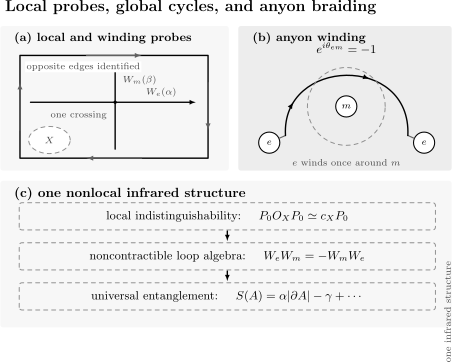
Three views of the same nonlocal structure. A contractible bulk region cannot read the ground-sector label, while loops around the torus cycles and can. Crossing and strings anticommute, equivalently giving a mutual braiding phase . The resulting global information is invisible to local probes and contributes universal long-distance entanglement data.
Logical operators
Section titled “Logical operators”From the quantum-information viewpoint, noncontractible loops are logical operators. If the ground space encodes a logical qubit, one can identify
with
A local operator has support too small to realize either logical action. The minimum support of a nontrivial logical operator defines a code-distance scale.
This analogy is structural, not merely rhetorical: local indistinguishability is closely related to the Knill–Laflamme condition for correcting local errors.
Anyons in Two Dimensions
Section titled “Anyons in Two Dimensions”Why two dimensions are special
Section titled “Why two dimensions are special”In three spatial dimensions, exchanging two point particles twice can be continuously undone, and ordinary point particles fall into bosonic or fermionic exchange classes. In two dimensions, worldlines can braid around one another. The relevant topology is richer because paths with different winding cannot generally be deformed into one another without particle collisions.
For identical particles in the plane, exchanges are organized by the braid group , generated by with relations
Unlike the permutation group, the braid group does not impose
That missing relation permits exchange statistics beyond bosons and fermions.
Superselection sectors
Section titled “Superselection sectors”An anyon type labels a topological superselection sector. Local operators cannot change the total topological charge inside a region without also creating compensating charge or moving charge across the boundary.
The vacuum sector is denoted by . Every type has an antiparticle such that
The Superselection Sectors Preview develops the general operator-algebraic idea. Here the sectors are emergent quasiparticle types of a two-dimensional topological phase.
Fusion rules
Section titled “Fusion rules”Bringing quasiparticles together can produce more than one possible total charge:
The nonnegative integers count fusion channels. If every pair has at most one fusion outcome and all sectors have quantum dimension one, the anyon theory is Abelian. Multiple fusion channels can produce a protected multidimensional state space and non-Abelian statistics.
Associativity requires
but the two bases need not be identical. Their change of basis is encoded by -moves in a full anyon theory. Anyons and Braiding develops the operational - and -move language, explicit non-Abelian examples, and braid protocols; this preview keeps only the phase-level diagnostic structure.
Quantum dimensions
Section titled “Quantum dimensions”The quantum dimensions are positive numbers satisfying
The total quantum dimension is
For an Abelian theory, every , so is the square root of the number of sectors. A non-Abelian anyon has
signaling asymptotic growth of the fusion-space dimension as more such anyons are added.
Abelian braiding
Section titled “Abelian braiding”For Abelian anyons, exchanging or winding quasiparticles changes the state by a phase. A full counterclockwise winding of around can give
For ordinary bosons or fermions, the exchange phase is restricted to or . For anyons it can be a more general phase, subject to consistency with fusion and locality.
Non-Abelian braiding
Section titled “Non-Abelian braiding”If a collection of anyons has a degenerate fusion space , a braid acts by a unitary matrix:
Two braid operations can fail to commute:
This is the origin of the term non-Abelian anyon. It refers to the braid representation, not to a non-Abelian microscopic symmetry group.
Exchange, winding, and topological spin
Section titled “Exchange, winding, and topological spin”Three related notions should not be conflated:
- exchanging two identical anyons;
- winding one anyon completely around another;
- rotating one anyon by , encoded by its topological spin.
Their phases are related by the consistency structure of the anyon theory, but they are not interchangeable in every convention. When quoting a statistical angle, state which process it describes.
The Toric Code as a Fixed-Point Example
Section titled “The Toric Code as a Fixed-Point Example”Degrees of freedom
Section titled “Degrees of freedom”Put one qubit on each edge of a square lattice embedded on a closed surface. Define star and plaquette operators
Every star and plaquette commute:
A star and a plaquette share either zero or two edges. On each shared edge, ; two minus signs cancel.
The Hamiltonian is
Its ground states satisfy
Counting the torus ground space
Section titled “Counting the torus ground space”For an square lattice on a torus,
qubits live on edges. There are
star and plaquette constraints.
Two global products are redundant:
The number of independent stabilizers is therefore
The encoded-qubit count is
Hence
This count uses periodic topology. A planar patch has boundary-dependent stabilizer relations and a different encoded dimension.
Electric and magnetic excitations
Section titled “Electric and magnetic excitations”A violated star constraint,
is an electric excitation . A violated plaquette constraint,
is a magnetic excitation .
Open strings create excitations at their endpoints. For a direct-lattice path ,
anticommutes with the endpoint star operators and creates an pair. For a dual-lattice path ,
creates an pair on endpoint plaquettes.
The energy cost depends on the endpoints, not on the path length:
for a well-separated pair in the bulk. This is deconfinement at the fixed point.
Fusion
Section titled “Fusion”Applying the same string twice gives the identity. The fusion rules are
All four sectors
have quantum dimension one. Therefore
The toric-code anyons are Abelian.
Mutual braiding
Section titled “Mutual braiding”Suppose an string and an string cross once. At the crossing edge,
All other factors commute, so
If the particle winds once around the particle, the many-body state acquires
Thus and are individually bosonic in the fixed-point theory but have nontrivial mutual statistics. Their composite is fermionic.
Ground-sector operators
Section titled “Ground-sector operators”Close the strings around noncontractible cycles. The loops create no excitations because they have no endpoints, so they commute with the Hamiltonian while acting within the ground space:
Loops of the same type along homologous paths differ by products of local stabilizers. Their action on the ground space depends only on the homology class.
This is the fixed-point realization of the diagnostic package:
What the fixed point hides
Section titled “What the fixed point hides”The exactly solvable Hamiltonian is unusually clean. A generic realization can have:
- dispersive quasiparticles;
- nonzero correlation length;
- exponentially split ground sectors at finite size;
- dressed, quasi-local string operators;
- interactions among excitations;
- nontrivial boundary dynamics.
These changes do not by themselves destroy the phase. The invariant statement concerns a gapped region of Hamiltonian space, not exact solvability.
The Surface Code develops code-family conventions, planar boundaries, decoding, thresholds, and lattice surgery. Those engineering questions are separate from the intrinsic-phase structure developed here.
Long-Range Entanglement
Section titled “Long-Range Entanglement”Circuit definition
Section titled “Circuit definition”A pure gapped state is short-range entangled if, after allowing appropriate local ancillas and conventions, a finite-depth local unitary circuit can transform it to a product state:
The circuit depth remains bounded as , and every gate acts on a bounded-diameter region.
An intrinsically topologically ordered state is long-range entangled in the sense that no such finite-depth local circuit removes its nonlocal structure:
under the declared equivalence rules.
The phrase does not mean that a two-point correlator remains large at arbitrary separation. It means that the global entanglement pattern cannot be disentangled by bounded-depth local operations.
Why finite depth matters
Section titled “Why finite depth matters”A circuit of depth with gate range spreads the support of a local operator by at most a distance of order
If and remain fixed as grows, the circuit cannot turn a contractible local operator into one that wraps a macroscopic cycle. It therefore cannot erase the noncontractible loop algebra of an intrinsic topological phase.
A circuit whose depth scales with can move information across the system and may disentangle the state. Such a circuit is not a phase-equivalence transformation of bounded depth.
Not the same as long-range order
Section titled “Not the same as long-range order”In a gapped topological phase, connected correlations of local operators can decay exponentially:
At the same time, the state has long-range entanglement and nontrivial loop operators. Long-range entanglement is not long-range local correlation.
This distinction is central. The Long-Range Order page owns the correlation-based notion.
Entanglement entropy
Section titled “Entanglement entropy”For a smooth simply connected region in a suitable two-dimensional gapped topological phase,
The leading coefficient is nonuniversal. The constant
is the topological entanglement entropy under the standard assumptions and vacuum-sector convention.
For the toric-code phase,
This formula is powerful but easy to misuse. Corners, finite correlation length, symmetry breaking, Goldstone modes, boundaries, and small-region fits can contaminate constant terms. Reliable extraction uses combinations of regions designed to cancel boundary contributions; those protocols belong to the dedicated topological-entanglement page linked above.
Entanglement is richer than one number
Section titled “Entanglement is richer than one number”Topological entanglement entropy determines , not the entire anyon theory. Distinct topological orders can share the same total quantum dimension. A fuller diagnosis can require:
- minimally entangled states on a cylinder or torus;
- entanglement spectra;
- modular transformations;
- topological spins;
- fusion coefficients;
- braiding matrices;
- chiral central charge or thermal response.
Topological Order owns these classification tools, including modular data, genus-dependent ground spaces, Abelian matrices, chiral response, and phase-identification standards.
Quantum Error-Correction Viewpoint
Section titled “Quantum Error-Correction Viewpoint”Approximate Knill–Laflamme structure
Section titled “Approximate Knill–Laflamme structure”For a code projector and a set of correctable errors , the Knill–Laflamme condition is
Compare this with local indistinguishability:
If products of sufficiently local errors remain supported in a correctable region, the topological ground space behaves as a quantum code against those local errors.
Local information and global information
Section titled “Local information and global information”The ground-sector label is stored globally. A local perturbation can:
- create nearby quasiparticle pairs;
- dress the ground states;
- shift their common energy;
- deform a logical string locally.
But it cannot distinguish or enact a logical transformation at leading order unless a process spans a noncontractible distance.
This explains both robustness and finite-size splitting. A logical error requires an extended process:
Protection is not absolute
Section titled “Protection is not absolute”Topological encoding does not mean immunity to all noise. Protection depends on:
- a locality structure;
- a nonzero energy gap;
- system size;
- temperature and noise dynamics;
- active error correction when required;
- boundaries and defects;
- measurement and control errors.
The two-dimensional toric code at nonzero temperature is not a self-correcting quantum memory in the thermodynamic limit. Pointlike anyons can be thermally created and diffuse around noncontractible cycles at a finite energetic cost. Static ground-state robustness and long-time thermal memory are different claims.
Neighboring Notions
Section titled “Neighboring Notions”A comparison table
Section titled “A comparison table”| Structure | Local bulk order parameter | Needs protecting symmetry | Intrinsic anyons | Long-range entangled in the standard non-invertible sense |
|---|---|---|---|---|
| Symmetry-breaking phase | usually yes | symmetry defines the broken pattern | no | no |
| Trivial symmetric phase | no | no | no | no |
| Bosonic SPT phase | no | yes | no intrinsic bulk anyons | no after symmetry is forgotten |
| Free-fermion band topology | no | sometimes | no intrinsic fractional anyons | classification depends on symmetry and fermionic conventions |
| Intrinsic topological order | no local classifier | not required | yes in two dimensions | yes |
| Stable gapless phase | not necessarily | model dependent | possible fractionalization | circuit classification requires extra care |
The final column uses a common condensed-matter convention. Terminology around invertible topological order, chiral phases, and fermionic systems varies in the literature. State the convention rather than arguing from the word topological alone.
Symmetry-protected phases
Section titled “Symmetry-protected phases”An SPT phase can be nontrivial only while a specified symmetry is preserved. Once that symmetry constraint is removed, a bosonic SPT ground state can be connected to a trivial short-range-entangled state without closing the bulk gap.
Intrinsic topological order does not require an ordinary global protecting symmetry. Weak local perturbations that break microscopic symmetries need not destroy it, provided locality and the bulk gap survive.
This distinction does not make SPT phases less physical. It says that their equivalence relation includes a symmetry constraint. See Symmetry-Protected Structure Preview.
Band topology and invertible phases
Section titled “Band topology and invertible phases”An integer quantum Hall state or Chern insulator can have:
- a unique ground state on a closed manifold;
- no fractional anyons;
- a quantized Hall response;
- protected chiral edge structure.
Such phases are topological, but they are not the same as non-invertible intrinsic topological order exemplified by a fractional quantum Hall fluid or the toric code. Invertible phases possess an inverse under stacking and require their own classification language.
String order
Section titled “String order”A nonlocal string expectation value can diagnose some one-dimensional phases:
The presence of a string order parameter does not by itself imply two-dimensional intrinsic topological order. Some string orders diagnose hidden symmetry breaking or SPT structure.
Fracton and gapless extensions
Section titled “Fracton and gapless extensions”Fracton phases can have restricted quasiparticle mobility and ground-state degeneracy that depends on system size or lattice geometry, not merely manifold topology. Gapless spin liquids can have fractionalized excitations without a fully gapped topological field theory.
These are important extensions, but importing the ordinary two-dimensional package without modification can be misleading.
Robustness Under Perturbations
Section titled “Robustness Under Perturbations”Admissible perturbations
Section titled “Admissible perturbations”Consider
Topological stability concerns perturbations that are:
- local or sufficiently rapidly decaying;
- bounded in strength relative to the gap;
- applied without changing the thermodynamic setting;
- small enough that the relevant bulk gap remains open.
Under suitable topological-order conditions, weak local perturbations preserve a separated low-energy band and give it only exponentially small width.
The statement is not
A sufficiently strong perturbation can close the gap, condense an anyon, confine excitations, or drive a first-order transition.
Dressed operators
Section titled “Dressed operators”Away from an exactly solvable point, bare strings may no longer commute with the Hamiltonian. Quasi-adiabatic continuation dresses them into quasi-local operators:
The support develops exponentially decaying tails, but the global algebra within the low-energy sector remains stable while the gapped path exists.
Exact microscopic formulas are therefore not phase invariants. Fusion, braiding, topology-dependent sector structure, and robust response data are the infrared content.
Ways a topological phase can end
Section titled “Ways a topological phase can end”A phase transition can occur through:
- closure of the bulk quasiparticle gap;
- condensation of a bosonic anyon;
- confinement of formerly deconfined excitations;
- proliferation of defects;
- a first-order level crossing between distinct phases;
- loss of the locality or dimensional assumptions.
At a continuous transition, the correlation length can diverge:
The finite-depth circuit and exponentially local dressing arguments then cease to apply uniformly. Quantum Phase Transitions owns the general transition framework.
Boundaries, Defects, and Geometry
Section titled “Boundaries, Defects, and Geometry”Closed versus open systems
Section titled “Closed versus open systems”Topology-dependent ground-state degeneracy is cleanest on a closed surface. Boundaries introduce additional choices:
- which anyons can terminate or condense at a boundary;
- whether gapless edge modes are required;
- whether boundary conditions create logical sectors;
- how corners and defects bind localized modes.
A planar toric-code patch can encode information even though the underlying surface is topologically a disk. Different boundary types allow different strings to end, creating nontrivial logical paths between boundaries.
Edge degeneracy is not bulk degeneracy
Section titled “Edge degeneracy is not bulk degeneracy”Low-energy edge states can be distinguished by operators near the boundary. They may be protected by symmetry, chirality, or an anomaly. This differs from bulk topological ground states that are indistinguishable by every contractible bulk probe on a closed manifold.
When reporting degeneracy, specify:
Punctures and defects
Section titled “Punctures and defects”Punctures, twist defects, and boundaries can enlarge a protected state space. Their degeneracy may depend on defect type and separation. Such structures can emulate aspects of non-Abelian braiding even when the underlying bulk anyons are Abelian.
Defect statistics and intrinsic quasiparticle statistics must therefore be labeled separately.
Finite Temperature
Section titled “Finite Temperature”Ground-state order versus thermal order
Section titled “Ground-state order versus thermal order”This page has used a pure ground-state notion. At nonzero temperature,
contains a thermal density of excitations. Questions about mixed-state topological order, thermal stability, and memory time require definitions beyond the ground-state projector.
Two-dimensional toric-code warning
Section titled “Two-dimensional toric-code warning”Pointlike and excitations cost finite energy. At any nonzero temperature, sufficiently large systems contain thermally activated anyons. Their diffusion can implement a noncontractible logical process.
The equilibrium density is schematically
which is small at low temperature but nonzero. Increasing system size supplies more places for errors and does not create a growing energy barrier for separating pointlike anyons.
Thus the statements
are not equivalent.
Higher-dimensional codes, constrained dynamics, long-range interactions, or active correction can change the memory problem. Those mechanisms lie beyond this preview.
Evidence in Numerics and Experiments
Section titled “Evidence in Numerics and Experiments”Finite-size numerical evidence
Section titled “Finite-size numerical evidence”A responsible numerical claim should report:
- the Hamiltonian, geometry, and boundary conditions;
- a low-energy multiplet separated from higher states;
- scaling of the multiplet splitting and bulk gap;
- local matrix elements or reduced-state distances across sectors;
- loop, flux-insertion, or modular data;
- entanglement diagnostics with controlled region sizes;
- robustness across a finite parameter interval;
- tests against symmetry breaking, edge states, and accidental crossings.
For a candidate ground band,
at the largest accessible sizes is encouraging but not conclusive. One should fit plausible competing forms and avoid inferring an exponential from two or three sizes.
Entanglement-based evidence
Section titled “Entanglement-based evidence”Useful measurements include:
Each has finite-size and gauge-convention issues. For example, an apparent constant in can arise from corners or symmetry-breaking cat states. Agreement among independent constructions is more persuasive than one fit.
Experimental evidence
Section titled “Experimental evidence”Experiments do not measure an abstract phase label directly. Depending on the platform, evidence may combine:
- fractionalized charge or flux;
- quantized electrical or thermal response;
- interferometric braiding phases;
- quasiparticle fusion outcomes;
- ground-state preparation across nontrivial geometry;
- string-operator measurements;
- topological contributions to entanglement proxies;
- robustness to local deformations.
The fractional quantum Hall effect is the canonical physical setting in which fractionalization, quantized response, and anyonic statistics meet. Its Quantum Matter treatment owns filling fractions, Laughlin and composite-fermion structure, edge observables, interferometry, and the evidence status of candidate non-Abelian states.
Claims of experimentally realizing non-Abelian anyons remain platform and protocol dependent. One should distinguish:
- intrinsic quasiparticles of an equilibrium material;
- engineered excitations in a quantum simulator;
- twist defects or measurement-induced defects;
- verified braid-group action within a code space;
- a complete demonstration of a topological phase.
A Practical Diagnostic Workflow
Section titled “A Practical Diagnostic Workflow”Step 1: State the setting
Section titled “Step 1: State the setting”Declare:
Without these, the phrase “topological order” is underspecified.
Step 2: Exclude conventional order
Section titled “Step 2: Exclude conventional order”Test symmetry-resolved local observables, structure factors, susceptibilities, and long-distance correlations. An absent signal is not proof, but an unrecognized ordered phase can imitate low-energy degeneracy and entropy constants.
Step 3: Identify a separated low-energy sector
Section titled “Step 3: Identify a separated low-energy sector”Track
across sizes and geometries. Verify that the candidate band persists over a parameter interval rather than at a tuned point.
Step 4: Test locality
Section titled “Step 4: Test locality”Compute
for a basis of local observables or compare reduced density matrices. The result should approach a scalar matrix within the candidate ground sector.
Step 5: Probe global operators
Section titled “Step 5: Probe global operators”Construct Wilson loops, string operators, flux insertion, or adiabatic cycles. Determine whether their projected algebra is nontrivial:
Step 6: Resolve excitation data
Section titled “Step 6: Resolve excitation data”Look for:
- superselection sectors;
- fusion channels;
- deconfined pair creation;
- exchange or winding phases;
- fractional quantum numbers.
Step 7: Cross-check entanglement
Section titled “Step 7: Cross-check entanglement”Use region combinations with
and compare the extracted with the proposed sector data:
Step 8: Stress-test the claim
Section titled “Step 8: Stress-test the claim”Vary local couplings, aspect ratio, boundary conditions, and analysis windows. A phase occupies a robust region. A diagnostic that exists only at one fine-tuned Hamiltonian may describe a solvable point rather than a stable phase.
Common Mistakes
Section titled “Common Mistakes”Calling every nonlocal feature topological order
Section titled “Calling every nonlocal feature topological order”Bell nonlocality, long-range interaction, nonlocal order parameters, geometric Berry phases, and topological order are distinct notions. Shared vocabulary does not make them equivalent.
Treating four low-energy states as proof
Section titled “Treating four low-energy states as proof”A fourfold multiplet can be generated by broken symmetry, two edge qubits, or a tuned level crossing. Local indistinguishability and topology dependence are needed to interpret it.
Requiring exact finite-size degeneracy
Section titled “Requiring exact finite-size degeneracy”Exact degeneracy is typical of solvable fixed points, not of every Hamiltonian in the phase. Exponentially small finite-size splitting is compatible with topological order.
Calling any degeneracy topological
Section titled “Calling any degeneracy topological”Kramers pairs, symmetry multiplets, and boundary zero modes have different protection mechanisms. State what forbids the splitting and where a distinguishing operator must act.
Equating topological order with a Chern number
Section titled “Equating topological order with a Chern number”A Chern number can classify a band or many-body response bundle, but intrinsic topological order includes fractionalized excitation and long-range-entanglement structure not captured by one integer in general.
Equating an area law with topological order
Section titled “Equating an area law with topological order”Many trivial gapped states obey an area law. The universal subleading term and richer entanglement data carry the topological information.
Equating long-range entanglement with slow correlations
Section titled “Equating long-range entanglement with slow correlations”The toric-code fixed point has zero correlation length for many local correlators while retaining nontrivial global entanglement. The two adjectives refer to different structures.
Saying anyons are particles with arbitrary spin
Section titled “Saying anyons are particles with arbitrary spin”An anyon is a two-dimensional topological quasiparticle sector with braid statistics. Fractional topological spin is part of the data, but the sector, fusion rules, and braiding structure are essential.
Ignoring boundaries and temperature
Section titled “Ignoring boundaries and temperature”A ground-state claim on a torus does not automatically imply protected edge modes, finite-temperature order, or a self-correcting memory.
Using one entropy intercept
Section titled “Using one entropy intercept”The constant term from one small-region fit is contaminated by geometry and short-distance effects. Use controlled cancellation schemes and independent diagnostics.
Exercises
Section titled “Exercises”Exercise 1: Local distinguishability
Section titled “Exercise 1: Local distinguishability”Two finite systems each have two nearly degenerate low-energy states. In system A, there is a fixed local operator such that
In system B, every fixed contractible obeys
Which system is compatible with ordinary symmetry breaking, and which is compatible with a topological ground sector?
Solution
System A is compatible with ordinary symmetry breaking. The two states remain distinguishable by the fixed local observable , which can serve as an order parameter or a local proxy for one.
System B has the local-indistinguishability structure expected of a topological ground sector. Every local operator acts approximately as a scalar on the low-energy subspace.
Neither condition alone proves the full interpretation. For A one should identify the symmetry, thermodynamic branches, and source response. For B one should additionally establish a bulk gap, topology dependence, noncontractible operators, and stability over a parameter region.
Exercise 2: Count the toric-code ground states
Section titled “Exercise 2: Count the toric-code ground states”On a square lattice with periodic boundary conditions, let
Assume all star and plaquette stabilizers commute and that the two global products are redundant. Compute the ground-space dimension.
Solution
The number of independent stabilizers is
For qubits, a rank- stabilizer group leaves
encoded qubits. Hence
Therefore
The topology enters through the global relations and the two independent noncontractible cycles.
Exercise 3: Crossing strings
Section titled “Exercise 3: Crossing strings”An string is a product of operators and an string is a product of operators. Show that strings crossing once anticommute, while strings crossing twice commute.
Solution
At each crossing edge,
Operators on distinct edges commute. If the number of crossings is , moving one full string past the other produces
For one crossing,
For two crossings,
Only the parity of the intersection number matters in the model. The odd-crossing minus sign is the mutual braiding phase between and .
Exercise 4: Quantum dimensions
Section titled “Exercise 4: Quantum dimensions”The toric-code fusion sectors are , all Abelian. Compute and .
Then consider a Fibonacci theory with sectors and fusion rule
Find the positive quantum dimension and the total quantum dimension.
Solution
For the toric code, every sector has quantum dimension one:
Therefore
For Fibonacci fusion, the dimension equation is
The positive solution is the golden ratio
Thus
Because , is non-Abelian: fusion spaces grow with the number of anyons.
Exercise 5: Exponentially small splitting
Section titled “Exercise 5: Exponentially small splitting”Suppose a virtual process that changes a torus sector requires a quasiparticle to traverse links. In perturbation theory, each step contributes a factor of order , with . Estimate the scaling of the sector splitting.
Solution
The first nontrivial process appears at an order proportional to , so
for a geometry-dependent positive constant . Writing
gives
with
This is a scaling estimate, not a universal prefactor. It assumes locality, a gapped intermediate process, and no lower-order path allowed by the geometry.
Exercise 6: Circuit-depth obstruction
Section titled “Exercise 6: Circuit-depth obstruction”A circuit has gate range and depth . Explain why a depth bounded independently of cannot map a local operator to a loop winding around a torus of circumference .
Solution
Conjugation by one layer enlarges an operator’s support only by a distance of order . After layers, the support expands by at most order
If and stay fixed while , then
The dressed operator remains supported in a contractible neighborhood and cannot wrap a noncontractible cycle. A bounded-depth circuit therefore preserves the distinction between local and logical loop operators.
To build or erase a winding loop by local gates, the depth must grow with system size or the allowed gates must become nonlocal.
Exercise 7: Classify the protection mechanism
Section titled “Exercise 7: Classify the protection mechanism”Classify each observation as most naturally suggesting symmetry breaking, SPT structure, invertible topology, intrinsic topological order, or insufficient evidence.
- Two ground states have opposite local magnetization.
- A one-dimensional gapped chain has edge spin- modes protected by spin rotation, but a unique bulk ground state on a ring.
- A two-dimensional insulator has a unique torus ground state and integer Hall conductance.
- A two-dimensional gapped system has four locally indistinguishable torus ground states and deconfined and excitations with mutual phase .
- Exact diagonalization on one cluster shows four equal lowest eigenvalues.
Solution
- Symmetry breaking. A local observable distinguishes the branches.
- SPT structure. The edge modes require the protecting symmetry, while the closed bulk is short-range entangled.
- Invertible topology. The integer Hall response and unique closed-manifold ground state are characteristic of an integer quantum Hall or Chern phase, not non-invertible intrinsic order.
- Intrinsic topological order. Local indistinguishability, topology-dependent sectors, and anyonic braiding form a coherent package.
- Insufficient evidence. One finite-size degeneracy could be accidental, symmetry generated, edge generated, or a solvable-point artifact.
The classification assumes the usual locality and gap conditions. Additional symmetries or interactions can refine each entry.
Exercise 8: Audit a numerical overclaim
Section titled “Exercise 8: Audit a numerical overclaim”A tensor-network calculation on cylinders of circumference , , and finds exponentially decaying spin correlations and fits
with . The authors conclude that the phase is definitively the toric-code phase.
List what the data support and what remains to be established.
Solution
The data support:
- absence of obvious conventional spin long-range order in the measured channel;
- an area-law entanglement pattern over the fitted sizes;
- a constant compatible with the toric-code value.
They do not yet uniquely identify the phase. The fit may suffer from short circumferences, corners or cylinder conventions, finite correlation length, restricted variational sectors, or symmetry-breaking contributions.
A stronger identification should include:
- stability across bond dimension and circumference;
- multiple region or cylinder constructions;
- a separated bulk gap or a controlled transfer-matrix correlation length;
- minimally entangled sectors and their local indistinguishability;
- noncontractible loop or flux-insertion algebra;
- sector counting;
- modular or braiding data compatible with ;
- exclusion of other phases with the same .
The value determines the total quantum dimension under suitable assumptions; it does not determine the complete anyon theory.
Key Takeaways
Section titled “Key Takeaways”- Intrinsic topological order is a gapped long-range-entangled phase structure beyond ordinary symmetry breaking.
- No single diagnostic is universal; the conclusion should combine local indistinguishability, global sectors, loop algebra, excitation data, and entanglement.
- A topological ground sector obeys for contractible local regions.
- Topology-dependent degeneracy means a quasi-degenerate low-energy band whose splitting vanishes relative to a nonzero bulk gap.
- In two dimensions, point-particle worldlines braid, allowing Abelian and non-Abelian anyonic statistics.
- Fusion rules and quantum dimensions describe the superselection structure; .
- The toric-code phase has sectors , four torus ground states, mutual – phase , and .
- Long-range entanglement is an obstruction to finite-depth local disentangling, not a claim of slowly decaying local correlations.
- Topological entanglement entropy gives under standard two-dimensional gapped assumptions, but it is not a complete classifier.
- SPT phases, band topology, invertible phases, edge degeneracy, and fracton phases require distinct language.
- Robustness applies to weak local perturbations while the bulk gap and locality assumptions remain intact.
- A stable zero-temperature topological phase does not automatically provide a self-correcting finite-temperature memory.
Further Reading
Section titled “Further Reading”-
For short-range-entangled phases that are nontrivial only with a specified symmetry, see Symmetry-Protected Topological Phases.
-
For the materials-facing classification ledger, see Topological Order.
-
For the general equivalence relation among gapped phases, see Phases of Matter in Many-Body QM.
-
For locally distinguishable thermodynamic branches, see Spontaneous Symmetry Breaking.
-
For spatial entropy scaling and extraction cautions, see Entanglement Entropy in Many-Body Systems.
-
For low-lying level counting, entanglement gaps, and the limits of spectrum-based phase claims, see Entanglement Spectrum.
-
For the mathematical meaning of topological data, see Topological Invariants.
-
For planar patches, syndrome extraction, decoding, and thresholds, see Surface Code; its model card provides a compact lookup.
-
For a learning path through fractionalization and topological phases, see the Condensed Matter Roadmap.
References
Section titled “References”- X.-G. Wen and Q. Niu, “Ground-State Degeneracy of the Fractional Quantum Hall States in the Presence of a Random Potential and on High-Genus Riemann Surfaces”, Physical Review B 41, 9377–9396, 1990.
- A. Y. Kitaev, “Fault-Tolerant Quantum Computation by Anyons”, Annals of Physics 303, 2–30, 2003.
- X. Chen, Z.-C. Gu, and X.-G. Wen, “Local Unitary Transformation, Long-Range Quantum Entanglement, Wave Function Renormalization, and Topological Order”, Physical Review B 82, 155138, 2010.
- M. B. Hastings and X.-G. Wen, “Quasi-Adiabatic Continuation of Quantum States: The Stability of Topological Ground-State Degeneracy and Emergent Gauge Invariance”, Physical Review B 72, 045141, 2005.
- S. Bravyi, M. B. Hastings, and S. Michalakis, “Topological Quantum Order: Stability under Local Perturbations”, Journal of Mathematical Physics 51, 093512, 2010.
- A. Kitaev and J. Preskill, “Topological Entanglement Entropy”, Physical Review Letters 96, 110404, 2006.
- M. Levin and X.-G. Wen, “Detecting Topological Order in a Ground State Wave Function”, Physical Review Letters 96, 110405, 2006.
- M. A. Levin and X.-G. Wen, “String-Net Condensation: A Physical Mechanism for Topological Phases”, Physical Review B 71, 045110, 2005.
- J. M. Leinaas and J. Myrheim, “On the Theory of Identical Particles”, Il Nuovo Cimento B 37, 1–23, 1977.
- F. Wilczek, “Quantum Mechanics of Fractional-Spin Particles”, Physical Review Letters 49, 957–959, 1982.
- D. Arovas, J. R. Schrieffer, and F. Wilczek, “Fractional Statistics and the Quantum Hall Effect”, Physical Review Letters 53, 722–723, 1984.
- C. Nayak, S. H. Simon, A. Stern, M. Freedman, and S. Das Sarma, “Non-Abelian Anyons and Topological Quantum Computation”, Reviews of Modern Physics 80, 1083–1159, 2008.
- D. C. Tsui, H. L. Störmer, and A. C. Gossard, “Two-Dimensional Magnetotransport in the Extreme Quantum Limit”, Physical Review Letters 48, 1559–1562, 1982.
- R. B. Laughlin, “Anomalous Quantum Hall Effect: An Incompressible Quantum Fluid with Fractionally Charged Excitations”, Physical Review Letters 50, 1395–1398, 1983.
- E. Dennis, A. Kitaev, A. Landahl, and J. Preskill, “Topological Quantum Memory”, Journal of Mathematical Physics 43, 4452–4505, 2002.
- C. Castelnovo and C. Chamon, “Entanglement and Topological Entropy of the Toric Code at Finite Temperature”, Physical Review B 76, 184442, 2007.
- A. Kitaev, “Anyons in an Exactly Solved Model and Beyond”, Annals of Physics 321, 2–111, 2006.
- X.-G. Wen, Quantum Field Theory of Many-Body Systems, Oxford University Press, 2004.