Topological Order
Intrinsic topological order is the universal long-distance structure of a gapped, long-range-entangled many-body phase whose bulk supports nontrivial superselection sectors and, in two dimensions, anyonic fusion and braiding. It is not defined by breaking an ordinary global symmetry and does not become trivial merely because an optional symmetry is removed.
The phrase names a phase, not one observable. In the standard two-dimensional setting, the same universal structure appears in several forms:
- a locally indistinguishable ground-state manifold on nontrivial space;
- Wilson loops and flux sectors associated with noncontractible cycles;
- anyon types with fusion, braiding, and topological spin;
- modular transformations acting on the ground-state manifold;
- quantized electromagnetic or thermal response when the needed probes exist;
- universal subleading entanglement data.
This page owns the classification and response ledger for two-dimensional topological order: fusion data, modular and matrices, chiral central charge, genus-dependent ground spaces, Abelian Chern–Simons matrices, and the relation between these quantities and material or numerical evidence.
Topological Order Preview remains the canonical home for local indistinguishability, long-range entanglement, loop-operator algebra, the toric-code Hamiltonian and ground-space derivation, and the basic diagnostic workflow. Anyons and Braiding owns braid groups, fusion spaces, - and -moves, and adiabatic braid operations. Fractional Quantum Hall Effect owns Laughlin and composite-fermion physics, transport plateaus, fractional-charge measurements, edge probes, and experiment-specific claims.
Required background. Topological Order Preview supplies local indistinguishability and the toric-code diagnostic baseline, Anyons and Braiding supplies fusion and exchange data, and Entanglement Entropy supplies the reduced-state diagnostic language.
Helpful background. Fractional Quantum Hall Effect supplies the principal electronic realization and its experimental evidence ledger.
Scope and Convention Ledger
Section titled “Scope and Convention Ledger”Unless a qualification is stated, the discussion assumes:
- two spatial dimensions and one time dimension;
- a local or sufficiently short-range Hamiltonian;
- a stable bulk gap in the thermodynamic limit;
- finite correlation length away from edges and quasiparticles;
- a closed orientable surface for ground-state topology;
- finitely many pointlike superselection sectors;
- nondegenerate braiding for the bosonic modular-category statements.
The vacuum sector is labeled . Anyon labels are , with conjugate . Fusion multiplicities are . Quantum dimensions are , and
is the total quantum dimension.
The modular matrices use
and
where is the topological spin and is the chiral central charge. Authors sometimes remove the common framing phase from and call the resulting diagonal matrix . Always check the convention before comparing tables.
For Abelian Chern–Simons formulas, is a symmetric, integral, nondegenerate matrix and is the conserved-charge vector. We quote response magnitudes unless orientation and carrier-charge signs are explicitly fixed. The Fractional Quantum Hall Effect page owns the electronic Hall-sign convention.
Beyond Symmetry Breaking
Section titled “Beyond Symmetry Breaking”In a conventional broken-symmetry phase, local observables distinguish thermodynamic branches. If projects onto the low-energy sector, one can often find a local for which
is not proportional to . Different states have different local order-parameter expectations.
In a topologically ordered ground sector, sufficiently local bulk operators instead satisfy
where vanishes rapidly as the system becomes large compared with the correlation length. A local observer cannot determine the global flux sector or implement a logical transition between sectors.
This statement is a diagnostic under locality and gap assumptions, not the full classification. It can also resemble quantum error correction, and exact equality occurs at special commuting-projector fixed points. The preview page owns the derivation and finite-size qualifications.
Comparison with symmetry-protected phases
Section titled “Comparison with symmetry-protected phases”A nontrivial symmetry-protected topological phase is short-range entangled and invertible. If the protecting symmetry is relaxed, it can become a product-like phase.
An intrinsically topologically ordered phase is long-range entangled. Removing optional symmetry does not eliminate its anyons or global ground sectors. It is generally noninvertible under stacking because its anyon content cannot be canceled by another ordinary phase to leave a one-dimensional state space.
| Property | SPT phase | Intrinsic topological order |
|---|---|---|
| needs optional symmetry for distinction | yes | no |
| finite-depth disentangling after symmetry is forgotten | allowed | obstructed |
| deconfined bulk anyons in two dimensions | no | yes |
| topology-dependent ground space | absent in the invertible idealization | characteristic |
| boundary | anomalous only with symmetry | constrained by bulk anyon and chiral data |
Symmetry can still enrich intrinsic order. It may permute anyons, fractionalize on them, or protect additional distinctions. That is symmetry-enriched topological order, not an SPT.
Long-Range Entanglement and Renormalization
Section titled “Long-Range Entanglement and Renormalization”A finite-depth local unitary circuit changes short-distance entanglement but cannot change topological order. If
then and have the same long-distance anyon theory. Adding or removing product-state ancillas does not change that conclusion. Nontrivial invertible chiral layers, such as the bosonic phase, must instead be tracked separately through ; they are not removed by a finite-depth circuit.
Long-range entanglement does not imply algebraically decaying local correlations. A gapped topological phase can obey
for local operators while retaining noncontractible loop algebra and nontrivial entanglement across arbitrarily large cuts.
Fixed points and phases
Section titled “Fixed points and phases”The toric code and string-net models supply exactly solvable fixed points. A real Hamiltonian in the same phase need not commute term by term and need not have an exactly flat correlation length or exactly degenerate finite-size ground states.
The phase statement is stability under local deformation:
Along such a path, microscopic spectra and correlation lengths change, but fusion and braiding data remain fixed. A topological phase transition requires a failure of the assumptions, often a bulk-gap closing, anyon condensation, or a first-order level crossing in the thermodynamic limit. Topological Phase Transitions compares those mechanisms with band, mobility-gap, and Green-function routes.
Ground-State Manifolds and Topology
Section titled “Ground-State Manifolds and Topology”Let be a closed orientable surface of genus . A two-dimensional topological order assigns a finite-dimensional ground-state space
For a unitary modular tensor category, its dimension is
Using ,
Three checks are immediate:
and higher genus introduces more independent noncontractible cycles.
Degeneracy means a low-energy band
Section titled “Degeneracy means a low-energy band”At a fixed point, ground states can be exactly degenerate. In a generic finite sample, virtual anyon tunneling around a noncontractible cycle produces a splitting
where depends on the lightest process that changes the flux sector. The defining scaling is
as , with .
Counting several low-energy states on one small torus is therefore not enough. Symmetry breaking, center-of-mass degeneracy, accidental levels, and edge states can all imitate the count.
Mapping-class-group action
Section titled “Mapping-class-group action”Large diffeomorphisms of the torus act on . Two generators are:
- , which exchanges the two primitive cycles up to orientation;
- , a Dehn twist that shears one cycle around the other.
Their quantum action is projective and obeys convention-dependent versions of
where is charge conjugation. This ground-space geometry is how braiding data can be extracted without explicitly moving localized quasiparticles.
Minimally entangled states
Section titled “Minimally entangled states”For a cylindrical bipartition of a torus, special ground-state combinations diagonalize the anyon flux through the cut. These minimally entangled states provide a basis labeled by topological charge. Overlaps between bases adapted to inequivalent cuts can yield modular matrices.
This procedure requires:
- a converged basis for the full ground-state manifold;
- sufficiently large circumference and length;
- careful phase and permutation fixing;
- control of lattice symmetries and cut conventions;
- evidence that the low-energy states belong to one phase.
An arbitrary basis returned by diagonalization does not carry canonical anyon labels.
Anyon Data as a Classification Ledger
Section titled “Anyon Data as a Classification Ledger”An anyon theory must say more than “Abelian” or “non-Abelian.” Its universal data include:
- simple sectors and conjugates ;
- fusion multiplicities ;
- associativity transformations ;
- braiding transformations ;
- topological spins ;
- quantum dimensions ;
- chiral central charge , including information not fixed by bulk anyons alone.
Anyons and Braiding owns the fusion-space bases, pentagon and hexagon consistency equations, and braid operations. Here the emphasis is how the data classify and constrain a phase.
Fusion and quantum dimension
Section titled “Fusion and quantum dimension”Fusion is
Quantum dimensions form a positive solution of
For an Abelian anyon, . A non-Abelian anyon has , and the fusion-space dimension for many such anyons grows asymptotically like a power of .
Modular S and T
Section titled “Modular S and T”The entry encodes a normalized mutual-braiding amplitude. The first row gives quantum dimensions:
The diagonal matrix records topological spins together with a common framing phase. Fusion can be recovered from through the Verlinde formula:
Central charge from Gauss and Milgram
Section titled “Central charge from Gauss and Milgram”The Gauss–Milgram relation connects bulk spins to the chiral central charge:
For a bosonic topological order, the anyon data therefore determine modulo . Stacking with the bosonic invertible phase changes by without changing anyon sectors.
Modular data are powerful but not complete
Section titled “Modular data are powerful but not complete”and determine fusion through Verlinde and capture spins and mutual braiding. They are not, in full mathematical generality, a complete invariant of a modular tensor category: inequivalent categories can share the same modular data. Complete specification can require and data or equivalent higher link and punctured-surface invariants.
For many low-rank physical examples, , , and are highly discriminating. The correct phrase is “a strong or nearly complete characterization in this candidate family,” not a theorem that two matching matrices always imply identical topological order.
Bosonic and fermionic orders
Section titled “Bosonic and fermionic orders”For a bosonic phase with nondegenerate braiding, the low-energy category is modular: the only sector that braids trivially with every sector is the vacuum.
In an electronic system, the physical electron is a local transparent fermion. It is not treated as a nontrivial emergent anyon, yet it cannot be identified with the bosonic vacuum. Fermionic topological orders require spin-sensitive or super-modular refinements. Applying a bosonic modular formula without tracking the local fermion can double-count sectors or assign the wrong central-charge equivalence.
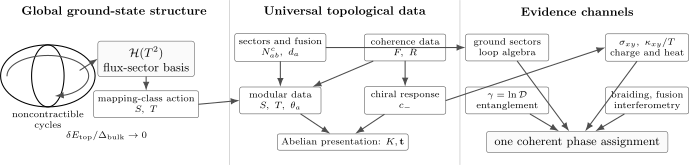
The classification flow in two-dimensional topological order. A converged global ground-state manifold supports flux bases and mapping-class-group actions. Universal data such as , , , and constrain one another. Experiments and numerics access only projections of that package—ground-state counting, Hall and thermal response, topological entanglement entropy, or statistics-sensitive protocols—so a mature claim combines several columns.
Topological Field Theory
Section titled “Topological Field Theory”At energies well below the bulk gap and distances much larger than the correlation length, local propagating bulk modes disappear. The remaining universal amplitudes depend on topology, links, and background fields. A topological quantum field theory assigns:
for a closed spatial surface and
for a spacetime with anyon worldlines. Gluing spacetimes corresponds to composing linear maps. This is why ground-space dimension, braiding, and knot invariants belong to one structure.
TQFT is an infrared description. It does not determine the microscopic gap, correlation length, quasiparticle mass, edge velocity, disorder sensitivity, or which Hamiltonian realizes the phase.
Chern–Simons theory
Section titled “Chern–Simons theory”In a non-Abelian Chern–Simons theory with gauge connection and integer level , the action is schematically
Wilson lines
represent anyon worldlines labeled by representations. Their expectation values produce link invariants. Boundary gauge variation is canceled by a chiral edge theory, connecting bulk topological order to conformal field theory.
This formalism captures a broad family of chiral orders, not every lattice topological order in one gauge-theory presentation.
Abelian K-Matrix Theory
Section titled “Abelian K-Matrix Theory”An Abelian topological order with emergent gauge fields can often be described by
Here is a background electromagnetic field and is the magnitude of the microscopic unit charge. This convention fixes the formulas below; changing orientation or the sign of the charge coupling changes response signs.
Anyon labels and local particles
Section titled “Anyon labels and local particles”An anyon is labeled by an integer vector
Vectors differing by a local excitation are equivalent:
Therefore the number of Abelian anyon types is
Fusion is vector addition modulo the lattice.
Charge and statistics
Section titled “Charge and statistics”The conserved charge is
The exchange angle is
and the full winding phase of around is
Thus
Response and ground-space dimension
Section titled “Response and ground-space dimension”Integrating out the internal gauge fields gives
On genus ,
The edge has net chiral central charge
for the minimal -matrix edge theory, subject to stable additions and fermionic refinements.
Basis changes and stable equivalence
Section titled “Basis changes and stable equivalence”An integral change of gauge-field basis,
acts as
It does not change the physical topological order. Complete stable equivalence can also allow adding unimodular trivial or invertible blocks, so matching determinants alone is far too weak.
For a bosonic microscopic system, diagonal entries of are even in the usual local-boson convention. Fermionic systems allow odd diagonal entries and require the local transparent fermion to be tracked.
Toric Code as a Calibration Model
Section titled “Toric Code as a Calibration Model”The toric-code Hamiltonian, commuting-projector proof, loop algebra, and excitation construction live in Topological Order Preview. Here it calibrates the classification formulas.
Order the sectors as
Their fusion is
and
All quantum dimensions are one:
The modular matrices, with the common framing phase omitted, are
The minus sign for says it is a fermion. The entries encode the mutual phase between and after normalization.
An Abelian Chern–Simons representation is
Since
there are four anyon types and four torus ground states. The signature is zero, so . Gauss–Milgram gives
consistent with .
This data package distinguishes the phase more sharply than the phrase “ spin liquid,” which can hide symmetry enrichment, fermionic versus bosonic partons, and different microscopic realizations.
Fractional Quantum Hall Order
Section titled “Fractional Quantum Hall Order”The fractional quantum Hall effect is the canonical equilibrium material realization because transport, quasiparticle charge, edge structure, and topological order are accessible in one platform.
Laughlin order as a one-component K matrix
Section titled “Laughlin order as a one-component K matrix”For a Laughlin state at filling magnitude , take
with odd for a one-component electronic state. Anyons are labeled by
Their universal data are
For odd , replacing by attaches a local electron. Mutual braiding is unchanged, but the exchange angle shifts by . The displayed therefore refers to the chosen representatives ; a complete fermionic description also retains the transparent electron and spin structure.
and
Every sector is Abelian, so
The vacuum-sector topological entanglement entropy is therefore
These formulas classify the Laughlin topological order. They do not derive the Laughlin wavefunction, explain why a particular Landau-level interaction stabilizes it, or establish a plateau in a real device; those are owned by the Fractional Quantum Hall Effect page.
Beyond one-component Abelian order
Section titled “Beyond one-component Abelian order”Multicomponent Abelian Hall states use larger matrices. Different candidate orders can share the same electrical Hall conductivity:
while differing in:
- quasiparticle charge and statistics;
- neutral modes;
- chiral central charge;
- shift and geometric response;
- edge stability and equilibration;
- ground-state degeneracy.
Non-Abelian orders require fusion spaces and cannot be encoded by an ordinary Abelian matrix alone. A measured filling fraction is therefore not a complete topological-order label.
Established and active claims
Section titled “Established and active claims”Fractionally quantized Hall plateaus and fractional quasiparticle charge are established in multiple Abelian regimes. Statistics-sensitive experiments provide increasingly direct evidence for Abelian anyonic behavior, but their interpretation still requires electrostatics, coherence, edge-mode, and nonequilibrium modeling.
The identity of non-Abelian order at several even-denominator or otherwise exotic fillings remains platform and filling dependent. Thermal Hall response, upstream neutral modes, interferometry, tunneling, and numerics can narrow candidates, but no single measurement should be promoted to a universal phase proof.
Topological Entanglement Entropy
Section titled “Topological Entanglement Entropy”For a smooth simply connected region in the vacuum sector of a suitable two-dimensional gapped topological phase,
with
If a definite anyon lies in the region, the universal constant changes to
Thus a non-Abelian anyon with changes the constant term.
Why one fitted intercept is weak evidence
Section titled “Why one fitted intercept is weak evidence”The coefficient is nonuniversal. Corners, finite correlation length, Goldstone modes, symmetry breaking, finite bond dimension, and cut geometry can all contribute constants. Reliable schemes combine several regions so boundary terms cancel.
Topological Entanglement Entropy Preview owns the Kitaev–Preskill and Levin–Wen subtraction geometries, sector dependence, numerical protocols, and failure modes.
Even a reliable gives only . Distinct anyon theories can share the same total quantum dimension. It must be joined with sector counting, modular data, response, or excitation information.
Chiral Central Charge and Thermal Response
Section titled “Chiral Central Charge and Thermal Response”The chiral central charge is
the difference between right- and left-moving edge central charges. In a well-equilibrated chiral edge, the thermal Hall conductance obeys
This response detects information invisible to electrical Hall conductance, including neutral modes. It also sees invertible chiral layers that carry no nontrivial anyons.
Real measurements require caution:
- edge modes may not equilibrate over the device length;
- phonons and metallic channels carry heat;
- contacts can mix modes;
- upstream and downstream sectors can exchange energy;
- the measured plateau may be a crossover rather than the asymptotic limit.
The Gauss–Milgram relation fixes only modulo for a bosonic modular category. Thermal response can distinguish phases that share anyon data but differ by an layer.
From Universal Data to Evidence
Section titled “From Universal Data to Evidence”No experiment or numerical calculation usually returns the full topological order directly. Each probe constrains part of the ledger.
| Universal datum | Possible access | Main ambiguity |
|---|---|---|
| bulk gap | spectroscopy, activation, finite-size scaling | mobility gap versus spectral gap; disorder broadening |
| ground-space dimension | torus numerics, cylinder flux sectors, engineered handles | symmetry or center-of-mass degeneracy |
| and | entanglement, fusion-space growth | finite-size and sector identification |
| fusion | controlled fusion, modular , flux insertion | incomplete state preparation or readout |
| topological spin | modular , interferometry, momentum polarization | framing, geometry, and Abelian phase offsets |
| mutual braiding | modular , interferometry, collider protocols | Coulomb phase and path dependence |
| charge | shot noise, charge sensing, flux insertion | bunching and nonequilibrium effective charge |
| thermal Hall or momentum polarization | edge equilibration and non-topological heat paths | |
| entropy subtraction, tensor networks | corners, correlation length, and bond truncation |
Numerical evidence ladder
Section titled “Numerical evidence ladder”A robust numerical claim should progress through:
- Bulk convergence: energy density, correlation length, gap estimates, and truncation errors.
- Competing orders: structure factors and susceptibilities exclude conventional symmetry breaking.
- Ground sectors: quasi-degenerate states are identified across geometries and boundary conditions.
- Local indistinguishability: local reduced states or matrix elements agree within controlled errors.
- Flux and loop algebra: noncontractible operators connect or distinguish sectors as predicted.
- Entanglement: , spectrum counting, and minimally entangled states agree with one candidate.
- Modular or braiding data: , , spins, or fusion close the classification loop.
Agreement with one expected degeneracy or one entropy constant is an entry point, not the top rung.
Experimental evidence ladder
Section titled “Experimental evidence ladder”For an equilibrium material:
- establish a low-temperature bulk phase and its dimensional regime;
- identify a gap or incompressibility scale;
- exclude ordinary order and parallel conducting channels;
- measure quantized response where applicable;
- establish fractional charge or neutral content;
- test statistics or fusion with a controlled protocol;
- check consistency among electrical, thermal, edge, and bulk data.
For a quantum simulator, also report state-preparation fidelity, stabilizer or Wilson-loop measurements, logical-sector control, noise model, and whether observed excitations are deconfined equilibrium quasiparticles or programmed defects.
Boundaries, Condensation, and Interfaces
Section titled “Boundaries, Condensation, and Interfaces”A topological bulk does not uniquely determine one boundary spectrum. Boundary conditions can condense selected bosonic anyons. A gapped boundary is possible only when the condensed set has mutually compatible statistics and is large enough to remove the boundary anomaly.
At an interface between phases and , the relevant order is the folded product
Anyon condensation can identify, confine, or split sectors across the interface. Chiral central charge constrains whether a fully gapped interface is possible:
up to the appropriate invertible equivalence is a necessary thermal condition, but not by itself sufficient.
Detailed edge spectra, reconstruction, and experimental boundary probes belong to the planned dedicated boundary article. The universal lesson here is that bulk anyon data constrain the set of allowed boundaries rather than fixing every microscopic edge dispersion.
Limits of the Two-Dimensional Ledger
Section titled “Limits of the Two-Dimensional Ledger”The modular-category framework is tailored to gapped pointlike excitations in two dimensions.
Three-dimensional topological order
Section titled “Three-dimensional topological order”In three spatial dimensions, excitations can include particles, loops, and membranes. Universal processes include particle–loop and loop–loop braiding. Ground-state structure and higher-form symmetries replace parts of the two-dimensional anyon ledger. A two-dimensional matrix is not a complete classifier.
Fracton phases
Section titled “Fracton phases”Fracton phases can have excitations with restricted mobility and degeneracy that scales with system size or foliation structure rather than only manifold topology. They require subsystem-symmetry, tensor-gauge, or foliated-equivalence language.
Gapless spin liquids
Section titled “Gapless spin liquids”Fractionalized excitations can occur in a gapless phase. Emergent photons, spinon Fermi surfaces, and algebraic correlations do not define a fully gapped TQFT. Calling every fractionalized state “topologically ordered” without specifying the gap convention obscures this difference.
Nonunitary effective theories
Section titled “Nonunitary effective theories”Unitary topological order in a stable Hermitian quantum system requires positive-definite Hilbert spaces and unitary braiding. Nonunitary conformal blocks may be useful trial-state constructions but do not automatically define a stable gapped phase.
Common Mistakes
Section titled “Common Mistakes”Using degeneracy alone
Section titled “Using degeneracy alone”Symmetry breaking, lattice momentum, center-of-mass motion, and edge states can all produce degeneracy. Test local indistinguishability and topology dependence.
Equating fractional response with a complete order
Section titled “Equating fractional response with a complete order”The same Hall conductivity can occur in distinct Abelian or non-Abelian orders. Add charge, thermal, edge, entanglement, or statistics data.
Treating S and T as universally complete
Section titled “Treating S and T as universally complete”Modular data are exceptionally informative but do not determine every modular category. Keep track of , , and invertible layers when the distinction matters.
Forgetting the local fermion
Section titled “Forgetting the local fermion”Electronic topological order is not always a bosonic modular category. The transparent physical fermion and spin structure must be retained.
Reading an exact finite-size degeneracy as required
Section titled “Reading an exact finite-size degeneracy as required”Generic local perturbations split topological sectors exponentially in size. The asymptotic separation from the bulk gap is the robust statement.
Fitting topological entropy from one geometry
Section titled “Fitting topological entropy from one geometry”Boundary-law and corner constants can imitate . Use subtraction schemes and convergence in region size and bond dimension.
Calling the toric code a material
Section titled “Calling the toric code a material”The toric code is a fixed-point Hamiltonian and code model. A material or simulator can realize its phase data without reproducing every microscopic term.
Treating edge counting as immutable
Section titled “Treating edge counting as immutable”Boundary reconstruction and added trivial modes can change spectra. Net anomaly, condensable sectors, and chiral response are more robust.
Exercises
Section titled “Exercises”1. Genus-dependent ground spaces
Section titled “1. Genus-dependent ground spaces”Use
to compute the dimensions for the toric-code phase at .
Solution
The toric code has four sectors with and .
For the sphere,
For the torus,
For genus two,
Equivalently, the toric-code matrix has , so the Abelian formula gives .
2. Verlinde reconstruction for the toric code
Section titled “2. Verlinde reconstruction for the toric code”Using the toric-code matrix, compute from
Solution
Order columns as . The relevant rows are
and
Every . Therefore
Thus contains once. Repeating the calculation for other gives zero, so .
3. Laughlin K-matrix data
Section titled “3. Laughlin K-matrix data”For
find the number of anyon types, the minimal quasiparticle charge magnitude, its exchange angle, the Hall conductivity magnitude, the torus degeneracy, and .
Solution
Since , there are three sectors, labeled by modulo .
For ,
and
The response is
On a torus,
All sectors are Abelian, so and
These are topological data. The measured sign of depends on orientation, field, and charge conventions.
4. Invariance under an integral basis change
Section titled “4. Invariance under an integral basis change”Let
where . Show that is invariant.
Solution
Since
we have
Therefore the Hall response is basis independent. The map on anyon labels is or its inverse depending on the gauge-field convention; physical charges and braiding phases remain unchanged when transformed consistently.
5. Gauss–Milgram for a semion theory
Section titled “5. Gauss–Milgram for a semion theory”Consider two sectors and with
Use Gauss–Milgram to determine .
Solution
The total quantum dimension is
Gauss–Milgram gives
Therefore
so
The opposite-semion theory with has .
6. Anyon-sector entanglement constant
Section titled “6. Anyon-sector entanglement constant”A phase has . A disk contains a definite anyon with . Compare the universal constant with the vacuum value.
Solution
In the vacuum sector,
With anyon inside,
Since the entropy is
the region containing the non-Abelian anyon has a universal entropy larger by
This comparison assumes a definite topological-charge sector and a cut large compared with the correlation length.
7. Diagnose a finite-size ground-state claim
Section titled “7. Diagnose a finite-size ground-state claim”A numerical study on one torus finds four low-energy states. The splitting is , the next gap is , and no other sizes or geometries are available. Can fourfold topological degeneracy be claimed?
Solution
No. The ratio
does not show a well-separated ground-state band. One size cannot establish exponentially collapsing internal splitting and a nonzero bulk gap.
The four states could reflect lattice symmetry, momentum sectors, symmetry breaking, center-of-mass structure, or accidental levels. A credible claim needs size and aspect-ratio scaling, local indistinguishability, competing-order diagnostics, twisted boundaries or flux insertion, and preferably loop, entanglement, or modular data.
8. Audit a candidate-order identification
Section titled “8. Audit a candidate-order identification”Two candidate orders have the same electrical Hall conductivity and the same total quantum dimension. An experiment measures only a Hall plateau and one thermal-conductance value obtained in a short device without an equilibration study. What can be concluded?
Solution
The Hall plateau establishes a robust transverse response under the experiment’s transport assumptions. It does not distinguish the two candidates because they share .
Equal means that even an ideal vacuum-sector topological entanglement entropy would not distinguish them. The thermal value is potentially discriminating through , but a short device may have unequilibrated counterpropagating modes, contact heat paths, or phonon contamination.
A stronger identification would combine:
- length- and temperature-dependent thermal equilibration;
- upstream and downstream mode detection;
- quasiparticle charge;
- statistics-sensitive interference or collision data;
- edge-mode and tunneling consistency;
- numerical comparison of energetics, entanglement spectra, and modular data.
The appropriate conclusion is that the data are compatible with a subset of candidate orders, not that one order has been uniquely established.
Connections
Section titled “Connections”- Topological Order Preview owns local indistinguishability, long-range entanglement, loop algebra, the toric-code derivation, and the general diagnostic package.
- Anyons and Braiding develops braid groups, fusion spaces, and moves, adiabatic operations, and non-Abelian examples.
- Fractional Quantum Hall Effect owns the material phenomenon, Laughlin and composite-fermion physics, fractional-charge evidence, edges, and experimental status.
- Moiré Topology explains how partially filled lattice Chern bands realize candidate intrinsic order and where Hall quantization stops short of identifying anyon data.
- Fractionalization compares local-operator selection rules, deconfinement, spinons, holons, visons, symmetry quantum numbers, and evidence across gapped and gapless settings.
- Quantum Spin Liquids applies gapped and gapless fractionalization concepts to frustrated magnetic materials and owns their experimental status ledger.
- Emergent Gauge Fields explains when compact U(1), , Higgs, and confining gauge descriptions arise from microscopic constraints.
- Edge and Surface States compares chiral, helical, superconducting, and semimetal boundaries and states what spectroscopy or transport can establish about them.
- Bulk–Boundary Correspondence explains why intrinsic order may admit anyon-condensed gapped boundaries while chiral response and anomalies retain stable boundary content.
- Symmetry-Protected Topological Phases explains short-range-entangled invertible phases and anomalous boundaries that require a protecting symmetry.
- Topological Entanglement Entropy Preview owns subtraction geometries, numerical convergence, sector dependence, and finite-size pitfalls.
- Entanglement Spectrum owns Schmidt spectra, minimally entangled sectors, edge correspondence, and extraction methods.
- Superselection Sectors Preview develops the operator-algebra meaning of sectors that local observables cannot coherently mix.
- Surface Code owns the active-code architecture built from related local checks and logical strings; the model card is the compact lookup.
- Topological Quantum Computation Bridge owns the protection, material and programmed-platform translation, and dated evidence boundary. Topological Quantum Computation owns the finite-anyon encoding, program, induced logical channel, completion, leakage, and verification record.
Further Reading
Section titled “Further Reading”- Topological Codes owns the general active-code taxonomy of local checks, logical strings, homology, and syndrome recovery. This page retains intrinsic-phase classification, modular data, response, and evidence standards; Surface Code remains the principal concrete planar architecture.
- X.-G. Wen, Quantum Field Theory of Many-Body Systems, Oxford University Press (2004), Chapters 4–10.
- S. H. Simon, Topological Quantum, Oxford University Press (2023).
- P. Bonderson, Non-Abelian Anyons and Interferometry, PhD thesis, California Institute of Technology (2007), doi:10.7907/5NDZ-W890.
- C. Nayak, S. H. Simon, A. Stern, M. Freedman, and S. Das Sarma, “Non-Abelian Anyons and Topological Quantum Computation,” Reviews of Modern Physics 80, 1083–1159 (2008), doi:10.1103/RevModPhys.80.1083.
References
Section titled “References”Ground spaces, stability, and fixed-point models
Section titled “Ground spaces, stability, and fixed-point models”- X.-G. Wen, “Vacuum Degeneracy of Chiral Spin States in Compactified Space,” Physical Review B 40, 7387–7390 (1989), doi:10.1103/PhysRevB.40.7387.
- X.-G. Wen and Q. Niu, “Ground-State Degeneracy of the Fractional Quantum Hall States in the Presence of a Random Potential and on High-Genus Riemann Surfaces,” Physical Review B 41, 9377–9396 (1990), doi:10.1103/PhysRevB.41.9377.
- M. B. Hastings and X.-G. Wen, “Quasi-Adiabatic Continuation of Quantum States: The Stability of Topological Ground-State Degeneracy and Emergent Gauge Invariance,” Physical Review B 72, 045141 (2005), doi:10.1103/PhysRevB.72.045141.
- S. Bravyi, M. B. Hastings, and S. Michalakis, “Topological Quantum Order: Stability under Local Perturbations,” Journal of Mathematical Physics 51, 093512 (2010), doi:10.1063/1.3490195.
- A. Y. Kitaev, “Fault-Tolerant Quantum Computation by Anyons,” Annals of Physics 303, 2–30 (2003), doi:10.1016/S0003-4916(02)00018-0.
- M. A. Levin and X.-G. Wen, “String-Net Condensation: A Physical Mechanism for Topological Phases,” Physical Review B 71, 045110 (2005), doi:10.1103/PhysRevB.71.045110.
- A. Kitaev, “Anyons in an Exactly Solved Model and Beyond,” Annals of Physics 321, 2–111 (2006), doi:10.1016/j.aop.2005.10.005.
Topological field theory and classification data
Section titled “Topological field theory and classification data”- E. Witten, “Quantum Field Theory and the Jones Polynomial,” Communications in Mathematical Physics 121, 351–399 (1989), doi:10.1007/BF01217730.
- G. Moore and N. Seiberg, “Classical and Quantum Conformal Field Theory,” Communications in Mathematical Physics 123, 177–254 (1989), doi:10.1007/BF01238857.
- E. Verlinde, “Fusion Rules and Modular Transformations in 2D Conformal Field Theory,” Nuclear Physics B 300, 360–376 (1988), doi:10.1016/0550-3213(88)90603-7.
- X.-G. Wen and A. Zee, “Classification of Abelian Quantum Hall States and Matrix Formulation of Topological Fluids,” Physical Review B 46, 2290–2301 (1992), doi:10.1103/PhysRevB.46.2290.
- J. Fröhlich and A. Zee, “Large Scale Physics of the Quantum Hall Fluid,” Nuclear Physics B 364, 517–540 (1991), doi:10.1016/0550-3213(91)90475-V.
- S.-C. Zhang, T. H. Hansson, and S. Kivelson, “Effective-Field-Theory Model for the Fractional Quantum Hall Effect,” Physical Review Letters 62, 82–85 (1989), doi:10.1103/PhysRevLett.62.82.
- E. C. Rowell, R. Stong, and Z. Wang, “On Classification of Modular Tensor Categories,” Communications in Mathematical Physics 292, 343–389 (2009), doi:10.1007/s00220-009-0908-z.
- M. Mignard and P. Schauenburg, “Modular Categories Are Not Determined by Their Modular Data,” Letters in Mathematical Physics 111, 60 (2021), doi:10.1007/s11005-021-01395-0.
Entanglement and numerical extraction
Section titled “Entanglement and numerical extraction”- A. Kitaev and J. Preskill, “Topological Entanglement Entropy,” Physical Review Letters 96, 110404 (2006), doi:10.1103/PhysRevLett.96.110404.
- M. Levin and X.-G. Wen, “Detecting Topological Order in a Ground State Wave Function,” Physical Review Letters 96, 110405 (2006), doi:10.1103/PhysRevLett.96.110405.
- H. Li and F. D. M. Haldane, “Entanglement Spectrum as a Generalization of Entanglement Entropy: Identification of Topological Order in Non-Abelian Fractional Quantum Hall Effect States,” Physical Review Letters 101, 010504 (2008), doi:10.1103/PhysRevLett.101.010504.
- Y. Zhang, T. Grover, A. Turner, M. Oshikawa, and A. Vishwanath, “Quasiparticle Statistics and Braiding from Ground-State Entanglement,” Physical Review B 85, 235151 (2012), doi:10.1103/PhysRevB.85.235151.
- L. Cincio and G. Vidal, “Characterizing Topological Order by Studying the Ground States on an Infinite Cylinder,” Physical Review Letters 110, 067208 (2013), doi:10.1103/PhysRevLett.110.067208.
- M. P. Zaletel, R. S. K. Mong, and F. Pollmann, “Topological Characterization of Fractional Quantum Hall Ground States from Microscopic Hamiltonians,” Physical Review Letters 110, 236801 (2013), doi:10.1103/PhysRevLett.110.236801.
Fractional quantum Hall realization
Section titled “Fractional quantum Hall realization”- D. C. Tsui, H. L. Störmer, and A. C. Gossard, “Two-Dimensional Magnetotransport in the Extreme Quantum Limit,” Physical Review Letters 48, 1559–1562 (1982), doi:10.1103/PhysRevLett.48.1559.
- R. B. Laughlin, “Anomalous Quantum Hall Effect: An Incompressible Quantum Fluid with Fractionally Charged Excitations,” Physical Review Letters 50, 1395–1398 (1983), doi:10.1103/PhysRevLett.50.1395.
- R. de-Picciotto et al., “Direct Observation of a Fractional Charge,” Nature 389, 162–164 (1997), doi:10.1038/38241.
- L. Saminadayar, D. C. Glattli, Y. Jin, and B. Etienne, “Observation of the Fractionally Charged Laughlin Quasiparticle,” Physical Review Letters 79, 2526–2529 (1997), doi:10.1103/PhysRevLett.79.2526.
- H. Bartolomei et al., “Fractional Statistics in Anyon Collisions,” Science 368, 173–177 (2020), doi:10.1126/science.aaz5601.