Fractionalization
Fractionalization is the emergence of independently propagating excitation sectors whose quantum numbers, exchange properties, or gauge fluxes cannot be assigned to an isolated excitation created by a microscopic local operator. A physical electron, spin flip, or other local disturbance can excite several such sectors together, while the low-energy dynamics allows them to separate.
The electron does not literally split into smaller elementary particles. Spinons, holons, chargons, visons, and emergent Majorana fermions are collective excitations of a particular many-body state. They exist only within the material, model, dimensionality, and energy window that support them.
Three distinctions prevent most overclaims:
- A parton representation is a change of variables with a gauge redundancy; it is not by itself a phase of matter.
- A continuum can arise from fractional excitations, but also from ordinary multiparticle decay, disorder, or instrumental averaging.
- A fractionalized excitation need not carry a numerical fraction such as . A neutral spin- spinon, a charge- spinless holon, or a gauge-flux vison is fractionalized because quantum numbers and superselection data have been reassigned among independently mobile sectors.
Canonical Scope
Section titled “Canonical Scope”This page is the canonical home for the general physical meaning and diagnosis of fractionalization in quantum matter. It owns:
- the local-operator and deconfinement criteria;
- electron fractionalization and the parton-versus-particle distinction;
- spin–charge separation as the controlled one-dimensional benchmark;
- the roles of spinons, holons or chargons, and visons;
- symmetry quantum-number fractionalization;
- a cross-platform evidence ledger for spectroscopy, transport, noise, interferometry, and numerics.
Neighboring pages own the detailed theories. Luttinger Liquid Preview develops bosonization and correlation exponents. Hubbard Chain and Heisenberg Chain own the exact one-dimensional spectra. Topological Order owns long-range entanglement, loop algebra, modular data, and topological degeneracy. Anyons and Braiding owns fusion and braid operations. Quantum Spin Liquids owns material phases and candidate status. The next page, Emergent Gauge Fields, will own the physical origin and dynamics of the gauge field itself.
What Counts as Fractionalization?
Section titled “What Counts as Fractionalization?”The local-operator criterion
Section titled “The local-operator criterion”Let be the algebra generated by operators supported in bounded spatial regions. Acting on a closed system, a local operator can create only an excitation set with the total quantum numbers and total topological charge of a local sector. If is a nontrivial fractionalized sector, an isolated cannot be created from the ground state by an operator in . Instead, a local disturbance creates a neutral combination such as
or creates several sectors whose product is locally allowed. The symbol denotes the vacuum or another local sector; the omitted channels depend on the phase. A boundary, defect, reservoir, or pre-existing quasiparticle can absorb the compensating sector, so “created in pairs” is a bulk selection rule rather than a universal laboratory geometry.
This criterion explains why a spin- neutron probe can reveal spin- spinons without creating one isolated spinon in the bulk. The measured state has an allowed total spin even though its constituents carry fractional spin.
The energetic deconfinement test
Section titled “The energetic deconfinement test”For a gapped pair separated by distance , define the lowest energy in that constrained sector as . Ideal deconfinement means
where is the single-sector gap. By contrast, a confining string with tension gives
Gapless phases require a softer formulation because long-range gauge and critical interactions need not vanish exponentially. The operational question is whether the sectors remain distinct infrared degrees of freedom, with separate thresholds, velocities, quantum numbers, or response channels, rather than binding into the original local particle.
Fractionalization is sharper than compositeness
Section titled “Fractionalization is sharper than compositeness”A Cooper pair is composite, yet its electrons are not generally deconfined excitations of the superconducting bulk. A magnon is collective, yet it carries the same integer spin representation available to a local spin operator. Fractionalization adds a superselection or asymptotic-separation statement.
| Phenomenon | Independent low-energy sectors? | Local creation rule | Fractionalized? |
|---|---|---|---|
| phonon | one collective lattice mode | one phonon may be created by a local displacement | no |
| two-magnon continuum | two conventional magnons | total spin and momentum are locally allowed | not necessarily |
| one-dimensional spinon pair | spin- sectors propagate separately | local spin probe creates an allowed multi-spinon state | yes |
| Laughlin quasiparticle | charge and anyonic sector | bulk local operator creates net-local combinations | yes |
| confined partons | auxiliary variables bind at long distance | only their gauge-neutral composite survives | no physical fractionalization |
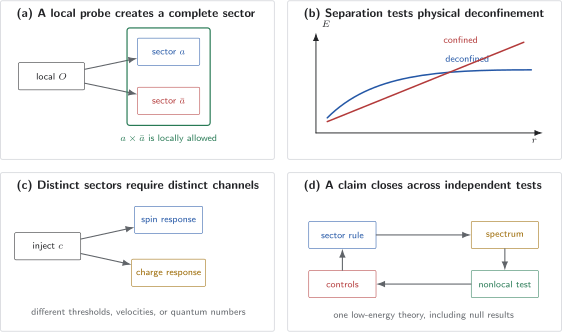
Fractionalization is a chain of statements: a local operator creates a complete sector, the proposed constituents remain deconfined, different quantum-number channels separate, and one low-energy theory survives independent controls. No single panel is sufficient by itself.
Electron Fractionalization and Partons
Section titled “Electron Fractionalization and Partons”A representation with a redundancy
Section titled “A representation with a redundancy”A schematic parton decomposition writes an electron operator as
where carries spin and carries the complementary electric quantum number. The product is unchanged by the local redefinition
This is an internal gauge redundancy, not a new microscopic global symmetry. A constraint projects the enlarged parton Hilbert space back onto physical states. Its exact form depends on whether represents a holon, a doublon, a rotor, or another charge variable.
Mean-field theory can assign bands or pairing amplitudes to and , but those bands are not automatically observable. A physical fractionalized phase additionally requires:
- a stable deconfined gauge regime after fluctuations and projection;
- gauge-invariant operators whose spectra encode the proposed sectors;
- consistency with microscopic symmetries and filling constraints;
- robustness under all perturbations that leave the phase intact.
Spinons, holons, chargons, and visons
Section titled “Spinons, holons, chargons, and visons”Names are convention-dependent, so quantum numbers must be stated rather than inferred from a label.
| Excitation | Typical defining property | What the name does not guarantee |
|---|---|---|
| spinon | carries spin, often spin , with reduced or zero electric charge | fermionic statistics, a particular gauge group, or a stable material phase |
| holon | a spinless charge excitation associated with an empty site or charge defect | charge in every convention |
| chargon | spinless excitation carrying the electric part of an electron | bosonic statistics or condensation |
| vison | flux excitation of a deconfined gauge field | nonzero spin or electric charge |
| emergent Majorana mode | self-adjoint matter degree of freedom in an effective description | a free relativistic Majorana particle or an isolated zero mode |
In a two-dimensional phase, the minimal sectors are often denoted . The sector is a gauge charge, is a vison, and . Which sector is called a spinon depends on its symmetry quantum numbers. Taking an excitation around an excitation produces a mutual phase ; the full anyon data belong on Anyons and Braiding.
What happens to the electron spectrum
Section titled “What happens to the electron spectrum”If an electron creates a charge sector and a spin sector, its Green function need not contain an electron quasiparticle pole. At a factorized level its spectral weight has the convolution structure
with gauge vertices and interactions correcting the simple product. The convolution naturally produces thresholds and continua because the total energy and momentum can be shared in many ways. If one constituent condenses or confinement binds the sectors, a coherent electron pole can reappear.
This operator dependence is crucial. The physical-electron spectrum may be broad or gapped while neutral heat carriers, spin response, or a charged emergent fermion remain sharp in their own channels. Spectral Functions provides the normalization and sum-rule framework needed to compare those channels.
Spin–Charge Separation in One Dimension
Section titled “Spin–Charge Separation in One Dimension”Controlled low-energy factorization
Section titled “Controlled low-energy factorization”One-dimensional interacting fermions provide the cleanest generic benchmark. Away from perturbations that gap a sector, the spinful Luttinger Hamiltonian separates into charge and spin parts,
Here and are generally different. With one common field convention,
Injecting an electron excites both sectors. After time , wave-packet centers separate by approximately
The electron spectral function therefore has distinct spin and charge thresholds rather than a single Landau pole. Angle-resolved photoemission, momentum-resolved tunneling, neutron scattering, and time-resolved cold-atom experiments can test those thresholds or velocities.
The commensurate qualification
Section titled “The commensurate qualification”At half filling, repulsive umklapp scattering opens a charge gap in the one-dimensional Hubbard model while its spin sector remains gapless. Away from commensurability, both sectors can be gapless. Attractive interactions reverse the usual spin-gap pattern. Thus “spin–charge separation” does not mean that both modes are always gapless, nor that every microscopic electron produces two infinitely sharp particles at all energies.
One-dimensional fractionalization also need not imply intrinsic topological order. It can arise from the kinematics and critical fixed point of one dimension. Interchain hopping, confinement-generating perturbations, a Peierls instability, disorder, or finite experimental resolution can eventually restore bound excitations or obscure the separation. Exact model details and the full bosonization dictionary remain at Hubbard Chain and Luttinger Liquid Preview.
Fractional Charge and Anyonic Sectors
Section titled “Fractional Charge and Anyonic Sectors”Laughlin flux insertion
Section titled “Laughlin flux insertion”For a Laughlin state at filling with odd , adiabatically inserting one electromagnetic flux quantum through a puncture pumps charge
This links a quantized bulk response to fractional quasiparticle charge without picturing an electron as a rigid object cut into pieces. The quasihole is a collective rearrangement of the correlated Hall fluid. Its exchange angle is also fractional, but charge and statistics are independent observables and must be tested separately. Fractional Quantum Hall Effect owns the wavefunctions, hierarchy, edges, and plateau phenomenology.
In the dilute weak-backscattering limit, low-frequency partition noise approaches
where is the backscattered current and is the charge transferred by an elementary stochastic event. Finite temperature, quasiparticle bunching, edge reconstruction, neutral modes, and crossover between weak and strong backscattering can make the fitted effective charge differ from the smallest bulk quasiparticle charge. A noise measurement is therefore model-assisted, even when its fractional result is compelling.
Symmetry quantum numbers can fractionalize
Section titled “Symmetry quantum numbers can fractionalize”Topologically equivalent phases can differ in how their anyons transform under global symmetry. For an anyon sector , localized symmetry actions can obey a projective composition law
where phase redefinitions of change but not its equivalence class. Fusion constrains the classes: when contains , the combined symmetry action must match that of , including any twists from antiunitary operations or symmetry permutations.
Examples include a spinon with half-odd-integer spin, a Kramers anyon, or an anyon on which translations satisfy
The case means that the anyon experiences an effective background flux per unit cell. It can produce an enhanced periodicity of multi-anyon spectral weight. Such a periodicity is more specific than generic continuum broadening, although crystal domains, multiple bands, and ordinary zone folding still require exclusion. Not every algebraically imaginable assignment is realizable in a strictly two-dimensional system; anomaly tests are part of a full classification.
Gapless, Metallic, and Critical Fractionalization
Section titled “Gapless, Metallic, and Critical Fractionalization”Fractionalization is not restricted to fully gapped topological phases, but the diagnostics become less absolute when continua extend to zero energy.
| Setting | Proposed infrared sectors | Sharp structural statement | Main caveat |
|---|---|---|---|
| gapless spin liquid | Dirac spinons, a spinon Fermi surface, or emergent photons | gauge-charged matter survives at low energy | power laws and continua are not unique |
| fractionalized Fermi liquid | small charged Fermi surface plus a fractionalized local-moment sector | modified Fermi-volume accounting includes a topological sector | broken symmetry can also reconstruct a Fermi surface |
| orthogonal metal | a charged fermion carries current while the electron operator is gapped | metallic transport coexists with a gapped electron spectrum | material realization is not established generically |
| deconfined critical point | spinons and a gauge field emerge at a critical point | conventional order parameters are composites of critical fields | the fractionalization may exist only at criticality |
In a simple parton metal, integrating out an internal gauge field can lead to the Ioffe–Larkin composition rule
It expresses a current constraint between sectors, not two independent electrical wires in parallel. The formula depends on the gauge-charge assignment, response convention, and approximation; Chern–Simons couplings, additional electron channels, drag, or strong vertex corrections change it. It should be derived for the stated effective action rather than used as a universal signature.
Kondo Lattices owns the FL* Fermi-volume argument. Non-Fermi Liquids owns orthogonal metals and gauge-coupled critical Fermi surfaces. Quantum Criticality distinguishes stable phases from fractionalization confined to a tuning trajectory.
Experimental and Numerical Evidence
Section titled “Experimental and Numerical Evidence”A hierarchy of claims
Section titled “A hierarchy of claims”- Identify the microscopic phase space. Establish dimension, filling, symmetries, interaction scales, disorder, and competing order.
- Resolve reassigned quantum numbers. Measure separate spin and charge velocities, a fractional transferred charge, a spin- continuum threshold, or another sector-specific prediction.
- Exclude conventional continua. Test multiparticle magnons, phonons, domains, impurities, inhomogeneous gaps, and matrix-element effects with the same resolution model.
- Seek nonlocal or projective information. Braiding phase, flux memory, topological-sector switching, symmetry-enforced spectral periodicity, or entanglement structure is more selective than breadth alone.
- Close under perturbations. Field, pressure, temperature, sample quality, geometry, and boundary conditions should evolve according to one low-energy theory.
Probe ledger
Section titled “Probe ledger”| Probe | Fractionalization-sensitive readout | What it cannot establish alone |
|---|---|---|
| photoemission or tunneling | distinct spinon and holon thresholds; no electron pole | whether broadening is intrinsic rather than phononic, disordered, or matrix-element driven |
| neutron or Raman scattering | continuum boundaries and symmetry-enriched momentum periodicity | that every broad magnetic continuum consists of spinons |
| charge shot noise | transferred charge in a declared transport limit | exchange statistics or the complete bulk topological order |
| interferometry | phase evolution consistent with enclosed anyons and controlled Coulomb effects | a topological phase unless dynamical and electromagnetic phases are separated |
| heat versus charge transport | mobile neutral entropy carriers in an electrical insulator | spinons without a quantitative phonon and boundary analysis |
| Fermi-volume measurement | count incompatible with an ordinary symmetric Fermi liquid | fractionalization if translation symmetry breaking or missing pockets remain possible |
| finite-size numerics | sector counting, string operators, entanglement, and projective symmetry action | a thermodynamic phase without scaling and competing-state checks |
For a gapped two-dimensional state, the entanglement scaling form
can yield , where is the total quantum dimension. Finite cylinders, corners, symmetry breaking, and incomplete convergence can contaminate the constant term. Agreement among entanglement, flux insertion, sector quantum numbers, and excitation spectroscopy is much stronger than one fitted intercept.
Status by platform
Section titled “Status by platform”- One-dimensional chains and quantum simulators: spin–charge or spinon fractionalization has controlled theory and multiple velocity- or continuum-resolved observations. The dimensional crossover remains sample- and energy-dependent.
- Fractional quantum Hall fluids: fractional charge is established, and Abelian anyonic phase measurements are strong. Extracting statistics still requires careful control of Coulomb-dominated interferometers, edge reconstruction, and thermal averaging.
- Quantum spin-liquid materials: many candidates exhibit fractionalization-compatible continua and thermodynamics, but disorder and alternative multiparticle descriptions remain central. The phase assignments are material-specific rather than inherited from the concept.
- Fractionalized metals: FL* and orthogonal-metal theories are internally sharp. Unambiguous material identification requires simultaneous Fermi-volume, electron-spectrum, neutral-response, and symmetry evidence and remains active.
Common Mistakes
Section titled “Common Mistakes”- Treating a factorization as a discovery. Writing enlarges the Hilbert space; it does not establish deconfinement.
- Reading names as fixed quantum numbers. “Holon” and “chargon” conventions vary, and a vison need not carry spin or electric charge.
- Calling any continuum fractionalized. Ordinary two-particle states, decay, disorder, and resolution also make continua.
- Demanding a literal fractional number. Spin–charge separation can fractionalize the electron even when the charge sector carries magnitude .
- Equating fractionalization with topological order. One-dimensional critical liquids and deconfined critical points fractionalize without being fully gapped topological phases.
- Equating all topological phases with fractionalization. A noninteracting topological insulator has protected boundary structure but no intrinsic anyonic bulk sectors.
- Ignoring confinement scales. A useful parton description over an intermediate window may recombine at the longest distances.
- Inferring braid statistics from charge. Fractional charge and fractional exchange phase are separate measurements.
- Using transport composition rules universally. Internal gauge constraints and response tensors must be derived for the chosen effective theory.
Exercises
Section titled “Exercises”1. Local spin probes and spinons
Section titled “1. Local spin probes and spinons”A spin-rotation-invariant magnet has spin- spinons, while every microscopic local spin operator transforms as integer spin. Explain why a local neutron-scattering event cannot create one isolated spinon in a closed bulk. What total-spin channels can a pair of spin- spinons occupy?
Solution
An isolated spinon belongs to a fractionalized superselection sector: its half-odd-integer representation cannot equal the integer representation of a local bulk operator. A local event must create a collection with locally allowed total quantum numbers. Two spin- representations combine as
The spin- channel couples directly to a spin operator; matrix elements and symmetry can also place weight in larger multi-spinon sectors. A boundary or pre-existing spinon can supply the compensating sector, so the statement concerns an initially closed bulk.
2. Arrival-time separation
Section titled “2. Arrival-time separation”A one-dimensional pulse creates charge and spin packets that travel with velocities and . Find their arrival-time difference. What additional observation is needed before calling two broad arrivals spin–charge separation?
Solution
The arrival times are , so
One should verify that the two packets couple respectively to charge- and spin-sensitive observables and that their velocities, interaction dependence, spectral weights, and temperature evolution agree with one microscopic or Luttinger-liquid description. Dispersion, reflections, two ordinary bands, or inhomogeneity can also split a pulse.
3. Flux insertion and fractional charge
Section titled “3. Flux insertion and fractional charge”Use the Hall response to find the charge pumped by one flux quantum in a state. Does the answer alone determine the smallest quasiparticle charge or its statistics?
Solution
The transported charge is
This is the charge pumped by the global flux-insertion process. It does not by itself determine the smallest quasiparticle charge; hierarchical states can contain quasiparticles of charge even though one flux quantum pumps . Nor does charge determine exchange statistics. Those require a theory of the topological sectors and separate noise or interference measurements.
4. Projective translations
Section titled “4. Projective translations”An anyon satisfies . Show that translations by two cells commute with the other primitive translation. Give one possible spectroscopic consequence.
Solution
Using twice,
Thus the projective minus sign disappears for translation by two cells. A two-spinon density of states can consequently repeat under a momentum shift smaller than an ordinary reciprocal-lattice vector, producing enhanced spectral periodicity. Observing folded-looking weight is not sufficient unless ordinary unit-cell enlargement, domains, and multi-band effects are excluded.
5. A response-composition check
Section titled “5. A response-composition check”In a scalar Ioffe–Larkin regime, the charge and spin sectors have conductivities and . Find the physical conductivity. Why is adding the two conductivities incorrect here?
Solution
The internal gauge constraint gives resistivities in series:
in units of . Therefore
The sectors are not independent electrical channels. Their currents are tied by the internal gauge field. Parallel addition would ignore that constraint. The calculation applies only after the stated effective theory has been shown to yield this composition rule.
6. Audit a material claim
Section titled “6. Audit a material claim”An electrical insulator has no magnetic Bragg peaks, a broad neutron continuum, and a linear term in . List four distinct alternatives to fractionalization and four measurements that would sharpen the claim.
Solution
Alternatives include a random-singlet regime, a spin glass below the measurement floor, two-magnon or paramagnon decay, and phonon or crystal-field backgrounds. A weakly ordered small-moment phase or impurity band supplies further possibilities.
Sharper tests include: local probes and frequency-dependent susceptibility to exclude freezing; momentum-, polarization-, temperature-, and field-resolved scattering to test predicted continuum boundaries; sample and disorder control with quantitative structural refinement; and low-temperature thermal transport with a phonon boundary model. A phase-specific test such as symmetry-enhanced spectral periodicity, flux-sector response, or numerically matched entanglement and excitation data would strengthen the case further. The three observations in the prompt define a candidate, not a closed fractionalization diagnosis.
Research Status and Open Problems
Section titled “Research Status and Open Problems”The existence of fractionalized excitations is settled in controlled one-dimensional models, fractional quantum Hall phases, and exactly solvable topologically ordered Hamiltonians. Fractional charge measurements and several one-dimensional spinon or spin–charge observations provide direct experimental anchors. Symmetry fractionalization and anomaly constraints form a mature theoretical classification for many gapped two-dimensional phases.
The frontier lies in unique inference and in gapless matter:
- Which material probes can distinguish a spinon continuum from disorder and ordinary multiparticle decay without relying on one fitted line shape?
- Can symmetry-fractionalization quantum numbers be extracted reproducibly from scattering, defects, or boundary responses?
- Which gapless spin liquids and fractionalized metals are stable beyond parton mean field and controlled expansions?
- How do confinement scales appear in finite-temperature, finite-frequency experiments?
- Can Fermi-volume anomalies, neutral heat transport, and electron spectral functions close on one FL* or orthogonal-metal theory?
- How should anyonic phase measurements be separated from Coulomb, edge, and nonequilibrium dynamics in realistic interferometers?
These questions concern realization and diagnosis, not whether fractionalization is mathematically possible.
Connections
Section titled “Connections”- Quantum Spin Liquids applies the diagnostic ladder to frustrated magnets and keeps the material-candidate ledger.
- Emergent Gauge Fields develops the local constraints, compact dynamics, confinement tests, and matter coupling behind deconfined sectors.
- Topological Order develops superselection sectors, ground-state topology, loop operators, and entanglement invariants.
- Anyons and Braiding distinguishes exchange, monodromy, fusion, and interferometric evidence.
- Fractional Quantum Hall Effect supplies the canonical fractional-charge and anyon platform.
- Superselection Sectors Preview gives the operator-algebra meaning of sectors that local observables cannot coherently mix.
- Structure Factors provides scattering conventions, sum rules, and detailed balance for continuum claims.
- Kondo Lattices develops fractionalized Fermi liquids and their Fermi-volume constraint.
- Non-Fermi Liquids treats spectral failure of electron quasiparticles, gauge-coupled Fermi surfaces, and orthogonal metals.
References
Section titled “References”- E. H. Lieb and F. Y. Wu, “Absence of Mott Transition in an Exact Solution of the Short-Range, One-Band Model in One Dimension,” Physical Review Letters 20, 1445–1448 (1968). Exact Hubbard-chain solution underlying the one-dimensional spin and charge sector structure.
- W. P. Su, J. R. Schrieffer, and A. J. Heeger, “Solitons in Polyacetylene,” Physical Review Letters 42, 1698–1701 (1979). Foundational lattice example of solitons with unconventional spin and charge assignments.
- F. D. M. Haldane, “Luttinger Liquid Theory of One-Dimensional Quantum Fluids,” Journal of Physics C 14, 2585–2609 (1981). Universal low-energy framework for one-dimensional interacting fluids.
- R. B. Laughlin, “Anomalous Quantum Hall Effect: An Incompressible Quantum Fluid with Fractionally Charged Excitations,” Physical Review Letters 50, 1395–1398 (1983). Laughlin state and fractional quasiparticle charge.
- D. Arovas, J. R. Schrieffer, and F. Wilczek, “Fractional Statistics and the Quantum Hall Effect,” Physical Review Letters 53, 722–723 (1984). Berry-phase derivation of Laughlin quasiparticle statistics.
- P. W. Anderson, “The Resonating Valence Bond State in LaCuO and Superconductivity,” Science 235, 1196–1198 (1987). Influential RVB proposal connecting strong correlations and spin–charge separation.
- S. A. Kivelson, D. S. Rokhsar, and J. P. Sethna, “Topology of the Resonating Valence-Bond State: Solitons and High- Superconductivity,” Physical Review B 35, 8865–8868 (1987). Early topological formulation of fractionalized RVB excitations.
- L. B. Ioffe and A. I. Larkin, “Gapless Fermions and Gauge Fields in Dielectrics,” Physical Review B 39, 8988–8999 (1989). Gauge constraint and response-composition framework.
- M. Ogata and H. Shiba, “Bethe-Ansatz Wave Function, Momentum Distribution, and Spin Correlation in the One-Dimensional Strongly Correlated Hubbard Model,” Physical Review B 41, 2326–2338 (1990). Strong-coupling factorization of charge coordinates and spin wavefunction.
- X.-G. Wen, “Mean-Field Theory of Spin-Liquid States with Finite Energy Gap and Topological Orders,” Physical Review B 44, 2664–2672 (1991). Gauge structure and topological order in parton spin-liquid states.
- D. A. Tennant, T. G. Perring, R. A. Cowley, and S. E. Nagler, “Unbound Spinons in the Antiferromagnetic Chain KCuF,” Physical Review Letters 70, 4003–4006 (1993). Neutron-scattering evidence for the two-spinon continuum.
- C. Kim et al., “Observation of Spin-Charge Separation in One-Dimensional SrCuO,” Physical Review Letters 77, 4054–4057 (1996). Photoemission evidence for distinct spinon and holon branches.
- R. de-Picciotto et al., “Direct Observation of a Fractional Charge,” Nature 389, 162–164 (1997). Shot-noise measurement at filling .
- L. Saminadayar, D. C. Glattli, Y. Jin, and B. Etienne, “Observation of the Fractionally Charged Laughlin Quasiparticle,” Physical Review Letters 79, 2526–2529 (1997). Independent fractional-charge shot-noise experiment.
- T. Senthil and M. P. A. Fisher, “ Gauge Theory of Electron Fractionalization in Strongly Correlated Systems,” Physical Review B 62, 7850–7881 (2000). Deconfinement, visons, and electron fractionalization in two and higher dimensions.
- R. Coldea, D. A. Tennant, A. M. Tsvelik, and Z. Tylczynski, “Experimental Realization of a 2D Fractional Quantum Spin Liquid,” Physical Review Letters 86, 1335–1338 (2001). Continuum dynamics in the anisotropic triangular antiferromagnet CsCuCl.
- T. Senthil, S. Sachdev, and M. Vojta, “Fractionalized Fermi Liquids,” Physical Review Letters 90, 216403 (2003). FL* phase and modified Fermi-volume accounting.
- T. Senthil, A. Vishwanath, L. Balents, S. Sachdev, and M. P. A. Fisher, “Deconfined Quantum Critical Points,” Science 303, 1490–1494 (2004). Fractional degrees of freedom and emergent gauge fields at a quantum critical point.
- A. Kitaev, “Anyons in an Exactly Solved Model and Beyond,” Annals of Physics 321, 2–111 (2006). Exact honeycomb model with gauge fluxes and fractionalized Majorana matter.
- Y. Jompol et al., “Probing Spin-Charge Separation in a Tomonaga–Luttinger Liquid,” Science 325, 597–601 (2009). Momentum-resolved tunneling evidence in quantum wires.
- T.-H. Han et al., “Fractionalized Excitations in the Spin-Liquid State of a Kagome-Lattice Antiferromagnet,” Nature 492, 406–410 (2012). Momentum-resolved continuum in herbertsmithite, with material-specific interpretation limits.
- R. Nandkishore, M. A. Metlitski, and T. Senthil, “Orthogonal Metals: The Simplest Non-Fermi Liquids,” Physical Review B 86, 045128 (2012). Fractionalized metal with conventional bulk transport and a gapped electron spectrum.
- M. Mourigal et al., “Fractional Spinon Excitations in the Quantum Heisenberg Antiferromagnetic Chain,” Nature Physics 9, 435–441 (2013). Quantitative neutron-scattering resolution of multi-spinon dynamics in KCuF.
- A. M. Essin and M. Hermele, “Classifying Fractionalization: Symmetry Classification of Gapped Spin Liquids in Two Dimensions,” Physical Review B 87, 104406 (2013); erratum 87, 139905. Projective symmetry classes and fusion constraints.
- A. M. Essin and M. Hermele, “Spectroscopic Signatures of Crystal Momentum Fractionalization,” Physical Review B 90, 121102(R) (2014). Enhanced continuum periodicity from projective translations.
- X. Chen, “Symmetry Fractionalization in Two-Dimensional Topological Phases,” Reviews in Physics 2, 3–18 (2017). Classification, fusion consistency, and anomalies.
- M. Carrega, L. Chirolli, S. Heun, and L. Sorba, “Anyons in Quantum Hall Interferometry,” Nature Reviews Physics 3, 698–711 (2021). Interferometer regimes, edge complications, and experimental interpretation.
- M. Nakamura et al., “Direct Observation of Anyonic Braiding Statistics,” Nature Physics 16, 931–936 (2020). Fabry–Pérot evidence for Abelian anyonic phase evolution.
- H. Bartolomei et al., “Fractional Statistics in Anyon Collisions,” Science 368, 173–177 (2020). Collision-noise evidence for fractional statistics at a fractional Hall edge.
- J. Vijayan et al., “Time-Resolved Observation of Spin-Charge Deconfinement in Fermionic Hubbard Chains,” Science 367, 186–189 (2020). Quantum-gas imaging of separated spin and charge dynamics.
Summary
Section titled “Summary”Fractionalization is not a visual metaphor for breaking an electron apart. It is an infrared statement about sectors that a local operator must create in allowed combinations but that can propagate independently. One-dimensional spin–charge separation, Laughlin quasiparticles, spinons and visons in deconfined gauge phases, symmetry-fractionalized anyons, and fractionalized metals realize this idea in different ways. The trustworthy diagnosis combines a local selection rule, deconfinement or asymptotic sector separation, quantum-number-resolved response, and perturbation closure. Parton notation and broad continua are useful starting points; the physical claim begins only after gauge projection, conventional alternatives, and phase-specific tests are under control.