Mott Insulators
A Mott insulator is an interaction-driven, charge-incompressible state at a commensurate filling for which the appropriate independent-particle baseline would permit metallic charge motion. Its defining physics is a many-body obstruction to changing the charge density, not merely large resistivity, a narrow band, suppressed double occupancy, or magnetic order.
This definition is operational rather than taxonomic perfection. Real compounds can combine Coulomb repulsion with ligand hybridization, crystal-field splitting, magnetism, disorder, and structural distortion. “Mott” is most trustworthy when it identifies the dominant origin of charge incompressibility and survives tests against those alternatives. It should not be used as a decorative synonym for “strongly correlated.”
This page is the canonical home for Mott insulators as material phases: their charge gap, local moments, bandwidth- and filling-controlled routes, experimental evidence, and relation to doped correlated matter. Hubbard Model owns the model Hamiltonian, exact limits, symmetries, and strong-coupling derivations. Metals, Insulators, Semiconductors, and Semimetals owns the broader classification of conducting and insulating mechanisms. What Are Strong Correlations? owns the general materials diagnostic hierarchy.
Charge Incompressibility
Section titled “Charge Incompressibility”Let be the ground-state energy in the sector with particles. The zero-temperature costs to add and remove one particle are
Their difference is the finite-system charge gap,
For a stable homogeneous phase, convexity gives . A nonzero thermodynamic limit of means that the chemical potential can vary across an interval without changing the ground-state particle number. If , a convenient lattice compressibility is
At zero temperature, an ideal clean Mott phase has a density plateau and at its commensurate filling. In a grand-canonical calculation,
so incompressibility is also the suppression of long-wavelength number fluctuations. At nonzero temperature, thermally activated carriers round the plateau; “zero compressibility” must then be understood as a zero-temperature statement or as an exponentially small response in a specified temperature window.
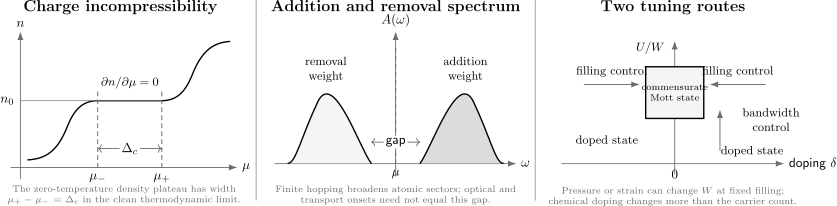
Three ledgers for Mott physics. A charge gap produces a plateau in ; electron removal and addition occupy separated spectral sectors; and the insulating state can be approached by changing near fixed commensurate filling or by changing the filling. Real tuning parameters generally alter more than one coordinate.
One phrase, several gaps
Section titled “One phrase, several gaps”The phrase “Mott gap” is often used too loosely. These quantities answer different experimental questions:
| Quantity | Definition or operational meaning | Typical access | Why it can differ |
|---|---|---|---|
| Many-body charge gap | Difference between addition and removal chemical potentials | density plateau, compressibility, total-energy differences | This is the thermodynamic incompressibility criterion |
| One-particle gap | Separation between electron-removal and electron-addition spectral edges | photoemission plus inverse photoemission, tunneling with suitable surfaces | Matrix elements, surface states, lifetime broadening, and in-gap defects alter apparent edges |
| Optical gap | Lowest dipole-allowed absorption onset | optical conductivity, ellipsometry | Excitons, selection rules, phonons, and indirect transitions shift the onset |
| Transport activation scale | Slope inferred from a specified transport law | dc resistivity, Hall response, thermopower | Defects, hopping, mobility edges, contacts, and multiple carrier channels often dominate |
| Neutral or spin gap | Lowest excitation at fixed total charge | neutron scattering, Raman, NMR, heat capacity | Charge can be gapped while spin excitations are gapless or much softer |
No theorem requires these measured scales to coincide. A transport activation energy much smaller than a photoemission gap is therefore not paradoxical; it may reveal defect-assisted conduction rather than a collapsed bulk charge gap. Conversely, an optical onset below the unbound particle–hole continuum may be an exciton and does not by itself establish compressibility.
From Atomic Repulsion to Hubbard Bands
Section titled “From Atomic Repulsion to Hubbard Bands”The repulsive Hubbard model supplies the cleanest minimal mechanism. At one particle per site in the atomic limit, removing a particle creates an empty site and adding one creates a doubly occupied site. Their combined charge cost is . Finite hopping gives those atomic transitions dispersion and transfers their weight into broad removal and addition structures conventionally called lower and upper Hubbard bands.
That language is useful but schematic:
- the centers of broad spectral features are not automatically the thermodynamic gap edges;
- a Mott spectrum need not display two clean, symmetric peaks;
- the gap is generally not exactly once hopping, nonlocal interactions, hybridization, and multiplets matter;
- a coherent quasiparticle feature can appear on the metallic side between incoherent high-energy structures;
- orbital-selective systems may localize one orbital sector while others remain itinerant.
The ratio , with an explicitly defined bandwidth, organizes the competition between localization and delocalization. It is not a universal phase boundary. The critical ratio depends on lattice density of states, dimensionality, frustration, filling, orbital degeneracy, Hund coupling, temperature, magnetic constraints, and the approximation used. A quoted “” without an orbital window and a prescription for extracting and is not reproducible evidence.
Local Moments and Spin–Charge Separation
Section titled “Local Moments and Spin–Charge Separation”Suppressing double occupancy tends to leave spin or orbital degrees of freedom active on each site. Virtual charge fluctuations then generate exchange at an energy scale much smaller than the charge cost. In the simplest large- one-band setting,
while the charge scale remains of order after bandwidth corrections. A Mott material can consequently satisfy
with charge frozen over a broad temperature range but spins still fluctuating, ordering, or forming a more entangled state at much lower energies.
This scale separation is central and prevents three common identifications:
- a Mott insulator need not have a spin gap;
- local moments do not imply long-range magnetic order;
- antiferromagnetic order is not the definition of Mott localization.
Exchange Interactions owns the material mechanisms behind , while Effective Hamiltonians in Many-Body Systems owns the controlled projection from charge sectors to spin or t–J descriptions.
Bandwidth and Filling Control
Section titled “Bandwidth and Filling Control”Two idealized routes out of a Mott insulator should be kept distinct.
Bandwidth control
Section titled “Bandwidth control”At fixed commensurate filling, pressure, strain, bond angles, or chemical substitution can increase orbital overlap and hence , decreasing an effective . This route can connect an incompressible state to a correlated metal without intentionally changing the carrier count. In practice, pressure also changes crystal fields, hybridization, phonons, and sometimes structure; “bandwidth control” is a model coordinate, not a guarantee that only moved.
Within single-site dynamical mean-field theory for a frustrated half-filled single-band Hubbard model, a low-temperature coexistence region between metallic and insulating self-consistent solutions terminates at a finite-temperature critical endpoint. A Landau description of that endpoint is standard within this framework. It is not a universal phase diagram for every solid: magnetic order, lattice distortion, charge order, nonlocal correlations, or disorder can preempt or reshape the paramagnetic transition.
Experiments on pressure-tuned and -type BEDT–TTF organic salts have revealed hysteresis, crossovers, and critical behavior consistent with important parts of this picture. They also reveal spatial inhomogeneity, elastic coupling, and material-specific exponents. Agreement with one model feature should be stated as such rather than promoted to proof of a universal Mott endpoint.
Filling control
Section titled “Filling control”Changing the density away from the commensurate value removes the density plateau. For hole doping of a one-band half-filled state, write
The doped system is generally compressible, but it is not a rigidly shifted version of the noninteracting band. Mobile carriers propagate through a constrained spin and orbital background, and spectral weight can move between energy windows separated by the original interaction scale. Chemical substitution additionally introduces disorder, local strain, and electrostatic changes, whereas electrostatic gating or cold-atom preparation can more nearly isolate filling.
Bandwidth- and filling-controlled transitions can therefore end in different metals and need not share a critical theory.
Beyond the One-Band Mott–Hubbard Picture
Section titled “Beyond the One-Band Mott–Hubbard Picture”Charge-transfer insulators
Section titled “Charge-transfer insulators”Many transition-metal compounds contain ligand states near the correlated metal states. Let denote a ligand-to-metal charge-transfer energy and the interaction cost within the shell. In the Zaanen–Sawatzky–Allen organization:
- a Mott–Hubbard insulator has low-energy removal and addition edges dominated primarily by different -electron configurations, with setting the basic charge cost;
- a charge-transfer insulator has the lowest removal states predominantly on ligands, so rather than controls the smallest gap.
Hybridization means that actual eigenstates are mixtures, not ionic labels. In late transition-metal oxides, ligand holes and even negative effective charge-transfer energies can make formal oxidation-state counting especially misleading. The correct classification follows the orbital character and energetics of the many-body addition and removal states.
The parent copper oxides are more accurately described as strongly hybridized charge-transfer insulators than as literal realizations of a one-band atomic Mott gap. A low-energy one-band or t–J description can still be useful after a justified downfolding; it should not erase the oxygen degrees of freedom from statements about spectroscopy or charge transfer.
Multiorbital and structural entanglement
Section titled “Multiorbital and structural entanglement”Crystal-field splittings, Hund coupling, spin–orbit coupling, intersite repulsion, and electron–lattice coupling can cooperate with localization. Rare-earth nickelates and , for example, exhibit strong electronic effects but also decisive lattice, bonding, or charge-disproportionation physics. Calling either a “pure Mott transition” without qualifying the structural evidence overstates what the label resolves.
Filling constraints
Section titled “Filling constraints”For a clean periodic system with conserved charge, a unique, symmetry-preserving, short-range-entangled gapped ground state is generally compatible only with an integer filling per primitive unit cell. At fractional filling, a fully gapped phase must evade that conclusion through translation-symmetry breaking, topological order, or another assumption failure. This Lieb–Schultz–Mattis–Oshikawa logic does not prove that an integer-filled insulator is Mott; it constrains which insulating outcomes are possible before a material mechanism is assigned.
Experimental Diagnosis
Section titled “Experimental Diagnosis”A credible Mott assignment closes several independent ledgers.
Establish the noninteracting baseline
Section titled “Establish the noninteracting baseline”Determine the primitive and any ordered unit cells, electron count, orbital character, spin–orbit scale, and plausible band structure. A half-filled band in an oversimplified cell is not evidence if a structural dimerization or antiferromagnetic unit-cell enlargement already permits a conventional gap. Compare nonmagnetic, magnetic, and distorted baselines when the relevant orders are close in energy.
Measure charge incompressibility
Section titled “Measure charge incompressibility”Direct bulk electronic compressibility is difficult in solids because long-range Coulomb forces, lattice elasticity, and contacts complicate density response. Useful proxies include chemical-potential shifts, capacitance, quantum oscillation disappearance, thermodynamic charge susceptibility in controlled simulators, and consistent total-energy calculations. Ultracold fermions in optical lattices provide a particularly transparent demonstration: in situ density plateaus and reduced local compressibility can be measured without relying on electrical transport.
Reconstruct addition and removal sectors
Section titled “Reconstruct addition and removal sectors”Angle-resolved photoemission spectroscopy measures occupied removal spectra; inverse photoemission and suitable x-ray probes access addition character; scanning tunneling microscopy and spectroscopy sample a surface-weighted local spectrum. A bulk gap claim should account for surface reconstruction, charging, matrix elements, energy resolution, and whether the same chemical potential aligns the two sectors. Spectral Functions supplies the common Lehmann and sum-rule language.
Use optical sum rules, not only an onset
Section titled “Use optical sum rules, not only an onset”Optical conductivity can follow weight over a much wider energy window than dc transport. Across pressure, temperature, or doping, transfer between a Drude response, mid-infrared structures, and high-energy interband or Hubbard features is stronger evidence than fitting one activation slope. The integration cutoff and subtraction of phonons and interband backgrounds must be reported because partial spectral weights are cutoff dependent. Sum Rules owns the exact moment constraints and Kubo Formula owns the response-function framework.
Separate charge, spin, and structure
Section titled “Separate charge, spin, and structure”Magnetic susceptibility, NMR, neutron scattering, and resonant x-ray probes can establish local moments and their correlations. Diffraction, Raman, and elastic measurements test whether a structural or charge-ordering transition accompanies the gap. A Mott interpretation is strongest when the charge gap or local-moment regime persists where long-range order has melted and when tuning evolves charge, spin, and structure consistently.
Require a parameter-consistent model
Section titled “Require a parameter-consistent model”A realistic calculation should use the same structure, filling, orbital window, and interaction convention across spectra and thermodynamics. Density-functional theory plus dynamical mean-field theory can connect material bands to local dynamics; cluster extensions and other many-body methods test nonlocal correlations. Matching one gap after fitting is a low rung. Reproducing spectral-weight transfer, moments, compressibility, and their tuning with uncertainty is much stronger.
Mott, Slater, Band, and Anderson Limits
Section titled “Mott, Slater, Band, and Anderson Limits”The labels identify mechanisms, not mutually exclusive appearances.
| Limit | Primary obstruction to dc charge motion | Symmetry relation | Strong diagnostic |
|---|---|---|---|
| Band insulator | filled one-particle bands | no broken symmetry required | independent-particle gap survives controlled interaction reduction |
| Slater-like insulator | band reconstruction from magnetic order | gap tied closely to ordering symmetry | gap and folding track the order parameter |
| Mott-like insulator | interaction-driven charge incompressibility | magnetic order is optional | charge gap and local constraints survive beyond the ordered regime |
| Charge-transfer insulator | correlated metal–ligand charge-transfer cost | order is optional | ligand and metal character of addition/removal edges |
| Anderson insulator | localization of available one-particle states by disorder | translation symmetry absent | finite local density of states with vanishing diffusion and localized wavefunctions |
Mott and Slater behavior can form a continuum when the same interactions create both moments and order. A gap that grows below the Néel temperature need not be purely Slater, and a large does not make every ordered insulator purely Mott. The useful question is which observables require local interaction physics above and beyond symmetry-induced band folding.
Representative Platforms
Section titled “Representative Platforms”Vanadium sesquioxide
Section titled “Vanadium sesquioxide”and chromium-doped variants are classic bandwidth-controlled systems. Pressure and composition access paramagnetic metal, paramagnetic insulator, and antiferromagnetic insulating regimes. Transport criticality and spectroscopy support a correlation-driven transition, while phase coexistence, orbital changes, and structural coupling warn against reducing the material to one scalar .
Organic salts
Section titled “Organic salts”In -(BEDT–TTF) salts, molecular dimers form narrow effective bands, and modest pressure can cross a first-order metal–insulator boundary near superconducting and magnetic phases. These systems make bandwidth tuning unusually accessible. Their anisotropic triangular geometry, intradimer charge structure, elastic coupling, and sample dependence remain part of the physics rather than small corrections.
Transition-metal chalcogenides
Section titled “Transition-metal chalcogenides”offers a route in which chemical substitution and pressure tune a correlated pyrite system. It is useful for comparing bandwidth, disorder, and magnetic effects, but chemical and hydrostatic pressure are not interchangeable controls.
Copper oxides
Section titled “Copper oxides”Undoped cuprates contain local copper moments and a robust insulating gap despite an odd electron count in the simplest band baseline. Their lowest charge excitations have strong oxygen character, placing them in the charge-transfer sector. Doping produces antiferromagnetism, pseudogap behavior, strange metallic transport, charge order, and high-temperature superconductivity across material-dependent phase diagrams. Proximity to a correlated parent state is established; a unique microscopic pairing mechanism is not.
Quantum simulators
Section titled “Quantum simulators”Fermionic atoms in optical lattices can realize controlled Hubbard parameters and reveal incompressible density plateaus, suppressed double occupancy, and spin correlations. Traps, entropy redistribution, finite temperature, and the mapping from local-density shells to homogeneous thermodynamics must still be audited. These experiments are clean model tests, not replicas of all orbital and lattice complexities in solids.
Doping a Mott Insulator
Section titled “Doping a Mott Insulator”In a rigid-band semiconductor, doping primarily changes which pre-existing one-particle states are occupied. In a doped Mott system, changing the occupancy also changes the number and character of allowed local transitions. Even the atomic counting is non-rigid: removing a fraction of particles creates empty sites that accept either spin at low energy, while addition to singly occupied sites still accesses a high-energy doubly occupied sector. Finite hopping mixes these sectors and produces dynamical spectral-weight transfer.
At strong coupling, the projected t–J Model captures mobile holes constrained against double occupancy and coupled to exchange. It is a controlled descendant of the Hubbard model only within a specified hierarchy such as and with generated longer-range terms tracked. It is not a universal phenomenology for every doped oxide.
Doping may lead to a correlated Fermi liquid, pseudogap, strange metal, charge or spin order, phase separation frustrated by long-range Coulomb interactions, superconductivity, or coexistence among these tendencies. Which outcome occurs depends on dimension, frustration, longer-range hopping and interactions, phonons, disorder, and orbital composition. “Doped Mott insulator” defines a starting constraint, not a solved phase diagram.
The connection to high-temperature superconductivity is therefore precise but limited. Cuprate superconductivity emerges after doping a charge-transfer-correlated parent, and the redistribution of spectral weight and persistence of short-range spin correlations show that parent-state physics remains relevant. Those facts do not by themselves select a pairing glue, establish a particular gauge theory, or prove that all unconventional superconductors share the same mechanism.
Method and Claim Ladder
Section titled “Method and Claim Ladder”Use the weakest claim justified by the evidence:
- Correlated insulator: independent-particle calculations fail and interaction-sensitive observables are large.
- Charge-incompressible state: a thermodynamic charge gap or controlled density plateau is established.
- Mott-dominant mechanism: the commensurate independent-particle baseline is metallic, while interaction-driven spectra and tuning explain the gap better than structural, Slater, or disorder alternatives.
- Material Hamiltonian: a specified orbital model reproduces several observables with one parameter set.
- Transition universality: scaling, coexistence, and critical exponents survive finite-window, elasticity, disorder, and alternative-theory tests.
- Doped emergent phase: broken symmetry, topology, fractionalization, or a pairing mechanism has its own direct evidence beyond proximity to the Mott state.
Computational method should match the claim. Atomic limits and strong-coupling expansions expose local sectors; dynamical mean-field theory treats local temporal fluctuations and a paramagnetic Mott transition; cluster, tensor-network, quantum Monte Carlo, exact-diagonalization, and diagrammatic methods test spatial correlations in their controlled domains. Analytic continuation and finite-size extrapolation add separate uncertainties. No method name substitutes for convergence and cross-method checks.
Common Mistakes
Section titled “Common Mistakes”- Calling every magnetic insulator Mott. A symmetry-broken band reconstruction can open a Slater-like gap.
- Using large resistivity as the definition. Disorder, dilute carriers, contacts, or a small mobility can produce insulating transport without a Mott gap.
- Equating the gap with . Bandwidth, hybridization, ligand states, multiplets, and nonlocal interactions shift both edges.
- Treating as universal. Both quantities depend on the chosen low-energy basis, and the critical ratio is model dependent.
- Reading one broad peak as a Hubbard band. Matrix elements, overlapping orbitals, phonons, disorder, and lifetime effects need alternatives.
- Identifying local moments with order. A local moment can persist far above an ordering temperature or remain disordered at zero temperature.
- Treating chemical doping as pure filling control. Substitution commonly changes structure, electrostatics, disorder, and bandwidth.
- Calling cuprate parents simple one-band Mott insulators. Their charge-transfer and oxygen character matter for material spectroscopy.
- Assuming a DMFT coexistence diagram is universal. The result is standard for a specified paramagnetic model, while real orders and elasticity can intervene.
- Inferring a pairing mechanism from Mott proximity. The parent constraint narrows the problem but does not uniquely solve it.
Exercises
Section titled “Exercises”1. Addition and removal chemical potentials
Section titled “1. Addition and removal chemical potentials”A finite system has ground-state energies, in electronvolts,
Compute , , and . Show that adding a term to every sector energy leaves unchanged.
Solution
The removal-side and addition-side chemical potentials are
and
Therefore
Under , the second difference becomes
The arbitrary zero of energy and a uniform shift of chemical-potential convention cancel, as a physical charge gap must.
2. Density plateau and compressibility
Section titled “2. Density plateau and compressibility”At zero temperature a homogeneous lattice system has
with . Find in each region and identify the charge gap. Why does a smooth but shallow finite-temperature curve not prove that the zero-temperature gap vanished?
Solution
Differentiation gives
The plateau width is
At nonzero temperature, particle and hole excitations occur with Boltzmann-suppressed probabilities. They round the sharp edges and give a small nonzero compressibility even when the zero-temperature spectrum remains gapped. One must extrapolate a controlled temperature dependence or compare with a finite-temperature equation of state; smoothness at one temperature is not a gap-closing criterion.
3. Atomic addition and removal sectors
Section titled “3. Atomic addition and removal sectors”For one Hubbard site,
take , so the singly occupied states are ground states. Find the removal and addition costs. What happens at the particle–hole-symmetric choice ?
Solution
The empty, singly occupied, and doubly occupied grand energies are
Removing the particle from a singly occupied ground state costs
whereas adding the opposite spin costs
Their sum, equivalently the separation between atomic removal and addition transitions, is . At , the two edges are symmetric:
Thus is the full atomic charge gap, while each edge lies from the symmetric chemical potential. Confusing those quantities creates a factor-of-two error.
4. Three experimental gaps
Section titled “4. Three experimental gaps”A compound has a separation between bulk-sensitive addition and removal edges, an optical onset at , and dc resistivity fitted over a narrow range by . Give one physically consistent interpretation. Which number should be called the thermodynamic charge gap?
Solution
The spectral separation may approximate the one-particle fundamental gap. An optically allowed bound exciton can lie below the unbound electron–hole continuum, giving a onset. Defects or impurity bands can support activated or hopping transport at a much smaller scale, producing the fit.
None of these numbers is automatically the thermodynamic charge gap. That gap is the difference of addition and removal chemical potentials in the bulk thermodynamic limit. Bulk addition/removal edges may estimate it if chemical-potential alignment, surface effects, and excitonic binding are controlled, but a density or total-energy determination is conceptually direct. The transport slope alone is the least reliable identification.
5. Mott or Slater evidence audit
Section titled “5. Mott or Slater evidence audit”Material A becomes antiferromagnetic at . Above , spectroscopy shows a broad charge gap and local moments; below , band folding appears and the gap increases by 15%. Material B is metallic above ; below , a gap opens continuously with the staggered moment and disappears when the order is suppressed. Classify the dominant limits and state what remains uncertain.
Solution
Material A is Mott-dominant in this comparison: charge localization and local moments already exist without long-range order, while antiferromagnetism reconstructs and enlarges an existing gap. The ordered phase can still contain a Slater contribution.
Material B is Slater-like because the insulating gap tracks the ordering symmetry and vanishes with it. This does not imply weak interactions; interactions may generate the magnetism and renormalize the bands.
For both materials, one should still test structure, disorder, orbital character, and thermodynamic charge response. The evidence assigns a dominant limit, not an exact decomposition of the gap into additive “Mott” and “Slater” pieces.
6. Atomic spectral-weight transfer under hole doping
Section titled “6. Atomic spectral-weight transfer under hole doping”In the large- atomic counting limit, suppose a fraction of sites is empty and is singly occupied, with no double occupancy. Count the spin-summed electron-removal weight, low-energy electron-addition weight, and high-energy addition weight per site. Verify the total addition sum rule.
Solution
Each singly occupied site contains one removable electron, so the removal weight is
Each empty site accepts either spin without paying , giving low-energy addition weight
Each singly occupied site accepts only the opposite spin into the high-energy doubly occupied sector, so
The total addition weight is therefore
This equals the number of empty spin orbitals per site:
Even before finite hopping introduces dynamical transfer, doping creates low-energy addition weight proportional to , not merely . This is the simplest demonstration that a doped Mott spectrum is not a rigidly shifted band.
Research Status
Section titled “Research Status”Interaction-driven charge localization, Hubbard-band formation, spin–charge scale separation, and bandwidth- and filling-controlled routes are established. The Mott transition in benchmark Hubbard models and its local dynamical mean-field description are mature subjects. Charge-transfer classification and the central role of correlated parent states in cuprates are also standard.
Material-specific boundaries remain active. Real transitions can combine electronic, magnetic, orbital, and elastic degrees of freedom; extracting a unique low-energy Hamiltonian and screened interaction is not exact; and different probes can sample different surfaces, timescales, or energy windows. The phases reached by doping two-dimensional Mott and charge-transfer insulators, including pseudogap, strange-metal, and superconducting regimes, contain major unresolved questions. Those uncertainties should narrow claims, not blur the well-established definition of charge incompressibility.
Connections
Section titled “Connections”- What Are Strong Correlations? — interaction scales, quasiparticle failure, spectral-weight transfer, and general evidence standards.
- Hubbard Model — canonical Hamiltonian, atomic limit, charge-gap preview, and strong-coupling exchange.
- Hubbard Physics in Materials — orbital windows, screened parameters, double counting, and model-to-probe validation.
- Correlated Insulators in Moiré Systems — the moiré-specific distinction among Mott-like localization, generalized Wigner order, flavor reconstruction, and topology.
- t–J Model — material reduction, projected carrier motion, cuprate relevance, and validation limits.
- Metals, Insulators, Semiconductors, and Semimetals — comparison with band, Anderson, topological, and pairing mechanisms.
- Spectral Functions — Lehmann sectors, sum rules, and one-particle spectral edges.
- Density of States — state counting and why a local density of states is not a transport criterion.
- Kubo Formula — exact linear response, contact terms, and orders of limits.
- Sum Rules — exact spectral moments and cutoff-aware integrated weights.
- Exchange Interactions — superexchange and the distinction between local moments and order.
- Effective Hamiltonians in Quantum Matter — downfolding, screened parameters, and model-validity audits.
- Fermi-Liquid Theory Preview — the coherent metallic baseline on the weakly correlated or doped side.
References
Section titled “References”- N. F. Mott, Metal-Insulator Transitions, 2nd ed., Taylor & Francis (1990).
- M. Imada, A. Fujimori, and Y. Tokura, “Metal-insulator transitions,” Reviews of Modern Physics 70, 1039–1263 (1998).
- A. Georges, G. Kotliar, W. Krauth, and M. J. Rozenberg, “Dynamical mean-field theory of strongly correlated fermion systems and the limit of infinite dimensions,” Reviews of Modern Physics 68, 13–125 (1996).
- G. Kotliar, E. Lange, and M. J. Rozenberg, “Landau theory of the finite temperature Mott transition,” Physical Review Letters 84, 5180–5183 (2000).
- M. J. Rozenberg, R. Chitra, and G. Kotliar, “Finite temperature Mott transition in the Hubbard model in infinite dimensions,” Physical Review Letters 83, 3498–3501 (1999).
- J. Zaanen, G. A. Sawatzky, and J. W. Allen, “Band gaps and electronic structure of transition-metal compounds,” Physical Review Letters 55, 418–421 (1985).
- P. Limelette, A. Georges, D. Jérome, et al., “Universality and critical behavior at the Mott transition,” Science 302, 89–92 (2003).
- P. Limelette, P. Wzietek, S. Florens, et al., “Mott transition and transport crossovers in the organic compound -(BEDT–TTF)Cu[N(CN)]Cl,” Physical Review Letters 91, 016401 (2003).
- F. Kagawa, K. Miyagawa, and K. Kanoda, “Unconventional critical behaviour in a quasi-two-dimensional organic conductor,” Nature 436, 534–537 (2005).
- A. Husmann, D. S. Jin, Y. V. Zastavker, et al., “Dynamical signature of the Mott–Hubbard transition in Ni(S,Se),” Science 274, 1874–1876 (1996).
- Y. Tokura, Y. Okimoto, and T. Katsufuji, “Spectral weight transfer of the optical conductivity in doped Mott insulators,” Physical Review Letters 75, 3497–3500 (1995).
- D. N. Basov, R. D. Averitt, D. van der Marel, M. Dressel, and K. Haule, “Electrodynamics of correlated electron materials,” Reviews of Modern Physics 83, 471–541 (2011).
- P. A. Lee, N. Nagaosa, and X.-G. Wen, “Doping a Mott insulator: Physics of high-temperature superconductivity,” Reviews of Modern Physics 78, 17–85 (2006).
- P. Phillips, “Colloquium: Identifying the propagating charge modes in doped Mott insulators,” Reviews of Modern Physics 82, 1719–1742 (2010).
- B. Keimer, S. A. Kivelson, M. R. Norman, S. Uchida, and J. Zaanen, “From quantum matter to high-temperature superconductivity in copper oxides,” Nature 518, 179–186 (2015).
- M. Oshikawa, “Commensurability, excitation gap, and topology in quantum many-particle systems on a periodic lattice,” Physical Review Letters 84, 1535–1538 (2000).
- P. M. Duarte, R. A. Hart, T.-L. Yang, et al., “Compressibility of a fermionic Mott insulator of ultracold atoms,” Physical Review Letters 114, 070403 (2015).
- C. Hofrichter, L. Riegger, F. Scazza, et al., “Direct probing of the Mott crossover in the SU() Fermi–Hubbard model,” Physical Review X 6, 021030 (2016).
- D. P. Arovas, E. Berg, S. A. Kivelson, and S. Raghu, “The Hubbard model,” Annual Review of Condensed Matter Physics 13, 239–274 (2022).
Summary
Section titled “Summary”A Mott insulator is diagnosed by interaction-driven charge incompressibility at a commensurate filling whose proper independent-particle baseline is metallic. Its thermodynamic charge gap, one-particle spectral gap, optical onset, transport activation scale, and neutral gaps are distinct observables. Local moments and magnetic order are frequent consequences but not definitions. Trustworthy material assignments combine structure and filling, addition and removal spectra, optical sum rules, charge response, spin and lattice probes, controlled tuning, and a parameter-consistent model while testing Slater, band, charge-transfer, disorder, and structural alternatives. Doping releases mobile charge into a constrained many-body background and reorganizes spectral weight; it does not merely shift a rigid band.