Pair-Density Waves and Exotic Orders
A pair-density wave (PDW) is superconducting order whose Cooper pairs carry a nonzero center-of-mass crystal momentum. Its pair field contains one or more Fourier components at instead of only the uniform component at . The state can therefore combine superconducting phase coherence with translation-symmetry breaking, generate secondary charge or nematic order, and support defects that bind a fractional superconducting vortex to a density-wave dislocation.
The definition concerns the anomalous pair field, not merely a modulated tunnelling gap or charge density. An ordinary charge-density wave can modulate a uniform superconductor’s local gap, and disorder can modulate both. Conversely, a single plane-wave pair field can have constant magnitude even though its pair momentum is nonzero. Establishing a PDW therefore requires a phase-sensitive or pair-sensitive observable plus symmetry, wavevector, and control-parameter consistency.
The durable questions are:
- Which pair-field component becomes nonzero?
- Is it primary, or induced by uniform superconductivity and another density wave?
- Which gauge-neutral composite orders must accompany it?
- Is the observation local or bulk, equilibrium or field-induced, long-ranged or pinned?
- Which alternative forward models reproduce the same measured modulation?
Canonical Scope
Section titled “Canonical Scope”This page is the canonical home for finite-momentum superconducting order in quantum materials. It owns the PDW order parameter, its relation to Fulde–Ferrell–Larkin–Ovchinnikov states, induced charge-density and charge- composites, half-vortex–dislocation defects, melting routes, and the experimental evidence ledger. It also supplies a compact taxonomy for other proposed exotic orders.
Use Superfluidity and Superconductivity to route generic pairing, coherence, electromagnetic, vortex, and weak-link claims; this page owns only finite-momentum pair order and its coupled composites.
Ginzburg–Landau Theory owns uniform superconducting electrodynamics, vortices, and characteristic lengths. BCS Theory owns the uniform weak-coupling paired state. Charge and Spin Density Waves owns particle–hole density waves, reconstruction, phasons, and scattering probes. Competing Orders owns coupled-order phase topology and coexistence tests. Topological Superconductors owns bulk topology and protected boundary modes; finite pair momentum alone is not a topological invariant.
The Finite-Momentum Pair Field
Section titled “The Finite-Momentum Pair Field”Microscopic definition
Section titled “Microscopic definition”Let be relative momentum and the center-of-mass crystal momentum. Suppressing orbital and form-factor indices, a pair component can be written
where fixes spin and internal pairing symmetry. The corresponding slowly varying real-space pair field is
A uniform superconductor has . A pure PDW has at least one and ; a mixed state can contain both. On a lattice, momenta are defined modulo reciprocal lattice vectors, and a commensurate permits additional Umklapp terms.
The terminology “pair density” is historical. The complex is gauge charged and is not itself an ordinary density. Its phase is observable relative to another condensate through Josephson interference, while gauge-neutral bilinears of PDW components can appear in diffraction, spectroscopy, or local density maps.
Symmetry ledger
Section titled “Symmetry ledger”For an electron phase rotation , a lattice translation by , and singlet time reversal , use
Point-group operations rotate and the internal form factor. Thus a square lattice can support components at and ; unequal weight in the two directions is a superconducting nematic. Unequal weight at and can break inversion and time reversal, but it should not automatically be called an equilibrium current: condensate, quasiparticle, and lattice contributions must be combined.
Plane-wave and standing-wave states
Section titled “Plane-wave and standing-wave states”A one-component Fulde–Ferrell-like field is
Its magnitude is constant. A two-component Larkin–Ovchinnikov-like state with equal amplitudes can be parameterized as
so that
The phase is the common superconducting phase; slides the modulation. The nodes of the cosine are sign changes of the pair field, not automatically lines of zero charge density.
Relation to FFLO physics
Section titled “Relation to FFLO physics”Fulde–Ferrell and Larkin–Ovchinnikov states are weak-coupling finite-momentum superconductors driven by spin imbalance or Zeeman splitting. “PDW” is broader: it includes lattice- and correlation-driven finite- pairing, multi- states, and coexistence with uniform superconductivity even without a large spin polarization.
The relationship is conceptual, not an identification rule. A field-induced modulated state near the Pauli limit should be tested against orbital depairing, dimensionality, impurity scattering, and spin polarization. A zero-field modulation in a correlated lattice should be tested against charge-order-induced gap modulation and structural superlattices.
Minimal Coupled Theory
Section titled “Minimal Coupled Theory”After the preferred wavevectors have been selected microscopically, a minimal envelope free energy is
with
The sign and magnitude of help decide whether one traveling-wave component or both standing-wave components condense. Crystal symmetry generally adds couplings among rotated wavevectors, while commensurability permits phase-locking terms only when their net momentum is a reciprocal lattice vector.
This functional starts after is known. A microscopic calculation or a gradient expansion with a finite-wavevector minimum must explain why pairing is strongest at that . Nesting alone is not sufficient: the interaction, pair susceptibility, form factor, and positive superfluid stiffness must be checked.
Induced and Vestigial Orders
Section titled “Induced and Vestigial Orders”Charge order and charge-4e order
Section titled “Charge order and charge-4e order”Two opposite PDW components generate gauge-neutral and higher-charge composites. Introduce a charge modulation and a uniform charge- field . The lowest couplings are
For positive and , minimization gives
The first field is charge neutral and carries momentum . The second carries charge and zero momentum. They are consequences of the PDW whenever the corresponding susceptibilities are finite, but either composite can also survive after the primary PDW loses long-range coherence.
If uniform superconductivity coexists with the PDW, another invariant is allowed:
Thus a mixed uniform–PDW state can induce charge order at , whereas a pure PDW naturally induces it at . Wavevector arithmetic is one of the most useful consistency tests in experiment.
Nematic and time-reversal-breaking composites
Section titled “Nematic and time-reversal-breaking composites”For square-lattice components, a gauge-neutral nematic variable is
A nonzero breaks fourfold rotation even if translational PDW correlations are short-ranged. Relative phases among three symmetry-related wavevectors on a hexagonal lattice can instead form a chiral bilinear that breaks time reversal. Calling either one “vestigial” requires evidence that it descends from fluctuations of the multicomponent parent rather than from an independent instability with the same symmetry.
| Composite | Momentum | Charge | Broken symmetry or response |
|---|---|---|---|
| charge or bond modulation | |||
| higher-charge superconductivity | |||
| rotational symmetry | |||
| relative-phase bilinear of several components | possible chirality or time reversal |
Defects and Partial Melting
Section titled “Defects and Partial Melting”With , single-valuedness of each component requires
Three elementary defect classes follow:
| Common-phase winding | Sliding-phase winding | Interpretation | |
|---|---|---|---|
| ordinary superconducting vortex | |||
| double density-wave dislocation | |||
| half vortex bound to a single dislocation |
The composite defect is allowed because a sign change from is cancelled by the sign change of the cosine under . In a charged system, its phase winding corresponds ideally to
provided screening and boundary conditions permit an isolated composite defect.
Different defect proliferation sequences produce different descendants. Disorder of can destroy translational PDW order while preserving coherence of , yielding charge- superconductivity. Disorder of can leave the density composite coherent. Proliferation of both destroys both composites, possibly leaving only nematic order. In two dimensions, thermal fluctuations often reduce continuous order to algebraic correlations, so “melting” must specify dimension, correlation function, and defect species.
What Would Count as Evidence?
Section titled “What Would Count as Evidence?”No single generic modulation establishes a PDW. The most reliable inference combines a pair-sensitive observable with the symmetry-required secondary structure and independent controls.
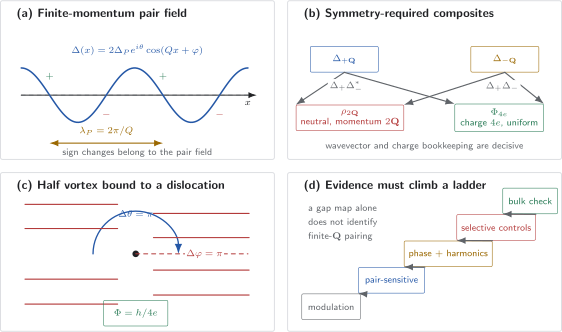
A finite-momentum pair field must be separated from the observables it induces. Opposite components form a sign-changing standing wave, generate charge order at and uniform charge- order, and admit a half vortex bound to a dislocation. A persuasive material claim climbs from modulation to pair sensitivity, phase and wavevector consistency, selective control, and bulk confirmation.
Pair-sensitive probes
Section titled “Pair-sensitive probes”In scanned Josephson tunnelling microscopy, a superconducting tip probes the local critical pair current rather than only the single-particle density of states. Spatial Fourier peaks in the pair channel, their phase relation to charge order, and their disappearance with superconductivity are substantially stronger evidence than a normal-tip gap map alone.
Extended Josephson junctions provide a momentum filter. A spatially uniform junction averages a sign-changing PDW toward zero, while junction roughness, facets, an applied magnetic phase gradient, or a patterned counterelectrode can supply the missing momentum. Orientation and field dependence should follow the same inferred .
Spectroscopy and imaging
Section titled “Spectroscopy and imaging”A PDW reconstructs the Bogoliubov–de Gennes problem by coupling states whose momenta differ by . Consequences can include gap modulations, Andreev states near sign changes, particle–hole-related features at and , or residual Bogoliubov pockets and arcs. These signatures are model dependent. Charge order, pair-breaking disorder, structural supermodulation, quasiparticle interference, and setup effects require explicit forward modelling.
Normal-tip scanning tunnelling spectroscopy measures local single-particle spectral weight. It can support a PDW when the energy, phase, particle–hole symmetry, defect structure, and field dependence match a common finite-momentum pairing model, but it is not intrinsically phase sensitive to the pair field.
Bulk response and flux
Section titled “Bulk response and flux”Layer decoupling, anisotropic stiffness, unusual Josephson interference, and field-enhanced modulations constrain a PDW theory but are not unique. A charge- descendant would ideally show flux periodicity together with thermodynamic and phase-coherence evidence. Fractional periodicities can also arise from multi-junction paths, nonequilibrium switching, or device geometry, so the circuit model is part of the claim.
Diffraction is bulk sensitive to a charge or lattice modulation, not directly to a charge- anomalous expectation value. A bulk PDW case is strongest when diffraction or another bulk probe confirms the required secondary order while phase-sensitive local or junction measurements identify the pair channel at a consistent wavevector.
Evidence ladder
Section titled “Evidence ladder”- Identify a reproducible modulation and exclude topographic and setup artifacts.
- Show that a pair-sensitive observable has a nonzero finite- component.
- Measure phase relations among PDW, uniform superconductivity, and charge order.
- Verify the predicted versus harmonic structure.
- Track temperature, field, disorder, strain, and domain response with one coupled theory.
- Establish correlation length, dimensionality, volume fraction, and surface versus bulk character.
- Test alternative CDW-induced gap-modulation and pair-breaking models quantitatively.
- Reserve “primary PDW” for cases where the hierarchy of transition scales and couplings excludes a daughter order.
Material Evidence Ledger
Section titled “Material Evidence Ledger”Striped cuprates
Section titled “Striped cuprates”In La-based cuprates near one-eighth doping, charge and spin stripe order coexist with a broad regime of strong in-plane superconducting correlations while interlayer Josephson coherence is strongly frustrated. A PDW whose sign alternates between neighboring charge stripes explains how the stripe direction’s layer-by-layer rotation can cancel leading interlayer Josephson coupling.
This is an influential organizing mechanism, not a standalone proof. Stripe order, disorder, frustrated junctions, and dimensional crossover can affect the same transport observables. The full case combines layer decoupling, stripe periodicities, field response, and local pair-sensitive measurements in related cuprates.
Bi-2212
Section titled “Bi-2212”Scanning Josephson measurements in BiSrCaCuO have reported finite-wavevector Cooper-pair-density modulations. Normal-tip studies found gap and particle–hole-related modulations, including field-induced structures in vortex halos, while later Josephson imaging resolved directional pair components and nematic domains.
These experiments provide strong local and pair-sensitive evidence. Open questions include how the local components extend into the bulk, whether the zero-field PDW is a primary phase or coexists as a subsidiary of uniform -wave superconductivity, and how disorder pins its domains.
NbSe₂ and iron-based monolayers
Section titled “NbSe₂ and iron-based monolayers”In 2H-NbSe, scanned Josephson microscopy found pair-density and gap modulations locked to the pre-existing charge-density-wave wavevectors. Because uniform superconductivity and charge order already coexist, the trilinear invariant naturally induces a subsidiary PDW. This is a clean demonstration of finite- pair amplitude without requiring the PDW to be the mother order.
Monolayer Fe(Te,Se) studies reported a PDW localized at domain walls, including phase-shift structures tied to vortices of an intertwined charge modulation. Smectic pair order has also been reported in EuRbFeAs. These are spatially specific, multicomponent settings; bulk extension and microscopic origin remain material-dependent questions.
Surface tunnelling measurements in UTe found superconducting-gap modulations at three wavevectors and phase-locked charge modulations, followed by field-dependent defect observations consistent with coupled PDW and CDW order. The finite- pair channel is therefore a serious surface-state interpretation.
The bulk hierarchy remains unresolved. A 2024 resonant x-ray study did not detect the normal-state charge-order structure factor in the bulk within its sensitivity, leaving two live possibilities: a surface-confined density-wave complex, or bulk orders that appear together only near the superconducting transition. “PDW in UTe” must therefore carry a surface/bulk qualifier.
Kagome superconductors
Section titled “Kagome superconductors”Josephson and normal tunnelling in KVSb and CsVSb reported chiral pair-density and gap modulations with field-tunable handedness, together with residual Fermi-arc-like states. Ring-device experiments have also reported and periodicities.
These results make kagome metals a prominent frontier platform, but several orders already coexist: structural and electronic charge order, nematicity, possible loop currents, multiband superconductivity, and surface reconstruction. The pair-sensitive observations are significant; bulk chirality, higher-charge condensation, and the parent–daughter hierarchy still require independent confirmation.
| Platform | Pair-sensitive or coupled observation | Present inference |
|---|---|---|
| striped La-based cuprates | frustrated interlayer coherence tied to rotating stripes | compelling PDW mechanism; indirect |
| Bi-2212 | Josephson pair-density modulation, gap harmonics, vortex-halo response | strong local evidence; bulk and hierarchy active |
| 2H-NbSe | Josephson modulation locked to pre-existing CDW | well-motivated induced PDW |
| monolayer Fe(Te,Se) | domain-wall pair/gap modulation and phase defects | strong local interfacial evidence |
| UTe | surface gap/charge modulation and field-coupled defects | surface evidence; bulk status unresolved |
| AVSb | chiral Josephson modulation and fractional device periodicities | active frontier; multi-order alternatives |
Other Exotic Orders
Section titled “Other Exotic Orders”“Exotic” is not a symmetry class and should never substitute for an operator. A useful proposal states the microscopic observable, its transformation law, conjugate field if any, dimensionality, and direct probe.
Composite and vestigial order
Section titled “Composite and vestigial order”Charge- superconductivity, nematicity, and chirality can be composites of a fluctuating multicomponent parent. A composite may order at a higher temperature because it does not require coherence of every parent phase. The same symmetry can also arise independently, so a vestigial interpretation needs correlated onset scales, defects, and susceptibilities rather than symmetry matching alone.
Orbital-current and loop-current order
Section titled “Orbital-current and loop-current order”Orbital-current order is defined by gauge-invariant currents on bonds or loops, for example
Patterns can break time reversal and selected point-group operations while preserving lattice translations. Kerr rotation, polarized neutrons, muon spin rotation, and local magnetic probes have different domains and systematic errors; a current pattern should predict all of them consistently. A time-reversal-breaking signal is not by itself a loop-current image.
Multipolar and hastatic order
Section titled “Multipolar and hastatic order”Multipolar phases order tensor moments beyond dipolar magnetization. Their local operator may be quadrupolar, octupolar, or higher rank, so ordinary magnetometry can be weak while resonant x-ray scattering, ultrasound, strain response, or symmetry-resolved spectroscopy is strong. Hastatic order is a spinorial hybridization proposal for certain non-Kramers Kondo systems; it is a specific microscopic hypothesis, not a generic label for hidden order.
Odd-frequency pairing
Section titled “Odd-frequency pairing”An odd-frequency anomalous correlator obeys
in the relevant exchange channel, so its equal-time value vanishes. Its order parameter must be formulated through a time derivative, a composite operator, or a frequency-resolved anomalous response. This is conceptually different from a static PDW: “odd” refers to relative time or frequency, whereas PDW refers to center-of-mass momentum.
Topological superconductivity
Section titled “Topological superconductivity”A topological superconductor is classified by the topology and symmetries of its Bogoliubov quasiparticle bands or interacting ground state. It may be uniform or modulated. A PDW can reconstruct bands into a topological phase, but neither finite momentum nor sign modulation alone guarantees protected Majorana boundary modes.
Frontier Status
Section titled “Frontier Status”The following statements are on different epistemic levels:
- Standard: finite- pair fields have the symmetry transformations and composite couplings derived above.
- Standard: opposite PDW components permit charge order, charge- order, and half-vortex–dislocation defects.
- Material dependent: a measured pair modulation may be primary, induced, surface-confined, field-induced, or disorder-pinned.
- Active: whether cuprate phenomenology requires a PDW mother order rather than a competing or subsidiary PDW.
- Active: whether reported higher-charge flux periodicities establish a thermodynamic charge- or charge- condensate.
- Active: the bulk extent and parent–daughter hierarchy of UTe and kagome density-wave superconductivity.
- Emerging constraint: calculations published in 2026 find broad model regimes with negative PDW superfluid stiffness, emphasizing that a self-consistent gap solution need not be a stable phase.
A trustworthy claim should report the pair-sensitive observable, ordering wavevectors, phase relations, correlation lengths, sample geometry, disorder and surface sensitivity, alternative forward models, and a stability check. The phrase “exotic order” belongs at the end of that chain, not the beginning.
Exercises
Section titled “Exercises”1. Derive the composite quantum numbers
Section titled “1. Derive the composite quantum numbers”Use the symmetry transformations of to determine the charge and momentum of and .
Solution
Under , . Therefore
so this bilinear is charge neutral. Translation contributes from and another from , giving momentum .
For the second product,
while the momenta and cancel. It is a uniform charge- field.
2. Integrate out a secondary charge modulation
Section titled “2. Integrate out a secondary charge modulation”Starting from the terms in , minimize over and find the induced quartic interaction among PDW components.
Solution
For real ,
Stationarity gives
Substitution yields
A soft charge channel therefore favors simultaneous opposite-momentum components and can convert a traveling-wave preference into a standing-wave preference.
3. Classify a half vortex
Section titled “3. Classify a half vortex”Take . Show that the physical pair field is single-valued and determine its ideal flux.
Solution
The windings are
The common phase changes the pair field’s sign. The sliding phase changes
so the two signs cancel. The superconducting phase winding is half the ordinary value, hence the ideal flux is . The defect cannot be treated as an isolated half vortex without its attached density-wave dislocation.
4. Derive the Josephson momentum filter
Section titled “4. Derive the Josephson momentum filter”A uniform reference superconductor is coupled across a junction of length to . For uniform local coupling, evaluate the leading Josephson amplitude.
Solution
Up to constants and the reference phase, the amplitude is
For , positive and negative lobes cancel. If a magnetic field, patterned junction, or second modulated condensate supplies momentum , then
which peaks near momentum matching . Junction nonuniformity can also relax the selection rule and must be measured independently.
5. Distinguish a primary from an induced PDW
Section titled “5. Distinguish a primary from an induced PDW”A material has a CDW at above . Below , uniform superconductivity and a pair modulation at the same appear. What does symmetry imply, and what would be needed to claim a primary PDW?
Solution
The invariant
acts as a linear source for once and are nonzero. An induced PDW is therefore the default symmetry explanation. A primary claim needs evidence that the finite- pair susceptibility becomes critical independently, such as a distinct transition, a dominant energy scale, selective tuning inconsistent with the induced relation, or persistence when either source order is removed.
6. Audit a modulation claim
Section titled “6. Audit a modulation claim”Normal-tip tunnelling finds a gap modulation at , and x-ray scattering finds charge order at the same . List the minimum additional tests needed for a persuasive PDW claim.
Solution
At minimum:
- use a pair-sensitive Josephson or equivalent phase-sensitive probe;
- establish the phase relation among the pair, charge, and structural modulations;
- test whether or follows the allowed coupling structure;
- track both channels through temperature, field, and disorder controls;
- fit a forward model that includes ordinary CDW-induced gap modulation and quasiparticle interference;
- determine whether the result is surface-local or bulk and report its correlation length and volume fraction.
The two original observations establish intertwined gap and charge modulation, not finite-momentum pairing by themselves.
Connections
Section titled “Connections”- Unconventional Superconductivity owns the internal crystal, orbital, and pseudospin representation of a translation-invariant zero-momentum pair state; this page retains finite pair momentum, induced composites, partial melting, and fractional defects.
- Competing Orders supplies the coupled-order thermodynamics and evidence standards used to distinguish a primary PDW from a subsidiary one.
- Charge and Spin Density Waves owns particle–hole density-wave operators, reconstruction, phasons, and scattering observables.
- Ginzburg–Landau Theory owns gauge coupling, conventional vortices, critical fields, and superconducting length scales.
- Josephson Effect develops phase-sensitive tunnelling, interference, and junction dynamics.
- Order Parameters provides the symmetry, source, thermodynamic-limit, and composite-order framework.
- Landau–Ginzburg Theory Preview develops spatial order-parameter functionals, stiffness, interfaces, and topological defects.
- Bogoliubov Quasiparticles supplies Nambu doubling, anomalous propagation, coherence factors, and superconducting spectral structure.
- Topological Superconductors distinguishes finite-momentum pairing from a protected bulk topological invariant.
References
Section titled “References”- P. Fulde and R. A. Ferrell, “Superconductivity in a strong spin-exchange field”, Physical Review 135, A550–A563 (1964). Plane-wave finite-momentum pairing.
- A. I. Larkin and Y. N. Ovchinnikov, “Nonuniform state of superconductors”, Soviet Physics JETP 20, 762–769 (1965). Standing-wave finite-momentum pairing.
- A. Himeda, T. Kato, and M. Ogata, “Stripe states with spatially oscillating -wave superconductivity in the two-dimensional –– model”, Physical Review Letters 88, 117001 (2002). Strong-coupling lattice realization.
- E. Berg et al., “Dynamical layer decoupling in a stripe-ordered high- superconductor”, Physical Review Letters 99, 127003 (2007). PDW explanation of frustrated interlayer coherence.
- D. F. Agterberg and H. Tsunetsugu, “Dislocations and vortices in pair-density-wave superconductors”, Nature Physics 4, 639–642 (2008). Composite defects and induced order.
- Q. Li et al., “Evidence for unusual superconducting correlations coexisting with stripe order in LaBaCuO”, Physical Review B 78, 174529 (2008). Layer-decoupled superconducting correlations.
- E. Berg, E. Fradkin, and S. A. Kivelson, “Charge-4e superconductivity from pair-density-wave order in certain high-temperature superconductors”, Nature Physics 5, 830–833 (2009). Charge- vestigial order.
- L. Radzihovsky and A. Vishwanath, “Quantum liquid crystals in an imbalanced Fermi gas: fluctuations and fractional vortices in Larkin–Ovchinnikov states”, Physical Review Letters 103, 010404 (2009). Smectic fluctuations and half defects.
- E. Berg et al., “Striped superconductors: how spin, charge and superconducting orders intertwine in the cuprates”, New Journal of Physics 11, 115004 (2009). Coupled stripe phenomenology.
- E. Fradkin, S. A. Kivelson, and J. M. Tranquada, “Colloquium: Theory of intertwined orders in high temperature superconductors”, Reviews of Modern Physics 87, 457–482 (2015). Symmetry and cuprate context.
- M. H. Hamidian et al., “Detection of a Cooper-pair density wave in BiSrCaCuO”, Nature 532, 343–347 (2016). Scanned Josephson evidence.
- D. F. Agterberg et al., “The physics of pair-density waves: cuprate superconductors and beyond”, Annual Review of Condensed Matter Physics 11, 231–270 (2020). Comprehensive review and evidence assessment.
- S. D. Edkins et al., “Magnetic field-induced pair density wave state in the cuprate vortex halo”, Science 364, 976–980 (2019). Vortex-halo harmonic and particle–hole signatures.
- Z. Du et al., “Imaging the energy gap modulations of the cuprate pair-density-wave state”, Nature 580, 65–70 (2020). Gap modulation and defect structure.
- P. Choubey et al., “Atomic-scale electronic structure of the cuprate pair density wave state coexisting with superconductivity”, Proceedings of the National Academy of Sciences 117, 14805–14811 (2020). Microscopic forward modelling.
- X. Liu, Y. X. Chong, R. Sharma, and J. C. S. Davis, “Discovery of a Cooper-pair density wave state in a transition-metal dichalcogenide”, Science 372, 1447–1452 (2021). Josephson imaging of an induced PDW in NbSe.
- W. Chen et al., “Identification of a nematic pair density wave state in BiSrCaCuO”, Proceedings of the National Academy of Sciences 119, e2206481119 (2022). Direction-resolved Josephson imaging.
- H. Chen et al., “Roton pair density wave in a strong-coupling kagome superconductor”, Nature 599, 222–228 (2021). Pair modulation in CsVSb.
- Q. Gu et al., “Detection of a pair density wave state in UTe”, Nature 618, 921–927 (2023). Multicomponent surface gap modulation.
- A. Aishwarya et al., “Magnetic-field-sensitive charge density waves in the superconductor UTe”, Nature 618, 928–933 (2023). Coupled surface charge order.
- Y. Liu et al., “Pair density wave state in a monolayer high- iron-based superconductor”, Nature 618, 934–939 (2023). Domain-wall-localized PDW evidence.
- H. M. Zhao et al., “Smectic pair-density-wave order in EuRbFeAs”, Nature 618, 940–945 (2023). Smectic pair-order imaging.
- A. Aishwarya et al., “Melting of the charge density wave by generation of pairs of topological defects in UTe”, Nature Physics 20, 964–969 (2024). Field-controlled coupled defects.
- C. S. Kengle et al., “Absence of bulk charge density wave order in the normal state of UTe”, Nature Communications 15, 9713 (2024). Bulk-null constraint and surface/bulk alternatives.
- H. Deng et al., “Chiral kagome superconductivity modulations with residual Fermi arcs”, Nature 632, 775–781 (2024). Josephson pair modulation and time-reversal-breaking evidence.
- J. Ge et al., “Charge-4e and charge-6e flux quantization and higher charge superconductivity”, Physical Review X 14, 021025 (2024). Kagome ring-device periodicities.
- Y.-M. Wu and Y. Wang, “-wave charge-4e superconductivity from fluctuating pair density waves”, npj Quantum Materials 9, 66 (2024). Microscopic composite-order mechanism.
- K. Wang et al., “Anomalous superfluid density in pair-density-wave superconductors”, npj Quantum Materials 11, 13 (2026). Stability and stiffness constraints.
- C. M. Varma, “Non-Fermi-liquid states and pairing instability of a general model of copper oxide metals”, Physical Review B 55, 14554–14580 (1997). Loop-current proposal.
- P. Chandra, P. Coleman, and R. Flint, “Hastatic order in the heavy-fermion compound URuSi”, Nature 493, 621–626 (2013). Spinorial hybridization order.
- J. Linder and A. V. Balatsky, “Odd-frequency superconductivity”, Reviews of Modern Physics 91, 045005 (2019). Frequency-odd anomalous pairing.
Summary
Section titled “Summary”A pair-density wave is superconducting order at nonzero center-of-mass momentum, not merely a modulated gap. Opposite components form a standing-wave pair field, induce charge order at and uniform charge- order, and admit half vortices bound to dislocations. Coexisting uniform superconductivity changes the wavevector arithmetic and can make the PDW a daughter of pre-existing charge order. Pair-sensitive Josephson measurements, phase relations, harmonics, selective controls, and bulk confirmation form the evidence ladder. Current experiments establish compelling local finite-momentum pair modulations in several platforms, while the primary-versus-induced and surface-versus-bulk questions remain material dependent. Other proposed exotic orders deserve the same operator-first, symmetry-resolved, probe-aware standard.