Quantum Information and Computation
Quantum information studies what can be encoded, transformed, transmitted, learned, protected, and simulated when the information-bearing system obeys quantum mechanics. Its central objects are not only state vectors and Hamiltonians, but also preparations, channels, measurements, resources, tasks, error models, and operational success criteria.
This viewpoint changes the questions asked of a physical system. Instead of stopping at “what is the state?” or “how does it evolve?”, one also asks:
- Which preparations can an observer distinguish?
- Which transformations can be implemented with the allowed controls?
- What information survives a noisy channel?
- Which correlations enable a task that local operations cannot?
- How many physical resources are needed for a specified logical accuracy?
- How can an output be verified when direct classical calculation is difficult?
Quantum information is therefore both a language for quantum mechanics and the conceptual foundation of quantum computation, communication, cryptography, sensing, simulation, and error-corrected quantum engineering.
Canonical Scope
Section titled “Canonical Scope”This volume is the canonical home for the operational and information-processing organization of quantum mechanics: qubits and other encodings, circuits, algorithms, complexity, quantum communication, quantum cryptography, quantum networks, sensing, simulation, error mitigation, quantum error correction, fault tolerance, hardware architectures, software stacks, benchmarking, resource estimation, and evidence standards for quantum-technology claims.
It does not duplicate the mathematical foundations. Quantum States, Density Operators, and Tensor Products own the core formalism. Composite Systems and Entanglement owns structural entanglement theory. Generalized Measurements and Instruments and Quantum Channels and Noise own the technical POVM, instrument, Kraus, Choi, Stinespring, and open-system machinery. This volume asks what those structures permit, forbid, cost, and accomplish in declared tasks.
Hardware pages will own architecture-level operation and scaling constraints, not the underlying material or atomic physics. Josephson devices remain grounded in Quantum Matter; photons, trapped ions, neutral atoms, and cavity systems remain grounded in Atomic, Molecular, and Optical Physics. The information-processing layer connects those platforms without pretending they are physically interchangeable.
The Operational Grammar
Section titled “The Operational Grammar”Preparation, process, and measurement
Section titled “Preparation, process, and measurement”A broad class of quantum-information experiments can be summarized by four objects:
- a classical input or label ;
- a prepared density operator ;
- a quantum channel controlled by settings ;
- a measurement with positive operators and classical outcome .
The predicted conditional probability is
with
This compact expression covers a circuit output distribution, a communication receiver, a syndrome measurement, a sensor readout, and many verification tests. It also reveals where assumptions enter:
- includes state-preparation error and unwanted correlations;
- includes intended control, noise, leakage, loss, and drift;
- includes readout errors and coarse graining;
- repeated samples estimate only to finite precision;
- the task determines which feature of the distribution counts as success.
If a later quantum state matters, the measurement must be represented by an instrument rather than outcome probabilities alone. That state-update theory remains in Quantum Instruments.
Measurement in Circuits specializes this operational grammar to finite-dimensional circuit readout: it declares measured and retained registers, basis rotation, record and bitstring order, selected or unread output, shots, and classical postprocessing.
A task needs a resource theory
Section titled “A task needs a resource theory”A quantum feature becomes a resource only relative to restrictions. Entanglement is useful when operations are local and classical communication is limited; coherence is useful relative to a preferred incoherent basis; magic states are useful when stabilizer operations are treated as inexpensive; asymmetry is useful when a reference frame or symmetry-breaking operation is unavailable.
An operational resource theory specifies:
- free states that are available without consuming the resource;
- free operations that define the allowed processing;
- resource states or channels outside the free set;
- monotones that cannot increase under free operations;
- conversion tasks and rates in one-shot or asymptotic regimes.
There is no context-free scalar called “quantumness.” A state can be valuable for one task and useless for another. Resource Theories owns the general operational contract, while Entanglement in Quantum Information supplies the bridge from entanglement structure to operational use.
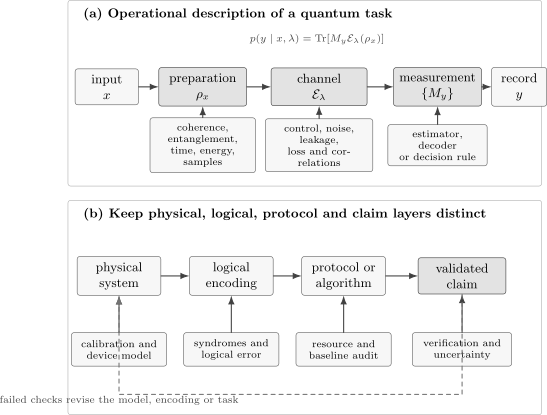
The upper panel is the common probability model for computation, communication, sensing, and simulation. The lower panel separates the physical system, logical encoding, protocol, and validated claim. Noise acts throughout the stack, while calibration and verification constrain different layers rather than producing one universal quality number.
What Changes When Information Is Quantum?
Section titled “What Changes When Information Is Quantum?”States are not classical labels
Section titled “States are not classical labels”A classical bit has two distinguishable logical values. A qubit has a two-dimensional state space. A normalized pure qubit can be written
The amplitudes are not probabilities for every possible measurement. They determine probabilities only after a measurement basis is chosen, and their relative phase changes interference in other bases.
A general qubit state is a density operator,
The interior of the Bloch ball represents mixed states, not additional pure-state directions. Bloch Sphere owns the geometric derivation, while Bloch Vector is the compact formula reference.
Two different quantum preparations need not be perfectly distinguishable. Orthogonal states can be separated without error in one shot; nonorthogonal states cannot. This is not an engineering defect. It is a structural constraint behind state discrimination, cryptography, information–disturbance tradeoffs, and the no-cloning theorem.
Composition grows state space and changes locality
Section titled “Composition grows state space and changes locality”The state space of qubits has dimension . A generic pure-state coordinate list therefore grows exponentially:
This does not mean that measuring the register reveals all amplitudes. A computational-basis measurement returns one bit string per shot. Reconstructing a generic state requires many settings and samples, and a useful algorithm must arrange interference so that the desired property is recoverable with acceptable resources.
Tensor products also define locality. An operation on subsystem alone cannot instantaneously signal through the reduced state of spacelike or otherwise noncommunicating subsystem , even when the joint state is entangled. Entanglement changes achievable correlations and protocols; it does not replace a classical communication channel.
Dynamics becomes a channel
Section titled “Dynamics becomes a channel”Closed-system unitary evolution is one special channel,
A realistic component may lose energy, dephase, leak from the computational subspace, correlate with an environment, or be conditioned on a measurement record. The relevant object is then a completely positive trace-preserving map for an unconditional process, or a trace-nonincreasing operation for a selected outcome.
This change of language matters operationally. Two devices may implement nearly the same average gate fidelity while differing in coherent error, leakage, temporal correlation, or crosstalk. Those differences can produce very different circuit-level failures and error-correction behavior.
Measurement is an information-limited interface
Section titled “Measurement is an information-limited interface”Measurement turns quantum states into classical records. A measurement design is judged by a task: discrimination error, estimation variance, mutual information, disturbance, confidence, or decision cost. More outcomes do not automatically mean more useful information, and a high-fidelity detector does not correct an unidentifiable preparation model.
The same measurement can be:
- a final circuit readout;
- a syndrome extraction that preserves logical information;
- a receiver for a communication code;
- an estimator in a sensing protocol;
- a feedback signal in adaptive control;
- a verification test for a simulator.
The distinction between a POVM outcome and its conditional state update is essential for mid-circuit measurement, feedback, and error correction.
Four Central Tasks
Section titled “Four Central Tasks”| Task | Quantum object being engineered | Typical output | Central proof obligation |
|---|---|---|---|
| computation | circuit, query algorithm, Hamiltonian, or encoded logical process | bit string, estimate, sample, or prepared state | complexity and total resources under a stated input and error model |
| communication | source code, channel code, entanglement-assisted protocol, or network | transmitted classical or quantum information, secret key, or shared entanglement | rate, fidelity, security, and composability under a stated channel or adversary |
| sensing | probe state, interaction, control sequence, and estimator | parameter estimate and uncertainty region | precision at fixed time, energy, particles, bandwidth, loss, and prior information |
| simulation | controlled quantum system or algorithm representing a target model | observables, spectra, dynamics, or samples | mapping accuracy, state preparation, measurement cost, error control, and verification |
Computation
Section titled “Computation”Quantum computation is not “trying all answers and reading the correct one.” Algorithms use coherent transformations, phase relations, entanglement, measurement, and sometimes oracle access to change the complexity of a specified problem. A speedup statement must identify:
- the computational problem and input representation;
- the output and permitted error;
- the cost model, including queries, gates, depth, qubits, memory, and samples;
- the classical comparison class and best relevant baseline;
- data loading and output extraction;
- noise assumptions and whether fault tolerance is included.
A polynomial improvement, an exponential query separation, and an end-to-end practical advantage are different claims. The later algorithms chapter will keep those categories explicit.
Communication and cryptography
Section titled “Communication and cryptography”Quantum communication studies capacities and protocols for transmitting classical information, quantum states, entanglement, or secret correlations through quantum channels. Quantum Teleportation, for example, consumes shared entanglement and classical communication to transfer an unknown quantum state; Entanglement Swapping instead converts two neighboring entangled links into one conditional remote link. Neither protocol transmits matter or sends information faster than light.
Quantum Key Distribution instead establishes classical key material through quantum exchange and authenticated public postprocessing. Quantum cryptography derives security from a physical and adversarial model. A proof for ideal single-photon states and trusted detectors is not automatically a proof for a source with multiphoton emission, detector side channels, imperfect randomness, or correlated devices. Decoy-State QKD shows how intensity variation can bound the one-photon contribution of phase-randomized weak coherent pulses, Measurement-Device-Independent QKD moves the complete Bell measurement and its detectors into an untrusted relay, and Device-Independent QKD derives secrecy from loophole-aware Bell statistics under an explicit causal and laboratory contract. Protocol security and implementation security must be stated separately.
Quantum Randomness follows a parallel evidence chain from physical samples to conditional min-entropy, extraction, and delivered bits. It separates output tests from entropy certification and compares trusted, source-independent, semi-device-independent, steering-based, and fully device-independent generators.
Sensing and metrology
Section titled “Sensing and metrology”A quantum sensor prepares a probe, lets an unknown parameter affect it, and estimates that parameter from measurement outcomes. Quantum Measurement as Estimation develops the full contract from estimand and likelihood through inference, uncertainty, nuisance parameters, and validation. Classical and Quantum Fisher Information then separates information extracted by a chosen detector from the measurement-optimized SLD metric. Standard Quantum Limit derives the inverse-square-root benchmark for independent probes and shows why the comparator needs an explicit resource boundary. Heisenberg Scaling develops the ideal inverse-resource law and explains how generator width, phase ambiguity, nonlinear dynamics, loss, and decoherence qualify it. The resource ledger may include probe number, interrogation time, total time, energy, bandwidth, dynamic range, loss, control power, and prior information.
Squeezing shows how reduced variance becomes a precision gain only when the reference, signal response, readout direction, and loss model are fixed. Spin Squeezing specializes that logic to collective spins, Ramsey readout, entanglement certification, and atomic clocks. Ramsey Interferometry then treats the binary fringe as an estimation channel, including Fisher information, optimal interrogation time, phase aliases, adaptive design, readout errors, and duty cycle. Entanglement and squeezing can improve a precision scaling or constant in appropriate regimes, but state preparation, decoherence, readout, calibration, and estimator bias determine whether the full instrument improves.
Simulation
Section titled “Simulation”A quantum simulator maps a target Hamiltonian, field theory, chemical problem, or dynamical process to a controllable quantum system. What Is Quantum Simulation? defines the target-model mapping, digital–analog–hybrid taxonomy, task-specific error budget, and verification contract. Digital simulation compiles evolution into gates; analog simulation engineers a physical Hamiltonian; hybrid approaches combine quantum state preparation or dynamics with classical optimization and inference.
A simulator is not self-validating. Trust comes from calibration, solvable limits, conservation laws, cross-platform comparisons, error bounds, finite-size analysis, and measurements that distinguish target physics from device artifacts. Validation Tests supplies the general computational analogue.
Three Worked Anchors
Section titled “Three Worked Anchors”Anchor 1: nonorthogonal states carry limited one-shot evidence
Section titled “Anchor 1: nonorthogonal states carry limited one-shot evidence”Suppose one of two pure states is prepared with equal prior probability:
Their overlap is
The optimal equal-prior success probability for minimum-error discrimination is
No apparatus can make the one-shot error vanish for this ensemble. The task statement must include the candidate states, priors, allowed inconclusive outcomes, number of copies, and cost function. A detector accuracy alone does not define the discrimination problem.
Anchor 2: one noise probability can hide different physics
Section titled “Anchor 2: one noise probability can hide different physics”The bit-flip channel is
For , conjugation by leaves unchanged and reverses and . Therefore
This channel is a useful stochastic model. It is not equivalent to a coherent overrotation , even if both produce the same error probability in one measurement basis. Coherent errors can accumulate with circuit depth; stochastic errors average differently. Noise characterization must preserve distinctions relevant to the intended protocol.
Anchor 3: connectivity changes circuit depth
Section titled “Anchor 3: connectivity changes circuit depth”The -qubit GHZ state is
Starting from , apply a Hadamard gate to one qubit and then entangle fresh qubits with CNOT gates. A nearest-neighbor line can propagate the entanglement with two-qubit layers. With suitable all-to-all connectivity, already entangled controls can double the entangled set each layer, giving depth
for the entangling stage, while still using CNOT gates.
The CNOTs do not clone an unknown state. Acting on and blank targets, they create the entangled state , not independent copies. This example also shows why gate count, depth, connectivity, crosstalk, and fidelity are separate resource coordinates.
From Physical System to Defensible Claim
Section titled “From Physical System to Defensible Claim”Physical layer
Section titled “Physical layer”A physical qubit is a controlled subspace of a larger device. Relevant quantities include transition frequencies, anharmonicity or level structure, coherence, leakage, control bandwidth, measurement fidelity, reset, connectivity, correlated noise, fabrication spread, and environmental stability. A long coherence time is valuable but does not by itself imply accurate gates or scalable control.
Logical layer
Section titled “Logical layer”A logical qubit is encoded in a larger physical Hilbert space so that errors can be detected, corrected, or avoided. Its performance depends on the code, decoder, syndrome circuit, noise bias and correlation, leakage treatment, measurement latency, and logical operation. Dividing a physical error rate by the number of qubits is not a logical error model.
The no-cloning theorem does not forbid quantum error correction. Codes do not create independent copies of an unknown state. They embed logical amplitudes into a larger entangled subspace so that error information can be extracted without measuring the logical value directly.
Protocol and application layer
Section titled “Protocol and application layer”A protocol combines logical operations, measurements, classical control, compilation, and verification to accomplish a task. End-to-end resources can be dominated by state preparation, magic-state factories, routing, repeated measurement, data loading, sampling, decoding, or classical postprocessing rather than by the short mathematical circuit usually used to explain an algorithm.
Evidence layer
Section titled “Evidence layer”Claims should be labeled by what was established:
| Evidence type | What it can establish | What it does not establish by itself |
|---|---|---|
| theorem | a statement follows from declared assumptions | physical realizability or practical advantage |
| complexity result | asymptotic resources in a specified model | low constants, data access, or near-term usefulness |
| numerical simulation | behavior of a modeled finite system | correctness of hardware or asymptotic scaling |
| experimental demonstration | a protocol or component works under reported conditions | scalability, fault tolerance, or application value |
| benchmark | performance on a defined test and analysis | universal device quality |
| resource estimate | projected requirements under an architecture and error model | that those assumptions will be achieved |
| engineering projection | a technically motivated path and dependencies | a demonstrated capability |
Physical qubit count, logical qubit count, circuit volume, application runtime, energy, confidence, and verification cost must not be collapsed into one headline number. Claims, Hype, and Evidence Standards gives the canonical claim contract and evidence classification; Claims and Evidence Checklist turns it into a practical review procedure; Negative Results and Limitations owns the cross-domain limitation ledger and update triggers; and Metrics for Quantum Hardware defines component, gate, cycle, logical, and workload-level quantities.
Map of the Volume
Section titled “Map of the Volume”| Section | Central question | Canonical responsibility |
|---|---|---|
| Overview | What is quantum information, and how should claims be read? | field map, reading paths, technology boundaries, evidence labels |
| Information-Theoretic Foundations | How should a carrier, state, transformation, measurement, figure of merit, and resource claim be separated and routed? | task-first routing to the canonical homes for carriers, one-qubit geometry, density-operator workflows, entropy, entanglement measures, operational limits, and resources |
| Gates, Circuits, and Computation Models | Which transformations form computational models? | circuits, gates, universality, measurement, feedforward, alternative models |
| Quantum Algorithms and Complexity | Which tasks gain which rigorously stated advantages? | primitives, full algorithms, query and runtime complexity, limitations |
| Noise, Channels, and Error Mitigation | How do imperfect processes alter operational tasks? | QI noise models, SPAM, leakage, crosstalk, mitigation assumptions and limits |
| Quantum Error Correction and Fault Tolerance | How is logical information protected during computation? | stabilizers, codes, syndromes, decoding, thresholds, logical resources |
| Communication, Cryptography, and Networks | How are states, keys, and entanglement transmitted securely? | protocols, capacities, repeaters, memories, networks, security models |
| Quantum Sensing and Metrology | How does quantum control improve parameter estimation? | Fisher information, precision scalings, interferometry, sensor protocols |
| Quantum Simulation | How can controlled quantum systems represent other quantum systems? | digital, analog, and hybrid methods plus verification |
| Hardware Platforms and Engineering | How are logical operations realized physically? | architecture-level platform comparisons, control, readout, scaling constraints |
| Software, Compilation, and Control | How are abstract tasks translated into device operations? | intermediate representations, mapping, pulses, calibration, simulation tools |
| Benchmarking, Verification, and Validation | What does device or protocol performance evidence mean? | tomography, randomized tests, application benchmarks, claim validation |
| Applications and Case Studies | What survives an end-to-end resource and baseline audit? | chemistry, materials, optimization, cryptography, sensing, and negative results |
| Frontiers and Open Problems | Which scaling and verification questions remain unresolved? | fault tolerance, networks, quantum utility, algorithms, hardware roadmaps |
| Reference for QI | Where are standard objects looked up quickly? | gates, states, channels, codes, algorithms, protocols, metrics, reading lists |
Reading Paths
Section titled “Reading Paths”Start with What Is Quantum Information? for the field definition, conceptual boundaries, and task families. The Quantum Information Roadmap provides the cross-volume route. The Math Needed for Quantum Information page routes linear algebra, probability, entropy, tensor products, optimization, and numerical prerequisites.
Physics-to-information path
Section titled “Physics-to-information path”Begin with quantum states, density operators, tensor products, reduced states, and generalized measurements. Continue through qubits, gates, circuits, noise, and entanglement as a resource; then choose algorithms, communication, sensing, simulation, or error correction.
Computer-science path
Section titled “Computer-science path”Begin with finite-dimensional state spaces, reversible computation, circuits, universality, query models, and complexity. Keep the physical distinction among unitary gates, measurements, channels, and fault-tolerant logical operations visible throughout.
Use Controlled Operations to audit coherent conditional gates, branch phases, and the assumptions that license controlled access before treating those gates as algorithmic primitives; algorithm and hardware pages retain their own resource and implementation questions.
Use Mid-Circuit Measurement and Feedforward to audit the complementary measured-control path: a recorded outcome may select only later operations, and branch maps, merges, reset and reuse, and abstract resource or latency assumptions must remain explicit.
Use Quantum Fourier Transform to follow the coherent Fourier path from a declared finite-register convention through binary phase structure, exact or approximate circuits, and a sampled output without mistaking the transform for a readable list of classical coefficients.
Use Phase Kickback to audit how a licensed controlled branch family, Boolean XOR oracle, or modular addition places a relative phase on a coherent selector while the target returns or factors. Its record keeps phase sign, cleanup, readout, and abstract access costs explicit before an algorithmic owner uses the primitive.
Use Quantum Oracles to replace an unspecified promise of “oracle access” with a complete domain, encoding, full-space action, capability, reduction, query-cost, and fair-comparator record before a full algorithm treats that access as a primitive.
Use Measurement-Based Quantum Computation to follow the complementary resource-state model: prepare an open graph, consume it through adaptive single-qubit measurements, track byproducts and flow or gflow dependencies, and verify the corrected logical channel without turning logical pattern size into physical runtime.
Use Adiabatic Quantum Computation to audit the complementary Hamiltonian-path model: declare the encoded instance, initial and accepted final ground subspaces, schedule, relevant external gap, error certificate, endpoint decoder, and normalized resources before invoking circuit equivalence or computational scaling.
Use Quantum Annealing to audit a finite-time driver–problem process: declare the encoding and decoder, schedule and controls, closed or reduced-open evolution, temperature and rate assumptions, measured distribution, repetitions, embeddings, gauges, and comparator boundary before using equilibrium, freeze-out, or speedup language.
Use Continuous-Variable Quantum Computation to audit the mode-based model: declare the modes, quadrature and energy conventions, finite-energy input family, Gaussian operations and channels, non-Gaussian resource, continuous measurements and feedforward, output decoder, approximation metric, cutoff, and resource ledger without turning abstract universality into a hardware or advantage claim.
Use Topological Quantum Computation to audit the finite-anyon model: declare the anyon data and total-charge sector, fusion-space encoding, oriented braid and fusion-measurement program, adaptive frame, induced projective logical channel, non-braid completion, leakage, verification, and resource ledger without confusing model-level protection with material evidence or a complete fault-tolerant architecture.
Use Bosonic and Encoded Computation Models to audit a finite logical system encoded in oscillator modes: declare the encoding and projector, compose the complete physical program before decoding, and report the induced logical channel, leakage, rejection, recovery, adaptive frame, truncation, target metric, and resource ledger without treating projection as free recovery or ideal encoded algebra as hardware evidence.
Error-correction path
Section titled “Error-correction path”Begin with Quantum Error Correction and Fault Tolerance to freeze the protected task, code, extraction, decoder, logical-operation, evidence, and resource records and select the canonical next owner. Begin with Why Quantum Error Correction Is Possible to separate encoding from cloning and syndrome information from logical information. Continue to Stabilizer Formalism for Pauli constraints, code spaces, logical operators, Clifford propagation, and binary tableaux. Then use Surface Code for planar patches, repeated syndrome histories, decoding, thresholds, lattice surgery, and architecture-level overhead. Error-Correction Case Studies follows the complete experimental chain through repetition-code records, finite-distance surface-code memories, matched logical-lifetime references, bosonic break-even demonstrations, and fault-tolerant architecture evidence. Continue from there to other code families, logical gates, and resource estimation. Stabilizer States Preview remains the state-level bridge.
Communication and networks path
Section titled “Communication and networks path”Begin with no-cloning, no-signaling, state discrimination, and entanglement. Use Quantum Teleportation to see how one ebit and two classical bits simulate an identity qubit channel without cloning or superluminal signaling, then use Entanglement Swapping to extend entanglement across neighboring links while tracking outcomes, fidelity, and success probability. Follow with Entanglement Distillation to learn how recurrence and hashing exchange raw-pair yield for better shared states. Continue to Quantum Key Distribution for composable secrecy, finite-key accounting, authentication, and implementation boundaries, then work through BB84 as the canonical four-state protocol and E91 and Entanglement-Based QKD for singlet key rounds, Bell testing, and device trust. Use Decoy-State QKD to connect weak coherent pulses to single-photon yield bounds, then Measurement-Device-Independent QKD to move the Bell analyzer and detectors into an untrusted relay. Finish the key-establishment sequence with Device-Independent QKD for Bell-to-entropy security, loophole control, and finite-key accumulation. Then use Blind and Delegated Quantum Computation to separate privacy, verifiability, client trust, computational assumptions, and availability when a remote server executes a private quantum computation. Quantum Repeaters then develops asynchronous link generation, memory cutoffs, nested connection, error-control generations, and honest end-to-end resource accounting. Quantum Network Architectures expands that path into multiuser services, protocol layers, routing, entanglement inventory, internetworking, and trust domains. Distributed Quantum Computing then turns those services into coherent cross-QPU execution through teledata, telegates, circuit partitioning, distributed scheduling, circuit cutting, and logical resource accounting. Network Verification completes the path with destructive test-versus-use sampling, calibrated and device-independent trust models, source-independence and topology tests, heralded-channel checks, finite statistics, and service-level acceptance. Continue to channel capacities, memories, and transduction.
Sensing path
Section titled “Sensing path”Begin with Quantum Measurement as Estimation to define the estimand, likelihood, inference rule, loss, and uncertainty statement. Continue with Classical and Quantum Fisher Information for detector-dependent information, the SLD metric, geometry, noise, and compatibility. Then use Cramér–Rao Bounds for the regularity, bias, nuisance, attainability, and global conditions behind precision floors, followed by Standard Quantum Limit to connect independent-probe statistics to projection noise, shot noise, and matched-resource claims. Heisenberg Scaling then compares parallel entanglement, sequential queries, global phase protocols, and noisy asymptotes. Continue with Squeezing for covariance, response, readout, and loss, then Spin Squeezing for collective-spin generation, Ramsey use, and entanglement certification. Ramsey Interferometry follows with binary likelihoods, interrogation-time design, phase unwrapping, adaptive readout, and duty-cycle accounting. Continue to Mach–Zehnder interferometry, decoherence, and calibration. Precision Measurement and Metrology owns the AMO instrument physics.
Hardware and systems path
Section titled “Hardware and systems path”Begin with Hardware Overview, use Control, Readout, and Calibration for the closed operating loop, and use Metrics for Quantum Hardware to interpret performance claims. Superconducting Qubits is the first full platform case study, connecting circuit families and microwave operations to planar layouts, cryogenic integration, and logical-memory evidence. Trapped-Ion Qubits provides the contrasting architecture case, connecting atomic encodings and shared motion to QCCD routing, photonic modules, and logical-error evidence. Neutral-Atom and Rydberg Qubits then connects stochastic loading, reconfigurable tweezer geometry, digital and analog Rydberg interactions, located loss, and zone-based logical processing. Photonic Qubits follows photons from source and encoding through linear optics, fusion, detection, feed-forward, loss accounting, and network interfaces. Silicon Spin Qubits connects gate-defined dots and donor registers to exchange control, spin-to-charge readout, shuttling, foundry evidence, cryogenic electronics, and small-code experiments. Defect and Solid-State Spin Qubits then follows optically active electron spins, nuclear memories, nanophotonic interfaces, heralded links, and distributed-gate evidence. Bosonic Qubits treats oscillator encoding as an architecture layer across substrates, expanding the storage mode into its nonlinear ancilla, reset, decoder, and outer-code resource contract. Topological Qubits separates nonlocal encoding from a complete tetron, anyon, or synthesized-code module and audits parity control, universal-gate completion, protection scaling, and present evidence. Continuous-Variable Platforms then follows optical and microwave modes through Gaussian processing, non-Gaussian resource injection, multiplexing, adaptive measurement, and logical or task-level accounting. Quantum Memories compares write–store–read channels across those carriers and keeps efficiency, fidelity, lifetime, bandwidth, mode capacity, noise, latency, and duty cycle in one resource boundary. Interconnects and Transduction then treats direct transfer, heralded entanglement, and carrier conversion as complete accepted-input-to-usable-output channels rather than isolated converter efficiencies. Continue with other platform-specific encodings, gates, readout, errors, connectivity, control stacks, vacuum or optical infrastructure, and logical architecture. Follow physical questions back to the AMO and Quantum Matter canonical homes.
Cryogenic and Vacuum Infrastructure supplies the cross-platform environmental ledger: staged cooling power, signal-line heat and noise, radiation and vibration, local residual-gas conditions, collision and loss observables, diagnostics, recovery time, and availability.
Materials and Fabrication Interface supplies the cross-platform manufacturing ledger: source lots, surfaces, interfaces, defects, process dispersion, joint parameter distributions, predictive screening, graph-aware yield, calibration burden, aging, and architecture-level acceptance.
Modular Architectures closes the hardware sequence by composing screened modules and qualified links into one machine. It develops role-resolved module contracts, topology and cut capacity, stochastic entanglement inventory, scheduling, distributed error correction, control-plane timing, fault domains, replaceability, and sustained system evidence.
Quantum Software Stack begins the software sequence by following typed artifacts from application intent and logical programs through fault-tolerant lowering, target-specific compilation, controller execution, measurement records, postprocessing, and reproducible evidence.
Circuit Intermediate Representations then makes those artifacts precise: types and value ownership, control and data flow, gate alphabets and capability profiles, semantic preservation, target legalization, and the different strengths of portability claims.
Gate Decomposition begins executable lowering by preserving structure, reducing bounded blocks with Euler or Cartan/KAK forms, using cosine–sine or Quantum Shannon decomposition only for genuinely dense targets, and verifying exact or finite-alphabet approximate synthesis.
Circuit Optimization then reduces the cost of an existing circuit through certified local identities, dependency-aware commutation, structured Clifford and phase-polynomial algebra, bounded search, and abstract depth reduction without confusing a local fixed point with global optimality.
Qubit Mapping and Routing assigns program qubits to a constrained target, legalizes nonlocal interactions, tracks the changing logical-to-physical map, and verifies the output permutation.
Error-Aware Compilation then uses dated topology, calibration, crosstalk, and readout evidence to rank legal candidates under explicit uncertainty, validity, budget, and held-out validation contracts.
Pulse-Level Control completes the current lowering sequence by binding selected gate intent to calibrated frames and waveform families, materializing sample-grid and scheduling decisions, modeling the delivery path, and attaching qualification evidence to the executable artifact.
Calibration Loops then keeps those target records trustworthy over time: it models dependencies and validity, detects drift without chasing shot noise, schedules maintenance under resource conflicts, compares candidates with incumbents on held-out data, and publishes or rolls back coherent snapshots transactionally.
Optimal Control for Quantum Processors completes this control-facing path by comparing GRAPE and other gradient methods with CRAB, black-box search, hybrid refinement, and reinforcement learning; it then follows an optimized candidate through sampling, delivery, device evaluation, independent qualification, and versioned release.
Quantum Circuit Simulation opens the classical-simulation path: it derives exact local state-vector updates, explains the exponential memory wall, separates amplitudes and probabilities from sampling, executes mid-circuit measurement and feedforward, and compares structure-aware methods under explicit accuracy and resource contracts.
Stabilizer Simulation then exploits Clifford closure in practice: it compares tableau and graph-state data structures, separates one-shot trajectories from batched Pauli-frame sampling, constructs detector streams, isolates the decoder from withheld logical labels, and validates logical-error experiments with explicit uncertainty.
Tensor-Network Simulation follows with structure beyond Clifford closure: it maps circuits to MPS and spacetime networks, tracks entanglement and contraction width, optimizes and slices contraction trees, reuses work for amplitudes and samples, and separates exact path choices from controlled truncation and environment approximations.
Noise Simulation completes the simulation sequence by binding channels, continuous-time generators, readout, leakage, drift, and correlations to the compiled timeline; it compares density, trajectory, Pauli, tensor, and finite-memory engines while keeping model error distinct from numerical and statistical uncertainty.
Resource Estimation Tools then connects algorithms to proposed machines through a versioned chain of symbolic counts, logical lowering, error budgets, code-distance selection, factory and routing schedules, hardware scenarios, Pareto tradeoffs, and reproducibility tests.
Reproducible Notebooks closes the software sequence with a status-aware artifact directory: stable planned filenames, quantum-specific validation gates, clean-execution requirements, environment and provenance records, and explicit boundaries between a notebook, a reproduced result, and a scientific claim.
Why Benchmarking Is Hard opens the validation sequence by treating every score as a conditional projection of device state, workload, implementation policy, verification method, resources, and statistical analysis; it explains why a benchmark suite and performance surface are more trustworthy than a universal ranking.
State Tomography then develops the complete finite-dimensional reconstruction contract: informational completeness and conditioning, linear and physical estimators, confidence and credible regions, SPAM and drift diagnostics, validation, and the exponential boundary of unrestricted many-qubit reconstruction.
Process Tomography extends that contract from states to channels through prepare-and-measure and ancilla-assisted protocols, constrained Choi estimation, gate-set and memory caveats, held-out validation, and explicit parameter scaling.
Shadow Tomography then narrows the estimand to many selected properties: it derives inverse measurement-channel snapshots, local-Pauli and global-Clifford tradeoffs, shadow-norm sample bounds, target-aware schedules, nonlinear estimators, noise calibration, and reproducible evidence records.
Randomized Benchmarking develops the complementary sequence-decay contract: reference Clifford twirling, sequence and shot statistics, fit diagnostics, error-per-Clifford interpretation, interleaved and related variants, and the limits imposed by compilation, drift, leakage, gate dependence, and memory.
Cycle Benchmarking then keeps a scheduled layer fixed and uses local Pauli dressing to estimate its process fidelity in parallel context, including Pauli-orbit decays, sequence and shot statistics, SPAM and leakage limits, learnability, and the distinction between dressed and inferred bare cycles.
What to Know First
Section titled “What to Know First”A reader should be comfortable with:
- complex vector spaces, inner products, eigenvalues, and tensor products;
- pure and mixed states;
- unitary evolution and basis changes;
- projective measurement and the Born rule;
- partial trace and reduced states;
- elementary probability and conditional probability;
- basic entropy and asymptotic notation;
- for pulse-level material, driven two-level dynamics, rotating frames, and sampled-signal conventions.
The most direct preparation sequence is:
- Quantum States
- Born Rule
- Tensor Products
- Density Operators
- Partial Trace: First Encounter
- POVMs: First Encounter
- Quantum Channels and Noise
- Entanglement in Quantum Information
Canonical-Home Boundaries
Section titled “Canonical-Home Boundaries”- State and operator foundations: Core Formalism.
- Entanglement structure and measures derived as state properties: Composite Systems and Entanglement.
- POVMs, instruments, Kraus operators, Choi matrices, dilations, and master equations: Measurement and Open Quantum Systems.
- Spin rotations, Pauli algebra, symmetry, and geometric phases: Symmetry, Angular Momentum, and Spin.
- Photonic, atomic, molecular, ion, neutral-atom, and cavity platform physics: Atomic, Molecular, and Optical Physics.
- Superconducting, semiconductor, topological, mesoscopic, and material device physics: Quantum Matter.
- Many-body entanglement, tensor-network physics, thermalization, and phases: Many-Body and Quantum Statistical Mechanics.
- Quantum-information tasks, resource conversions, circuits, algorithms, codes, protocols, architecture, and benchmarks: this volume.
Cross-links should translate between layers. A superconducting-qubit page here should link to Josephson and circuit physics rather than rederive it. A channel page here should use the technical channel theory from the open-systems volume and focus on coding, capacity, mitigation, or protocol consequences.
Common Mistakes
Section titled “Common Mistakes”Calling a qubit a probabilistic bit
Section titled “Calling a qubit a probabilistic bit”A pure qubit has coherent amplitudes whose relative phase changes later interference. A classical random bit is represented by a diagonal density operator in the chosen basis. They can produce the same statistics for one measurement and differ in another.
Treating amplitudes as directly observable
Section titled “Treating amplitudes as directly observable”Measurements sample outcome probabilities determined by a state and a measurement. State amplitudes are representation-dependent coordinates, not a list printed by the apparatus.
Equating exponential Hilbert-space dimension with accessible output
Section titled “Equating exponential Hilbert-space dimension with accessible output”An -qubit state has exponentially many generic coordinates, but one shot returns a limited classical outcome. Algorithms need structured inputs, interference, and efficient observables; tomography of a generic state is expensive.
Saying entanglement sends information faster than light
Section titled “Saying entanglement sends information faster than light”Entanglement enables correlations and protocols but does not let local operations change a remote marginal without communication.
Saying no-cloning forbids error correction
Section titled “Saying no-cloning forbids error correction”Quantum codes distribute logical amplitudes through an encoded subspace and measure error syndromes. They do not create independent copies of an unknown state.
Counting physical qubits as computational power
Section titled “Counting physical qubits as computational power”Encoding overhead, logical error rate, connectivity, speed, leakage, readout, decoding, and workload requirements determine what the qubits can accomplish.
Treating error mitigation as error correction
Section titled “Treating error mitigation as error correction”Mitigation estimates or cancels selected noise effects using additional assumptions and samples. Error correction encodes information, detects syndromes, and suppresses logical errors under a fault-tolerance architecture.
Inferring an application advantage from an algorithmic speedup
Section titled “Inferring an application advantage from an algorithmic speedup”Input preparation, output extraction, precision, constants, fault-tolerant overhead, verification, and improved classical algorithms can dominate the end-to-end comparison.
Using one benchmark as a universal ranking
Section titled “Using one benchmark as a universal ranking”Benchmarks weight gate sets, connectivity, noise, compilation, and workloads differently. A device can lead one metric and perform poorly for another task.
Treating a quantum simulator as an oracle
Section titled “Treating a quantum simulator as an oracle”Calibration and internal consistency do not prove that the implemented model matches the target in the regime where classical validation fails.
Exercises
Section titled “Exercises”1. Reveal a relative phase
Section titled “1. Reveal a relative phase”Consider
Find the probabilities for a computational-basis measurement and for the basis. Which measurement reveals ?
Solution
In the computational basis,
independent of . For the basis,
The -basis statistics reveal the cosine quadrature of the relative phase. A -basis measurement would reveal the sine quadrature. No single basis gives every state coordinate from one shot.
2. Quantify nonorthogonal discrimination
Section titled “2. Quantify nonorthogonal discrimination”For equal priors, use the two pure states and
with . Find the optimal minimum-error success probability and check the limits and .
Solution
The overlap magnitude is . The equal-prior Helstrom result gives
At , the preparations are identical and the best strategy is a guess, so . At , they are orthogonal and .
3. Follow a bit-flip channel
Section titled “3. Follow a bit-flip channel”Let the input be , , or . Apply the bit-flip channel with probability . Which state is unchanged, and how do the relevant Bloch components change?
Solution
The three states have Bloch vectors
The channel maps
Thus is unchanged. The polarization of and the polarization of are attenuated by . At , those two outputs are maximally mixed.
4. Compare GHZ preparation depths
Section titled “4. Compare GHZ preparation depths”How many two-qubit gates and entangling layers are needed to prepare using the line and doubling constructions described above? Why does the answer not follow from the target state alone?
Solution
Both constructions use CNOT gates. On a nearest-neighbor line, entanglement propagates one site per layer, requiring entangling layers. With all-to-all connectivity and doubling,
The target state fixes neither connectivity nor the allowed simultaneous gates. Hardware graph, scheduling, crosstalk constraints, native entanglers, and compilation therefore belong in a resource estimate.
5. Bound accessible classical information
Section titled “5. Bound accessible classical information”An equal-prior source emits or . Its average state is
Show that its eigenvalues are . Compute the Holevo quantity for this pure-state ensemble.
Solution
In the computational basis,
Its trace is and determinant is , so
Because each signal state is pure, its von Neumann entropy vanishes. The Holevo quantity is therefore
where is the binary entropy. The source label contains one classical bit before encoding, but nonorthogonality limits accessible information per emitted state.
6. Audit a quantum-advantage claim
Section titled “6. Audit a quantum-advantage claim”A processor with 100 physical qubits samples a circuit faster than one published classical implementation. The output is not connected to an end-user task, device noise is omitted from the theoretical speedup, and verification is performed only at smaller sizes. Classify what has and has not been established.
Solution
The result may establish an experimental benchmark comparison for a specified circuit family, processor, classical code, hardware, accuracy criterion, and date. It may also demonstrate control of a large quantum state space.
It does not by itself establish:
- superiority over the best possible or subsequently improved classical method;
- an end-to-end useful application;
- fault-tolerant computation or a logical error rate;
- correctness at unverified sizes;
- an asymptotic speedup under the device’s noise model;
- favorable energy, cost, or wall-clock scaling for a practical workflow.
A defensible report states the sampling task, distance or fidelity criterion, full classical baseline, excluded costs, verification method, uncertainty, and the exact evidence label.
Research Status
Section titled “Research Status”- Established: finite-dimensional quantum information theory, channel and measurement formalisms, no-go theorems, circuit models, major algorithmic results, quantum error-correction principles, and core communication and estimation protocols.
- Architecture dependent: logical error rates, fault-tolerance overhead, network rates, sensor advantage, verification cost, and the usefulness of a given hardware metric.
- Fast moving: code families and decoders, fault-tolerant resource estimates, hardware platforms, compilation and control methods, large-scale verification, and claims of quantum computational utility or advantage.
- Not implied by “quantum”: speedup, security, metrological improvement, scalability, energy advantage, or commercial value.
Connections
Section titled “Connections”- Bits, Qubits, Qudits, and Modes separates abstract carriers, code subspaces, physical realizations, leakage, and logical encodings.
- Bloch Sphere for Quantum Information connects one-qubit states to calibrated measurements, tomography, gates, and affine noise maps.
- Density Operators for Quantum Information develops the practical state workflow for ensembles, subsystems, channels, instruments, metrics, and numerical checks.
- Entanglement Measures matches entropy, concurrence, negativity, formation, distillation, and squashed entanglement to their valid state classes and operational questions.
- Circuit Model defines registers, wires, gates, measurement records, feedforward, input-output contracts, and resource accounting.
- Single-Qubit Gates fixes matrices, phase and rotation conventions, Bloch actions, Euler synthesis, and the boundary between logical gates and physical controls.
- Multi-Qubit Gates develops controlled, exchange, and Toffoli gates; parity measurements; entangling capability; and native-versus-compiled contracts.
- Universal Gate Sets distinguishes exact from approximate universality, Clifford from Clifford+, and logical from native gate alphabets.
- Quantum Software Stack maps the translation, execution, and evidence contracts between an algorithm and a qualified result.
- Circuit Intermediate Representations defines typed quantum–classical IRs, capability profiles, lowering invariants, and portability levels.
- Gate Decomposition develops exact and approximate synthesis from structured or dense unitary targets to verified gate circuits.
- Circuit Optimization develops behavior-preserving simplification, commutation, structured rewrites, depth reduction, and translation-validation certificates.
- Qubit Mapping and Routing develops placement, connectivity legalization, map evolution, routing costs, output decoding, and route verification.
- Error-Aware Compilation develops evidence-qualified objectives, uncertainty-aware ranking, crosstalk scheduling, readout-aware decisions, decision certificates, and held-out validation.
- Pulse-Level Control develops calibrated waveform families, frame tracking, pulse IR, sample-grid realization, scheduling, transfer bindings, and qualification certificates.
- Calibration Loops develops calibration records, dependency invalidation, latent-state tracking, drift triggers, stable update laws, acceptance gates, atomic publication, rollback, and quarantine.
- Optimal Control for Quantum Processors develops method selection, constrained search contracts, CRAB and learning-based alternatives, hardware budgets, robustness tests, and deployment evidence.
- Quantum Circuit Simulation develops state-vector kernels, output tasks, measurement and dynamic-circuit semantics, method selection, performance engineering, numerical validation, and reproducible simulator contracts.
- Stabilizer Simulation develops polynomial Clifford-circuit execution, representation choices, batched Pauli frames, QEC detector and decoder interfaces, logical-rate estimation, and reproducible validation.
- Tensor-Network Simulation develops circuit tensorization, MPS execution, spacetime contraction trees, path search, slicing, output-aware sampling, truncation evidence, and hardware-conscious performance records.
- Noise Simulation develops timeline-aware model placement, density and stochastic propagation, structured mixed-state methods, finite-memory models, nested uncertainty, and cross-method validation.
- Resource Estimation Tools develops layered logical and physical estimates, precision and failure budgets, code and factory coupling, uncertainty sweeps, Pareto frontiers, and versioned estimate bundles.
- Reproducible Notebooks inventories the planned circuit, algorithm, code, benchmark, communication, and metrology artifacts and defines the evidence required before any notebook can support a claim.
- Why Benchmarking Is Hard develops the benchmark contract, capability surfaces, SPAM and context limits, drift controls, compiler boundaries, verification gap, classical baselines, Pareto comparisons, and reporting requirements.
- State Tomography develops informationally complete state reconstruction, estimator tradeoffs, uncertainty regions, trusted-measurement limits, residual tests, and scaling alternatives.
- Process Tomography develops standard and ancilla-assisted channel reconstruction, Choi-space estimators, SPAM composition, context and memory limits, derived metrics, and scaling alternatives.
- Shadow Tomography develops classical-shadow acquisition, inverse-channel snapshots, ensemble-dependent sample complexity, robust aggregation, target-aware measurement, calibration limits, and reusable reporting records.
- Randomized Benchmarking derives the reference sequence-decay model, separates sequence and shot variation, develops fit and reporting practice, and explains which average error claims survive gate dependence, leakage, drift, and compilation choices.
- Cycle Benchmarking derives Pauli-randomized decay estimates for scheduled layers, distinguishes orbit products from individual Pauli fidelities, and states the dressed-cycle, statistical, and learnability contracts.
- Cross-Entropy Benchmarking derives logarithmic and linear random-circuit scores, their finite-circuit normalization and statistics, the conditional fidelity interpretation, and the boundary between measured correlation and computational-advantage evidence.
- Quantum Volume and Application Benchmarks derives the heavy-output protocol and quantum-volume score, recovers the width–depth capability map, and develops quality, timing, resource, compiler, and comparison contracts for application-oriented suites.
- Algorithmic Benchmarking turns a named algorithm into an end-to-end task contract, distinguishing kernel, execution, and solution boundaries while accounting for input access, hybrid control, output quality, retries, scaling, and cost per accepted answer.
- Verification of Quantum Advantage validates advantage claims through the conjunction of quantum correctness, scoped hardness evidence, a dated classical frontier, matched resources, hierarchical statistics, adversarial challenge, and independent reproduction.
- Certification of Entanglement compares trusted witnesses, tomography and PPT, steering, Bell tests, and robust self-testing while making finite statistics, calibration, loss, postselection, multipartite depth, and dimensionality part of the claim.
- Device Characterization develops predictive device-model identification through sensitivity design, coherent and incoherent diagnostics, spectroscopy, GST, randomized protocols, context and drift tests, uncertainty, and held-out validation.
- Reporting Standards defines a common transparent report plus profiles for characterization, tomography, certification, randomized benchmarks, hybrid algorithms, logical experiments, simulation, resource estimates, and advantage claims.
- Quantum Algorithms and Complexity is the chapter guide for auditing problem, promise, access, output, success, resource, classical-comparator, and evidence claims before entering the seven live algorithm owners.
- Algorithmic Primitives maps coherent access, phase kickback, interference, Fourier and polynomial transforms, amplification, simulation, and postselection.
- Grover Search derives the two-reflection search rotation, exact success probability, stopping rule, optimal query bound, and limits of the oracle speedup.
- Quantum Phase Estimation derives powered phase kickback, inverse-QFT decoding, precision guarantees, energy aliasing, iterative variants, and coherent-time costs.
- Variational Quantum Algorithms develops the complete hybrid loop from task contract and ansatz design through finite-shot objectives, quantum gradients, trainability, noise, optimization, fresh validation, and end-to-end resource accounting.
- VQE develops Rayleigh–Ritz guarantees, Hamiltonian averaging, chemistry ansatzes, energy-specific error budgets, excited-state extensions, validation, and complete resource accounting.
- Quantum Chemistry Case Studies compares molecular VQE and phase-estimation experiments, active-space models, logical demonstrations, and fault-tolerant catalysis estimates using one evidence-centered framework.
- Materials Simulation Case Studies separates model, material, and property claims across cold-atom, gate-model, Rydberg, annealing, and fault-tolerant studies.
- Optimization Case Studies compares QAOA, annealing, Rydberg arrays, Grover-based search, and structured interference under matched quality and timing boundaries.
- Cryptography Case Studies compares lossy BB84, entanglement-based links, post-quantum protocol migration, and Shor resource estimates under explicit trust and timing contracts.
- Sensing Case Studies compares Ramsey and spin-squeezed clocks, NV magnetometry, atom gravimetry, and Rydberg electrometry under matched bandwidth, spatial, calibration, and uncertainty contracts.
- Network Case Studies compares swapping chains, memory-assisted repeaters, teleported intermodule gates, and satellite links through matched rate, fidelity, latency, trust, and evidence ledgers.
- Error-Correction Case Studies compares repeated syndrome extraction, surface-code scaling, logical lifetime references, and bosonic break-even evidence under one end-to-end QEC claim contract.
- Claims and Evidence Checklist supplies a claim card, gate-based comparator audit, provenance check, domain modules, and bounded review dispositions.
- Negative Results and Limitations distinguishes no-go theorems, lower bounds, empirical nulls, comparator reversals, resource bottlenecks, and claims that remain open.
- Shor Algorithm develops the complete factoring reduction, quantum order finding, continued-fraction recovery, discrete logarithms, cryptographic impact, and fault-tolerant resource caveats.
- Quantum Complexity Classes defines BQP, QCMA, QMA, and QIP; distinguishes proved containments from open separations; and develops the local Hamiltonian problem.
- Noise, Channels, and Error Mitigation routes a device discrepancy or intervention claim through its system boundary, mechanism, representation, context, diagnostic evidence, estimand, uncertainty, and total-cost ledger.
- Noise in Quantum Information distinguishes coherent, incoherent, leakage, crosstalk, SPAM, drift, and correlated errors; then connects each mechanism to diagnostics and engineering action.
- Common Noise Models supplies device-facing model cards, convention translations, – composition rules, leakage and seepage models, and correlation checks.
- Claims, Hype, and Evidence Standards separates theorems, simulations, demonstrations, benchmarks, resource estimates, projections, and applications.
- Quantum Information Roadmap gives the recommended learning sequence across existing foundational volumes and this one.
- Math Needed for Quantum Information maps the required linear algebra, tensor products, probability, entropy, optimization, and numerics.
- Quantum States and Density Operators own the state formalism used by every protocol.
- Entanglement in Quantum Information explains teleportation, dense coding, cryptography, sensing, and error correction as operational uses of correlations.
- Quantum Channels and Noise develops the completely positive map machinery beneath noise, communication, and device processes.
- Quantum Information: Symmetry Application Map connects Pauli strings, Clifford structure, Bell sectors, and stabilizers to symmetry language.
- Effective Hamiltonians in Quantum Information derives leakage-aware logical Hamiltonians from physical multilevel systems.
- Atomic, Molecular, and Optical Physics owns photonic, trapped-ion, neutral-atom, cavity, and precision-measurement platform physics.
- Quantum Matter owns superconducting, semiconductor, mesoscopic, topological, and material-device foundations.
- Quantum Gates, Fidelity, and Trace Distance provide compact formula references.
- No-Cloning and No-Signaling gives the canonical operational statements, assumptions, proofs, allowed relaxations, and communication consequences.
References
Section titled “References”- C. E. Shannon, “A Mathematical Theory of Communication”, Bell System Technical Journal 27, 379–423 (1948).
- B. Schumacher, “Quantum Coding”, Physical Review A 51, 2738–2747 (1995).
- M. A. Nielsen and I. L. Chuang, Quantum Computation and Quantum Information, 10th anniversary ed., Cambridge University Press (2010).
- J. Watrous, The Theory of Quantum Information, Cambridge University Press (2018).
- M. M. Wilde, Quantum Information Theory, 2nd ed., Cambridge University Press (2017).
- J. Preskill, Lecture Notes for Physics 219/Computer Science 219: Quantum Computation, Caltech, living course notes.
- R. P. Feynman, “Simulating Physics with Computers”, International Journal of Theoretical Physics 21, 467–488 (1982).
- D. Deutsch, “Quantum Theory, the Church–Turing Principle and the Universal Quantum Computer”, Proceedings of the Royal Society A 400, 97–117 (1985).
- S. Lloyd, “Universal Quantum Simulators”, Science 273, 1073–1078 (1996).
- P. W. Shor, “Algorithms for Quantum Computation: Discrete Logarithms and Factoring”, Proceedings of the 35th Annual Symposium on Foundations of Computer Science, 124–134 (1994).
- L. K. Grover, “A Fast Quantum Mechanical Algorithm for Database Search”, Proceedings of the 28th Annual ACM Symposium on Theory of Computing, 212–219 (1996).
- C. H. Bennett et al., “Teleporting an Unknown Quantum State via Dual Classical and Einstein–Podolsky–Rosen Channels”, Physical Review Letters 70, 1895–1899 (1993).
- P. W. Shor, “Scheme for Reducing Decoherence in Quantum Computer Memory”, Physical Review A 52, R2493–R2496 (1995).
- E. Knill and R. Laflamme, “Theory of Quantum Error-Correcting Codes”, Physical Review A 55, 900–911 (1997).
- E. Chitambar and G. Gour, “Quantum Resource Theories”, Reviews of Modern Physics 91, 025001 (2019).
- V. Giovannetti, S. Lloyd, and L. Maccone, “Advances in Quantum Metrology”, Nature Photonics 5, 222–229 (2011).
- I. M. Georgescu, S. Ashhab, and F. Nori, “Quantum Simulation”, Reviews of Modern Physics 86, 153–185 (2014).
- J. Preskill, “Quantum Computing in the NISQ Era and Beyond”, Quantum 2, 79 (2018).
- National Academies of Sciences, Engineering, and Medicine, Quantum Computing: Progress and Prospects, National Academies Press (2019).
Summary
Section titled “Summary”- Quantum information organizes quantum mechanics around preparations, channels, measurements, resources, tasks, and success criteria.
- A qubit is not a probabilistic bit: coherent phase changes what later measurements can reveal.
- Exponential state-space dimension does not imply exponentially accessible classical output.
- Computation, communication, sensing, and simulation require different resource and evidence contracts.
- Physical components, logical encodings, protocols, and validated claims are distinct layers of a quantum technology.
- Algorithmic speedup, experimental demonstration, benchmark performance, resource estimates, scalability, and practical advantage must not be conflated.