Reproducible Notebooks
Short Definition
Section titled “Short Definition”A reproducible quantum-information notebook is a versioned executable argument that connects a declared physical or algorithmic model to numerical outputs through visible conventions, code, parameters, environment metadata, and validation tests. The notebook is not just its final plot, and successful execution is not by itself evidence that the calculation is correct.
A useful abstraction is
where is source code and narrative, the inputs, the execution environment, the mathematical and physical model, the validation record, the outputs, and the provenance. A reader should be able to inspect every component needed for the claim the artifact supports.
This page owns the quantum-information notebook inventory: stable planned filenames, links to canonical physics pages, minimum computations, admission gates, and the current state of each artifact. It does not redefine general notebook policy. Notebook Index owns the sitewide metadata contract, Reproducibility Status owns status labels, Environments owns dependency policy, and Validation Tests owns the general test taxonomy. Individual concept and algorithm pages remain the canonical homes for the physics.
Current Repository Status
Section titled “Current Repository Status”As of the review date above, the repository does not contain a committed
notebooks/quantum-information/ directory. Every filename in
the catalogs below is therefore planned. None is downloadable, none has
been cleanly executed in a recorded environment, and none may support a
numerical claim.
The distinction is basic but important:
The committed notebook family under
notebooks/wave-mechanics-canonical-systems/ provides an
implementation precedent. Its successful checks do not transfer to quantum
circuits, stochastic sampling, variational optimization, or decoders.
Notebook-style pages under Computational
Notebooks provide useful
open-system contracts, but a page describing a notebook is not evidence that
an .ipynb artifact exists or runs.
Two Independent Status Axes
Section titled “Two Independent Status Axes”Inventory state answers, “What artifact is present?” Reproducibility status answers, “What evidence has been recorded for that artifact?” Keep the two axes separate.
| Inventory state | Meaning | May support a claim? |
|---|---|---|
planned | filename and admission contract are reserved; no artifact exists | no |
present_unreviewed | source exists but clean execution and checks have not been reviewed | no |
candidate | clean execution succeeds and the validation record is under review | not yet |
admitted | source, environment, checks, and provenance meet this index contract | only under its separate reproducibility label |
Once a notebook is admitted, assign the sitewide status
reproduced,
reproduced_with_warnings,
needs_update, broken, or
archived. An admitted notebook can later become
needs_update after dependency or convention drift. Conversely,
a planned filename cannot be called conceptual_only: that
label describes a real explanatory artifact, not a proposal.
Different research communities use “repeatability,” “reproducibility,” and “replicability” differently. The inventory uses the labels defined by the reference library rather than silently changing meaning. When independent reimplementation matters, state the actors, artifacts, environment, and tolerance explicitly.
Stable Paths and Artifact Boundaries
Section titled “Stable Paths and Artifact Boundaries”The first family reserves a flat, readable directory:
notebooks/quantum-information/ basic-qubit-states.ipynb single-two-qubit-gates.ipynb bell-teleportation.ipynb grover-search.ipynb phase-estimation.ipynb shor-period-finding-toy.ipynb hamiltonian-simulation-toy.ipynb vqe-h2.ipynb qaoa-small-graphs.ipynb noise-channels-fidelity.ipynb randomized-benchmarking-simulation.ipynb stabilizer-syndrome-extraction.ipynb surface-code-toy-decoder.ipynb qkd-finite-key-toy.ipynb ramsey-fisher-information.ipynb classical-shadows.ipynbThese names are semantic and stable. A later reorganization may add helper modules, data, or environment files without renaming cited notebooks. Once a path is used by a page, figure, release, or external citation, preserve it or publish an explicit migration record.
One notebook should make one computational argument. Shared circuit construction, channel utilities, decoders, and statistical estimators belong in tested modules once they are reused. A notebook may orchestrate those modules and expose checks, but it should not become the only place where a large software system exists.
The Evidence Chain
Section titled “The Evidence Chain”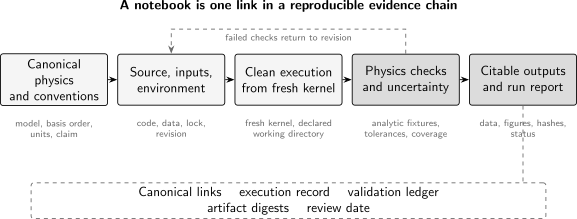
A notebook becomes citable evidence only when the model, source, environment, clean execution, physics checks, outputs, and provenance remain connected. Failed validation returns the artifact to revision rather than being hidden by a new plot.
The source notebook is only one node in this chain. A complete release bundle should make the following relations traversable:
- the notebook links to each canonical physics, convention, and formula page;
- the environment record identifies an interpreter, direct dependencies, and a reconstruction mechanism;
- the execution record identifies the source revision, command, runtime class, platform qualifications, and date;
- each reported result points to a validation test and predeclared tolerance;
- generated figures or tables point back to source data and the producing notebook or script;
- the documentation page records which artifact revision it cites.
A cryptographic digest can detect changed bytes, but it cannot establish physical correctness. Hashes protect identity; validation protects a declared claim.
Family-Wide Notebook Contract
Section titled “Family-Wide Notebook Contract”Every candidate notebook should expose the following material near its beginning.
Purpose and canonical targets
Section titled “Purpose and canonical targets”State one concrete question and the level of evidence sought. “Explore Grover’s algorithm” is too broad. “Verify the exact success curve for one and two marked states, then compare finite-shot estimates with binomial uncertainty” is testable.
Link to the canonical pages that define the state, circuit, channel, code, algorithm, or benchmark. The notebook may summarize enough theory to be read, but it must not become a competing derivation.
Conventions
Section titled “Conventions”Record at least:
- tensor-factor and basis ordering;
- the mapping between qubit labels, state-vector axes, and displayed bitstrings;
- gate matrices, rotation signs, and global-phase policy;
- measurement-bit and classical-register ordering;
- units, scaled quantities, and time convention;
- channel representation and vectorization convention;
- boundary conditions or truncations when a Hilbert space is finite;
- whether exact arithmetic, floating point, sampling, or hardware data is being used.
The integer index of a basis state is not a convention-free object. If
then is the least-significant bit of . A package may nevertheless draw qubit zero at the top, display bitstrings in the reverse order, or order tensor factors differently. The notebook must state each map instead of asking a plot to reveal it.
Method and environment
Section titled “Method and environment”Name the algorithm and its approximation regime. State whether the result comes from exact state-vector propagation, a stabilizer tableau, a tensor network, a density matrix, trajectories, finite shots, a variational optimizer, a decoder, or a remote processor.
Record direct dependency versions and a lock or reconstruction recipe. Also record the kernel, operating-system or accelerator qualification when relevant, thread and precision settings, input data, and random-number generator. A seed makes a pseudorandom stream repeatable; it does not turn one sample into a statistical error analysis.
Validation and outputs
Section titled “Validation and outputs”Declare checks before examining the headline output. Store machine-readable summary values before rendering figures. Every plot should expose labels, units, sampling counts, and uncertainty where applicable.
The notebook should end with an evidence horizon:
- which identities or benchmarks passed;
- which parameter region was tested;
- which numerical and statistical errors were bounded;
- which claims remain outside the calculation;
- which warnings or failures were retained.
Quantum-Information Validation Core
Section titled “Quantum-Information Validation Core”Generic “runs without an exception” tests miss the errors most likely to corrupt a quantum-information calculation.
States, gates, and global phase
Section titled “States, gates, and global phase”For a state vector, begin with normalization:
When comparing pure states, use a phase-insensitive quantity such as
Elementwise equality can fail for physically identical states that differ by a global phase. The same issue occurs for gates. For unitary matrices and , first test unitarity, then compare their induced operations modulo a common phase:
If controlled versions are compared, a phase that was global on the target operation can become a relative phase. The notebook must test the actual controlled circuit rather than discarding every phase automatically.
Channels and noisy circuits
Section titled “Channels and noisy circuits”For a claimed quantum channel , test more than trace preservation. With a declared Choi convention, complete positivity and trace preservation require
Report the minimum Choi eigenvalue and the norm of the partial-trace residual before applying any numerical projection. Channel-composition order, idle-noise placement, measurement noise, leakage, and conditional branches must match the timeline described by the canonical model. Noise Simulation owns the broader method-selection and convergence workflow.
Exact probabilities and finite shots
Section titled “Exact probabilities and finite shots”When an exact probability distribution is available, compare it with the computed distribution before adding sampling. A useful discrepancy is total variation distance,
For independent Bernoulli trials with success probability , the standard deviation of the sample proportion is
This formula is a model-based sampling scale, not a universal pass threshold. Use a declared confidence interval, account for multiple comparisons, and separate shot noise from simulator approximation or device drift.
Algorithm-specific invariants
Section titled “Algorithm-specific invariants”Algorithm notebooks should test the mathematical shape predicted by the canonical derivation, not only one favorable instance. For Grover search with marked items among candidates,
The notebook should compare the full iteration curve with this expression, include and overshoot behavior, and count oracle calls separately from high-level iterations. Grover Search owns the derivation and query-complexity statement.
For phase estimation, use exactly representable dyadic phases as unit tests, then study off-grid phases and finite precision. Report eigenstate overlap, controlled-unitary cost, output-bit convention, circular phase error, and success window. Quantum Phase Estimation owns the precision guarantees and resource interpretation.
Variational notebooks need a classically solvable reference. In an ideal state-vector calculation with a normalized ansatz,
Report all declared initialization seeds, optimizer termination reasons, function evaluations, and energy errors. A single successful seed is not an optimizer benchmark, while a noisy estimate slightly below is not automatically a physical violation; its uncertainty and estimator bias must be examined.
Codes, syndromes, and rare failures
Section titled “Codes, syndromes, and rare failures”For stabilizer generators , first check commutation and code-space dimension. If a Pauli error is applied, the binary syndrome bit may be defined by
The notebook must state whether a syndrome value of one means an anticommuting error, a detector event, or a package-specific boolean. Test all single-qubit errors for a toy code before estimating logical failure rates.
For independent trials and logical failures, the naive estimator is
When , reporting is unjustified. Under the independent Bernoulli model, the approximate one-sided 95% upper limit is a useful diagnostic. Production studies should use a stated interval method, assess correlations, and use rare-event methods when direct sampling is inefficient.
Planned Catalog: States, Gates, and Protocols
Section titled “Planned Catalog: States, Gates, and Protocols”All entries in this and the following catalogs are currently
planned.
| Canonical filename | Physics owner | Minimum computation | Admission gate |
|---|---|---|---|
basic-qubit-states.ipynb | Bloch Sphere for Quantum Information | state vectors, density matrices, Bloch coordinates, basis measurements | normalization; positivity; $ |
single-two-qubit-gates.ipynb | Single-Qubit Gates and Multi-Qubit Gates | gate matrices, tensor placement, controlled and exchange operations | unitarity; basis truth tables; phase-aware identities; ordering fixtures |
bell-teleportation.ipynb | Quantum Teleportation | exact branches and finite-shot circuit for arbitrary input states | four equiprobable outcomes; unit branch fidelity after correction; unconditioned Bob state |
The first two notebooks should be deliberately small. Their main role is to make conventions executable and to supply fixtures reused by every later artifact. A visually attractive Bloch sphere does not compensate for a wrong density-matrix convention or reversed bitstring.
Teleportation as a release fixture
Section titled “Teleportation as a release fixture”Let the unknown state be
Under a declared circuit convention, let Alice’s Bell-measurement outcomes be and Bob’s conditional pre-correction state be
The exact-branch test should verify and unit fidelity after the declared correction for random normalized inputs and the basis fixtures , , , and . Before conditioning on Alice’s classical record, Bob’s reduced state must be . Together, these checks expose qubit ordering, classical-bit ordering, correction order, global phase, and the no-signaling average.
Planned Catalog: Algorithms and Simulation
Section titled “Planned Catalog: Algorithms and Simulation”| Canonical filename | Physics owner | Minimum computation | Admission gate |
|---|---|---|---|
grover-search.ipynb | Grover Search | exact amplitudes and sampled searches for small and several | analytic curve; edge cases; oracle-call ledger; bit-order fixtures |
phase-estimation.ipynb | Quantum Phase Estimation | exact and finite-shot phase histograms with configurable precision | dyadic exactness; normalized off-grid distribution; circular-error and success-window checks |
shor-period-finding-toy.ipynb | Shor Algorithm | order finding for small coprime bases and classical post-processing | modular-arithmetic truth table; order check; continued-fraction recovery; explicit failed draws |
hamiltonian-simulation-toy.ipynb | What Is Quantum Simulation? | exact evolution and a product formula for a small noncommuting Hamiltonian | unitarity; exact comparison; time-step convergence; observable and state error |
vqe-h2.ipynb | planned VQE canonical page; simulation overview above | a declared small-basis H Hamiltonian, exact diagonalization, ansatz, and optimizer ensemble | Hamiltonian provenance; variational bound; all-seed report; parameter and shot convergence |
qaoa-small-graphs.ipynb | QAOA; simulation overview above | exact objective landscape and optimizer runs on named small graphs | brute-force optimum; approximation ratio convention; all-seed distribution; graph-instance record |
Toy does not mean evidentially casual. The small size is what permits stronger checks: complete truth tables, exact diagonalization, exhaustive optima, and cross-method comparisons. A Shor notebook must display unsuccessful random bases and post-processing failures rather than presenting one hand-selected run as the algorithm’s success probability.
The VQE artifact must either embed a small Hamiltonian with traceable provenance or generate it through a separately versioned chemistry workflow. The notebook should not silently download changing data. The QAOA artifact must store each graph explicitly and distinguish the best sampled bitstring, expected objective, approximation ratio, and optimizer performance.
Planned Catalog: Noise, Benchmarking, and Codes
Section titled “Planned Catalog: Noise, Benchmarking, and Codes”| Canonical filename | Physics owner | Minimum computation | Admission gate |
|---|---|---|---|
noise-channels-fidelity.ipynb | Common Noise Models and Noise Simulation | Kraus, Choi, and sampled forms of standard one- and two-qubit channels | complete positivity; trace preservation; limiting cases; representation agreement; fidelity convention |
randomized-benchmarking-simulation.ipynb | Randomized Benchmarking; Metrics for Quantum Hardware | generated Clifford sequences, inverse checks, noisy survival data, and fitted decay | sequence inversion; seed ensemble; confidence interval; fit residuals; known injected-error recovery |
stabilizer-syndrome-extraction.ipynb | Stabilizer Formalism | toy code generators, encoded states, Pauli errors, syndrome table, and recovery | commutation; code dimension; exhaustive single-error syndromes; logical-operator checks |
surface-code-toy-decoder.ipynb | Surface Code | small code geometry, detector events, a named decoder, and logical-failure trials | boundary and detector conventions; hand-worked fixtures; decoder determinism; confidence interval |
classical-shadows.ipynb | Shadow Tomography; Quantum Measurement as Estimation | small-state randomized measurements and estimators for declared observables | exact expectation comparison; independent seeds; confidence coverage; observable-set declaration |
Randomized benchmarking and decoder notebooks are stochastic benchmark artifacts, not merely circuit demonstrations. Preserve the generated sequence or an unambiguous seed and generator version. Fit uncertainty, model mismatch, and between-sequence variation must remain visible.
A surface-code toy decoder should not claim a threshold from one code distance. Its role is to make geometry, detector conventions, error injection, matching or decoding, logical-observable tracking, and confidence intervals inspectable on small fixtures. Large-scale threshold studies need a separate benchmark design and computational budget.
Planned Catalog: Communication and Metrology
Section titled “Planned Catalog: Communication and Metrology”| Canonical filename | Physics owner | Minimum computation | Admission gate |
|---|---|---|---|
qkd-finite-key-toy.ipynb | Quantum Key Distribution | transparent BB84 sampling, sifting, parameter estimation, and toy key-length accounting | basis and disclosure ledger; abort cases; confidence parameters; no production-security claim |
ramsey-fisher-information.ipynb | Quantum Measurement as Estimation and Standard Quantum Limit | exact Ramsey probabilities, finite shots, likelihood, estimator, and Fisher information | analytic probability and Fisher information; estimator bias; confidence coverage; phase-wrap handling |
The QKD notebook is pedagogical. A small simulator cannot establish implementation security, composable finite-key security, side-channel resistance, or production randomness quality. It must name every idealization and link security statements to the canonical protocol page.
For a simple Ramsey fringe
the classical Fisher information for one binary observation is
The notebook should compare this analytic expression with a numerical derivative away from singular parameterizations, then test estimator bias and interval coverage over repeated synthetic datasets. Plotting a likelihood for one sample is not a coverage study.
Tool-Neutral Core and Optional Adapters
Section titled “Tool-Neutral Core and Optional Adapters”Core notebooks should prefer transparent numerical dependencies and explicit matrices for small fixtures. A notebook may offer adapters for common quantum SDKs, but the conceptual result should not depend on one vendor’s bit order, cloud service, account, transpiler default, or calibration archive.
Use three layers when an SDK adds value:
- a tool-neutral reference fixture;
- an adapter that translates the fixture into the SDK;
- a comparison cell that returns both results to the same canonical convention.
Record the package version and backend options. Do not call a result portable because two interfaces use the same gate names. Their matrix conventions, implicit swaps, noise placement, measurement representation, and compiler passes may differ.
Remote hardware runs belong in dated result bundles. The notebook should run without credentials in a simulator-only mode, while a separate opt-in cell records provider, backend identifier, calibration time, compilation artifact, job identifier, shot count, queue exclusions, and returned data. A provider job URL is useful provenance but not an archival copy.
Metadata and Validation Records
Section titled “Metadata and Validation Records”A candidate notebook should have machine-readable metadata equivalent to:
notebook: path: notebooks/quantum-information/grover-search.ipynb runtime: python runtime_class: short packages: numpy: '<exact version>' scipy: '<exact version>' matplotlib: '<exact version>' environment: '<lockfile or environment recipe>' canonical_targets: - quantum-information/grover-search source_revision: '<commit or release identifier>' source_sha256: '<digest>' tested: '<YYYY-MM-DD>' status: '<sitewide reproducibility label>'The notebook should also emit or accompany a compact validation record:
validation: artifact: grover-search.ipynb test_id: qi-grover-success-curve model: search_space: 32 marked_items: 1 method: exact-state-vector tolerance: absolute_probability_error: 1.0e-12 observed: maximum_absolute_probability_error: '<measured value>' result: '<passed, warning, failed, or skipped>' environment_hash: '<digest>'Placeholders are not valid release metadata. They show the required fields without pretending that a planned notebook has run. Tolerances must be declared from arithmetic, conditioning, approximation order, or statistical coverage, not copied mechanically across notebook families.
Clean Execution and Continuous Checks
Section titled “Clean Execution and Continuous Checks”A release candidate must execute from a fresh kernel, from first cell to last, using only declared inputs. Restart-and-run-all catches hidden state such as a variable created in a deleted or out-of-order cell. Automated execution can enforce this property, but it should fail on unexpected errors rather than save a superficially complete notebook.
Assign one runtime class:
| Runtime class | Intended use | Validation cadence |
|---|---|---|
short | deterministic fixtures and small sampled examples | every relevant change |
medium | parameter sweeps or moderate stochastic ensembles | scheduled or affected changes |
long | expensive optimization, decoding, or convergence studies | release and periodic validation |
specialized | accelerator, cluster, proprietary, or hardware-backed work | qualified environment with saved summary evidence |
Ordinary documentation builds should not depend on long or specialized notebooks. Extract small deterministic checks into tests, retain versioned reference summaries, and run expensive artifacts on a declared schedule. Cached output must be labeled with its source and environment revision; cache presence is not a passing test.
A minimum continuous-check sequence is:
- validate notebook structure and metadata;
- create or restore the declared environment;
- execute in a clean working directory with network access disabled unless explicitly required;
- run deterministic and statistical validation cells;
- compare machine-readable diagnostics with declared tolerances;
- regenerate figures and tables;
- verify links and artifact digests;
- publish a run report even when a test fails.
Dependency updates trigger a notebook review. Update one layer at a time, inspect changed numerical outputs, and record the reason for accepting any new baseline. Regenerating a golden file before diagnosing the difference turns a regression test into a formatting exercise.
What Reproduction Does and Does Not Establish
Section titled “What Reproduction Does and Does Not Establish”A clean rerun can establish that a declared source and environment reproduce specified outputs within tolerance. It does not automatically establish:
- that the physical model is appropriate for a device;
- that a simulator represents unmodeled noise or drift;
- that an asymptotic quantum speedup survives input, compilation, correction, and readout costs;
- that a variational optimizer works on larger or different instances;
- that a finite-key toy model provides implementation security;
- that a small decoder benchmark establishes a threshold;
- that an artifact is independently replicated from a separate implementation.
The evidential label belongs to the exact question tested. Claims, Hype, and Evidence Standards provides the broader vocabulary for distinguishing a simulation, benchmark, experiment, estimate, projection, and application claim.
Common Mistakes
Section titled “Common Mistakes”- Treating saved output as proof that the notebook still runs.
- Executing cells out of order and leaving hidden kernel state.
- Using a fixed seed as a substitute for uncertainty quantification.
- Comparing state vectors elementwise without accounting for global phase.
- Comparing bitstrings before reconciling qubit and classical-register order.
- Sampling a tiny circuit without first checking exact probabilities.
- Testing trace preservation but not complete positivity for a channel.
- Reporting zero logical failures as zero logical error probability.
- Selecting the best optimizer seed and hiding the run distribution.
- Letting a remote backend, mutable dataset, or network request change an otherwise undocumented input.
- Updating tolerances or golden outputs without diagnosing the discrepancy.
- Citing an SDK tutorial as the canonical statement of an algorithm.
- Calling a planned path, notebook-style page, or rendered figure a reproduced artifact.
Exercises
Section titled “Exercises”1. Classify an artifact
Section titled “1. Classify an artifact”A file named phase-estimation.ipynb has been committed. It
opens successfully, but no one has executed it from a fresh environment and
it contains no validation record. What inventory and reproducibility status
should it receive?
Solution
Its inventory state is present_unreviewed. It should not
receive a positive reproducibility status and cannot support a numerical
claim. Opening a notebook checks neither hidden state nor dependency
reconstruction, execution, conventions, or physics.
2. Detect an ordering error
Section titled “2. Detect an ordering error”A two-qubit notebook prepares the state that its author calls . The state-vector backend reports its only nonzero amplitude at integer index two. Is this necessarily wrong?
Solution
No. Under , index two corresponds to when displayed most-significant bit first. It may represent a state called under a tensor-factor convention that lists qubit zero first. The notebook is ambiguous until it declares the tensor order, index map, qubit labels, and display order. A useful fixture prepares each computational basis state and records all four mappings.
3. Compare gates modulo phase
Section titled “3. Compare gates modulo phase”A simulator returns for a target one-qubit gate . The elementwise difference is large. What should be tested, and when might the phase still matter?
Solution
Test that both matrices are unitary and minimize over a common phase. As isolated one-qubit operations, they induce the same channel. The phase can matter after forming a controlled operation or combining branches, because a phase that was global on one block can become relative to another block. Test the complete circuit being claimed.
4. Design a shot-noise check
Section titled “4. Design a shot-noise check”An exact circuit predicts a success probability , and a sampled run uses . Estimate the binomial standard deviation of the measured proportion and explain why “within one standard deviation” is not a complete release rule.
Solution
The model-based standard deviation is
A release rule should declare a confidence level or hypothesis test before the run, account for repeated tests, and include non-sampling errors. A one-standard-deviation interval has limited coverage, while simulator approximation, correlated shots, or drift can invalidate the independent binomial model.
5. Audit a channel
Section titled “5. Audit a channel”A noisy-circuit notebook verifies for several random states. Why is that insufficient, and what small-system test should be added?
Solution
Trace preservation does not imply complete positivity, and random state tests do not exhaust the operator space. Construct the Choi matrix using a declared normalization, check its minimum eigenvalue against a justified tolerance, and verify the required partial trace equals the input identity. Also compare Kraus, superoperator, and direct-action forms on fixed fixtures when those representations are claimed equivalent.
6. Bound an unseen logical failure
Section titled “6. Bound an unseen logical failure”A toy decoder observes no logical failures in independent trials. What should be reported instead of ?
Solution
Report the count, trial number, sampling assumptions, and a confidence bound. The rule-of-three diagnostic gives an approximate one-sided 95% upper limit
For a release, use a stated interval method and check whether trials are independent. If the target rate is much smaller, direct Monte Carlo has not resolved it and a rare-event method or many more trials are needed.
7. Review a variational claim
Section titled “7. Review a variational claim”Twenty VQE initializations were run, but the notebook plots only the lowest energy and reports that the optimizer is reliable. What evidence is missing?
Solution
Report every predeclared seed, initial parameters, final energy, error from exact diagonalization, evaluations, termination reason, runtime, and any failures. Summarize the distribution and sensitivity to shots, optimizer settings, and ansatz depth. The minimum of twenty trials estimates a best-found result, not the probability that a new run succeeds.
8. Trace a generated figure
Section titled “8. Trace a generated figure”A documentation figure has a source notebook link and the notebook has a passing validation cell. Name four additional records needed for a durable claim.
Solution
Useful records include the exact notebook revision or digest, environment lock or digest, input-data version, clean-execution command and date, machine-readable diagnostics and tolerances, source data used by the plot, figure digest, runtime/platform qualification, and the reproducibility status. The page should identify which artifact revision it cites.
Research Status
Section titled “Research Status”Notebook formats, clean execution, dependency recording, version control, physics-aware testing, and artifact review are mature practices. Their application to quantum information is technically demanding because tensor ordering, global phase, stochastic sampling, channel conventions, compiler defaults, calibration drift, rare logical failures, and optimization variability can each produce plausible but wrong output.
The software ecosystem is active. Quantum SDK interfaces, simulator backends, compiler passes, hardware services, accelerator stacks, and environment tools change faster than the underlying algorithms. The durable object is therefore not one package-specific tutorial. It is a small canonical problem, explicit conventions, a tool-neutral reference, versioned adapters, and validation evidence strong enough to reveal drift.
No notebook in this planned family is currently evidence. The first useful milestone is not sixteen colorful files; it is one short artifact that passes the complete contract from a fresh environment and establishes the pattern for the rest.
Further Connections
Section titled “Further Connections”- How to Use Computational Notebooks explains how a reader should inspect models, units, convergence, benchmarks, and plots.
- Notebook Index provides the sitewide inventory and promotion contract.
- Reproducibility Status defines the maintenance labels used after an artifact exists.
- Validation Tests provides reusable smoke, shape, Hermiticity, normalization, conservation, analytic-target, convergence, regression, and stochastic checks.
- Environments owns dependency locks, reconstruction instructions, platform qualifications, and archival environment records.
- Code Style owns notebook organization and the boundary between narrative orchestration and reusable modules.
- Quantum Circuit Simulation develops output-aware simulation methods and exact cross-checks.
- Stabilizer Simulation develops tableau, Pauli-frame, detector, decoder, and logical-rate workflows.
- Noise Simulation develops density, trajectory, structured, and finite-memory simulations with convergence and uncertainty.
- Resource Estimation Tools gives the analogous versioned-evidence contract for logical and physical resource forecasts.
- Why Benchmarking Is Hard defines the task, implementation, reference, uncertainty, and scope contract that a benchmark notebook must execute.
- Reporting Standards defines the broader human-readable and machine-actionable report manifest that links claims, systems, executables, records, analysis, uncertainty, resources, and restricted artifacts.
References
Section titled “References”- Project Jupyter, “The Notebook file format,”
nbformat5.11 documentation, reviewed 2026-08-10, official documentation. - Project Jupyter, “Executing notebooks,”
nbclientdocumentation, reviewed 2026-08-10, official documentation. - A. Rule et al., “Ten simple rules for writing and sharing computational analyses in Jupyter Notebooks,” PLOS Computational Biology 15, e1007007 (2019), doi:10.1371/journal.pcbi.1007007.
- G. K. Sandve, A. Nekrutenko, J. Taylor, and E. Hovig, “Ten simple rules for reproducible computational research,” PLOS Computational Biology 9, e1003285 (2013), doi:10.1371/journal.pcbi.1003285.
- G. Wilson et al., “Best practices for scientific computing,” PLOS Biology 12, e1001745 (2014), doi:10.1371/journal.pbio.1001745.
- G. Wilson et al., “Good enough practices in scientific computing,” PLOS Computational Biology 13, e1005510 (2017), doi:10.1371/journal.pcbi.1005510.
- M. D. Wilkinson et al., “The FAIR Guiding Principles for scientific data management and stewardship,” Scientific Data 3, 160018 (2016), doi:10.1038/sdata.2016.18.
- T. Kluyver et al., “Jupyter Notebooks — a publishing format for reproducible computational workflows,” in Positioning and Power in Academic Publishing, 87–90 (2016), doi:10.3233/978-1-61499-649-1-87.
- Project Jupyter et al., “Binder 2.0 — reproducible, interactive, shareable environments for science at scale,” Proceedings of the 17th Python in Science Conference, 113–120 (2018), doi:10.25080/Majora-4af1f417-011.
- Association for Computing Machinery, “Artifact Review and Badging,” version 1.1 policy, reviewed 2026-08-10, official policy.
- A. W. Cross et al., “OpenQASM 3: A broader and deeper quantum assembly language,” ACM Transactions on Quantum Computing 3, article 12 (2022), doi:10.1145/3505636.
- M. A. Nielsen and I. L. Chuang, Quantum Computation and Quantum Information, 10th anniversary ed., Cambridge University Press (2010), doi:10.1017/CBO9780511976667.