Quantum Teleportation
Protocol Statement
Section titled “Protocol Statement”Quantum teleportation transfers the state of an input system from a sender, Alice, to a receiver, Bob, using:
- one entangled pair shared in advance;
- a joint Bell-basis measurement by Alice;
- two classical bits sent from Alice to Bob;
- a correction chosen from the Pauli operators.
For an ideal qubit protocol, the induced channel from Alice’s input register to Bob’s output register is exactly the identity:
The word state is essential. The protocol does not transport the input particle, matter, energy, or a classical description of its amplitudes. It transfers the operational quantum state to a different physical carrier. The input state at Alice is consumed, the shared entangled pair is consumed, and Bob cannot recover the state until the classical message arrives.
This page is the canonical home for the protocol identity, circuit, resource accounting, no-signaling argument, and fidelity benchmarks. Bell States owns the four states and the Bell basis. No-Cloning and No-Signaling owns the general impossibility theorems and the distinction between conditional and unconditioned remote states. Entanglement Swapping owns the link-extension protocol, while Entanglement Sharing owns its multipartite structural context.
Registers and Shared Resource
Section titled “Registers and Shared Resource”Let the unknown input qubit be
Alice does not need to know or . She holds and one qubit of a shared Bell pair. Bob holds the other qubit :
The initial three-qubit state is
The Bell pair must have been distributed before the protocol’s classical communication step. Creating that pair ordinarily required a quantum channel, an entangling interaction, or a larger network protocol. Teleportation does not create remote connectivity for free; it converts previously distributed entanglement plus classical communication into one use of a quantum state-transfer channel.
The Bell-Basis Identity
Section titled “The Bell-Basis Identity”Use the Bell-state convention
Expanding the input and regrouping the first two qubits in the Bell basis gives the central identity:
This equation contains the whole protocol.
- Alice’s Bell measurement projects onto one of four orthogonal outcomes.
- Each outcome occurs with probability , independent of .
- Conditioned on that outcome, Bob holds up to a known Pauli operator.
- Two bits distinguish the four possible correction classes.
Let be the Bell phase bit and the Bell parity bit:
| Outcome | Bell result on | Bob before correction | Bob applies |
|---|---|---|---|
In compact form, Bob’s conditional state before correction is
He applies
The corrected state is
For , equivalent correction conventions can differ by a minus sign because . That sign is a global phase on the corrected pure state and has no observable effect. A protocol description should nevertheless state its bit ordering and Pauli convention explicitly.
Circuit Representation
Section titled “Circuit Representation”A Bell-basis measurement can be implemented by a CNOT from to , followed by a Hadamard on and computational-basis measurements. The inverse Bell transform obeys
The first measurement bit records the Bell phase class, and the second bit records the parity class.
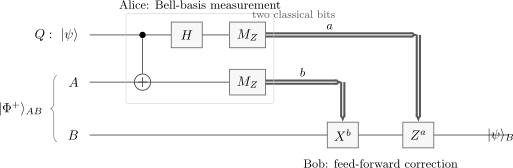
Canonical qubit teleportation circuit. Alice applies the inverse Bell transform and measures and , producing bits and . Bob applies followed by , so the net correction operator is . Double lines carry classical information; Bob’s quantum wire never crosses from Alice’s laboratory.
The circuit makes a timing fact visible. Bob may postpone the physical correction and track a Pauli frame, but he must receive and before he can interpret a noncommuting later measurement or deliver an unconditional output state. Classical feed-forward is part of the protocol, not optional bookkeeping.
Why There Is No Faster-Than-Light Signal
Section titled “Why There Is No Faster-Than-Light Signal”Bob without the message
Section titled “Bob without the message”Conditioned on , Bob’s state is
Before the message arrives, Bob must average over the four outcomes:
Write an arbitrary input density operator as
Conjugation by the four Pauli operators changes the signs of the Bloch components in all combinations. The components cancel in the average, leaving
Bob’s local state is therefore maximally mixed and independent of Alice’s input. No local measurement at Bob can reveal whether Alice has performed the Bell measurement, which input she held, or which outcome she obtained.
Only after a classical message traveling no faster than the allowed signaling speed can Bob select the correct conditional branch. Entanglement supplies correlations; it does not supply a controllable superluminal channel.
The two bits contain no state description
Section titled “The two bits contain no state description”The outcome distribution is
for every input pure state. The bits do not encode estimates of and . Repeating the protocol on identically prepared inputs gives uniformly random Bell labels, not a tomography record of the input. Their role is to identify which Pauli frame Bob occupies.
This is why a continuum of possible qubit states can be teleported using only two classical bits. The continuous quantum information was already represented relationally in the input and the shared entanglement; the bits merely unlock the correct branch.
Why Teleportation Is Not Cloning
Section titled “Why Teleportation Is Not Cloning”Alice’s Bell measurement consumes the original input as an independently available state. After the measurement, the registers occupy a definite Bell-outcome branch, while Bob’s register contains the Pauli-rotated input. Once Bob corrects, there is one accessible copy at , not one at and another at .
If a deterministic protocol left
for every unknown , it would violate No-Cloning and No-Signaling. Teleportation avoids that conclusion by transferring rather than duplicating the state.
The word “unknown” does not mean no physical system has information about the input. The input may be entangled with an external reference. It means Alice need not possess a classical specification from which she could prepare another copy.
The Reference-System Test
Section titled “The Reference-System Test”The pure-state derivation is useful, but the strongest statement treats the input as part of an arbitrary joint state with an inaccessible reference . An ideal teleportation protocol satisfies
where the last expression relabels subsystem as .
Thus teleportation preserves:
- mixed input states;
- entanglement between the input and a reference;
- coherence relative to degrees of freedom outside Alice’s control;
- the action of the identity channel on every operator, not only selected test states.
This test distinguishes genuine quantum state transfer from “measure the input and prepare a guessed state.” A measure-and-prepare channel is entanglement breaking: when applied to half of an entangled state, it cannot preserve the original entanglement with .
The same viewpoint connects teleportation to the channel–state correspondence. A maximally entangled resource is the Choi state of an identity channel, and the Bell measurement plus feed-forward turns that static bipartite resource into an operational channel.
Resource Accounting
Section titled “Resource Accounting”For one deterministic ideal qubit teleportation:
| Resource | Consumed or required |
|---|---|
| shared entanglement | one Bell pair, or one ebit |
| classical communication | two bits from Alice to Bob |
| local quantum operations | inverse Bell transform, two measurements, and a Pauli correction or frame update |
| input | one qubit state, consumed at Alice |
| output | one qubit at Bob in the transferred state |
A standard resource inequality is
Here denotes a shared ebit, one classical bit from Alice to Bob, and one ideal use of a qubit channel. The inequality describes convertibility, not a conservation law.
Several costs lie outside the compact notation:
- distributing and verifying the entangled pair;
- storing it until the input and classical controller are ready;
- synchronizing independent sources;
- implementing a complete Bell measurement;
- losses, heralding probability, detector dead time, and reset;
- classical latency and feed-forward electronics;
- purification or error correction for noisy network links.
Teleportation can trade a difficult direct quantum transmission at the time of use for earlier entanglement distribution and later classical communication. Whether that trade is advantageous depends on the platform and network.
Generalizations
Section titled “Generalizations”Qudits
Section titled “Qudits”For a -level system, define
and generalized Pauli operators
The generalized Bell basis has outcomes:
Alice sends the pair , requiring
classical bits in a fixed-length encoding. The shared maximally entangled state has entanglement entropy ebits. Bob applies the inverse generalized Pauli correction.
Continuous variables
Section titled “Continuous variables”Continuous-variable teleportation replaces the finite Bell basis by joint quadrature measurements and uses an EPR-like two-mode squeezed state. The two real-valued outcomes determine phase-space displacement feed-forward. Finite squeezing adds noise, so the ideal identity channel is approached only in a limiting resource regime. The finite-dimensional qubit protocol should not be transferred to continuous variables without changing both the resource and benchmark conventions.
Gate teleportation and measurement-based computation
Section titled “Gate teleportation and measurement-based computation”If a resource state has a gate embedded in it, Bell measurement and feed-forward can produce at the output. For Clifford , Pauli byproducts remain Pauli under propagation; for non-Clifford gates, correction structure is more demanding. This idea underlies teleportation-based gates, magic-state injection, and parts of Measurement-Based Quantum Computation.
The same correction structure appears in Blind and Delegated Quantum Computation, where a client masks adaptive measurement angles and tracks encrypted outcomes while logical information propagates through a graph state. Distributed Quantum Computing owns remote-gate constructions, teledata–telegate choices, partitioning, scheduling, and program-level resource accounting. The state-transfer identity remains the core primitive here. Protocol-specific privacy, verification, gate synthesis, and fault-tolerance costs belong to the corresponding computation pages.
Noisy Resources and Teleportation Fidelity
Section titled “Noisy Resources and Teleportation Fidelity”Bell-diagonal resource
Section titled “Bell-diagonal resource”Suppose the shared pair is Bell diagonal:
with . Running the standard Bell measurement and correction produces a Pauli channel:
The ideal resource has . The other Bell components appear as residual Pauli errors at Bob. This is a precise sense in which imperfect entanglement becomes channel noise.
For this qubit Pauli channel, the entanglement fidelity relative to the identity is
and the Haar-averaged pure-state fidelity is
Local unitary optimization can relabel which Bell component is treated as the target. More general resources and protocols are characterized by their maximal singlet fraction and the allowed local operations.
The classical benchmark
Section titled “The classical benchmark”For one unknown pure qubit drawn uniformly from the Bloch sphere, any deterministic measure-and-prepare strategy has
An ideal teleporter reaches . Exceeding under the stated ensemble and deterministic accounting rules rules out that classical strategy class.
The number is not a universal teleportation benchmark. It changes or becomes inapplicable when:
- the input ensemble is not Haar uniform;
- the protocol postselects successful events;
- loss and no-output events are omitted from the denominator;
- multiple input copies or side information are available;
- the figure of merit is worst-case, entanglement, or process fidelity;
- continuous-variable states use an energy-constrained ensemble.
A trustworthy experiment states the ensemble, heralding rule, success probability, correction policy, loss treatment, and confidence interval alongside fidelity.
What an implementation should report
Section titled “What an implementation should report”A complete teleportation demonstration separates:
- resource quality: fidelity or entanglement of the shared pair;
- Bell analyzer: which outcomes are resolved and with what success probability;
- input independence: whether the input source is independent of the entanglement source;
- feed-forward: whether Bob receives and uses the classical result in real time;
- output availability: whether a freely usable output remains after heralding and verification;
- state-transfer quality: conditional and unconditional fidelities with uncertainties;
- rate: attempts, heralds, accepted outputs, and latency;
- channel test: whether selected-state tomography or a reference-entanglement/process test is used.
Postselected teleportation can be valuable, especially in photonic systems, but success probability and output conditioning are part of the protocol claim. A high conditional fidelity at vanishing success rate is not equivalent to a deterministic high-rate channel.
What Is and Is Not Transmitted
Section titled “What Is and Is Not Transmitted”Teleportation transfers:
- the complete quantum state supported by the input Hilbert space;
- coherence and entanglement with external systems;
- the ability to reproduce every later measurement statistic at Bob;
- an unknown state without Alice learning its amplitudes.
Teleportation does not transfer:
- the original material carrier;
- a classical list of amplitudes;
- a second perfect copy;
- usable information before the classical message arrives;
- energy or matter instantaneously;
- entanglement without consuming or transforming network resources;
- immunity to loss, decoherence, detector error, or finite-rate constraints.
The safest operational statement is: the protocol simulates an identity quantum channel from Alice’s input register to Bob’s output register, using pre-shared entanglement and classical communication.
Common Mistakes
Section titled “Common Mistakes”- Saying the particle itself is teleported.
- Saying Alice measures or learns and .
- Omitting the two classical bits from the protocol.
- Treating Bob’s conditional state as usable before he knows the condition.
- Forgetting that the input and shared Bell pair are consumed.
- Describing teleportation as cloning.
- Treating entanglement distribution as free or instantaneous.
- Assuming every physical Bell analyzer is deterministic and complete.
- Quoting without defining the input ensemble and postselection rule.
- Verifying only a few convenient states and calling that an unconditional identity channel.
- Confusing state teleportation with entanglement swapping, where no independent input state is transferred.
Exercises
Section titled “Exercises”1. Derive the Bell decomposition
Section titled “1. Derive the Bell decomposition”Starting from
expand and recover the four-term Bell-basis identity.
Solution
The computational-basis expansion is
Use
Collecting Bob’s qubit in each Bell sector gives
which is the stated identity because the four Bob states are , , , and .
2. Uniform outcomes
Section titled “2. Uniform outcomes”Why does every Bell outcome have probability , independent of the input state?
Solution
Each Bell branch in the decomposition has amplitude factor . The corresponding Bob state is a unitary Pauli transform of a normalized input, so its norm is one. Therefore each branch has squared norm
The result does not depend on or . Consequently, Alice’s two-bit record is uniformly random and carries no classical state description.
3. Correction for outcome 11
Section titled “3. Correction for outcome 11”For outcome , Bob holds . Show that applying recovers the input.
Solution
Using ,
Hence
Applying instead would give because . The minus sign is a global phase, so both conventions describe the same output ray.
4. No-signaling Pauli twirl
Section titled “4. No-signaling Pauli twirl”Let
Evaluate the average of , , , and .
Solution
Pauli conjugation changes Bloch-vector signs:
Adding these to cancels every Bloch component. Dividing by four yields
Bob’s unconditioned state is independent of the input.
5. Reference entanglement
Section titled “5. Reference entanglement”Suppose begins in . What must an ideal teleportation channel produce, and why can a measure-and-prepare channel not do the same?
Solution
Ideal teleportation applies the identity to while leaving untouched, so the final state is
The entanglement has moved from the partition to . A measure-and-prepare channel first converts into a classical outcome and then prepares conditionally. Such a channel is entanglement breaking, so its output across is separable and cannot equal a Bell state.
6. Why the original is gone
Section titled “6. Why the original is gone”Explain why teleportation does not violate no-cloning even though Bob obtains the exact unknown state.
Solution
Alice performs a joint measurement on the input and her entangled qubit . After that measurement, is not still available in the state ; it belongs to a recorded Bell-outcome branch. Bob’s corrected register is the only output copy. The map is state transfer,
with other registers changed, not the forbidden cloning map
7. Qudit resources
Section titled “7. Qudit resources”How much entanglement and classical communication does ideal teleportation of a -level state use?
Solution
The shared state has equal Schmidt coefficients, so its entanglement entropy is
ebits. The generalized Bell measurement has outcomes. A fixed-length message identifying one outcome requires
classical bits. Bob then applies one of generalized Pauli corrections.
8. Bell-diagonal noise
Section titled “8. Bell-diagonal noise”A shared resource has and the remaining probability distributed among the other Bell states. Find the entanglement fidelity and average qubit teleportation fidelity of the standard protocol.
Solution
For the Bell-diagonal resource,
The qubit average fidelity is
This calculation assumes the target Bell component has already been aligned with and uses the deterministic standard protocol.
9. Benchmark audit
Section titled “9. Benchmark audit”An experiment reports a conditional average fidelity of and says it beats “the classical limit.” What additional information is needed?
Solution
At minimum, the report must state:
- the input-state ensemble and sampling weights;
- whether inputs are independently prepared;
- the accepted-event or heralding rule;
- the success probability and treatment of no-output events;
- whether Pauli feed-forward is applied or inferred afterward;
- the classical comparison strategy and allowed side information;
- statistical uncertainty and state-estimation bias.
The familiar bound applies to a deterministic measure-and-prepare channel acting on one Haar-uniform unknown pure qubit. A conditional does not establish that comparison unless the experiment’s contract matches it.
10. Deferred correction
Section titled “10. Deferred correction”Bob plans to measure immediately after teleportation. How can he use a Pauli frame instead of physically applying ?
Solution
A preceding correction commutes with a measurement and does not change its outcome. A preceding correction anticommutes with and flips the outcome label. Bob can therefore measure directly and reinterpret the raw bit as
The phase bit is irrelevant for this particular final measurement. For a different basis or a later non-Clifford operation, both frame bits may affect the required interpretation or control.
Further Connections
Section titled “Further Connections”- No-Cloning and No-Signaling proves the general operational restrictions that teleportation obeys.
- Communication with Quantum Systems places teleportation in the common task, channel, assistance, error, rate, and constraint framework and states its resource inequality.
- Superdense Coding uses the same Bell-pair and Bell-basis machinery for the complementary conversion of one transmitted qubit into two classical bits.
- Entanglement Swapping uses a Bell measurement to convert two neighboring entangled links into one conditional remote link, with no independent input state.
- Entanglement Distillation explains how several noisy shared pairs can be converted into fewer higher-fidelity teleportation resources, including the acceptance and yield cost.
- Bell States
- Conditional States
- Entanglement Sharing
- Multi-Qubit Gates
- Circuit Model
- Quantum Instruments
- No-Cloning Theorem
- Entanglement Measures
- Quantum Information Roadmap
References
Section titled “References”- C. H. Bennett, G. Brassard, C. Crépeau, R. Jozsa, A. Peres, and W. K. Wootters, “Teleporting an unknown quantum state via dual classical and Einstein–Podolsky–Rosen channels,” Physical Review Letters 70, 1895–1899, 1993, doi:10.1103/PhysRevLett.70.1895.
- S. Massar and S. Popescu, “Optimal extraction of information from finite quantum ensembles,” Physical Review Letters 74, 1259–1263, 1995, doi:10.1103/PhysRevLett.74.1259.
- D. Bouwmeester, J.-W. Pan, K. Mattle, M. Eibl, H. Weinfurter, and A. Zeilinger, “Experimental quantum teleportation,” Nature 390, 575–579, 1997, doi:10.1038/37539.
- D. Boschi, S. Branca, F. De Martini, L. Hardy, and S. Popescu, “Experimental realization of teleporting an unknown pure quantum state via dual classical and Einstein–Podolsky–Rosen channels,” Physical Review Letters 80, 1121–1125, 1998, doi:10.1103/PhysRevLett.80.1121.
- A. Furusawa, J. L. Sørensen, S. L. Braunstein, C. A. Fuchs, H. J. Kimble, and E. S. Polzik, “Unconditional quantum teleportation,” Science 282, 706–709, 1998, doi:10.1126/science.282.5389.706.
- M. Horodecki, P. Horodecki, and R. Horodecki, “General teleportation channel, singlet fraction, and quasidistillation,” Physical Review A 60, 1888–1898, 1999, doi:10.1103/PhysRevA.60.1888.
- D. Gottesman and I. L. Chuang, “Demonstrating the viability of universal quantum computation using teleportation and single-qubit operations,” Nature 402, 390–393, 1999, doi:10.1038/46503.
- R. F. Werner, “All teleportation and dense coding schemes,” Journal of Physics A: Mathematical and General 34, 7081–7094, 2001, doi:10.1088/0305-4470/34/35/332.
- X.-S. Ma, T. Herbst, T. Scheidl, D. Wang, S. Kropatschek, W. Naylor, B. Wittmann, A. Mech, J. Kofler, T. Jennewein, R. Ursin, and A. Zeilinger, “Quantum teleportation over 143 kilometres using active feed-forward,” Nature 489, 269–273, 2012, doi:10.1038/nature11472.
- S. Pirandola, J. Eisert, C. Weedbrook, A. Furusawa, and S. L. Braunstein, “Advances in quantum teleportation,” Nature Photonics 9, 641–652, 2015, doi:10.1038/nphoton.2015.154.
- J.-G. Ren et al., “Ground-to-satellite quantum teleportation,” Nature 549, 70–73, 2017, doi:10.1038/nature23675.
- M. A. Nielsen and I. L. Chuang, Quantum Computation and Quantum Information, 10th anniversary ed., Cambridge University Press, 2010, doi:10.1017/CBO9780511976667.
Summary
Section titled “Summary”Quantum teleportation turns one shared Bell pair and two classical bits into one use of an identity quantum channel. Alice’s Bell measurement places Bob in one of four Pauli frames; the two-bit message identifies the frame, and Bob corrects it. Before that message arrives, Bob’s state is maximally mixed, so the protocol cannot signal faster than light.
The input is transferred rather than copied. The strongest test is preservation of entanglement with an arbitrary reference, which establishes channel identity rather than agreement on a few test states. In realistic implementations, entanglement quality, Bell-measurement success, feed-forward, loss, heralding, rate, and a declared fidelity benchmark all belong to the protocol claim.