No-Cloning and No-Signaling
Two restrictions organize quantum communication before any protocol is built.
No-cloning says that one physical device cannot make exact, deterministic copies of every state in a nonorthogonal family. No-signaling says that a party cannot encode a message into another party’s unconditioned local statistics merely by choosing a local operation on a shared state. The first limits replication; the second limits controllable remote influence.
They are often mentioned together because a hypothetical perfect cloner could turn different ensemble decompositions of the same density operator into a superluminal communication scheme. They are nevertheless different statements. No-cloning follows from the linear, inner-product-preserving structure of quantum dynamics. No-signaling is an operational constraint on observable marginal probabilities. Neither slogan should be used as a substitute for its assumptions.
Canonical Scope
Section titled “Canonical Scope”This page is the canonical home for the operational no-cloning theorem, its proof and allowed relaxations, and the no-signaling theorem for local quantum operations. It also owns the communication consequences and the distinction between no-signaling, postselection, Bell locality, and relativistic causality.
The No-Cloning Theorem reference card provides a compact lookup. No-Broadcasting Theorem owns the mixed-state generalization. Local Measurement Statistics and Conditional States own the underlying reduced-state calculations. Entanglement in Foundations and the Bell Theorem develop the deeper foundational questions.
Two Operational Prohibitions
Section titled “Two Operational Prohibitions”The two results answer different task questions.
| Result | Hypothetical task | What is held fixed? | What is ruled out? |
|---|---|---|---|
| no-cloning | turn one input state into two exact copies | one physical map for a declared input family | exact deterministic copying of any family containing distinct nonorthogonal pure states |
| no-signaling | choose a local setting that changes a remote party’s observed distribution | no physical communication and no conditioning on an unavailable outcome | setting-dependent remote marginal probabilities |
Neither theorem says that quantum systems cannot carry information. Orthogonal states can encode classical records and can be copied. A quantum system can be sent through a channel. Entanglement can create correlations stronger than those allowed by Bell-local models. What fails is a more specific operation: universal exact replication, or controllable remote communication without a carrier.
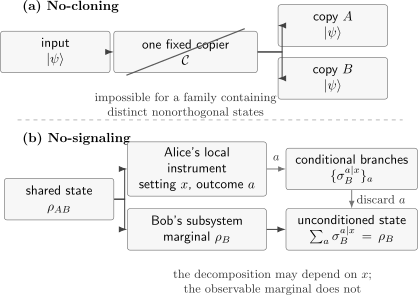
The two operational constraints. A single exact copier cannot duplicate every state in a nonorthogonal family. For a shared state , Alice’s local instrument may change Bob’s state conditioned on outcome , but discarding that outcome gives for every setting .
No-Cloning Theorem
Section titled “No-Cloning Theorem”Let be a possible input family. An exact deterministic cloner would be one physical channel , independent of , such that
for every . The blank state and the device are fixed. The input label is not supplied as side information.
The theorem can be stated sharply:
A single physical process can exactly and deterministically clone a family of pure states only when every pair is either orthogonal or represents the same ray. In particular, no universal cloner exists for all pure states of a nontrivial quantum system.
The common word “unknown” is operational shorthand. It does not impose a mysterious property on the state. It means that the device must work without being told which member of the promised family arrived. If a complete classical description of one fixed state is already known, another instance can simply be prepared.
Inner-product proof
Section titled “Inner-product proof”Every channel admits a Stinespring dilation. If exact cloning were possible, an isometry could act on the input, a blank register, and a fixed environment state as
Isometries preserve inner products. Writing gives
Taking absolute values,
For distinct nonorthogonal states, , so . The two inequalities contradict each other. Exact cloning is possible only for , meaning orthogonal alternatives, or , meaning the same physical pure state up to phase.
This proof includes noisy open-system implementations: any environment, ancilla, measurement, and discarded record can be absorbed into the dilation. Allowing a larger laboratory does not evade the theorem.
Linearity made visible
Section titled “Linearity made visible”Suppose a controlled-NOT gate copies the computational-basis alternatives:
For a superposition , linearity requires
This output is generally entangled. Two copies would instead be
The cross terms expose the contradiction. A gate that copies one orthogonal basis copies the classical label represented by that basis; it does not clone arbitrary superpositions.
What can still be copied?
Section titled “What can still be copied?”No-cloning has exact qualifications, not loopholes.
| Task | Possible? | Reason |
|---|---|---|
| prepare another instance of a known state | yes | the classical preparation description is available |
| copy states from one known orthogonal basis | yes | measure the basis label and reprepare it, or copy it coherently |
| clone an arbitrary nonorthogonal family exactly and deterministically | no | inner products cannot be preserved |
| clone selected linearly independent states exactly with a heralded failure outcome | sometimes | success need not occur on every run |
| produce imperfect copies | yes | fidelity remains below one for some inputs |
| broadcast a commuting mixed-state family | yes | the family is classical in one common eigenbasis |
A probabilistic exact cloner has a success flag. On success it produces exact copies, but its success probability is below one; a finite family of pure states is probabilistically cloneable precisely when it is linearly independent. An approximate cloner is deterministic but sacrifices fidelity. For example, each marginal output of the optimal symmetric universal qubit cloner has state fidelity
That value is an optimum for a specific universal, symmetric, single-copy task. It is not a generic fidelity bound for every state-dependent or asymmetric cloning problem.
Cloning and broadcasting are not synonyms
Section titled “Cloning and broadcasting are not synonyms”For a mixed input , cloning would demand the product output
Broadcasting asks only for an output whose two marginals are both :
The output may be correlated, so broadcasting is weaker. A family of density operators is exactly broadcastable by one channel if and only if its members commute. For pure inputs, a pure marginal cannot be correlated with another system, so broadcasting reduces to cloning. The full theorem and its mixed-state interpretation live in the No-Broadcasting Theorem.
No-Signaling as a Probability Constraint
Section titled “No-Signaling as a Probability Constraint”Consider two separated parties. Alice chooses a setting and records an outcome ; Bob chooses and records . Their experiment defines
No-signaling from Alice to Bob means that Bob’s marginal does not depend on Alice’s setting:
for every . No-signaling from Bob to Alice similarly requires
These equations do not require factorization. The joint distribution may contain strong correlations, and learning Alice’s setting and outcome may change Bob’s conditional distribution. The restriction is that Bob cannot detect Alice’s freely chosen setting from his local, unconditioned data.
Operationally, a signaling test must specify:
- which variables are settings and outcomes;
- which events are included in the trial sample;
- which information is locally available before classical communication;
- whether the tested probabilities are conditional or unconditional; and
- the spacetime and statistical assumptions behind the claim.
Why Local Quantum Operations Cannot Signal
Section titled “Why Local Quantum Operations Cannot Signal”Let be an arbitrary shared state. Alice chooses a local trace-preserving channel with Kraus operators :
After Alice’s operation, the joint state is
To compare Bob’s states, test them against an arbitrary observable . Cyclicity of the full trace and trace preservation give
Because this equality holds for every , Bob’s reduced state is unchanged:
The result holds for every initial state, including entangled states, and for every local trace-preserving quantum channel. Alice may rotate, dephase, measure and forget the outcome, attach an ancilla, or discard her subsystem. Without a system or classical record reaching Bob, his local statistics do not reveal .
Instruments, branches, and postselection
Section titled “Instruments, branches, and postselection”A measurement is more finely described by an instrument . Bob’s unnormalized conditional state is
Its trace is the branch probability,
and, when that probability is nonzero, the normalized conditional state is
Different settings and outcomes can produce different conditional states. That is remote steering at the level of an ensemble decomposition. But if Bob does not know which outcome occurred, he must average:
for every . Selecting a branch requires Alice’s outcome record, and delivering that record is ordinary classical communication. A trace- nonincreasing branch by itself is therefore not a counterexample to no-signaling.
Worked Example: Two Remote Decompositions
Section titled “Worked Example: Two Remote Decompositions”Suppose Alice and Bob share
Bob’s reduced state is maximally mixed:
If Alice measures in the basis, Bob’s unnormalized conditional states are
If she measures in the basis, where , they are
The ensembles differ, but their averages do not:
No measurement performed only on Bob’s system can determine whether Alice chose or . Once Alice communicates her setting and outcome, Bob can sort his records into different conditional ensembles and observe the correlations.
Why a Perfect Cloner Would Be Dangerous
Section titled “Why a Perfect Cloner Would Be Dangerous”The worked example also shows why cloning and signaling are historically linked. Imagine, contrary to quantum mechanics, that Bob could perfectly clone the pure state arriving in each run. He could make many replicas, estimate that run’s state with arbitrary precision, and decide whether Alice prepared a -basis or -basis ensemble. Alice’s setting would then become readable before her classical message arrived.
The legitimate density operator has no observable tag identifying its ensemble decomposition. A universal cloner that acted differently on those decompositions would fail to be a linear, well-defined channel on density operators. This counterfactual explains a shared mathematical pressure: linearity protects both ensemble equivalence and no-signaling.
It does not make the two propositions logically identical. General no-signaling theories can have state spaces and correlations unlike quantum theory. Conversely, the no-cloning theorem by itself is not a complete statement of relativistic causality.
No-Signaling Is Weaker Than Bell Locality
Section titled “No-Signaling Is Weaker Than Bell Locality”A Bell-local model has the factorized form
This condition implies no-signaling, but the converse is false. Quantum correlations from entangled states can violate Bell inequalities while their local marginals remain independent of the remote settings.
For the CHSH expression , the familiar hierarchy is
Thus no-signaling alone permits hypothetical correlations stronger than quantum mechanics, such as Popescu–Rohrlich boxes. Quantum theory occupies a proper subset of the no-signaling correlation set. The CHSH Inequality owns the derivation of these bounds, while Entanglement in Foundations separates entanglement, steering, Bell nonlocality, and causal language.
No-Signaling and Relativistic Causality
Section titled “No-Signaling and Relativistic Causality”The tensor-product theorem proved above is an operational statement about local subsystem operations. It should not be silently promoted into every notion of spacetime causality.
In a laboratory model, “local” means that Alice’s channel acts as on a declared tensor factor. The theorem then says that Bob’s reduced state is unchanged. It does not by itself assign spacetime positions, establish a finite propagation speed, or prove microcausality for quantum fields.
Relativistic quantum theory adds spacetime structure. Observables associated with spacelike separated regions commute in standard local quantum field theory, and admissible operations must respect the corresponding causal organization. General bipartite channels can also be classified by whether they signal in neither direction, one direction, or both; being non-signaling does not automatically mean that an operation can be implemented by separated parties using only local operations and shared entanglement.
The Causality, Support, and Interpretation page treats finite-speed propagation and explains why instantaneous support of a nonrelativistic wavefunction is a different issue.
Consequences for Communication Protocols
Section titled “Consequences for Communication Protocols”Teleportation needs the classical message
Section titled “Teleportation needs the classical message”Before Alice’s two classical bits arrive in qubit teleportation, Bob’s state averaged over her Bell-measurement outcomes is
It contains no locally accessible dependence on . Alice’s bits identify the Pauli frame and make the transfer usable. The input is consumed, so Quantum Teleportation respects both no-cloning and no-signaling.
Repeaters cannot copy and amplify
Section titled “Repeaters cannot copy and amplify”A classical repeater can read a symbol and regenerate many copies. A quantum repeater cannot measure an unknown qubit, clone it, and forward perfect instances. It instead distributes entanglement over elementary links, stores heralded successes, improves entanglement when allowed, and connects links by entanglement swapping. Each resource and failure probability must remain in the network ledger.
Quantum error correction encodes rather than clones
Section titled “Quantum error correction encodes rather than clones”An encoding isometry can map
across many physical systems. Those systems are not independent copies of the logical qubit. Their reduced states generally do not equal the input state, and syndrome measurements reveal error information without revealing the logical amplitudes. Why Quantum Error Correction Is Possible owns that resolution.
QKD needs more than no-cloning
Section titled “QKD needs more than no-cloning”No-cloning prevents a perfect “copy now, measure later” attack on arbitrary nonorthogonal signals. It does not bound Eve’s optimal approximate attack, authenticate the classical channel, estimate finite-sample leakage, model detector flaws, or produce a composable secrecy parameter. Those obligations belong to the full Quantum Key Distribution security contract. The BB84 protocol shows concretely how incompatible-basis sampling makes intercept–resend disturbance visible while keeping that diagnostic distinct from a proof against general attacks.
Entanglement does not add a hidden message channel
Section titled “Entanglement does not add a hidden message channel”Pre-shared entanglement can change communication resources: it enables teleportation, superdense coding, entanglement-assisted capacities, and distributed protocols. It cannot transmit a freely chosen message on its own. Every usable protocol includes an actual quantum transmission, classical communication, or both. The task ledger in Communication with Quantum Systems makes those carriers explicit.
Auditing a Claimed Violation
Section titled “Auditing a Claimed Violation”For a cloning claim, ask:
- What input family is promised?
- Is the same map used for every input?
- Is success deterministic or heralded?
- Are both outputs exact, or is a fidelity reported?
- Is the state itself copied, or only a classical label or observable?
- Are the two marginal copies assessed independently of correlations?
For a no-signaling claim, ask:
- Which remote setting is supposed to encode the message?
- Which local marginal is compared across settings?
- Was data postselected using a remote outcome or coincidence window?
- Could source drift, detector efficiency, trial definition, or memory correlate settings with the sample?
- Was an actual carrier, shared control line, or classical side channel present?
- Is the statement about subsystem marginals, Bell locality, or relativistic propagation?
Finite data will rarely satisfy empirical marginal equalities exactly. A serious analysis reports an effect estimate and uncertainty under a declared trial model. Small apparent signaling in a Bell data set is not automatically new physics; it first demands an audit of sampling, setting generation, detector behavior, timing, drift, and multiple testing.
Common Mistakes
Section titled “Common Mistakes”- Saying “quantum information cannot be copied.” Known states and orthogonal state families can be copied.
- Treating “unknown” as a metaphysical property rather than a promise that the device does not receive the input label.
- Calling an approximate or probabilistic cloner a violation of no-cloning.
- Assuming that a controlled-NOT gate clones arbitrary qubits because it copies and .
- Treating cloning and broadcasting as identical for mixed states.
- Inferring that entanglement permits a message without a transmitted system or classical record.
- Mistaking a postselected conditional state for Bob’s unconditioned local state.
- Saying no-signaling removes quantum correlations. It constrains marginals, not joint distributions.
- Equating no-signaling with Bell locality or with every notion of relativistic locality.
- Using no-cloning as a complete QKD security proof or as an objection to quantum error correction.
Exercises
Section titled “Exercises”1. Basis copying is not universal cloning
Section titled “1. Basis copying is not universal cloning”Apply a controlled-NOT gate to . Compare the output with and explain the difference.
Solution
Since , linearity gives
Two copies would be
The first state is entangled and has maximally mixed one-qubit marginals. The second is a product state with pure marginals. Controlled-NOT copies the computational-basis label, not an arbitrary input state.
2. Pairwise condition for exact cloning
Section titled “2. Pairwise condition for exact cloning”Suppose one isometry exactly clones every state in a finite set . Show that each pair must be orthogonal or identical up to phase.
Solution
For any pair , inner-product preservation gives
Therefore
Because , this can hold only when or . The first case is orthogonality. The second means that normalized pure states differ only by a phase and represent the same ray.
3. Why pure-state broadcasting becomes cloning
Section titled “3. Why pure-state broadcasting becomes cloning”Let have a pure marginal . Show that for some .
Solution
Choose a basis whose first vector is . The probability for the system to lie in the orthogonal subspace is zero:
Positivity then implies that has support only on the subspace . Every operator on that subspace has the form . If the marginal is also , the output is the cloned product state.
4. No-signaling for a discarded measurement
Section titled “4. No-signaling for a discarded measurement”Alice performs a projective measurement and discards the result. Prove directly that Bob’s reduced state remains .
Solution
The nonselective joint state is
For every ,
where . Equality of all local expectation values implies .
5. Conditional change without signaling
Section titled “5. Conditional change without signaling”For , Alice measures and obtains outcome . What state does Bob assign before and after learning that outcome? Why is the change not a signal?
Solution
Without Alice’s outcome, Bob assigns
Conditioned on outcome , he assigns . The conditional state changes because the classical record selects a subensemble. Bob cannot know which subensemble he occupies from his local data; Alice must communicate the outcome. His unconditioned state is unchanged.
6. A no-signaling correlation beyond quantum theory
Section titled “6. A no-signaling correlation beyond quantum theory”Let binary outcomes satisfy with probability one, and assign probability to each of the two outcome pairs satisfying that equation. Show that the distribution is no-signaling and reaches the algebraic CHSH value .
Solution
For every fixed , exactly one allowed pair has and one has , each with probability . Thus , independent of . Likewise , independent of , so the distribution is no-signaling.
Writing outcomes as signs, the relation gives correlations
Hence
This exceeds the quantum Tsirelson bound . No-signaling is therefore strictly weaker than belonging to the quantum correlation set.
7. Teleportation before the classical bits
Section titled “7. Teleportation before the classical bits”Show that averaging the four Pauli-corrected versions of an arbitrary qubit state gives .
Solution
Write
Conjugation by the four Pauli operators preserves the identity and changes the signs of the Bloch-vector components in a balanced way. Therefore
Before receiving Alice’s two-bit outcome, Bob sees this average and cannot extract the teleported state. The classical message identifies which Pauli frame applies.
8. Error correction versus copying
Section titled “8. Error correction versus copying”The repetition-code map sends to . Show from one-qubit reduced states that the three output qubits are not three copies of the input.
Solution
Tracing out any two output qubits removes the coherence between and :
The original pure-state density operator is
For a genuine superposition, the reduced output lacks the off-diagonal terms and is not equal to . The logical amplitudes reside in nonlocal correlations of the codeword, not in independent physical copies.
Further Connections
Section titled “Further Connections”- Communication with Quantum Systems supplies the task, channel, assistance, error, rate, and constraint language.
- Quantum Teleportation gives the canonical protocol and Pauli-twirl no-signaling calculation.
- Quantum Key Distribution develops composable security beyond the no-cloning slogan.
- BB84 derives the canonical four-state protocol and the limits of its intercept–resend disturbance argument.
- No-Broadcasting Theorem states the exact commuting-family criterion for mixed states.
- Local Measurement Statistics derives local marginals from the Born rule and partial trace.
- Conditional States treats selective measurements, subnormalized branches, and remote ensembles.
- Bell Theorem separates Bell-local factorization from operational no-signaling.
- Why Quantum Error Correction Is Possible explains encoding, syndrome extraction, and the no-cloning boundary.
- Quantum Information Roadmap places these restrictions before communication protocols and security proofs.
References
Section titled “References”- W. K. Wootters and W. H. Zurek, “A single quantum cannot be cloned,” Nature 299, 802–803 (1982), doi:10.1038/299802a0.
- D. Dieks, “Communication by EPR devices,” Physics Letters A 92, 271–272 (1982), doi:10.1016/0375-9601(82)90084-6.
- H. Barnum, C. M. Caves, C. A. Fuchs, R. Jozsa, and B. Schumacher, “Noncommuting mixed states cannot be broadcast,” Physical Review Letters 76, 2818–2821 (1996), doi:10.1103/PhysRevLett.76.2818.
- V. Bužek and M. Hillery, “Quantum copying: Beyond the no-cloning theorem,” Physical Review A 54, 1844–1852 (1996), doi:10.1103/PhysRevA.54.1844.
- N. Gisin and S. Massar, “Optimal quantum cloning machines,” Physical Review Letters 79, 2153–2156 (1997), doi:10.1103/PhysRevLett.79.2153.
- L.-M. Duan and G.-C. Guo, “Probabilistic cloning and identification of linearly independent quantum states,” Physical Review Letters 80, 4999–5002 (1998), doi:10.1103/PhysRevLett.80.4999.
- V. Scarani, S. Iblisdir, N. Gisin, and A. Acín, “Quantum cloning,” Reviews of Modern Physics 77, 1225–1256 (2005), doi:10.1103/RevModPhys.77.1225.
- N. Gisin, “Weinberg’s non-linear quantum mechanics and supraluminal communications,” Physics Letters A 143, 1–2 (1990), doi:10.1016/0375-9601(90)90786-N.
- J. Polchinski, “Weinberg’s nonlinear quantum mechanics and the Einstein–Podolsky–Rosen paradox,” Physical Review Letters 66, 397–400 (1991), doi:10.1103/PhysRevLett.66.397.
- C. Simon, V. Bužek, and N. Gisin, “No-signaling condition and quantum dynamics,” Physical Review Letters 87, 170405 (2001), doi:10.1103/PhysRevLett.87.170405.
- D. Beckman, D. Gottesman, M. A. Nielsen, and J. Preskill, “Causal and localizable quantum operations,” Physical Review A 64, 052309 (2001), doi:10.1103/PhysRevA.64.052309.
- S. Popescu and D. Rohrlich, “Quantum nonlocality as an axiom,” Foundations of Physics 24, 379–385 (1994), doi:10.1007/BF02058098.
- J. Barrett, N. Linden, S. Massar, S. Pironio, S. Popescu, and D. Roberts, “Nonlocal correlations as an information-theoretic resource,” Physical Review A 71, 022101 (2005), doi:10.1103/PhysRevA.71.022101.
- A. Peres and D. R. Terno, “Quantum information and relativity theory,” Reviews of Modern Physics 76, 93–123 (2004), doi:10.1103/RevModPhys.76.93.
- C. H. Bennett, G. Brassard, C. Crépeau, R. Jozsa, A. Peres, and W. K. Wootters, “Teleporting an unknown quantum state via dual classical and Einstein–Podolsky–Rosen channels,” Physical Review Letters 70, 1895–1899 (1993), doi:10.1103/PhysRevLett.70.1895.
- M. A. Nielsen and I. L. Chuang, Quantum Computation and Quantum Information, 10th anniversary ed., Cambridge University Press (2010).
- M. M. Wilde, Quantum Information Theory, 2nd ed., Cambridge University Press (2017), doi:10.1017/9781316809976.
- J. Watrous, The Theory of Quantum Information, Cambridge University Press (2018), doi:10.1017/9781316848142.