Communication with Quantum Systems
Quantum communication uses quantum systems and channels to transmit a classical message, preserve an unknown quantum state, establish entanglement, generate a secret key, or coordinate a distributed quantum task. These goals are not interchangeable. The same physical optical fiber can have a high rate for classical data, zero unassisted quantum capacity over a chosen operating regime, and a nonzero secret-key rate under a specific protocol and adversary model.
A communication claim must therefore name six things:
The task says what must arrive. The channel includes noise, loss, and memory. Assistance includes shared entanglement, feedback, side channels, or trusted relays. The error criterion says when a transmission counts as successful. The rate states the normalization, such as bits per channel use or ebits per second. Constraints include block length, energy, bandwidth, latency, security, and available hardware.
Canonical Scope
Section titled “Canonical Scope”This page is the canonical overview of quantum-communication tasks, point-to-point coding models, resource units, capacity families, finite-block interpretation, and the transition from a channel to a network service.
Quantum Channels owns completely positive trace-preserving maps, Kraus, Stinespring, and Choi representations. Classical Information Review owns finite-alphabet source–channel–code–decoder baselines; this page owns the classical-over-quantum and quantum-state communication tasks, capacity families, and their finite-block and network-service interpretation. Quantum Teleportation owns the Bell-measurement derivation and fidelity benchmark for that protocol. Entanglement Distillation owns recurrence, hashing, and accepted-quality-versus-yield accounting. Quantum Key Distribution owns composable key security and finite-key distillation. Entanglement Measures owns quantification of shared entanglement, and No-Cloning and No-Signaling owns the operational impossibility proofs and communication consequences. This page connects those ingredients without duplicating them.
Sender, Channel, Receiver, and Reference
Section titled “Sender, Channel, Receiver, and Reference”Classical message transmission
Section titled “Classical message transmission”Let Alice receive a message drawn from a distribution . An encoder maps to an input state for uses of a channel . Bob measures the output and reports :
The average error probability is
where is Bob’s decoding measurement. The encoder may use product or entangled codewords across channel uses, and Bob may need a collective measurement. A receiver restricted to measuring every signal separately is a different communication model.
Quantum-state transmission
Section titled “Quantum-state transmission”To test whether a channel preserves unknown quantum information, include a reference system that never enters the channel. If is maximally entangled with , successful encoding, transmission, and decoding should produce a state close to :
The entanglement fidelity is
Preserving the reference correlation is stronger than reproducing a few known signal states. It tests coherence with arbitrary external systems and is the natural criterion for transmitting a qubit that may be part of a larger computation.
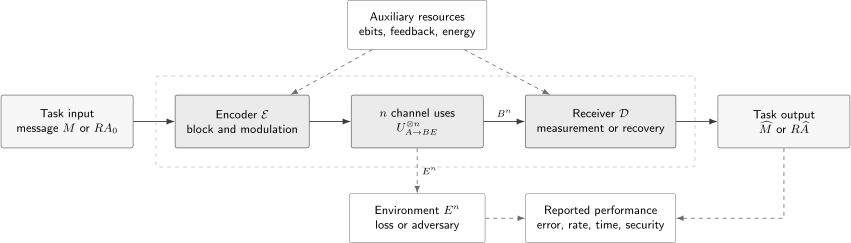
One physical quantum channel supports several operational tasks. Classical communication scores a decoded label; quantum communication scores preserved correlation with an untouched reference; private communication includes the environment as an adversarial output. Shared entanglement, feedback, energy, and timing assumptions change the resource model and therefore the capacity.
The environment is part of the model
Section titled “The environment is part of the model”Every channel has a Stinespring isometry
whose receiver output is and complementary output is . For ordinary reliability, explains lost information. For private communication, represents what an adversary may obtain. A channel can transmit a classical label reliably to Bob while leaking the same label to ; it then has useful classical communication but no privacy for that code.
What Can Be Communicated?
Section titled “What Can Be Communicated?”Classical information in quantum states
Section titled “Classical information in quantum states”Alice can encode a classical label in a quantum state . Orthogonal states can be distinguished perfectly in one shot. Nonorthogonal states cannot, but long block codes and collective measurements can transmit classical information reliably below a channel-dependent rate.
The signal ensemble is the classical–quantum state
Before measurement, Bob has a quantum system correlated with the classical label. After choosing a measurement, he obtains an ordinary random variable . The accessible classical information depends on the whole ensemble and the allowed measurement, not on a classical description of each ket.
Quantum information
Section titled “Quantum information”Quantum transmission preserves superpositions and entanglement with references. It is not equivalent to estimating the state and sending a classical description. No finite classical message can specify an arbitrary unknown state exactly, and measurement generally disturbs the correlations that a quantum channel must preserve.
A noiseless qubit channel can also distribute one ebit: Alice creates a Bell pair locally and sends one half. The converse conversion needs classical communication as well as shared entanglement, as teleportation makes explicit.
Shared entanglement
Section titled “Shared entanglement”Entanglement distribution aims to create a state close to a target shared state, often a Bell pair. Its outputs are correlations rather than a message chosen at transmission time. Shared entanglement can later support teleportation, dense coding, device-independent tests, clock synchronization, or distributed computation.
An entanglement-generation rate must state fidelity, success probability, heralding rule, memory time, and whether failed attempts consume the channel. “Pairs per second” without a quality threshold is not a complete service metric.
Secret classical information
Section titled “Secret classical information”Private communication asks Bob to learn a message while the environment learns asymptotically nothing about it. Key agreement is related but distinct: the parties generate a fresh random shared string rather than transmit a preexisting message. Interactive public discussion can change key-agreement rates even when it does not change a one-way message capacity.
Security statements require an adversary model, authentication, finite-size statistics, device assumptions, and a composable error criterion. A low bit error rate or visible disturbance is evidence inside a protocol, not a standalone security proof.
Resource Units and Conversions
Section titled “Resource Units and Conversions”It is useful to keep ideal resources symbolically distinct:
| Symbol | Resource |
|---|---|
| one noiseless classical bit from Alice to Bob | |
| one noiseless qubit channel use | |
| one shared maximally entangled qubit pair, or ebit | |
| one shared secret classical bit |
A resource inequality means that the resources on the left can simulate those on the right under the declared allowed operations.
Entanglement distribution
Section titled “Entanglement distribution”Sending half of a locally prepared Bell pair gives
This use establishes entanglement; it does not also leave an independent qubit channel use available.
Teleportation
Section titled “Teleportation”One ebit and two forward classical bits simulate one noiseless qubit channel:
The ebit is consumed. The classical message is indispensable, so the protocol does not transmit usable information faster than light.
Superdense coding
Section titled “Superdense coding”Superdense Coding shows that one shared ebit and one transmitted qubit can carry two classical bits:
The gain is relative to a model with preshared entanglement. Preparing and distributing that entanglement has a cost unless it is explicitly supplied as an auxiliary resource. The canonical protocol page derives the four orthogonal codewords and separates the ideal identity-channel statement from noisy and experimentally constrained realizations.
These identities are not claims that a qubit “contains two bits” or that an ebit alone carries a message. They describe conversions among resources under specific protocols.
Entanglement Does Not Signal
Section titled “Entanglement Does Not Signal”Suppose Alice and Bob share and Alice applies any local trace-preserving channel . Bob’s reduced state is unchanged:
Alice can change correlations and conditional states, but without a message Bob cannot know which local operation or measurement outcome occurred. This is why entanglement assists communication without replacing a communication channel.
Postselection must be handled carefully. Conditioned on an outcome known to Alice, Bob’s state can change. Before Alice communicates that outcome, Bob sees the average over outcomes, which remains independent of her choice for a valid local instrument.
Classical Information and the Holevo Quantity
Section titled “Classical Information and the Holevo Quantity”For an ensemble with average , define
where . Equivalently, for the classical–quantum state . For every measurement outcome ,
This is the Holevo bound. It limits the classical information accessible from one ensemble, but it does not say that a -dimensional system stores only one fixed classical variable. The bound depends on the ensemble, and coding over many channel uses can make collective measurements essential.
For a channel , the one-use Holevo information optimized over input ensembles is
The unassisted classical capacity permits coding across many uses:
The regularization matters because entangled inputs and collective effects can make one-shot optimizations nonadditive. For channels with proved additivity, the formula simplifies to one use; that simplification is not universal.
Quantum Information and Coherent Information
Section titled “Quantum Information and Coherent Information”Let purify an input , and send through a channel isometry to outputs and . The coherent information is
It measures a balance between correlation recoverable by Bob and information lost to the environment. Unlike ordinary mutual information, coherent information can be negative and is not generally additive.
The unassisted quantum capacity is the regularized optimized coherent information:
This is an asymptotic coding theorem: rates below can preserve quantum information with error tending to zero as block length grows. It is not a one-shot fidelity formula, and its regularization can make exact evaluation difficult.
Channels whose environment can simulate Bob’s output are antidegradable. If both Bob and the environment could receive high-fidelity quantum copies, one could violate no-cloning. Antidegradable channels therefore have zero unassisted quantum capacity. Zero does not imply zero classical capacity, and combinations of zero-capacity channels can display nonclassical activation effects.
A Family of Capacities
Section titled “A Family of Capacities”There is no single capacity of a quantum channel because the communication task and free assistance matter.
| Quantity | Task | Assistance | Typical asymptotic unit |
|---|---|---|---|
| reliable classical messages | none | bits per channel use | |
| reliable quantum states or entanglement | none | qubits or ebits per use | |
| private classical messages | secrecy from environment | private bits per use | |
| reliable classical messages | unlimited shared entanglement | bits per use | |
| secret-key agreement | declared public discussion | secret bits per use |
The entanglement-assisted classical capacity has the single-letter formula
where purifies and . The shared entanglement is an explicit resource; comparing with without noting that assistance is not a like-for-like hardware comparison.
Private capacity and key-agreement capacity involve decoupling an adversarial environment and may differ when public interaction or additional resources are permitted. A protocol-specific secret-key rate is not automatically the private capacity of the underlying physical channel.
Feedback and side information
Section titled “Feedback and side information”Classical feedback can improve finite-block performance and coordinate heralded attempts even when it does not change a particular asymptotic capacity. Quantum feedback, two-way classical communication, entanglement assistance, degradability flags, and trusted repeaters define still other capacity regions. Every quoted rate should list the allowed side resources.
Finite Blocks and Asymptotic Rates
Section titled “Finite Blocks and Asymptotic Rates”A capacity is the boundary of a limiting statement. For classical messages, a rate is achievable if there exists a sequence of block codes with
Real links operate at finite , finite latency, and nonzero target error. A finite-block report should specify at least
where is channel uses, the message-set size or logical dimension, the failure criterion, an energy or photon-number constraint where relevant, and the elapsed time. The achievable rate can be below capacity because short blocks spend resources on error detection, synchronization, pilots, and coding overhead.
For bosonic channels an unconstrained input Hilbert space can make an unqualified classical capacity infinite. Mean energy, peak photon number, bandwidth, mode count, and time must be constrained. “Bits per photon,” “bits per mode,” and “bits per second” describe different operating limits.
Strong converse and error conventions
Section titled “Strong converse and error conventions”Some coding theorems have a strong converse: attempting a rate above capacity forces error toward one. Others require more careful error and assistance conditions. Average message error, maximal message error, entanglement infidelity, trace-distance error, and purified-distance error are different criteria. State which convergence defines the capacity being used.
Worked Channel: Flagged Erasure
Section titled “Worked Channel: Flagged Erasure”The -dimensional erasure channel transmits its input perfectly with probability and replaces it with an orthogonal erasure flag with probability :
The flag tells Bob which uses were erased, a major difference from an unflagged replacement error. For this channel,
For a qubit and , these become
bits, qubits, and entanglement-assisted bits per channel use, respectively. The three values differ because they answer different operational questions.
At , : the environment receives at least as informative an erasure pattern as Bob, and the channel is antidegradable. Yet remains positive for every . The channel can still carry some classical information even though it cannot reliably preserve arbitrary quantum information without additional assistance.
Erasure and Loss Channels owns the channel’s Kraus and flag structure. The capacity example here owns only its communication interpretation.
From a Link to a Network
Section titled “From a Link to a Network”A point-to-point capacity treats a sender, receiver, and channel boundary. A network adds routing, shared nodes, memories, scheduling, contention, and possibly adversarial or untrusted stations.
Link layer
Section titled “Link layer”A physical link attempts photon transmission, remote emission, absorption, or heralded entanglement. Useful outputs include:
- success probability per attempt;
- attempt clock and duty cycle;
- Bell-pair fidelity or logical-channel error;
- heralding latency and false-herald probability;
- memory decoherence while waiting; and
- classical-control and synchronization requirements.
The mean raw pair rate is not the delivered high-fidelity rate if purification, multiplexing, or retries consume pairs.
End-to-end entanglement
Section titled “End-to-end entanglement”Quantum Repeaters create neighboring entanglement, store successful links, and use Entanglement Swapping to extend distance. Purification or quantum error correction controls accumulated noise. Because links succeed randomly, waiting-time distributions and memory lifetimes matter as much as average rates.
A simple two-link repeater does not usually complete in the inverse of the sum of mean link rates. It waits for both links, stores the earlier success, then performs a swap whose own success and fidelity enter the ledger. Multiplexing can increase throughput while consuming modes, detectors, switches, and memory capacity.
Network service
Section titled “Network service”Applications may request an ebit of minimum fidelity between named endpoints, a teleported logical gate before a deadline, a secret key with a composable security parameter, or a distributed sensing state. A network benchmark should report the delivered service-level distribution, not only elementary link loss. Quantum Network Architectures develops the corresponding service abstraction, protocol layers, control planes, routing, entanglement inventory, and trust boundaries. Distributed Quantum Computing develops the computational request semantics, remote-operation primitives, partitioning choices, and end-to-end execution ledger built on those services. Network Verification develops the sampled tests, trust models, finite-data rules, and operational records needed to certify that a declared service was actually delivered.
Physical Channels and Interfaces
Section titled “Physical Channels and Interfaces”The abstract map must be connected to a physical contract. For optical links this can include attenuation, coupling efficiency, detector efficiency, dark counts, background photons, mode mismatch, dispersion, phase noise, and source multiphoton probability. For microwave or matter links it can include thermal occupancy, conversion efficiency, added noise, bandwidth, and impedance matching.
An end-to-end transmissivity is a product only when losses are independent and the interfaces are correctly included. In decibels,
Loss and noise are not interchangeable. A heralded erasure can be easier for a code or protocol than an unflagged Pauli error at the same raw frequency. Likewise, a transducer with high efficiency but enough added thermal noise may destroy the entanglement needed by the application.
Interconnects and Transduction owns platform-level coupling, cooperativity, efficiency, noise, bandwidth, and interface evidence. Quantum Memories owns storage lifetime, fidelity, multimode capacity, and retrieval metrics.
Designing a Communication Claim
Section titled “Designing a Communication Claim”Use the following sequence.
- Name the task. Classical message, unknown quantum state, entanglement, private message, key, or distributed operation.
- Draw the system boundary. Include sources, encoders, channel uses, environment, receiver, memories, interfaces, and classical side channels.
- List assistance. Shared entanglement, feedback, public discussion, trusted relays, postselection, quantum memories, and preshared keys.
- Choose the error criterion. Average or maximal message error, entanglement fidelity, trace distance, secrecy, correctness, or service failure.
- Declare constraints. Block length, energy, bandwidth, time, mode count, distance, security model, and hardware limits.
- Report a rate vector. Per use, per mode, per photon, and per second when each is relevant; include latency and success distribution.
- Account for delivery. Include heralding, discarded blocks, retries, purification, memory waiting, decoding, and classical control.
- Match the comparison. Compare protocols under the same task, assistance, error target, and resource boundary.
Common Mistakes
Section titled “Common Mistakes”Saying a qubit contains an arbitrary amount of classical data
Section titled “Saying a qubit contains an arbitrary amount of classical data”Its amplitudes require continuous parameters in a mathematical description, but an unknown single qubit does not reveal those parameters on measurement. Accessible classical information is constrained by the signal ensemble and measurement.
Calling every quantum channel a quantum communication link
Section titled “Calling every quantum channel a quantum communication link”A channel may describe a gate, memory, measurement, or local noise process. Spatial communication is an operational use with sender and receiver boundaries.
Treating entanglement as a message
Section titled “Treating entanglement as a message”Shared entanglement changes achievable protocols and capacities but does not let Alice choose Bob’s local statistics without communication.
Quoting “the capacity”
Section titled “Quoting “the capacity””Classical, quantum, private, key-agreement, and entanglement-assisted capacities have different tasks and resources. The word needs a subscript or an explicit definition.
Using an asymptotic capacity as a device rate
Section titled “Using an asymptotic capacity as a device rate”Capacity assumes a coding limit. Finite blocks, decoder speed, duty cycle, loss, synchronization, and target latency can make delivered throughput much smaller.
Ignoring energy and bandwidth
Section titled “Ignoring energy and bandwidth”Infinite-dimensional channels require physical constraints. Bits per channel use cannot be converted to bits per second without a mode and clock model.
Treating heralding as deterministic delivery
Section titled “Treating heralding as deterministic delivery”A high-fidelity state conditioned on a rare flag must be accompanied by success probability, attempt rate, memory waiting, and false-herald rate.
Equating QKD with encrypted communication
Section titled “Equating QKD with encrypted communication”QKD establishes a key under a security model. Message encryption, authentication, endpoint security, and key management remain separate cryptographic operations.
Exercises
Section titled “Exercises”1. Distinguish four tasks
Section titled “1. Distinguish four tasks”Classify each output as classical communication, quantum communication, entanglement distribution, or key agreement: (a) Bob learns a chosen index; (b) Bob receives one half of a state still entangled with Alice’s reference; (c) Alice and Bob end with a Bell pair but no chosen message; (d) Alice and Bob end with matching random strings secret from Eve.
Solution
(a) is classical message transmission. (b) is quantum transmission because correlation with a reference is preserved. (c) is entanglement distribution. (d) is secret-key agreement. A single physical channel may support all four, but the success criterion and capacity differ.
2. Compute a Holevo quantity
Section titled “2. Compute a Holevo quantity”Alice chooses with probability and with probability . Compute the Holevo quantity of the pure-state ensemble.
Solution
The individual states are pure, so their entropies vanish. The average state is
Its eigenvalues are
Therefore
where is binary entropy. This upper-bounds the accessible information from one signal; the nonorthogonal states do not carry one perfectly recoverable bit in a one-shot measurement.
3. Audit a teleportation claim
Section titled “3. Audit a teleportation claim”A report says that one shared Bell pair lets Alice send a qubit to Bob instantaneously. Identify the missing resource and the causal error.
Solution
Teleportation also consumes two classical bits sent from Alice to Bob. Before those bits arrive, Bob’s reduced state is independent of Alice’s Bell- measurement outcome, so he cannot recover or use the input state. The shared ebit changes the conversion of communication resources but does not remove the causal classical channel.
4. Erasure-channel capacities
Section titled “4. Erasure-channel capacities”For a qubit erasure channel with , compute , , and .
Solution
Since ,
and
The channel still transmits classical labels on the unerased uses, but it is antidegradable and has no unassisted quantum capacity.
5. Convert loss units
Section titled “5. Convert loss units”A source-to-memory path has efficiencies , , and for collection, transmission, and storage/retrieval. Find the end-to-end efficiency and loss in decibels.
Solution
The efficiency is
Thus
This multiplication assumes the efficiencies are conditional stages with no double counting.
6. Include heralding in delivered rate
Section titled “6. Include heralding in delivered rate”A link attempts entanglement every , succeeds with probability , and retains 70% of successful pairs after purification. Ignoring memory contention, find the raw and delivered mean pair rates.
Solution
The attempt rate is . The raw heralded rate is
The delivered retained rate is
A real repeater would also include pair consumption, waiting-time decoherence, swap success, and buffer limits.
7. Preserve a reference
Section titled “7. Preserve a reference”Why is testing a channel only on and insufficient to establish quantum communication?
Solution
A completely dephasing channel transmits both computational-basis states perfectly but destroys their coherent superpositions and any entanglement with a reference. Quantum communication must preserve a spanning family of coherences or, more cleanly, high entanglement fidelity with an untouched reference. Correct transmission of orthogonal labels demonstrates a classical task only.
8. Repair a capacity comparison
Section titled “8. Repair a capacity comparison”System A reports entanglement-assisted bits per channel use. System B reports unassisted bits per channel use at a finite block length. Can the numbers rank the systems? State the missing information.
Solution
No. The assistance models differ, and one quantity may be asymptotic while the other is finite-block. A fair comparison must align the channel definition, task, shared-entanglement supply and cost, block length, target error, input energy, receiver restrictions, use duration, and delivered throughput. The larger numerical rate does not by itself identify the better implementation.
Research Status
Section titled “Research Status”The point-to-point coding framework, Holevo bound, HSW classical coding theorem, entanglement-assisted capacity theorem, and Lloyd–Shor–Devetak quantum-capacity formula are standard results. Their operational definitions are settled; evaluating regularized capacities for general channels is not. Nonadditivity, superactivation, finite-block tradeoffs, energy-constrained bosonic channels, and capacity regions with limited assistance remain rich areas of quantum Shannon theory.
At the network level, the main challenge is no longer only a formal channel capacity. Practical services combine stochastic entanglement generation, memories, swapping, purification or error correction, routing, congestion, classical control, and application deadlines. Dated hardware and deployment claims belong in Network Case Studies.
Further Connections
Section titled “Further Connections”- What Is Quantum Information? places communication beside computation, sensing, and simulation under one operational framework.
- Bits, Qubits, Qudits, and Modes distinguishes carrier dimension, classical alternatives, quantum coherence, and mode structure.
- Density Operators for Quantum Information develops ensembles, classical–quantum states, purification, and operational mixing.
- Quantum Channels develops the mathematical maps and representations consumed by communication coding theorems.
- Mutual Information defines total correlation, relative-entropy form, and data-processing behavior.
- Quantum Teleportation derives the canonical conversion of one ebit and two classical bits into one qubit-state transfer.
- Entanglement Distillation develops recurrence and hashing protocols that turn several noisy shared pairs into fewer better communication resources.
- Quantum Key Distribution develops composable secrecy, correctness, finite-key accounting, authentication, and implementation boundaries.
- No-Cloning and No-Signaling proves why unknown states cannot be copied as a workaround for channel noise and why shared entanglement alone cannot carry a message.
- Interconnects and Transduction maps abstract links to efficiency, added noise, bandwidth, cooperativity, and platform interfaces.
- Quantum Memories supplies storage fidelity, lifetime, efficiency, multimode capacity, and timing needed by repeaters and asynchronous networks.
References
Section titled “References”- C. E. Shannon, “A mathematical theory of communication,” Bell System Technical Journal 27, 379–423 and 623–656 (1948), doi:10.1002/j.1538-7305.1948.tb01338.x.
- A. S. Holevo, “Bounds for the quantity of information transmitted by a quantum communication channel,” Problems of Information Transmission 9, 177–183 (1973).
- B. Schumacher, “Quantum coding,” Physical Review A 51, 2738–2747 (1995), doi:10.1103/PhysRevA.51.2738.
- B. Schumacher and M. D. Westmoreland, “Sending classical information via noisy quantum channels,” Physical Review A 56, 131–138 (1997), doi:10.1103/PhysRevA.56.131.
- A. S. Holevo, “The capacity of the quantum channel with general signal states,” IEEE Transactions on Information Theory 44, 269–273 (1998), doi:10.1109/18.651037.
- S. Lloyd, “Capacity of the noisy quantum channel,” Physical Review A 55, 1613–1622 (1997), doi:10.1103/PhysRevA.55.1613.
- I. Devetak, “The private classical capacity and quantum capacity of a quantum channel,” IEEE Transactions on Information Theory 51, 44–55 (2005), doi:10.1109/TIT.2004.839515.
- C. H. Bennett, P. W. Shor, J. A. Smolin, and A. V. Thapliyal, “Entanglement-assisted capacity of a quantum channel and the reverse Shannon theorem,” IEEE Transactions on Information Theory 48, 2637–2655 (2002), doi:10.1109/TIT.2002.802612.
- C. H. Bennett et al., “Teleporting an unknown quantum state via dual classical and Einstein–Podolsky–Rosen channels,” Physical Review Letters 70, 1895–1899 (1993), doi:10.1103/PhysRevLett.70.1895.
- C. H. Bennett and S. J. Wiesner, “Communication via one- and two-particle operators on Einstein–Podolsky–Rosen states,” Physical Review Letters 69, 2881–2884 (1992), doi:10.1103/PhysRevLett.69.2881.
- I. Devetak, A. W. Harrow, and A. Winter, “A resource framework for quantum Shannon theory,” IEEE Transactions on Information Theory 54, 4587–4618 (2008), doi:10.1109/TIT.2008.928980.
- C. H. Bennett et al., “Purification of noisy entanglement and faithful teleportation via noisy channels,” Physical Review Letters 76, 722–725 (1996), doi:10.1103/PhysRevLett.76.722.
- I. Devetak and A. Winter, “Distillation of secret key and entanglement from quantum states,” Proceedings of the Royal Society A 461, 207–235 (2005), doi:10.1098/rspa.2004.1372.
- G. Smith, “Quantum channel capacities,” arXiv:1007.2855 (2010), arXiv:1007.2855.
- M. M. Wilde, Quantum Information Theory, 2nd ed., Cambridge University Press (2017), doi:10.1017/9781316809976.
- J. Watrous, The Theory of Quantum Information, Cambridge University Press (2018), doi:10.1017/9781316848142.
- S. Pirandola et al., “Fundamental limits of repeaterless quantum communications,” Nature Communications 8, 15043 (2017), doi:10.1038/ncomms15043.
- S. Wehner, D. Elkouss, and R. Hanson, “Quantum internet: A vision for the road ahead,” Science 362, eaam9288 (2018), doi:10.1126/science.aam9288.
- M. B. Hastings, “Superadditivity of communication capacity using entangled inputs,” Nature Physics 5, 255–257 (2009), doi:10.1038/nphys1224.
- G. Smith and J. Yard, “Quantum communication with zero-capacity channels,” Science 321, 1812–1815 (2008), doi:10.1126/science.1162242.