Superdense Coding
Superdense coding is an entanglement-assisted communication protocol in which Alice sends one of four classical messages by applying a local Pauli operator to her half of a shared Bell pair and then physically transmitting that qubit to Bob. Once Bob holds both qubits, a Bell-basis decoder identifies the message without error.
The ideal resource statement is
One shared ebit and one noiseless qubit transmission produce two classical bits of forward communication. The ebit is consumed. The statement is not that an isolated qubit always carries two accessible classical bits, nor that entanglement sends a message by itself.
Canonical Scope
Section titled “Canonical Scope”This page is the canonical home for the qubit superdense-coding protocol: its message convention, four Bell codewords, encoding and decoding circuit, Holevo-information accounting, qudit generalization, imperfect-resource capacity, and experimental performance contract.
Bell States owns the states as an orthonormal basis. Single-Qubit Gates and Multi-Qubit Gates own the Pauli, Hadamard, and controlled-NOT operations. Communication with Quantum Systems owns the wider family of assisted capacities. Quantum Teleportation owns the complementary state-transfer protocol.
Protocol Contract
Section titled “Protocol Contract”The ideal task has five declared ingredients:
- Alice and Bob initially share .
- After that entanglement is distributed, Alice receives a uniformly chosen message .
- Alice applies one of four local Pauli operations to qubit .
- Alice sends qubit through one noiseless qubit channel to Bob.
- Bob performs a joint Bell-basis measurement and outputs .
Ideal success means
The timing matters. The Bell pair is a preshared resource, independent of the later message. The forward qubit transmission is an actual communication event. If the Bell pair must first be distributed through the same counted channel, that earlier use belongs in the resource ledger.
Four Messages from Four Bell States
Section titled “Four Messages from Four Bell States”Alice encodes the phase bit and parity bit with
The rightmost operator acts first, so the circuit applies and then . Acting on Alice’s half of gives four codewords:
| encoded state | |||
|---|---|---|---|
| $ | |||
| $ | |||
| $ | |||
| $ |
The possible global phase of the last row under a different Pauli ordering has no observable effect. What matters is that the four messages map to four orthogonal joint states.
A compact expression is
Here denotes addition modulo two. The bit selects equal versus different computational-basis values, while selects the relative phase.
Orthogonality proof
Section titled “Orthogonality proof”For a maximally entangled qubit pair,
Therefore
because the four Pauli operators are orthogonal under the Hilbert–Schmidt inner product. Bob can distinguish the codewords perfectly once both qubits are in his laboratory.
Circuit and Decoder
Section titled “Circuit and Decoder”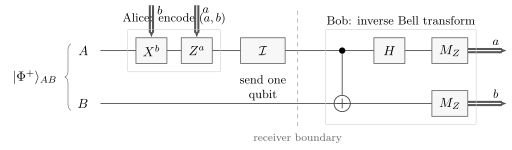
Canonical qubit superdense coding. Alice encodes with followed by and sends qubit . Bob applies and , the inverse Bell transform, then measures both qubits to recover and .
The decoding unitary is
Apply the controlled-NOT to the explicit codeword:
The final Hadamard gives
A computational-basis measurement therefore reads the original two-bit message. This derivation also fixes the bit convention: the first measured wire is the phase bit , and the second is the parity bit . Software frameworks may print bitstrings in the opposite order, so an implementation must state its wire and readout conventions.
Where the Two Bits Reside
Section titled “Where the Two Bits Reside”The message is not locally visible in either half of the encoded Bell pair. For every ,
Before Alice sends qubit , Bob holds only and sees the same state for all four messages. This is required by No-Cloning and No-Signaling. After the transmission, Bob holds the joint system , and the message is available in correlations between its two parts.
This is an example of a recurring principle: local states can be identical while joint states are perfectly distinguishable. Entanglement changes which global codewords Alice can reach by acting locally before she sends her subsystem.
Holevo Information and the Dimension Bound
Section titled “Holevo Information and the Dimension Bound”Without preshared entanglement, Alice can encode a classical variable into qubit states . The Holevo quantity obeys
Thus the unassisted classical capacity of a noiseless qubit channel is one bit per channel use, even though the Bloch sphere contains continuously many pure states.
In dense coding, Bob decodes an ensemble on the joint four-dimensional system . For four equiprobable Bell states,
Each codeword is pure, so
There is no violation of the Holevo bound. The relevant receiver system has dimension four because Bob combines the transmitted qubit with his preshared half. The extra dimension was not free: it came with the entangled resource.
Resource Accounting
Section titled “Resource Accounting”The protocol consumes:
- one Bell pair shared before the message is chosen;
- one local Pauli encoding;
- one forward qubit transmission;
- one joint two-qubit decoder;
- two final binary measurements.
It produces two classical message bits in the ideal one-shot protocol. The resource inequality
must be read with those timing and quality assumptions.
If Bob creates locally and sends half to Alice through the same channel being counted, then one use distributes the ebit and a second use returns Alice’s encoded half. Sending two classical bits required two qubit transmissions across that link. Dense coding becomes an advantage when entanglement is genuinely available as prior assistance, perhaps created during idle time, supplied by a separate link, or amortized within a larger resource protocol.
The protocol also consumes the ebit. After ideal decoding, the state is the product codeword , and the Bell entanglement is gone. Reusing the protocol requires another shared entangled pair.
Teleportation has the complementary resource inequality
The two protocols exchange the roles of classical and quantum communication, but neither makes communication free. Dense coding still sends a qubit; teleportation still sends two classical bits.
Qudit Generalization
Section titled “Qudit Generalization”Let Alice and Bob share the maximally entangled state
Define generalized shift and phase operators
Alice applies one of the Weyl operators
The resulting states
are orthonormal because
One transmitted -level system can therefore select among messages, or carry
classical bits, given one preshared maximally entangled qudit pair and a complete generalized Bell measurement.
Imperfect Shared Entanglement
Section titled “Imperfect Shared Entanglement”Suppose Alice and Bob share an arbitrary state , Alice’s subsystem has dimension , the forward channel is ideal, and Alice uses a complete orthogonal unitary ensemble with equal probabilities. The encoded states are
Unitary invariance gives
The complete unitary average depolarizes Alice’s subsystem:
The Holevo quantity of this standard dense-coding ensemble is therefore
This formula assumes the declared unitary encoding family and ideal transmission; it is an asymptotic Holevo rate when collective code construction and decoding are allowed. It should not be read as a guarantee of that many perfectly distinguishable messages in one shot.
The shared state gives a dense-coding advantage over the ordinary -bit baseline precisely when
Negative quantum conditional entropy implies entanglement, but not every entangled mixed state has negative conditional entropy. Entanglement is therefore not automatically useful for this particular coding task.
If the formula falls below the unassisted baseline, Alice can ignore the poor resource and use an ordinary orthogonal encoding. With that option included, the available rate is at least
Partially entangled pure pair
Section titled “Partially entangled pure pair”For
the joint entropy vanishes and Bob’s entropy is the binary entropy
The asymptotic dense-coding rate is
It ranges from one bit for a product state to two bits for a Bell pair. Except at maximal entanglement, the four Pauli codewords are not all orthogonal, so this fractional asymptotic rate is not a deterministic four-message one-shot protocol.
A Pauli-Noise Example
Section titled “A Pauli-Noise Example”Let the transmitted qubit pass through a Pauli channel
A Pauli error on Alice’s transmitted half permutes the Bell basis. After the ideal decoder, Bob sees the intended two-bit label plus an additive two-bit error determined by . With uniform messages, the induced classical channel has rate
where
The formula has useful checks:
- if one known Pauli occurs with probability one, it can be calibrated away and the rate is two bits;
- if all four Paulis are equally likely, the Bell label is fully randomized and the rate is zero;
- intermediate noise turns the perfect decoder into a four-symbol confusion channel.
For general noisy channels and unrestricted asymptotic coding, the relevant quantity is the entanglement-assisted classical capacity
That capacity theorem belongs to Communication with Quantum Systems. The Bell-pair protocol here is its most elementary noiseless qubit example.
Experimental Realization
Section titled “Experimental Realization”An experiment must implement more than four nominal encoder settings. It must prepare entanglement, preserve coherence during transmission, and distinguish the Bell codewords with a calibrated joint measurement.
A useful report includes:
- the shared-state fidelity or a fuller state characterization;
- encoder process quality for all four Pauli settings;
- channel loss, noise, and accepted-trial definition;
- the full conditional matrix ;
- average success probability and uncertainty;
- mutual information in bits per accepted trial and bits per attempted trial;
- wall-clock throughput and all preshared-resource costs.
The first photonic dense-coding demonstration transmitted three messages, not the ideal four, because its linear-optical analyzer did not provide a complete deterministic Bell measurement. Three equiprobable messages carry bits. This was an important demonstration, but it is not numerically identical to the ideal two-bit protocol.
Passive linear optics with ordinary ancillas and photodetection has intrinsic Bell-analysis restrictions. Additional degrees of freedom, auxiliary entanglement, nonlinear interactions, matter qubits, or more elaborate detectors can change the measurement model. Any claim of “deterministic dense coding” must state which Bell states are resolved, whether outcomes are unambiguous, and which trials are discarded.
Common Mistakes
Section titled “Common Mistakes”- Saying that one isolated qubit contains two readable classical bits.
- Omitting the preshared Bell pair from the resource ledger.
- Counting entanglement distribution as free when it uses the same channel.
- Forgetting that Alice must physically send her qubit.
- Assuming Bob can read the message from his original half alone.
- Swapping the phase and parity bit conventions in the decoder.
- Treating a global phase from as a different codeword.
- Claiming that any entangled mixed state provides a dense-coding advantage.
- Confusing an asymptotic Holevo rate with a deterministic one-shot message count.
- Reporting only postselected Bell-measurement fidelity while omitting loss, inconclusive outcomes, or the complete confusion matrix.
Exercises
Section titled “Exercises”1. Build the encoding table
Section titled “1. Build the encoding table”Starting from , apply , , , and to Alice’s qubit and recover the four Bell states.
Solution
Direct application gives
The last equality follows from and under the standard Pauli matrices, giving the same Bell ray up to the convention for an overall phase.
2. Verify the decoder algebra
Section titled “2. Verify the decoder algebra”Show explicitly that .
Solution
First,
Since ,
The top measurement returns the phase bit and the bottom measurement returns the parity bit.
3. Compute the ideal Holevo quantity
Section titled “3. Compute the ideal Holevo quantity”For four equiprobable Bell codewords, calculate the Holevo quantity.
Solution
The Bell states form an orthonormal basis, so their uniform average is . Each codeword is pure. Therefore
bits.
4. Locate the message before transmission
Section titled “4. Locate the message before transmission”Prove that Bob’s original qubit contains no information about before Alice’s qubit arrives.
Solution
Every encoded state is a Bell state, and every Bell state has maximally mixed one-qubit marginals:
Thus the ensemble available to Bob before transmission is independent of the message. Any local measurement has the same outcome distribution for all . The message becomes accessible only after Bob receives and can measure jointly.
5. Partially entangled resource
Section titled “5. Partially entangled resource”For , compute the asymptotic dense-coding rate of and explain why it is not a four-message one-shot protocol.
Solution
The binary entropy is
Hence
bits per use asymptotically. Because the state is not maximally entangled, the four Pauli-encoded states are not all orthogonal. A single joint measurement cannot identify four equiprobable labels perfectly.
6. Pauli-channel rate
Section titled “6. Pauli-channel rate”Let and . Find the mutual information of the uniform Bell-label scheme.
Solution
The four-symbol error entropy is
Therefore
bits per channel use for this encoding and decoder.
7. Count the distribution cost
Section titled “7. Count the distribution cost”Bob prepares a Bell pair, sends qubit to Alice, and later Alice uses dense coding to send back. If both transmissions use the same noiseless link, what is the net number of classical bits per forward-or-back channel use for this one-shot cycle?
Solution
The cycle uses the link once to distribute Alice’s half and once to return the encoded qubit. It communicates two classical bits in two quantum-channel uses, so the net rate is one classical bit per counted use. The ideal two-bits-per- use statement treats the Bell pair as prior assistance and counts only the message-bearing forward use.
8. Symmetric decoder errors
Section titled “8. Symmetric decoder errors”Suppose the correct two-bit label is reported with probability , and each of the other three labels is reported with probability . For uniform inputs, find the mutual information.
Solution
The output is uniform by symmetry, so . The conditional entropy is the entropy of one row of the confusion matrix:
Thus
This rate counts accepted trials. A complete experimental rate must also include inconclusive events, loss, and trial frequency.
Further Connections
Section titled “Further Connections”- Bell States defines the codeword basis and local-Pauli labeling.
- Communication with Quantum Systems places dense coding inside the general resource and capacity framework.
- No-Cloning and No-Signaling explains why Bob’s preshared half cannot reveal Alice’s message locally.
- Quantum Teleportation gives the complementary ebit-assisted resource conversion.
- Entanglement Measures distinguishes possession of entanglement from usefulness for a declared task.
- Mutual Information develops the correlation quantity appearing in entanglement-assisted capacities.
- Pauli Channels owns the general noise model used in the worked communication example.
- Quantum Information Roadmap places dense coding after Bell states, channels, and no-go theorems.
References
Section titled “References”- C. H. Bennett and S. J. Wiesner, “Communication via one- and two-particle operators on Einstein–Podolsky–Rosen states,” Physical Review Letters 69, 2881–2884 (1992), doi:10.1103/PhysRevLett.69.2881.
- A. Barenco and A. K. Ekert, “Dense coding based on quantum entanglement,” Journal of Modern Optics 42, 1253–1259 (1995), doi:10.1080/09500349514551091.
- P. Hausladen, R. Jozsa, B. Schumacher, M. Westmoreland, and W. K. Wootters, “Classical information capacity of a quantum channel,” Physical Review A 54, 1869–1876 (1996), doi:10.1103/PhysRevA.54.1869.
- K. Mattle, H. Weinfurter, P. G. Kwiat, and A. Zeilinger, “Dense coding in experimental quantum communication,” Physical Review Letters 76, 4656–4659 (1996), doi:10.1103/PhysRevLett.76.4656.
- N. Lütkenhaus, J. Calsamiglia, and K.-A. Suominen, “Bell measurements for teleportation,” Physical Review A 59, 3295–3300 (1999), doi:10.1103/PhysRevA.59.3295.
- C. H. Bennett, P. W. Shor, J. A. Smolin, and A. V. Thapliyal, “Entanglement-assisted classical capacity of noisy quantum channels,” Physical Review Letters 83, 3081–3084 (1999), doi:10.1103/PhysRevLett.83.3081.
- S. L. Braunstein and H. J. Kimble, “Dense coding for continuous variables,” Physical Review A 61, 042302 (2000), doi:10.1103/PhysRevA.61.042302.
- G. Bowen, “Classical information capacity of superdense coding,” Physical Review A 63, 022302 (2001), doi:10.1103/PhysRevA.63.022302.
- T. Hiroshima, “Optimal dense coding with mixed state entanglement,” Journal of Physics A: Mathematical and General 34, 6907–6912 (2001), doi:10.1088/0305-4470/34/35/316.
- R. F. Werner, “All teleportation and dense coding schemes,” Journal of Physics A: Mathematical and General 34, 7081–7094 (2001), doi:10.1088/0305-4470/34/35/332.
- C. H. Bennett, P. W. Shor, J. A. Smolin, and A. V. Thapliyal, “Entanglement-assisted capacity of a quantum channel and the reverse Shannon theorem,” IEEE Transactions on Information Theory 48, 2637–2655 (2002), doi:10.1109/TIT.2002.802612.
- C. Schuck, G. Huber, C. Kurtsiefer, and H. Weinfurter, “Complete deterministic linear optics Bell state analysis,” Physical Review Letters 96, 190501 (2006), doi:10.1103/PhysRevLett.96.190501.
- M. A. Nielsen and I. L. Chuang, Quantum Computation and Quantum Information, 10th anniversary ed., Cambridge University Press (2010).
- M. M. Wilde, Quantum Information Theory, 2nd ed., Cambridge University Press (2017), doi:10.1017/9781316809976.
- J. Watrous, The Theory of Quantum Information, Cambridge University Press (2018), doi:10.1017/9781316848142.