Spin and Spinors
Spin is an internal quantum degree of freedom that carries angular momentum under rotations. It obeys the same Lie algebra as orbital angular momentum, but it is not constructed from a position and momentum through . Spinors are the Hilbert-space objects on which half-integer-spin rotations act, and their transformation law reveals structure that ordinary three-dimensional vectors cannot represent.
Intrinsic angular momentum
gives finite spin multiplets
represented by spinors and spin matrices
measured along a chosen axis
rotated by
and coupled to magnetic fields through a magnetic moment.
This chapter develops that chain from the conceptual meaning of spin to practical calculations. Spin- receives special attention because every pure state has a Bloch-sphere representation and every Hermitian operator is built from the identity and Pauli matrices. The same angular-momentum structure then extends to arbitrary spin.
Canonical Boundaries
Section titled “Canonical Boundaries”This page owns the chapter map and the relations among its main formulas. Detailed derivations, experimental histories, and applications remain at their canonical homes.
| Topic | Canonical home | Role here |
|---|---|---|
| conceptual meaning and misconceptions | What Spin Is and Is Not | separates intrinsic spin from mechanical rotation |
| spin as an angular-momentum representation | Spin as Intrinsic Angular Momentum | owns the internal Hilbert-space and multiplet structure |
| two-dimensional spin space | Spin-1/2 Hilbert Space | fixes the basis and spinor convention |
| spin- matrix calculus | Pauli Matrices | owns the Pauli algebra and operator expansion |
| geometry of pure spin- states | Bloch Sphere | connects spinors, rays, and expectation values |
| arbitrary-axis projective measurements | Spin Measurements | owns projectors, probabilities, and state update |
| modern analyzer formalism | Stern–Gerlach Revisited | connects internal states to separated paths |
| finite spin rotations | Spin Rotations | owns the half-angle rotation operator |
| sign under a full turn | Spinors and 2π Rotations | distinguishes a ray from relative phase |
| static magnetic coupling | Spin in Magnetic Fields | owns Zeeman energies and sign conventions |
| precession dynamics | Larmor Precession | derives operator and Bloch-vector motion |
| classical-looking spin states | Spin Coherent States | introduces the rotated highest-weight family |
| representations beyond spin one-half | Higher Spin Systems | explains larger multiplets and state geometry |
| magnetic-moment conventions | Magnetic Moments and g-Factors | separates charge signs, magnetons, and factors |
The general measurement postulates belong to Projective Measurement. The historical 1922 experiment belongs to Stern–Gerlach Experiment. Qubits as information carriers belong to Quantum Information, while the spin interpretation of the Bloch sphere belongs here. Relativistic particle spin and Lorentz representations begin in From Spin to Relativistic Representations.
Spin Without Mechanical Rotation
Section titled “Spin Without Mechanical Rotation”Spin is angular momentum because its components generate rotations and satisfy
It is intrinsic because it acts on an internal factor of the Hilbert space rather than arising from spatial motion. In a simple nonrelativistic one-particle model,
Orbital operators act on the first factor and spin operators on the second. Consequently,
in this elementary product model. When both kinds of angular momentum are present, the generator of simultaneous rotations is
| Orbital angular momentum | Spin angular momentum |
|---|---|
| no position-space cross-product definition | |
| acts on spatial wavefunctions | acts on an internal spin space |
| integer for ordinary scalar wavefunctions | integer or half-integer |
| spatial probability distribution can carry orbital structure | spin state need not have a classical spatial shape |
The shared commutator algebra permits and to be added. It does not make their physical origins identical.
Spin Multiplets
Section titled “Spin Multiplets”For fixed spin , choose simultaneous eigenstates of and :
The allowed labels are
Thus one irreducible spin- multiplet has dimension
The ladder operators move between adjacent values without changing . Their normalized action is the general angular-momentum result developed in Ladder Operators.
The local commutator algebra is compatible with both integer and half-integer . Globally, integer-spin representations descend to ordinary representations of , whereas half-integer-spin states require the double cover or, equivalently, a projective action of spatial rotations on rays.
Spin One-Half State Space
Section titled “Spin One-Half State Space”For spin , the Hilbert space is . In the standard basis,
They obey
A normalized pure state is
with
The two complex amplitudes contain four real parameters. Normalization removes one and global phase removes another, leaving two physical parameters. This is why pure spin- rays form a two-dimensional sphere. The relative phase between and remains observable through measurements along axes other than .
The basis labels and do not describe permanent little arrows. They denote eigenstates of one specified component, here . Changing the quantization axis changes the basis.
Pauli Calculus
Section titled “Pauli Calculus”In the basis, the Pauli matrices are
Their compact product identity is
It implies both
and
Physical spin components are
The distinction matters dimensionally: is dimensionless, whereas has units of angular momentum. Every Hermitian operator on a two-dimensional Hilbert space has a unique expansion
with real and . For Hamiltonians, shifts both energies equally and selects a preferred axis in spin space.
Bloch-Sphere Geometry
Section titled “Bloch-Sphere Geometry”After removing global phase, every pure spin- state can be written
where
This direction is recovered from expectation values:
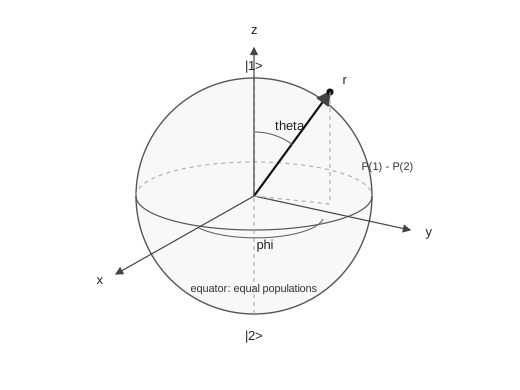
A normalized spin- ray is represented by a point on the sphere. The spinor uses half-angles, while the expectation-value direction transforms as an ordinary vector.
The same state has density operator
Mixed spin- states replace by a vector with , filling the Bloch ball. That density-operator treatment belongs to Bloch Sphere for Density Operators.
For , a direction on a sphere no longer specifies every pure state. Spin coherent states form an important sphere inside the larger projective state space, but generic higher-spin states contain additional multipole information.
Measuring a Spin Component
Section titled “Measuring a Spin Component”A spin measurement must specify an axis. Along a unit vector , the measured observable is
Because
the outcomes are , with projectors
For a state with Bloch vector ,
As a useful geometric example, prepare the state and measure along . If the angle between the axes is , then
The half-angle probabilities are a spinor effect. Orthogonal laboratory axes have and therefore give equal probabilities, not deterministic opposite outcomes.
Different components generally do not commute:
Thus preparing an eigenstate along one axis usually destroys sharpness along another. The general rules for Born probabilities, selective update, and nonselective measurement are developed in Core Formalism; this chapter supplies their spin- realization.
Stern–Gerlach as a Spin Analyzer
Section titled “Stern–Gerlach as a Spin Analyzer”An ideal Stern–Gerlach device uses an inhomogeneous magnetic field to correlate magnetic-moment projection with spatial path. In modern spin- notation, an analyzer oriented along implements the two projectors .
The device therefore plays three related roles:
| Laboratory use | Quantum description |
|---|---|
| separate an incoming beam | correlate spin eigenstates with distinct paths |
| block one output | prepare a selected spin eigenstate |
| detect both outputs | measure a spin component |
A sequence exposes noncommutativity. Preparing , measuring , selecting , and then measuring gives and with equal probabilities. The intermediate selection does not merely reveal a pre-existing value; it prepares a new state.
The original Stern–Gerlach experiment used neutral silver atoms, whose beam splitting cannot be identified naively with a bare free-electron trajectory. Its historical interpretation and atomic details are kept separate from the ideal analyzer model.
Rotating Spinors
Section titled “Rotating Spinors”The unitary operator for an active rotation by angle about is
For spin ,
Using gives
The spinor carries the half-angle, but its Bloch vector rotates through the physical angle . If is the corresponding vector rotation, then
This relation is a practical bridge between matrix calculations and ordinary three-dimensional geometry. It also makes the two-to-one map explicit: and induce the same rotation of Bloch vectors.
The 2π Spinor Sign
Section titled “The 2π Spinor Sign”For spin , one full physical turn gives
whereas two full turns give
More generally, the central element associated with a rotation acts on a spin- irreducible multiplet as
Integer-spin state vectors return after ; half-integer-spin vectors acquire a minus sign. This is a global representation-theoretic distinction, not a consequence visible from the infinitesimal commutators alone.
The sign does not change an isolated ray because
In particular, and represent the same pure state. The sign becomes observable when it is relative to another coherent amplitude. If only one arm of an interferometer applies a spin rotation, then schematically
Recombining the paths detects the changed relative phase. The Bloch sphere cannot display this sign because and act identically on the Bloch vector.
Spin in a Magnetic Field
Section titled “Spin in a Magnetic Field”A magnetic field couples to a magnetic moment:
If the effective magnetic moment is proportional to spin,
then
For spin this becomes
Take . The eigenstates are energy eigenstates with
The positive level spacing is
The absolute value gives the spacing, but it does not tell which state is lower. That ordering depends on the sign of . For an electron, the magnetic moment points opposite to the spin in the standard convention, so a verbal claim such as “aligned is lower” is ambiguous unless it says whether spin or magnetic moment is aligned with the field.
A fixed external field breaks full rotational symmetry down to rotations about the field axis. Accordingly, the spin component parallel to the field is conserved, while transverse components evolve.
Larmor Precession
Section titled “Larmor Precession”For the Zeeman Hamiltonian, the Heisenberg equation gives
The expectation value and the spin- Bloch vector obey the same rotation equation. In a constant field of magnitude , the precession-frequency magnitude is
The sign of fixes the sense of precession. For and the signed frequency ,
An energy eigenstate aligned with the field axis acquires only a global phase and has a stationary Bloch vector. Precession requires transverse coherence: the two Zeeman eigencomponents acquire a changing relative phase. Time-dependent transverse fields and Rabi oscillations are a further dynamical problem, introduced in Rabi Oscillations: First Encounter.
Spin Coherent States
Section titled “Spin Coherent States”For general spin , a spin coherent state is obtained by rotating the highest-weight state :
It satisfies
and
These states are the most classical-looking members of a spin- multiplet. Their relative transverse fluctuations scale down as grows, which makes them useful in semiclassical spin dynamics, many-body magnetism, and spin path integrals.
For , every pure state is spin coherent. For , coherent states form only a two-parameter subset of all pure states. A generic higher-spin state cannot be reconstructed from the direction alone.
Higher Spin Systems
Section titled “Higher Spin Systems”The same algebra produces a hierarchy of finite-dimensional representations:
| Spin | Magnetic labels | Dimension | Common multiplet name |
|---|---|---|---|
| singlet or scalar | |||
| doublet | |||
| triplet | |||
| quartet | |||
| quintet |
In the standard ordered basis, is diagonal and supplies the off-diagonal matrix elements. This constructs all three spin matrices for any without guessing them.
Higher spin also permits observables beyond the vector polarization . Spin and above can carry quadrupole alignment, and progressively higher ranks appear as increases. This is why a three-component Bloch vector is complete for a two-level density matrix but incomplete for a generic higher-spin density operator.
The labels integer and half-integer describe representation class, not particle count. A composite system of several spin- constituents can have an integer total spin, which is developed in Addition of Angular Momentum, beginning with Tensor Product Representations.
Magnetic Moments and g Factors
Section titled “Magnetic Moments and g Factors”For angular momentum , a magnetic moment is often written
Here is signed charge, is a mass scale appropriate to the model, and is dimensionless. The formula is useful only when those conventions are stated.
With , the Bohr magneton is
For an electron,
where the leading orbital factor is , while
with close to . The factor near two is not obtained by modeling spin as a classical rotating charged shell. Its relativistic origin belongs to the Dirac theory, and the small anomalous correction belongs to quantum electrodynamics.
For atoms with coupled and , an effective Landé factor describes the magnetic moment projected onto total . The coupling derivation belongs to angular-momentum addition and atomic spectroscopy rather than this chapter overview.
A Reliable Workflow
Section titled “A Reliable Workflow”For a spin problem, proceed in this order:
- Identify the spin representation. Record , the Hilbert-space dimension , and whether spatial degrees of freedom are also present.
- Choose and state a basis. For spin , name the axis defining and .
- Separate dimensionless matrices from observables. Use rather than interchanging and .
- Specify the physical operation. Distinguish state rotation, apparatus rotation, Hamiltonian evolution, and measurement.
- Use projectors for probabilities. For axis , compute with instead of relying on a sketch alone.
- Track signed magnetic conventions. Keep , , , and the direction of explicit until the energy ordering is known.
- Check invariant quantities. Probabilities must sum to one, rotations preserve norm, and unitary evolution preserves Bloch-vector length for a pure isolated spin- state.
Chapter Map
Section titled “Chapter Map”| Read this page | When the question is |
|---|---|
| What Spin Is and Is Not | Why is spin not literal mechanical rotation? |
| Spin as Intrinsic Angular Momentum | How does spin realize the angular-momentum algebra? |
| Spin-1/2 Hilbert Space | What is a two-component spinor state? |
| Pauli Matrices | Which matrix identities make spin- calculations efficient? |
| Bloch Sphere | How do pure spin- rays become directions on a sphere? |
| Spin Measurements | How are arbitrary-axis probabilities and updates computed? |
| Stern–Gerlach Revisited | How does a magnetic analyzer implement a spin measurement? |
| Spin Rotations | How does rotate a spinor? |
| Spinors and 2π Rotations | Why does a full turn produce a sign, and when can it matter? |
| Spin in Magnetic Fields | How are Zeeman energies and signs organized? |
| Larmor Precession | How does a spin direction evolve in a static field? |
| Spin Coherent States | Which higher-spin states look most classical? |
| Higher Spin Systems | What changes beyond the two-state case? |
| Magnetic Moments and g-Factors | How do charge, magnetons, and factors enter? |
Reading Paths
Section titled “Reading Paths”Core spin- formalism
Measurement and experiment
Magnetic dynamics
- Magnetic Moments and g-Factors
- Spin in Magnetic Fields
- Larmor Precession
- Rabi Oscillations: First Encounter
Representation and geometry bridge
- Spin as Intrinsic Angular Momentum
- Spinors and 2π Rotations
- Higher Spin Systems
- Spin Coherent States
- From SU(2) Spinors to Lorentz Spinors
Distinctions Worth Keeping
Section titled “Distinctions Worth Keeping”| Do not conflate | Why |
|---|---|
| spin vector and spinor | transforms as a vector; the state transforms in a spin representation |
| Pauli matrix and spin observable | is dimensionless; carries angular momentum |
| global phase and relative phase | only relative phase can alter interference or other observable statistics |
| element and rotation | and produce the same ordinary vector rotation |
| basis label and physical direction | “up” is always up along a specified quantization axis |
| spin and magnetic moment | they are proportional only after a signed, system-dependent gyromagnetic ratio is specified |
| Zeeman splitting and precession | splitting is spectral; precession requires a superposition with transverse coherence |
| Bloch sphere and all higher-spin states | the sphere is complete for pure spin , but only labels coherent states for larger |
Common Mistakes
Section titled “Common Mistakes”- Modeling spin as a tiny extended body literally rotating in space.
- Forgetting the factor between and .
- Asking for “the spin” without naming the measured component.
- Treating a Bloch vector as the two-component spinor itself.
- Using the physical angle instead of the half-angle in a spin- rotation operator.
- Claiming that a sign is either directly observable as an absolute phase or completely meaningless; it is meaningful as a relative phase.
- Inferring the lower Zeeman state from the word “aligned” without tracking the sign of the magnetic moment.
- Calling every two-level system a physical spin- without identifying how rotations act on it.
- Extending the pure-state Bloch sphere unchanged to arbitrary higher-dimensional spin spaces.
Cross-Links
Section titled “Cross-Links”- Rotations and Orbital Angular Momentum
- Projective Representations
- Rays and Global Phase
- Two-Level System
- Time Reversal for Spin-1/2 Particles
- Addition of Angular Momentum
- Pauli Matrix Identity Index
- Spin Problems
- From Spin to Relativistic Representations
- From SU(2) Spinors to Lorentz Spinors
References
Section titled “References”- J. J. Sakurai and J. Napolitano, Modern Quantum Mechanics, 3rd ed., Cambridge University Press, 2020.
- R. Shankar, Principles of Quantum Mechanics, 2nd ed., Springer, 1994.
- C. Cohen-Tannoudji, B. Diu, and F. Laloë, Quantum Mechanics, Wiley, 1977.
- D. J. Griffiths and D. F. Schroeter, Introduction to Quantum Mechanics, 3rd ed., Cambridge University Press, 2018.
- B. C. Hall, Lie Groups, Lie Algebras, and Representations: An Elementary Introduction, 2nd ed., Springer, 2015.
- C. J. Foot, Atomic Physics, Oxford University Press, 2005.
- H. Rauch and S. A. Werner, Neutron Interferometry: Lessons in Experimental Quantum Mechanics, 2nd ed., Oxford University Press, 2015.
- A. M. Perelomov, Generalized Coherent States and Their Applications, Springer, 1986.
Exercises
Section titled “Exercises”- Show that the arbitrary-axis operators
are orthogonal projectors that sum to the identity.
Solution
For a unit vector , the Pauli product identity gives
Therefore
The sum is , and
Thus the two ranges are orthogonal and complete.
- Consider
Find its Bloch vector and the probability of obtaining in an measurement.
Solution
For a normalized spinor ,
Here and , so
For an -axis measurement,
- Begin in and apply an active rotation by about . Find the final ray and its Bloch vector.
Solution
The rotation matrix is
Hence
The global factor does not change the ray. The Bloch vector is therefore , as expected from rotating by about .
- A spin- state initially points along and evolves under
For , find its Bloch vector as a function of time and state its initial direction of motion.
Solution
Let . The precession equations give
At , , so the Bloch vector initially moves from toward . Replacing by a negative value reverses the sense of precession without changing the positive frequency magnitude .
- Use a -axis rotation to show that a rotation acts as throughout a spin- multiplet.
Solution
On a basis state,
Every allowed differs from by an integer, so
The factor is therefore the same on every state in the irreducible multiplet. It is for integer and for half-integer .