Stern–Gerlach Revisited
A Stern–Gerlach analyzer is the laboratory prototype of a spin-component measurement. In the modern spin- idealization, orienting the magnet along a unit vector corresponds to measuring
with two possible spin eigenvalues,
The apparatus turns an internal spin distinction into spatially separated output beams. This page revisits Stern–Gerlach using the spin-state formalism. The original 1922 silver-atom experiment, its historical context, and its experimental caveats live in Stern–Gerlach Experiment.
Canonical Split
Section titled “Canonical Split”The Stern–Gerlach story has several canonical homes:
| Topic | Canonical home |
|---|---|
| Original silver-atom experiment and historical context | Stern–Gerlach Experiment |
| Space quantization as an early lesson | Space Quantization |
| Spin- Hilbert-space notation | Spin-1/2 Hilbert Space |
| Compact spin projectors and update formulas | Spin Measurements |
| Measurement postulates and state update | Projective Measurement |
| Sequential measurement formalism | Sequential Measurements |
| Stern–Gerlach as a spin analyzer | this page |
The goal here is to connect the experiment to spinors, Pauli matrices, projectors, and noncommuting measurement axes.
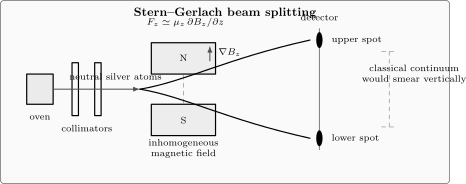
An inhomogeneous magnetic field correlates magnetic-moment projection with spatial path. The modern idealized analyzer is described by spin-component projectors along the magnet axis.
Ideal Analyzer Model
Section titled “Ideal Analyzer Model”For spin-, define the operator
It has eigenstates
Equivalently,
An ideal Stern–Gerlach analyzer oriented along correlates these eigenstates with different spatial paths:
and
For a superposition,
the coherent pre-detection idealization is
If the paths are detected, blocked, or become environmentally distinguishable, the apparatus acts as a measurement or preparation device rather than merely a reversible beam splitter.
Projectors and Probabilities
Section titled “Projectors and Probabilities”The projectors for an analyzer oriented along are
For an incoming pure state ,
If the incoming state has Bloch vector , so that
then
For a pure state prepared as , where is the angle between and ,
and
This half-angle law is one of the cleanest operational signatures of spin- geometry.
Orientation Is the Observable
Section titled “Orientation Is the Observable”A Stern–Gerlach magnet does not measure “spin” without qualification. It measures a component selected by the apparatus orientation:
Rotating the magnet changes the observable. A state with a definite value is not generally a state with a definite value. For example,
so an -oriented analyzer sends an incoming beam into two equal-intensity outputs.
The physical labels “upper” and “lower” are apparatus-calibration labels. They depend on field gradients, magnetic-moment sign conventions, and beam geometry. The formal labels and refer to eigenstates of the chosen spin component.
Sequential Analyzers
Section titled “Sequential Analyzers”Sequential Stern–Gerlach analyzers make noncommutativity visible.
Start with a analyzer and select the output:
Send that beam into an analyzer. Since
the analyzer produces
If the output is selected, the state is updated to . A final analyzer then gives
so
The middle analyzer has destroyed the original certainty of a later result. This is not because the particle had an unknown pre-existing classical spin direction that was revealed imperfectly. It is because and are noncommuting observables:
Selection Versus Recombination
Section titled “Selection Versus Recombination”There are two different idealizations that are often conflated.
In a selective measurement, one output beam is kept and the other is blocked or ignored. Keeping the output prepares
In a fully coherent beam-splitting model, the two paths could in principle be recombined before path information is lost. Then the device is closer to a unitary entangler between spin and spatial degrees of freedom than to an irreversible measurement.
Real Stern–Gerlach apparatuses are macroscopic, imperfect, and path-distinguishing. For most textbook spin examples, the projective measurement model is the appropriate abstraction. For foundational discussions, it matters that measurement is not merely a symbol attached to the magnet; it involves spatial separation, amplification, and loss or use of path information.
Relation to the Original Silver Experiment
Section titled “Relation to the Original Silver Experiment”The original Stern–Gerlach experiment used neutral silver atoms. It did not send a beam of isolated free electrons through an ideal spin analyzer. The silver atom is nevertheless effectively two-state in the relevant magnetic degree of freedom because its closed electron shells cancel and the unpaired valence electron carries the dominant magnetic moment.
This historical fact is why the same experiment can be both:
- an early experimental landmark for space quantization;
- a modern pedagogical model for spin- measurement.
Keeping those statements separate prevents two common errors: treating the original experiment as if it already used modern spin language, and treating the modern spinor analyzer as if all atomic-structure details had no role in the actual apparatus.
Common Mistakes
Section titled “Common Mistakes”- Saying a Stern–Gerlach device measures “spin” without specifying the axis.
- Treating the two output paths as proof of pre-existing classical arrows along all axes.
- Forgetting that selecting an output prepares a new state.
- Assuming a analyzer followed by an analyzer should preserve the original certainty.
- Confusing physical beam direction with the sign of the spin eigenvalue; magnetic-moment signs and apparatus geometry matter.
- Describing the original silver-atom experiment as a direct free-electron spin measurement.
- Ignoring the distinction between coherent path separation and an actual detected measurement.
Cross-Links
Section titled “Cross-Links”- Spin Problems
- Stern–Gerlach Experiment
- Space Quantization
- What Spin Is and Is Not
- Spin-1/2 Hilbert Space
- Pauli Matrices
- Spin Measurements
- Bloch Sphere
- Spin Rotations
- Projective Measurement
- Sequential Measurements
- Spin-1/2 as a Canonical System
- Stern–Gerlach Reference Card
References
Section titled “References”- W. Gerlach and O. Stern, “Der experimentelle Nachweis der Richtungsquantelung im Magnetfeld,” Zeitschrift für Physik 9, 349-352 (1922).
- B. Friedrich and D. Herschbach, “Stern and Gerlach: How a Bad Cigar Helped Reorient Atomic Physics,” Physics Today 56, 53-59 (2003).
- J. J. Sakurai and J. Napolitano, Modern Quantum Mechanics, 3rd ed., Cambridge University Press, 2020.
- C. Cohen-Tannoudji, B. Diu, and F. Laloë, Quantum Mechanics, Wiley, 1977.
- R. Shankar, Principles of Quantum Mechanics, 2nd ed., Springer, 1994.
Exercises
Section titled “Exercises”- A spin- particle is prepared in . What are the probabilities for an -oriented Stern–Gerlach analyzer?
Solution
Use
Therefore
- Use the projector formula to find the probability that gives the output.
Solution
For a pure state , the Bloch vector is . The projector is
Thus
If is the angle between the axes, , so
- Explain why a analyzer, followed by an analyzer with selected, followed by another analyzer gives equal final probabilities.
Solution
After the output is selected, the state is . In the basis,
Therefore a final analyzer gives
The intermediate selection prepares a new state rather than revealing a pre-existing definite value.
- Why is the original Stern–Gerlach experiment not literally a free-electron spin measurement?
Solution
The original experiment used neutral silver atoms. Neutral atoms avoid the dominant Lorentz-force deflection that a charged beam would experience. The effective two-state magnetic degree of freedom in silver is closely tied to the unpaired valence electron, but the actual beam particles were atoms with atomic structure. The modern free spin- analyzer is an idealization distilled from that physical setting.