Stern–Gerlach Experiment
The Stern–Gerlach experiment sends a collimated beam of neutral atoms through an inhomogeneous magnetic field. Instead of forming a continuous vertical smear on a detector, the beam splits into separated spots.
Today the experiment is a standard entrance to spin and two-outcome quantum measurements. Historically, the original 1922 silver-atom experiment was interpreted as evidence for directional quantization before the modern electron-spin formalism was in place. Both statements matter: the experiment is a clean modern prototype, but the original interpretation was not simply “they measured free electron spin.”
Atomic Beam Setup
Section titled “Atomic Beam Setup”The apparatus has four essential parts:
- an oven that emits neutral silver atoms,
- collimating slits that form a narrow beam,
- an inhomogeneous magnetic field,
- a detector plate where the beam deposits silver.
Neutral atoms were crucial. A charged beam in a magnetic field would experience a Lorentz force depending on its velocity. A neutral atom avoids that dominant charge deflection, while its magnetic moment can still couple to the field gradient.
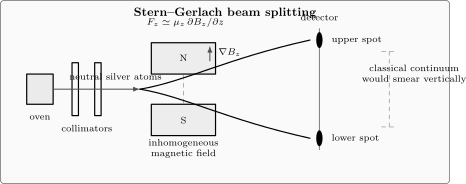
In a Stern–Gerlach apparatus, a field gradient converts magnetic-moment projection into spatial deflection. A continuous range of classical orientations would suggest a smear; the observed result was discrete beam splitting.
Magnetic Field Gradient
Section titled “Magnetic Field Gradient”A magnetic moment in a magnetic field has interaction energy
The force is the gradient of . In the simplest geometry, the vertical force is approximated by
The field must be nonuniform. A uniform magnetic field can exert a torque on a magnetic moment, but it does not by itself separate a neutral beam into spatial components. The gradient makes different magnetic-moment projections follow different trajectories.
Classical Expectation
Section titled “Classical Expectation”In a classical picture, magnetic moments can point in a continuum of orientations. If the beam contains atoms with many orientations, then the projection
can take a continuous range of values. The detector should show a continuous vertical distribution, broadened by the range of possible forces.
That is not what the experiment found. The silver beam separated into discrete components. The result challenged the idea that microscopic angular-momentum-like quantities simply have arbitrary classical orientations.
Observed Splitting
Section titled “Observed Splitting”The observed pattern was a split beam. In the original historical context, this was evidence for directional, or “space,” quantization: only certain projections of the relevant angular momentum along the apparatus axis were allowed.
Modern language is sharper. The apparatus orientation defines a component of an angular momentum or spin-like degree of freedom. The measurement outcomes are eigenvalues of that component, not arbitrary pre-existing classical directions. The original silver-atom experiment is especially useful because the ground-state silver atom is well approximated, for this purpose, by an effective two-state magnetic degree of freedom associated with its valence electron.
Space Quantization
Section titled “Space Quantization”“Space quantization” does not mean that physical space becomes a lattice. It means that the projection of angular momentum along the magnetic-field direction takes discrete values.
For angular momentum , the modern eigenvalue statement is
where
For a two-state spin- idealization,
Those two eigenvalues correspond to two ideal output beams for a measurement along .
Connection to Spin
Section titled “Connection to Spin”Electron spin was proposed after the original Stern–Gerlach experiment. The modern interpretation of the silver-atom result uses the fact that silver has one relevant unpaired valence electron in an state, so the effective magnetic degree of freedom is closely tied to spin rather than ordinary orbital angular momentum.
For a spin magnetic moment, an effective coupling is often written
where the constant depends on the particle and sign convention. A Stern–Gerlach magnet then correlates spin-component eigenstates with spatial paths:
The spatial separation makes an internal quantum degree of freedom visible in the laboratory.
Modern Two-Level Interpretation
Section titled “Modern Two-Level Interpretation”For a spin- system, a measurement axis corresponds to the operator
with outcomes
If the incoming spin state is , the probability of the output is
Changing the magnet orientation changes the measured operator. A state that is definite along is generally not definite along . This is why sequential Stern–Gerlach experiments are so useful: a analyzer, followed by an analyzer, followed by another analyzer exposes noncommuting measurement axes and state update.
The detailed spinor formalism is developed in Spin-1/2 Hilbert Space, Pauli Matrices, and Stern–Gerlach Revisited. The measurement idealization belongs in Projective Measurement and Sequential Measurements.
For the historical projection language that grew out of the experiment, see Space Quantization.
Common Misconceptions
Section titled “Common Misconceptions”- The original experiment was not a literal free-electron spin measurement.
- The two spots are not evidence that each atom carried a small classical arrow with a pre-existing orientation along every possible axis.
- A Stern–Gerlach device does not measure “spin” without specifying an axis; the magnet geometry defines the component.
- The word “up” names an eigenstate relative to an apparatus axis, not an absolute direction carried around by the particle.
- The absence of a continuous smear is the key historical shock; the modern noncommuting-axis lesson requires sequential measurements.
Exercises
Section titled “Exercises”- Explain why an inhomogeneous magnetic field is required for beam splitting.
Solution
The force on a neutral magnetic moment is obtained from the spatial gradient of its interaction energy. In the simplified geometry, . If the field is uniform, , so there is no Stern–Gerlach separation of the neutral beam, even though the magnetic moment may experience a torque.
- In a classical model with fixed magnetic-moment magnitude and random orientations, why would the detector show a continuous distribution?
Solution
The relevant projection is . If can vary continuously, then can take continuously many values between and . Since the vertical force is proportional to in the simple model, the detector positions should fill a continuous range rather than only two separated spots.
- A spin- system is prepared in . It is then measured along , and the output is selected. A final measurement is made along . What are the final probabilities?
Solution
After selecting the output, the state is . In the basis,
Therefore the final measurement gives
The intermediate measurement changes the state relative to the original preparation.
Cross-Links
Section titled “Cross-Links”- Stern–Gerlach Revisited develops the modern spin-analyzer model.
- Stern–Gerlach Experiment Reference Card gives the compact historical lookup.
- AMO Experiment Index compares the detector record, justified inference, and common overclaims with other AMO landmarks.
- Evidence Map places the experiment in the wider route from observations to formalism.
References
Section titled “References”- W. Gerlach and O. Stern, “Der experimentelle Nachweis der Richtungsquantelung im Magnetfeld,” Zeitschrift für Physik 9, 349-352 (1922), DOI: 10.1007/BF01326983.
- B. Friedrich and D. Herschbach, “Stern and Gerlach: How a Bad Cigar Helped Reorient Atomic Physics,” Physics Today 56, 53-59 (2003), DOI: 10.1063/1.1650229.
- J. J. Sakurai and J. Napolitano, Modern Quantum Mechanics, 3rd ed., Cambridge University Press, 2020.
- C. Cohen-Tannoudji, B. Diu, and F. Laloë, Quantum Mechanics, Wiley, 1977.