Rays and Global Phase
A normalized ket is a convenient representative of a pure quantum state, but it is not the physical state by itself. For every real number ,
represents the same pure state as . The phase is global because it multiplies the entire ket. It cancels from every measurement probability, every expectation value, and every state-update prediction.
The corresponding physical object is a ray: the equivalence class of all nonzero vectors that differ by an overall nonzero complex factor. After a representative has been normalized, the remaining freedom is precisely a global phase.
The exact equivalence among rays, normalized classes, and rank-one projectors—together with the transition-probability structure used by Wigner’s theorem—is owned by Physical States as Rays. This page retains the operational global-versus-relative phase treatment.
This statement does not mean that phase is generally irrelevant. A phase between two components or two alternatives is relative, and it can change interference. The reliable distinction is:
| Transformation | What changes? | Physical effect |
|---|---|---|
| one representative of the whole ray | none | |
| for only part of a superposition | relative relation among alternatives | generally observable |
| with coefficients transformed consistently | basis convention | none |
Required background. State Vectors supplies normalized Hilbert-space representatives and basis amplitudes; Inner-Product Conventions supplies the bra-slot conjugation used in every phase-cancellation and adjoint identity.
Global Phase in a Basis
Section titled “Global Phase in a Basis”Let an orthonormal basis be and write
A global phase multiplies every coefficient by the same number:
All coefficient ratios remain unchanged whenever they are defined:
By contrast, changing only one coefficient generally changes such ratios. For example,
do not differ by one overall scalar. They are different rays and can be distinguished by a suitable measurement.
The word “global” always refers to the whole state of the system being described. A phase applied to only one branch, path, energy component, or control sector is not global for that complete state.
Operational Proof for Arbitrary Measurements
Section titled “Operational Proof for Arbitrary Measurements”The phase cancellation is not restricted to measurements in one basis. Consider any measurement outcome represented by an effect , where
For a normalized pure state, its probability is
If , then the bra transforms with the complex-conjugate phase:
Therefore
Because this holds for every effect , no POVM can distinguish the two representatives. Projective measurements are included as the special case in which the effects are orthogonal projectors.
The same conclusion holds for expectation values:
It also holds for transition probabilities. Although a transition amplitude changes covariantly,
its squared modulus does not:
The canonical rules for amplitudes and probabilities are developed in Probability Amplitudes.
The Density-Operator Test
Section titled “The Density-Operator Test”The shortest representation-independent test uses the pure-state density operator
Global phase disappears exactly:
Thus and are not merely states that happen to agree for a few observables. They define the same density operator and hence the same prediction for every measurement, channel, and quantum instrument.
For an arbitrary nonzero, not necessarily normalized vector, the ray can be represented by
Under with , both numerator and denominator acquire the factor . Consequently,
This gives a one-to-one correspondence between pure-state rays and rank-one density operators. General mixed states require the broader density-operator language developed in Density Operators.
Rays in Hilbert Space
Section titled “Rays in Hilbert Space”On the nonzero vectors of a Hilbert space , define
This is an equivalence relation:
- reflexivity follows by choosing ;
- symmetry follows because exists;
- transitivity follows because the product of two nonzero scalars is nonzero.
The ray through is the equivalence class
Every nonzero member of this class represents the same pure state. If one first imposes normalization, the modulus of is fixed and only
remains. The normalized representatives of one ray form a orbit.
The zero vector belongs to no ray because it cannot be normalized and gives no probability distribution. Multiplication by a non-unit scalar preserves the ray but not normalization, so calculations must either renormalize the vector or use above.
Projective Hilbert Space
Section titled “Projective Hilbert Space”The set of all rays is the projective Hilbert space
For a finite-dimensional Hilbert space , this is complex projective space:
A normalized vector in has real parameters after its norm is fixed. Removing one global-phase parameter leaves
real parameters for a pure state. In particular, is the two-dimensional pure-state space of a qubit and can be represented as the Bloch sphere.
This page uses projective space only to identify the physical pure-state space. Quotient coordinates, geometry, distances, and the relation to the Bloch sphere belong to Projective Hilbert Space.
Global Phase Versus Relative Phase
Section titled “Global Phase Versus Relative Phase”Consider two nonzero components in a fixed orthonormal basis:
Factoring out gives
The first factor is global. The phase difference
remains inside the superposition and can affect interference. A common phase rotation changes and by the same amount and leaves fixed. A relative phase shift changes .
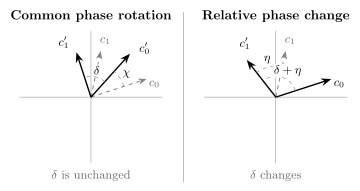
Dashed arrows show the original coefficients and solid arrows show the transformed coefficients. A common rotation moves both by and preserves their angular separation . Rotating only one coefficient changes and can therefore change interference.
The fuller treatment of coherent superpositions, basis dependence, and the distinction from statistical mixtures is in Superposition and Relative Phase.
Phase of Coefficients and Phase Conventions
Section titled “Phase of Coefficients and Phase Conventions”Coefficient phases are meaningful only together with a chosen basis convention. Rephase the basis vectors independently:
The same abstract state must then have coefficients
because
The numerical phase of therefore changes if the basis kets are rephased separately. This does not make interference conventional. The matrix elements of every measurement and evolution operator transform at the same time, leaving all probabilities invariant.
Accordingly, the phrase “relative phase is observable” is shorthand for a more precise statement: phase-sensitive, convention-independent combinations of state amplitudes, dynamics, and measurement amplitudes can affect observed probabilities. In an interferometer, the beam splitters and propagation phases supply the physical reference against which a path-phase difference is read.
Why Interference Detects Relative Phase
Section titled “Why Interference Detects Relative Phase”Suppose a detector outcome receives amplitudes and from two coherent alternatives. The total amplitude is
so the probability contains a cross term:
Multiplying both alternatives by the same leaves every term unchanged. Multiplying only the second by changes the interference term to
The observable is not the absolute phase of either amplitude. It is the phase-sensitive relation between alternatives in a complete experimental arrangement.
Worked Example: Spin-1/2
Section titled “Worked Example: Spin-1/2”Using the eigenbasis, write a general normalized spin- state as
An arbitrary global phase could multiply the right-hand side, but it would not add another physical coordinate. The probabilities for spin up along the Cartesian axes are
The relative phase changes the - and -measurement statistics. A global phase appears in none of them.
For example,
and
are two representatives of the same ray. By contrast,
is a different ray. Indeed,
so a measurement along distinguishes the two preparations probabilistically. The spin system itself is developed in Spin-1/2 Hilbert Space.
Worked Example: Two-Slit Amplitudes
Section titled “Worked Example: Two-Slit Amplitudes”At a screen position , let the two slit amplitudes be
where . The detection probability is proportional to
with
Adding the same to both phases leaves and the whole pattern unchanged. Inserting a phase shifter in only one path sends
and shifts the fringes. The physical experiment, including which-way information and loss of coherence, is discussed in the Double-Slit Experiment.
Stationary States and the Energy Zero
Section titled “Stationary States and the Energy Zero”If is an energy eigenvector of a time-independent Hamiltonian, then
At each time this differs from only by a global phase. The state vector evolves, but the ray and all time-independent measurement statistics remain fixed. This is why an energy eigenstate is stationary.
A superposition of distinct energies behaves differently:
After one common phase is factored out, the relative phase evolves as
That phase can produce time-dependent interference and expectation values. The complete distinction belongs to Stationary States.
The ray principle also explains the freedom to shift the zero of energy. If
then for a time-independent ,
Every state evolved by differs from the state evolved by by the same global phase. Closed-system predictions are therefore unchanged. If two control branches experience different offsets, however, the branch-dependent phases become relative phases of the larger controlled system.
A 2π Spin Rotation
Section titled “A 2π Spin Rotation”For a spin- state, a rotation by is represented by
Thus
The minus sign is a global phase for an isolated spin state, so no measurement on that state alone distinguishes it from the original. This does not make the sign physically empty in every arrangement. If only one arm of an interferometer undergoes the rotation, the minus sign is relative between the two arms and can shift the interference pattern.
The spinor-specific derivation and interferometric interpretation are in Spinors and 2π Rotations.
Can a Reference Reveal Global Phase?
Section titled “Can a Reference Reveal Global Phase?”Adding a reference system does not make the global phase of the total state observable. If
then applying to the second factor gives
which is still only a global phase of the joint state.
A controlled phase is different. Starting from
suppose the phase is applied only in the branch. The result is
This phase is relative between reference branches. Measuring the reference in the basis gives
so is observable. What was called a phase on one operation has become a relative phase in the complete state description; the global phase of that complete state remains unobservable.
Time-Dependent Rephasing
Section titled “Time-Dependent Rephasing”At the level of instantaneous physical states,
describes the same path of rays as . There is nevertheless a bookkeeping point in the Schrödinger equation. If
then the rephased representative obeys
where
Therefore an arbitrary time-dependent rephasing is not generally another solution of the Schrödinger equation with the identical Hamiltonian. It is a change of representative accompanied by an additive scalar shift of the Hamiltonian. The ray trajectory and all physical predictions remain the same.
Phase Choices Over Parameter Space
Section titled “Phase Choices Over Parameter Space”For one isolated ray, choosing a normalized ket is simply choosing a phase representative. For a smoothly parameterized family , one may choose a different phase at every point:
Quantities such as depend on this choice, while appropriate closed-loop phases and curvatures can be gauge invariant. This is not a failure of the global-phase principle. It is the geometry of making phase choices consistently across many rays.
The bundle language is developed in U(1) Bundles and Quantum Phase, and its adiabatic physical application is developed in Berry Phase.
What the Ray Statement Does Not Say
Section titled “What the Ray Statement Does Not Say”- It does not say that every phase in a state expansion is unobservable.
- It does not identify coherent superpositions with statistical mixtures.
- It does not permit dropping normalization in probability calculations.
- It does not say that amplitudes are directly observable complex numbers.
- It does not make basis-phase conventions into physical transformations.
- It does not imply that a phase applied to one branch is global for a larger composite state.
- It does not remove geometric or topological phase effects, which concern comparisons along paths or between alternatives.
- It does not mean a rephased vector satisfies the same dynamical equation unless the Hamiltonian is transformed consistently.
A Practical Phase Audit
Section titled “A Practical Phase Audit”When a phase appears in a calculation, ask the following questions in order:
- What is the complete state space? Include path, spin, control, ancilla, and reference degrees of freedom that participate in the experiment.
- Does one scalar multiply the entire ket? If yes, it is global for that state.
- Can the phase be factored from every component? If not, it is relative within the chosen decomposition.
- Was only the basis rephased? Transform state coefficients and operators consistently before assigning physical meaning.
- What probability changes? An observable claim should be expressible as a change in or another invariant prediction.
- Is time evolution involved? A time-dependent phase convention shifts the Hamiltonian by a scalar multiple of the identity.
- Is a family of rays involved? Local phase choices may lead to geometric connections even though each individual ray is phase invariant.
Common Mistakes
Section titled “Common Mistakes”Saying “phase does not matter”
Section titled “Saying “phase does not matter””Only a common phase multiplying the complete state is redundant. Relative phases can affect interference, spin measurements, oscillations, and quantum control.
Comparing entries instead of rays
Section titled “Comparing entries instead of rays”Two coordinate columns can look different and still differ by one common nonzero scalar. Test proportionality of the complete vectors, not equality of individual entries.
Ignoring normalization after rescaling
Section titled “Ignoring normalization after rescaling”lies on the same ray as , but it is not a normalized representative. The ordinary Born formula assumes normalization unless an explicit norm denominator is included.
Treating basis rephasing as state evolution
Section titled “Treating basis rephasing as state evolution”Changing to while transforming coefficients and operators consistently changes coordinates, not physics.
Calling a controlled phase global
Section titled “Calling a controlled phase global”A phase conditioned on one path or control state is relative in the composite state. It can be converted into a population difference by recombination.
Confusing a stationary ray with a constant ket
Section titled “Confusing a stationary ray with a constant ket”An energy eigenket generally acquires . Its ray is stationary even though the chosen vector representative is time dependent.
Connections
Section titled “Connections”- State Vectors develops normalized kets and basis coefficients.
- Physical States as Rays gives the precise projective-state and rank-one-projector equivalence used by the rigorous representation spine.
- Superposition and Relative Phase owns the detailed analysis of coherence and interference.
- Probability Amplitudes develops composition and interference of amplitudes.
- Density Operators gives the phase-invariant language for general states.
References
Section titled “References”- J. Anandan and Y. Aharonov, “Geometry of quantum evolution,” Physical Review Letters 65, 1697–1700 (1990), https://doi.org/10.1103/PhysRevLett.65.1697.
- L. E. Ballentine, Quantum Mechanics: A Modern Development, 2nd ed., World Scientific, 2014, Chapters 2–3.
- I. Bengtsson and K. Życzkowski, Geometry of Quantum States, 2nd ed., Cambridge University Press, 2017, Chapters 4–5.
- P. A. M. Dirac, The Principles of Quantum Mechanics, 4th ed., Oxford University Press, 1958, Chapters I and III.
- A. Messiah, Quantum Mechanics, Vol. I, North-Holland, 1961, Chapters II and IV.
- M. A. Nielsen and I. L. Chuang, Quantum Computation and Quantum Information, 10th anniversary ed., Cambridge University Press, 2010, Sections 2.1–2.2.
- A. Peres, Quantum Theory: Concepts and Methods, Kluwer, 1995, Chapters 2 and 4.
- J. J. Sakurai and J. Napolitano, Modern Quantum Mechanics, 3rd ed., Cambridge University Press, 2020, Chapters 1–2.
- J. von Neumann, Mathematical Foundations of Quantum Mechanics, Princeton University Press, 1955, Chapters I and III.
Exercises
Section titled “Exercises”- Arbitrary POVM and state update. Let . Prove that the two representatives give the same probability for every POVM effect . If outcome is implemented by a Kraus operator , show that the normalized post-measurement rays also agree.
Solution
The outcome probabilities are
For a nonzero-probability outcome, the two unnormalized conditional vectors are related by
Their norms are equal, so normalization preserves the same global factor. They therefore define the same post-measurement ray. Outcomes of zero probability have no normalized conditional state for either representative.
-
Same ray or different ray? For normalized orthogonal kets and , classify each pair.
Solution
In (a), multiplying the first ket by gives the second, so they are the same ray. In (b), matching the coefficient would require the overall scalar to be , but then the coefficients disagree. They are different rays. In (c), the vectors are nonzero scalar multiples and therefore lie on the same ray, although the second vector must be normalized before the ordinary Born rule is applied.
-
Spin phase tomography. Consider
Compute and . Which values of give the , , , and rays? Explain why an additional global phase cannot be inferred from these measurements.
Solution
Using
one obtains
Thus give the , , , and rays, respectively. Multiplying the whole state by multiplies every measurement amplitude by the same phase and leaves both probabilities unchanged. No collection of spin measurements can infer .
-
Ray projector from an unnormalized vector. Let
Compute . Verify explicitly that replacing by leaves the result unchanged.
Solution
The norm squared is
Therefore
If , then
The common factor cancels in the quotient.
-
Unequal two-path amplitudes. At one detector, take and with . Derive the detection probability and show that its fringe visibility under a variable is
What happens under a common phase? What happens if is uniformly random from trial to trial?
Solution
The coherent probability is proportional to
Its extrema are
Hence
Multiplying both amplitudes by the same leaves unchanged. If is uniformly random, and the averaged probability is ; phase averaging removes the interference term.
- Shift of the energy zero. Let for real constant . Without assuming that is an energy eigenstate, prove that evolution under produces the same ray at every time as evolution under . Show that expectation values of a time-independent observable are equal.
Solution
Because commutes with ,
Thus
which is the same ray for every . Consequently,
The scalar phase commutes with every operator and cancels.
-
Controlled phase is relative. For
compute the probabilities of and . For which values of is the reference certainly or certainly ? Explain why this does not measure the global phase of .
Solution
Using
the state becomes
Therefore
The result is certainly when modulo and certainly when modulo . The experiment reads a relative phase between the two reference branches. Rephasing globally multiplies the entire joint ket by that phase and leaves these probabilities unchanged.
- Time-dependent phase convention. Suppose solves the Schrödinger equation with Hamiltonian . Derive the Hamiltonian obeyed by . Then specialize to and interpret the result.
Solution
Differentiate the rephased ket:
Multiplication by and use of the original Schrödinger equation gives
Thus
For , one has , so
Changing the energy zero and applying the corresponding time-dependent global phase are two descriptions of the same ray evolution.