Double-Slit Experiment
The double-slit experiment is a compact way to see why quantum mechanics needs amplitudes, not only probabilities. A source sends light or matter toward two openings, and a detection screen records where arrivals occur. When the two alternatives are coherent and indistinguishable, the pattern is not the sum of two one-slit patterns. It contains interference.
This experiment is pedagogically central, but it was not the whole historical origin of quantum mechanics. Blackbody radiation, the photoelectric effect, spectra, matter-wave diffraction, and Stern–Gerlach outcomes supplied different pressures on classical physics. The double slit isolates one of those pressures with unusual clarity: alternatives can interfere.
Classical Wave Double Slit
Section titled “Classical Wave Double Slit”For a monochromatic classical wave, the field at a screen point is the sum of the fields arriving from the two slits. If the slit separation is , the screen is a distance away, and is measured near the center of the screen, the path difference is approximately
The corresponding phase difference is
If the intensities from the two slits alone would be and , then the combined intensity is
The final term is the interference term. For equal narrow slits, maxima occur when , and the approximate fringe spacing on the screen is
With finite slit width , the two-slit fringes are multiplied by a one-slit diffraction envelope:
The classical wave calculation is not mysterious by itself. Waves superpose, and intensity is quadratic in the field.
Particle Expectation
Section titled “Particle Expectation”A classical particle picture gives a different expectation. If each particle goes through slit 1 or slit 2 and the alternatives are ordinary mutually exclusive events, the screen probability should be
Opening both slits should then add the two one-slit patterns. No oscillatory cross term appears. This expectation is natural for bullets, grains, or any classical ensemble in which each event has a definite path and no phase relation between alternatives.
The quantum experiment combines features that do not fit either simple picture. Individual detections are localized spots, but a low-intensity beam accumulated over many trials forms an interference pattern. The pattern is wave-like; the detection events are discrete.
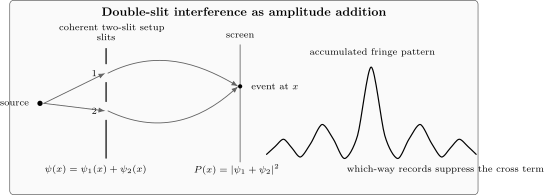
For a coherent double-slit setup, the two alternatives contribute amplitudes to the same detection event. The probability is obtained after adding amplitudes, so a cross term produces fringes. Which-way records reduce or remove that cross term.
Single-Particle Interference
Section titled “Single-Particle Interference”In the quantum description, the amplitude at a screen point is the sum of the amplitudes associated with the two coherent alternatives:
The detection probability density is then
Expanding gives
The third term has no counterpart in the naive classical particle rule. It depends on the relative phase between the two alternatives. At low beam intensity, the arrivals still occur one by one, but the accumulated distribution samples .
This is why the experiment is better summarized as amplitude interference than as a slogan about a particle “being a wave.” The wavefunction is not a classical mass density spread over the apparatus. It is the object whose amplitudes are combined and whose squared magnitude gives detection probabilities.
Which-Way Information
Section titled “Which-Way Information”Interference requires more than two open slits. The alternatives must remain coherent and indistinguishable in the relevant physical state. Suppose a path-sensitive device leaves detector states and correlated with the two alternatives. A schematic joint state at screen coordinate is
If the detector degree of freedom is not read out, the screen probability becomes
When , the detector states are identical and full interference remains. When , the path records are perfectly distinguishable and the interference term vanishes. Partial overlap gives partial fringe visibility.
A useful two-path diagnostic is the fringe visibility
In ideal two-path settings, visibility and path distinguishability obey a complementarity relation of the form
The important lesson is physical, not psychological: interference is suppressed by path information recorded in the apparatus or environment, whether or not a person looks at the record.
Modern Interpretation Using Amplitudes
Section titled “Modern Interpretation Using Amplitudes”The modern rule is:
- If alternatives are coherent and indistinguishable, add amplitudes and then square.
- If alternatives are distinguishable or incoherent, add probabilities.
The double slit is the cleanest introductory example of that rule. It points directly to Probability Amplitudes and the Born Rule. In path-integral language, the two slits are a coarse version of a broader rule: amplitudes from alternative paths are summed before probabilities are computed. The path-integral page Why Path Integrals? develops that idea without treating this historical page as the canonical derivation.
The experiment also gives a first encounter with decoherence. Environmental records of path information play the same mathematical role as a deliberate which-way detector: they reduce the overlap between alternatives and suppress interference. For the formal bridge, see Decoherence Preview. For broader matter-wave platforms, see Interference With Matter.
What the Experiment Does and Does Not Explain
Section titled “What the Experiment Does and Does Not Explain”The double slit shows that quantum probabilities are context-sensitive because amplitudes can interfere. It makes superposition, relative phase, coherence, and measurement context visible in one apparatus.
It does not, by itself, explain every quantum phenomenon. It does not derive spin, atomic spectra, energy quantization, entanglement, or Bell inequality violations. It also does not settle the interpretation of quantum mechanics. Different interpretations agree on the operational predictions for the standard double-slit setup while giving different accounts of what the wavefunction represents.
Common mistakes are:
- treating the interference pattern as proof that particles are ordinary classical waves;
- saying that a conscious observer is required to remove interference;
- assuming mechanical disturbance is the only way to destroy fringes;
- forgetting that single localized detections and interference in the accumulated distribution are both part of the same quantum prediction.
Exercises
Section titled “Exercises”- Derive the far-field fringe spacing from the condition .
Solution
For small angles, . Maxima satisfy , so . Consecutive maxima differ by .
- Let and at a screen point. Compute with no which-way detector and with perfectly distinguishable detector states.
Solution
With no which-way detector,
With perfectly distinguishable detector states, , so the cross term is absent:
- Explain why “the particle was observed” is an imprecise explanation for the loss of interference.
Solution
The relevant issue is whether path information is physically recorded or becomes entangled with uncontrolled degrees of freedom. A detector, scattered photon, vibrating slit, or environment can make the alternatives distinguishable and suppress the interference term. Human awareness is not part of the mathematical criterion.
References
Section titled “References”- T. Young, “The Bakerian Lecture: Experiments and calculations relative to physical optics,” Philosophical Transactions of the Royal Society of London 94, 1-16 (1804), DOI: 10.1098/rstl.1804.0001.
- C. Jönsson, “Elektroneninterferenzen an mehreren künstlich hergestellten Feinspalten,” Zeitschrift für Physik 161, 454-474 (1961).
- A. Tonomura, J. Endo, T. Matsuda, T. Kawasaki, and H. Ezawa, “Demonstration of single-electron buildup of an interference pattern,” American Journal of Physics 57, 117-120 (1989), DOI: 10.1119/1.16104.
- R. Bach, D. Pope, S.-H. Liou, and H. Batelaan, “Controlled double-slit electron diffraction,” New Journal of Physics 15, 033018 (2013), DOI: 10.1088/1367-2630/15/3/033018.
- B.-G. Englert, “Fringe visibility and which-way information: An inequality,” Physical Review Letters 77, 2154-2157 (1996), DOI: 10.1103/PhysRevLett.77.2154.
- R. P. Feynman, R. B. Leighton, and M. Sands, The Feynman Lectures on Physics, Volume III, Chapter 1, Addison-Wesley, 1965.