Davisson–Germer Experiment
The Davisson–Germer experiment observed diffraction of low-energy electrons scattered from a nickel crystal. It supplied direct evidence that electrons, already established as material charged particles, also propagate with a wavelength given by de Broglie’s relation:
Its importance is specific: it confirmed matter-wave behavior using electron scattering from a periodic crystal. It did not merely show that electrons scatter; charged particles scatter classically. It showed angular intensity maxima tied to wavelength and lattice spacing.
Experimental Setup
Section titled “Experimental Setup”The experiment used an electron beam in vacuum, a nickel target, and a detector that could measure scattered electron current as a function of angle. The electrons were accelerated through a known voltage, so their kinetic energy and de Broglie wavelength could be estimated.
For a nonrelativistic electron accelerated through voltage ,
Davisson and Germer measured how the scattered intensity varied with detector angle and accelerating voltage. A crystalline nickel surface provided a periodic scattering structure, while a Faraday-type collector measured the scattered electron current.
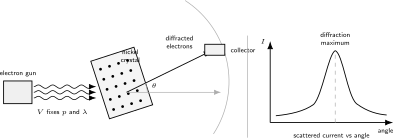
In the Davisson–Germer experiment, electrons scattered from a nickel crystal showed angular intensity maxima. A prominent peak near the low-energy regime matched the de Broglie wavelength expected from the accelerating voltage.
The experimental history was not a perfectly scripted confirmation of a theory. The apparatus and target preparation mattered. A clean crystalline surface made the diffraction structure visible; a disordered or contaminated surface would smear the wave evidence.
Nickel Crystal Scattering
Section titled “Nickel Crystal Scattering”A crystal is a periodic array of scattering centers. If an electron beam has wavelength comparable to the spacing between atomic planes, scattered amplitudes from successive planes can add coherently in certain directions.
Nickel was useful because its lattice spacings are on the same scale as low-energy electron wavelengths. For electrons accelerated through tens of volts, the wavelength is roughly an angstrom. At ,
This is close to the wavelength inferred from the diffraction geometry of the observed maximum. The numerical agreement was the crucial point: the electron wavelength computed from momentum matched the wavelength required to explain the angular peak as crystal diffraction.
Diffraction Maxima
Section titled “Diffraction Maxima”In a simplified Bragg-like interpretation, constructive interference from crystal planes separated by distance occurs when
One commonly discussed Davisson–Germer maximum involved electrons near and a nickel geometry corresponding to a de Broglie wavelength close to . Angular conventions differ in historical descriptions because the measured detector angle and the Bragg angle are not always the same angle. The safe statement is that the observed scattering maximum matched the wavelength predicted by .
Modern reciprocal-lattice language expresses the same elastic diffraction condition as
where is a reciprocal-lattice vector. The crystal supplies discrete momentum transfers, and the electron’s wave vector determines which directions are allowed for constructive interference.
Agreement With de Broglie Wavelength
Section titled “Agreement With de Broglie Wavelength”The de Broglie wavelength for a nonrelativistic electron accelerated through volts is often written numerically as
For ,
This agreement connected four independent ingredients:
- the electron acceleration voltage;
- the electron momentum;
- the de Broglie wavelength;
- the crystal diffraction condition.
That is why the experiment became a canonical confirmation of matter waves.
Historical Significance
Section titled “Historical Significance”The experiment was part of the 1920s convergence toward wave mechanics. de Broglie’s hypothesis predicted matter waves. Schrödinger’s wave mechanics gave a wave equation for matter. Electron diffraction then showed that wave-like propagation of electrons was not merely a formal analogy.
The 1937 Nobel Prize in Physics recognized C. J. Davisson and G. P. Thomson for the experimental discovery of electron diffraction by crystals. The two experimental routes were complementary: Davisson and Germer used scattering from a nickel crystal, while G. P. Thomson used transmission through thin films.
The result also made a useful historical symmetry visible:
| Evidence route | Classical starting point | Quantum reversal |
|---|---|---|
| Photoelectric and Compton effects | light as a wave | light exchanges energy-momentum in quanta |
| Davisson–Germer diffraction | electrons as particles | electrons propagate with wave-like phase |
The lesson was not that particles and waves trade costumes. The lesson was that the classical categories were inadequate.
Modern Interpretation
Section titled “Modern Interpretation”In modern quantum mechanics, the incoming electron is represented by a quantum state with momentum components. The nickel crystal is a periodic potential. Scattering amplitudes from different lattice sites add with phase factors. The observed intensity is proportional to the squared magnitude of the total amplitude:
Diffraction peaks occur where the phases align. A detector still records localized electron arrivals or current, but the distribution of arrivals reflects wave-like propagation of the quantum state.
This is the scattering counterpart of the lesson taught by Electron Diffraction in general and by the Double-Slit Experiment in a two-path geometry: amplitudes add before probabilities are formed.
What the Experiment Does Not Prove by Itself
Section titled “What the Experiment Does Not Prove by Itself”- It does not prove that electrons are classical waves of charge.
- It does not derive the Schrödinger equation.
- It does not eliminate localized detection events.
- It does not make the simple Bragg formula a complete theory of electron scattering.
- It does not mean crystal diffraction is the only evidence for matter waves.
Real electron diffraction depends on sample cleanliness, surface orientation, multiple scattering, inelastic losses, and detector geometry. Those complications do not erase the main conclusion; they explain why careful apparatus interpretation matters.
Common Mistakes
Section titled “Common Mistakes”- Saying the experiment showed electrons “turned into waves.” It showed wave-like propagation and interference of quantum amplitudes.
- Treating any electron scattering as diffraction evidence. The distinctive evidence is angular maxima tied to and crystal periodicity.
- Confusing the detector angle with the Bragg angle without stating the convention.
- Forgetting that G. P. Thomson’s thin-film experiments were an independent confirmation, not a footnote.
- Ignoring target preparation. Crystal order and surface quality are essential to seeing sharp diffraction.
- Overstating the result as a complete derivation of wave mechanics.
Cross-Links
Section titled “Cross-Links”- Matter Waves and Wave Mechanics
- de Broglie Matter Waves
- Electron Diffraction
- G. P. Thomson Experiment
- Double-Slit Experiment
- Davisson–Germer Experiment Reference
- Momentum Eigenstates
- Plane Waves and Delta Normalization
- Scattering Amplitude
- Cross Sections
- Probability Amplitudes
- Evidence Map
References
Section titled “References”- C. Davisson and L. H. Germer, “Diffraction of Electrons by a Crystal of Nickel,” Physical Review 30, 705-740, 1927, DOI: 10.1103/PhysRev.30.705.
- C. J. Davisson, The Discovery of Electron Waves, Nobel Lecture, 1937.
- Nobel Prize Outreach, The Nobel Prize in Physics 1937.
- L. de Broglie, “Recherches sur la théorie des quanta,” Annales de Physique 10, 22-128, 1925, DOI: 10.1051/anphys/192510030022.
- G. P. Thomson, “Experiments on the Diffraction of Cathode Rays,” Proceedings of the Royal Society A 117, 600-609, 1928, DOI: 10.1098/rspa.1928.0022.
- M. Jammer, The Conceptual Development of Quantum Mechanics, 2nd ed., American Institute of Physics, 1989.
Exercises
Section titled “Exercises”- Compute the de Broglie wavelength of a nonrelativistic electron using .
Solution
With ,
This is on the scale of crystal plane spacings, which is why diffraction from nickel was observable.
- Suppose a nickel plane spacing relevant to a simplified Bragg estimate is . For and , estimate .
Solution
Use
Then
so
This is a Bragg angle, not necessarily the same as the detector angle reported in every historical diagram.
- Why is surface crystalline order essential in the Davisson–Germer experiment?
Solution
Diffraction maxima require coherent phase relations among waves scattered from regularly spaced atoms or planes. A disordered or contaminated surface can still scatter electrons, but the scattered amplitudes do not add in sharply selected directions. Crystal order supplies the periodic geometry needed for constructive interference.
- State the difference between the claim “electrons diffract” and the claim “electrons are classical waves.”
Solution
“Electrons diffract” means their quantum amplitudes propagate with phase and interfere, producing probability patterns tied to wavelength. “Electrons are classical waves” would imply a continuously spread physical wave like an ordinary field of matter or charge. The experiment supports the first claim, not the second.