de Broglie Matter Waves
de Broglie’s matter-wave hypothesis assigns a wavelength to a material particle with momentum :
Historically, this was a bold extension of light-quantum reasoning in the opposite direction. If light, long understood as a wave, could show particle-like energy and momentum transfer, perhaps particles such as electrons could show wave-like propagation.
Historical Motivation
Section titled “Historical Motivation”The early quantum theory already contained two suggestive facts:
- Planck and Einstein had connected energy and frequency through .
- The Bohr model used an angular-momentum quantization rule that worked for hydrogen but looked ad hoc.
de Broglie’s proposal gave the Bohr rule a wave interpretation. A stable orbit could be seen as a standing-wave condition around a closed path, rather than only as a manually imposed classical orbit rule.
Wavelength and Momentum
Section titled “Wavelength and Momentum”The matter-wave relation is
or, using and wave number ,
This relation is now part of the standard bridge between momentum eigenstates and plane waves. Historically, it suggested that diffraction and interference should be possible for electrons.
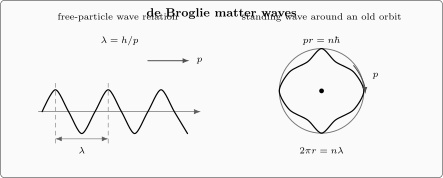
de Broglie’s relation connects momentum to wavelength. Around a closed old-quantum-theory orbit, the standing-wave condition leads to , matching the Bohr angular-momentum rule.
Connection to Bohr Quantization
Section titled “Connection to Bohr Quantization”For a circular orbit, a standing wave around the circumference requires
Substituting gives
so
This is the old Bohr angular-momentum rule. The argument did not make the Bohr model fully correct, but it made its quantization condition less arbitrary and pointed toward a wave equation for matter.
Experimental Evidence
Section titled “Experimental Evidence”The hypothesis became more than a suggestive analogy after electron diffraction experiments. Davisson and Germer observed electron scattering from nickel crystals consistent with a de Broglie wavelength, while G. P. Thomson observed electron diffraction through thin films. These experiments showed that matter-wave behavior was not merely a formal trick for Bohr orbits.
The detailed experimental pages keep setup, data, and interpretation separate from the basic wavelength-momentum hypothesis.
Modern Interpretation
Section titled “Modern Interpretation”Modern quantum mechanics does not say that an electron is a classical wave spread through space in the same sense as a water wave. It assigns a quantum state whose phase and amplitude determine probabilities for measurement outcomes. Plane waves are momentum eigenstates, and localized particles are represented by wave packets built from superpositions of momenta.
The historical matter-wave idea survives, but in a more precise language:
- connects translation symmetry to momentum,
- wave packets explain localization and spreading,
- interference comes from coherent amplitudes,
- measurements produce outcomes with probabilities given by the state.
Common Mistakes
Section titled “Common Mistakes”- Treating the de Broglie wavelength as a small physical ripple attached to a particle.
- Forgetting that a plane wave is not localized.
- Saying matter waves were fully confirmed before electron diffraction.
- Using the Bohr standing-wave argument as if it were the modern derivation of hydrogen.
- Confusing phase velocity, group velocity, and particle velocity.
Cross-Links
Section titled “Cross-Links”- Matter Waves and Wave Mechanics
- Electron Diffraction
- Davisson–Germer Experiment
- G. P. Thomson Experiment
- Bohr Model
- Momentum Eigenstates
- Plane Waves and Delta Normalization
- Wave Packets
- Schrödinger’s Wave Mechanics
- Fourier Wave Packets
- Time-Dependent Schrödinger Equation
References
Section titled “References”- L. de Broglie, Recherches sur la théorie des quanta, doctoral thesis, Paris, 1924.
- L. de Broglie, “Recherches sur la théorie des quanta,” Annales de Physique 10, 22-128 (1925), DOI: 10.1051/anphys/192510030022.
- Nobel Prize Outreach, Louis de Broglie Facts.
- C. Davisson and L. H. Germer, “Diffraction of Electrons by a Crystal of Nickel,” Physical Review 30, 705-740 (1927), DOI: 10.1103/PhysRev.30.705.
Exercises
Section titled “Exercises”- Starting from and , derive the Bohr angular-momentum rule.
Solution
Substitute into the standing-wave condition:
Multiplying by and dividing by gives
For a circular orbit, , so .