Bohr Model
The Bohr model is an old quantum model of the hydrogen atom. It explains important spectral regularities by imposing quantized angular momentum and transition frequencies on a classical-looking orbit picture. It is historically crucial and mathematically useful, but it is not modern quantum mechanics.
Problem: Hydrogen and Atomic Stability
Section titled “Problem: Hydrogen and Atomic Stability”Before Bohr, two facts stood in tension:
- atoms are stable enough to form matter,
- hydrogen emits and absorbs light at sharply defined frequencies.
Classical electromagnetism makes a charged electron in orbit radiate. A naive classical atom should lose energy and collapse. Empirical spectral formulas, such as Balmer’s formula for visible hydrogen lines, showed regularity without explaining why only certain frequencies appear.
Bohr’s 1913 model joined Rutherford’s nuclear atom to quantum conditions. It did not abandon classical pictures completely; instead it restricted them by new postulates.
Bohr Postulates
Section titled “Bohr Postulates”In a compact modern retelling, the model assumes:
- an electron can occupy certain stationary orbits without radiating continuously;
- angular momentum is quantized as
- radiation is emitted or absorbed when the atom transitions between stationary states, with
These rules were radical because they suspended the classical expectation of continuous radiation from accelerated charge.
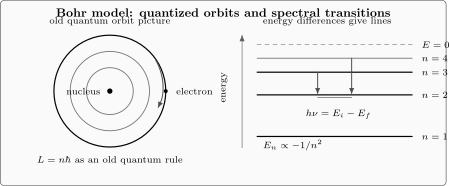
The Bohr model combines a classical-looking orbit picture with old quantum rules. The modern hydrogen atom keeps the energy-level idea but replaces literal electron orbits with wavefunctions and angular-momentum eigenstates.
Energy Levels
Section titled “Energy Levels”For hydrogen, the Bohr model gives energy levels of the form
Spectral lines arise from differences:
This relation reproduces the Rydberg pattern for hydrogen. The agreement was a major success because it connected a measured spectral constant to atomic structure and Planck’s constant.
Successes
Section titled “Successes”The model explained:
- the scale of the hydrogen atom,
- the Rydberg formula for hydrogen spectral lines,
- the appearance of a ground state rather than classical collapse,
- the role of Planck’s constant in atomic structure,
- why radiation frequencies correspond to energy differences rather than orbital frequencies.
It also gave a concrete route from spectroscopy to quantized energy levels.
Failures
Section titled “Failures”The Bohr model fails as a general theory:
- it is not systematic for multi-electron atoms,
- it does not explain line intensities or transition probabilities,
- it relies on special orbit quantization rules,
- it does not naturally include spin,
- it cannot replace noncommuting observables and Hilbert-space states,
- it treats electron orbits in a way modern quantum mechanics does not preserve.
The Sommerfeld Model extended old quantum theory, but it did not remove the framework’s conceptual patchwork character.
Why It Is Not Modern Quantum Mechanics
Section titled “Why It Is Not Modern Quantum Mechanics”Historical caution: Bohr orbits are not literal modern electron paths. In wave mechanics, the hydrogen atom is solved by a Hamiltonian eigenvalue problem. States are wavefunctions with angular-momentum quantum numbers, probability densities, and degeneracies. The energy formula survives, but the picture that supports it changes.
The modern hydrogen atom uses:
- a Hilbert space of wavefunctions,
- a Coulomb Hamiltonian,
- angular-momentum operators,
- radial wavefunctions,
- spherical harmonics,
- Born probabilities.
The Bohr model should therefore be taught as old quantum theory: a bridge, not the destination.
Bridge to Wave Mechanics
Section titled “Bridge to Wave Mechanics”Wave mechanics replaces the orbit rule with operator eigenvalue problems and boundary conditions. The discrete spectrum follows from normalizable solutions of the Schrödinger equation for the Coulomb potential, not from manually selected circular orbits.
Use the Bohr model to understand why energy levels mattered historically. Use the modern hydrogen pages to compute wavefunctions, degeneracies, selection rules, and observables.
Common Mistakes
Section titled “Common Mistakes”- Drawing Bohr orbits as if they were modern electron trajectories.
- Saying the Bohr model is wrong in a way that erases its real hydrogen-spectrum success.
- Forgetting that spectral frequencies come from energy differences.
- Applying the Bohr model uncritically to many-electron atoms.
- Treating angular-momentum quantization in old quantum theory as the same as the modern angular-momentum operator spectrum.
Cross-Links
Section titled “Cross-Links”- Atomic Structure and Spectra
- Sommerfeld Model
- Limits of Old Quantum Theory
- Where Classical Physics Failed
- Hydrogen Atom
- Hydrogen Spectrum Formula
- Angular Momentum Algebra
- Spherical Harmonics
References
Section titled “References”- N. Bohr, “On the Constitution of Atoms and Molecules,” Philosophical Magazine 26, 1-25 (1913), DOI: 10.1080/14786441308634955.
- E. Rutherford, “The Scattering of α and β Particles by Matter and the Structure of the Atom,” Philosophical Magazine 21, 669-688 (1911), DOI: 10.1080/14786440508637080.
- Nobel Prize Outreach, Niels Bohr Facts.
- M. Jammer, The Conceptual Development of Quantum Mechanics, 2nd ed., American Institute of Physics, 1989.
- J. Mehra and H. Rechenberg, The Historical Development of Quantum Theory, Springer, 1982-2001.
Exercises
Section titled “Exercises”- Explain why the statement “the Bohr model is wrong” is too blunt for a serious historical page.
Solution
The model is not the final theory and should not be interpreted as literal modern electron orbits. However, it correctly captured the hydrogen energy-level pattern and connected spectral lines to energy differences. A careful statement is that the Bohr model is a successful old-quantum-theory bridge whose orbit picture is superseded by wave mechanics.