Balmer Formula
The Balmer formula is the empirical rule that organizes the visible spectral lines of hydrogen. It was found before electrons, nuclei, energy levels, or quantum states were part of atomic physics, which is why it matters historically: the mathematical regularity came before the theory that explained it.
In modern language, the Balmer series consists of photon emissions or absorptions involving hydrogen states with final or initial principal quantum number . Balmer did not know that interpretation. He found a numerical pattern in wavelengths.
Hydrogen Visible Spectrum
Section titled “Hydrogen Visible Spectrum”Hydrogen gas produces a small set of prominent visible lines. The first few are conventionally called Hα, Hβ, Hγ, and Hδ. Their approximate vacuum wavelengths are
- Hα near ,
- Hβ near ,
- Hγ near ,
- Hδ near .
These lines were not isolated curiosities. They formed a sequence that approached a limiting wavelength in the near ultraviolet. Balmer’s achievement was to recognize that the visible sequence could be described by a compact integer formula.
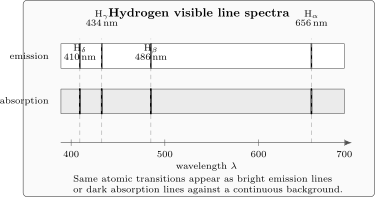
The visible hydrogen lines organized by Balmer are part of the broader empirical fact of atomic line spectra. In modern notation, the Balmer series corresponds to transitions involving the level .
Balmer Formula
Section titled “Balmer Formula”Balmer wrote the visible hydrogen wavelengths in a form equivalent to
Here is the series limit, approximately
For , the formula gives
which is the red Hα line. For , it gives the blue-green Hβ line near . Increasing gives lines closer and closer to the limiting wavelength .
The same pattern is often written in inverse-wavelength form:
The constants are related by
This inverse-wavelength form is closer to the later Rydberg formula and to modern energy-difference notation, because photon energy is proportional to frequency and therefore to inverse wavelength in vacuum.
Empirical Pattern Before Theory
Section titled “Empirical Pattern Before Theory”The formula should be read with historical care. Balmer did not derive the formula from quantum postulates. He did not know about a Coulomb Hamiltonian, stationary states, or transitions between eigenvalues. He found an arithmetic regularity involving integers and measured wavelengths.
That distinction is important because it shows how spectral data constrained atomic theory. A successful theory of hydrogen had to explain:
- why the spectral lines are sharp and reproducible;
- why integers appear in the formula;
- why the sequence approaches a finite limiting wavelength;
- why inverse wavelengths form a simple difference of terms;
- why hydrogen is especially simple compared with multi-electron atoms.
The formula was therefore more than a convenient fit. It was a target for theory.
Connection to the Rydberg Formula
Section titled “Connection to the Rydberg Formula”Rydberg generalized spectral patterns by organizing inverse wavelengths as differences of terms. For hydrogen-like notation, the modern form is
The Balmer series is the special case
The later Bohr model gave a partial explanation: if hydrogen energies scale as , then transition energies naturally produce differences of inverse squares. Modern wave mechanics keeps the energy formula for the Coulomb problem but replaces Bohr’s literal orbits with wavefunctions, angular-momentum quantum numbers, and probability densities.
Why Formula-Before-Theory Matters
Section titled “Why Formula-Before-Theory Matters”The Balmer formula is a good example of a recurring scientific pattern: precise empirical regularities can precede the concepts needed to explain them. In hindsight, the formula points toward quantized bound-state energies. Historically, it was one item in a growing list of pressures on classical physics.
A classical electron orbiting a nucleus would radiate continuously and lose energy. A naive classical model also gives no natural reason for hydrogen wavelengths to follow a clean integer sequence. Balmer’s formula did not by itself create quantum mechanics, but it made the spectral problem sharp enough that later theories could be judged against it.
Modern Interpretation
Section titled “Modern Interpretation”In modern quantum mechanics, the hydrogen atom has bound-state energies
Emission from to produces a photon satisfying
For Balmer lines, . Combining this energy spectrum with gives the inverse-square pattern. The historical lesson remains: the formula was discovered first, while the energy-level interpretation came later.
The detailed modern derivation belongs to the Hydrogen Atom and Hydrogen Spectrum Formula pages.
Common Mistakes
Section titled “Common Mistakes”- Reading modern quantum numbers back into Balmer’s 1885 paper as if the physical meaning was already known.
- Treating the formula as a proof of the Bohr model. It was an empirical target that Bohr later reproduced for hydrogen.
- Confusing wavelength regularity with frequency regularity. The simple difference formula is naturally written for inverse wavelength, not wavelength itself.
- Forgetting that measured wavelengths depend on conventions and medium. High-precision spectroscopy distinguishes air and vacuum wavelengths.
- Overgeneralizing hydrogen’s simple pattern to all atoms without accounting for electron interactions, fine structure, and selection rules.
Cross-Links
Section titled “Cross-Links”- Atomic Structure and Spectra
- Line Spectra
- Bohr Model
- Atomic Spectra Reference
- Hydrogen Spectrum Formula
- Discrete and Continuous Spectra
- Energy Eigenstates
- Hydrogen Atom
- Planck’s Constant
References
Section titled “References”- J. J. Balmer, “Notiz ueber die Spectrallinien des Wasserstoffs,” Annalen der Physik und Chemie 25, 80-87 (1885).
- J. R. Rydberg, “Recherches sur la constitution des spectres d’emission des elements chimiques,” Kungliga Svenska Vetenskapsakademiens Handlingar 23, 1-177 (1890).
- N. Bohr, “On the Constitution of Atoms and Molecules,” Philosophical Magazine 26, 1-25 (1913), DOI: 10.1080/14786441308634955.
- H. Haken and H. C. Wolf, The Physics of Atoms and Quanta, 7th ed., Springer, 2005.
- B. H. Bransden and C. J. Joachain, Physics of Atoms and Molecules, 2nd ed., Pearson, 2003.
Exercises
Section titled “Exercises”- Use to compute the Balmer wavelength for .
Solution
For ,
With , this gives
This is the Hα line, the red line in the visible hydrogen spectrum.
- Show that Balmer’s wavelength formula implies the inverse-wavelength formula with .
Solution
Starting from
invert both sides:
Factor out :
Thus
- Why was the Balmer formula important even before there was a quantum theory of the atom?
Solution
It gave a precise empirical pattern that any atomic theory had to explain. The formula showed that hydrogen line wavelengths were not arbitrary: they involved integers, a limiting wavelength, and a simple inverse-wavelength structure. Later quantum theories succeeded partly because they explained why such a pattern should arise from discrete bound-state energies.