Sommerfeld Model
The Sommerfeld model extended Bohr’s old quantum atom by allowing quantized elliptical orbits and by adding relativistic corrections. It made old quantum theory look unexpectedly powerful: hydrogen fine structure, additional quantum numbers, and a more systematic action-quantization rule all entered the story before modern wave mechanics existed.
Its success is also its warning label. Sommerfeld’s theory improved the Bohr model while keeping classical electron orbits. It sharpened the need for a deeper mechanics because its rules worked in selected cases without becoming a general theory of atoms.
From Bohr to Sommerfeld
Section titled “From Bohr to Sommerfeld”The Bohr Model treated hydrogen using circular orbits, angular-momentum quantization, and transition frequencies. Sommerfeld generalized the orbit picture by treating the electron as a classical Kepler particle whose periodic motions satisfy quantum conditions.
The guiding old-quantum-theory rule was action quantization:
The integral is taken over one period of the corresponding classical coordinate. In the Coulomb problem, the radial and angular motions can be assigned separate action variables. In one common old-quantum notation,
This was more flexible than Bohr’s original circular-orbit rule. It connected atomic spectra to the geometry of classical phase-space orbits, not just to a single angular-momentum postulate.
For the modern semiclassical method descended from this idea, see Bohr–Sommerfeld Quantization. This page is the historical model, not the canonical WKB derivation.
Elliptical Orbits
Section titled “Elliptical Orbits”In classical Coulomb motion, bound orbits are ellipses with the nucleus at one focus. The energy fixes the semimajor axis, while angular momentum controls the eccentricity. Circular Bohr orbits are only the special case of zero eccentricity.
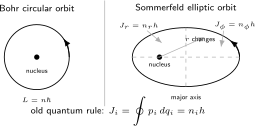
Sommerfeld’s model enlarged Bohr’s circular-orbit picture to quantized Kepler ellipses. The historical quantum numbers came from radial and angular action integrals, not from modern orbital wavefunctions.
Allowing ellipses introduced a radial quantum number. A highly eccentric orbit has radial motion in and out as well as angular motion around the nucleus. Sommerfeld’s action conditions quantized both pieces.
The nonrelativistic Coulomb energy still depends only on the principal combination :
where is the reduced mass. The old theory therefore reproduced the gross hydrogen spectrum while adding more labels to the allowed motions. This resembles, but is not the same as, the later wave-mechanical degeneracy among angular-momentum states.
Additional Quantum Numbers
Section titled “Additional Quantum Numbers”Sommerfeld’s extension introduced more quantum labels than the Bohr model. The old labels varied across authors and conventions, but the basic roles were:
| Old-quantum label | Rough role in the model | Modern caution |
|---|---|---|
| principal energy label | survives as the principal quantum number | |
| radial action label | not identical to a direct observable trajectory count | |
| or | angular action label | related historically to angular momentum, but not the modern without corrections |
| orientation label in a field | later reorganized by angular-momentum operators |
The similarity to modern quantum numbers is real but should not be overstated. Modern hydrogen states are wavefunctions labeled by eigenvalues of commuting operators such as , , and . They are not classical ellipses with definite electron positions.
The mismatch is especially visible in angular momentum. Old quantum theory did not include the correct zero-angular-momentum states in the same way wave mechanics does, and later semiclassical treatments require phase corrections such as the Langer modification.
Relativistic Corrections
Section titled “Relativistic Corrections”Sommerfeld also treated the electron’s Kepler motion relativistically. Near the nucleus, especially in eccentric orbits, the electron speed can be a significant fraction of . Relativity changes the orbital motion and produces a small splitting of levels that were degenerate in the simplest Bohr formula.
The relevant dimensionless strength is the fine-structure constant,
The size of fine-structure corrections is roughly smaller than the gross Bohr energy by a factor of :
In one common old-quantum notation, the Sommerfeld fine-structure expansion for a hydrogenic atom can be written schematically as
where is an old angular quantum number. The important historical point is not the notation; it is that the energy began to depend on a second label once relativistic motion was included.
Modern fine structure is explained using relativistic quantum mechanics and spin-dependent corrections. The Dirac equation later produced a formula with a related structure, but with quantum numbers and physical interpretation reorganized. That later agreement does not make Sommerfeld’s ellipses literal.
Fine-Structure Successes
Section titled “Fine-Structure Successes”The Sommerfeld model had genuine successes:
- it gave a more systematic old-quantum-theory rule through action integrals;
- it extended Bohr’s circular orbits to classical ellipses;
- it introduced quantum numbers beyond the principal energy label;
- it explained important features of hydrogenic fine structure;
- it made the fine-structure constant central in atomic spectroscopy;
- it prepared the conceptual ground for later semiclassical quantization.
These successes are why the model should not be dismissed as merely wrong. It captured real spectral regularities before the correct framework was known.
At the same time, its successes were fragile. They depended heavily on special properties of the Coulomb problem: separability, closed Kepler orbits, and high symmetry. The model did not generalize cleanly to the full range of atomic phenomena.
Why Old Quantum Theory Became Untenable
Section titled “Why Old Quantum Theory Became Untenable”Sommerfeld’s refinements made old quantum theory more impressive, but also more visibly patchwork. The theory kept classical trajectories and then imposed quantum rules on selected periodic motions. That strategy raised hard questions:
- Which coordinates should be quantized?
- Which action variables are allowed?
- How should radiation transitions be computed?
- Why do some classical quantities become quantized while others do not?
- How should multi-electron atoms be treated?
- How should intensities, selection rules, and transition probabilities be derived?
The old theory also struggled with phenomena that demanded new degrees of freedom or a new measurement language: anomalous Zeeman splitting, spin, noncommuting observables, and probability amplitudes.
Modern quantum mechanics did not merely adjust the Sommerfeld model. It changed the basic objects:
| Old quantum theory | Modern quantum mechanics |
|---|---|
| electron orbits | states in Hilbert space |
| selected classical action integrals | operators and spectra |
| transition frequencies from energy differences | amplitudes and probabilities for transitions |
| added quantum rules | a general state-observable-dynamics framework |
Historical Caution
Section titled “Historical Caution”The Sommerfeld model is not an embarrassing detour. It is a serious intermediate theory that worked well enough to teach physicists what needed explaining next.
But it should not be taught as an early version of modern orbital theory. A modern hydrogen orbital is not a smeared Sommerfeld ellipse. It is a wavefunction with angular and radial structure determined by the Schrödinger equation, boundary conditions, and angular-momentum operators.
The careful statement is: Sommerfeld’s model extended old quantum theory and achieved important fine-structure successes, while preserving a classical-orbit picture that modern quantum mechanics replaced.
Common Mistakes
Section titled “Common Mistakes”- Treating Sommerfeld ellipses as literal pictures of modern atomic orbitals.
- Assuming the old angular quantum number is identical to the modern orbital quantum number .
- Presenting the fine-structure agreement as a proof that classical electron orbits were almost right.
- Forgetting that spin is absent from the Sommerfeld model.
- Applying action quantization without checking separability, turning-point phases, or coordinate dependence.
- Concluding that old quantum theory failed because it produced no correct results. Its problem was that it had no general, coherent mechanics.
Cross-Links
Section titled “Cross-Links”- Atomic Structure and Spectra
- Bohr Model
- Rydberg Formula
- Franck–Hertz Experiment
- Limits of Old Quantum Theory
- Hydrogen Atom
- Fine Structure
- Degeneracy of the Hydrogen Atom
- Angular Momentum Algebra
- Bohr–Sommerfeld Quantization
- Semiclassical Limit Overview
- Spectra
- Evidence Map
References
Section titled “References”- A. Sommerfeld, “Zur Quantentheorie der Spektrallinien,” Annalen der Physik 51, 1-94 and 125-167, 1916.
- A. Sommerfeld, Atombau und Spektrallinien, Vieweg, 1919; English translation Atomic Structure and Spectral Lines, Methuen, 1923.
- W. Wilson, “The Quantum-Theory of Radiation and Line Spectra,” Philosophical Magazine 29, 795-802, 1915.
- M. Jammer, The Conceptual Development of Quantum Mechanics, 2nd ed., American Institute of Physics, 1989.
- J. Mehra and H. Rechenberg, The Historical Development of Quantum Theory, Springer, 1982-2001.
- H. Haken and H. C. Wolf, The Physics of Atoms and Quanta, 7th ed., Springer, 2005.
- B. H. Bransden and C. J. Joachain, Physics of Atoms and Molecules, 2nd ed., Pearson, 2003.
Exercises
Section titled “Exercises”- In the old Coulomb model, . Why does the nonrelativistic energy depending only on imply a degeneracy among different old orbit shapes?
Solution
Different pairs can have the same sum . If the nonrelativistic energy depends only on that sum, then distinct elliptical orbit shapes have the same energy. Relativistic corrections partly split this degeneracy by making the energy depend on an additional angular label.
- Estimate the fine-structure scale for the hydrogen ground-state energy using and .
Solution
The rough scale is
The exact splitting pattern depends on the level labels and on the full fine-structure Hamiltonian, but the estimate shows why fine structure is much smaller than the gross Bohr energy scale.
- Why is it misleading to say that the Sommerfeld model is simply “wrong”?
Solution
It is misleading because the model captured real spectral patterns, introduced action quantization, and gave an important fine-structure formula. Its failure was not that it had no successes. Its failure was that it kept classical electron trajectories and added quantum rules without a general state, observable, and probability framework.
- Explain why a modern hydrogen orbital should not be interpreted as a Sommerfeld ellipse.
Solution
A Sommerfeld ellipse is a classical trajectory with a definite path. A modern hydrogen orbital is a stationary wavefunction, labeled by operator eigenvalues and interpreted through probability density. It does not assign the electron a definite Kepler ellipse. Similar quantum numbers record a historical relationship, not an identity of physical pictures.