Nuclear Atom
The nuclear atom is the post-Rutherford picture in which almost all positive charge and most atomic mass are concentrated in a tiny nucleus, with electrons outside it. It replaced diffuse positive-charge atom models, but it did not by itself solve atomic stability or spectra.
This page is the conceptual bridge from Rutherford Scattering to the Bohr Model: the scattering evidence identifies a compact Coulomb center; the stability and spectral problems require new quantum rules.
Nucleus and Electrons
Section titled “Nucleus and Electrons”The nuclear atom separates atomic structure into two very different scales:
- a compact, positively charged nucleus carrying charge ;
- negatively charged electrons outside the nucleus;
- an atom that is neutral when the total electron charge is ;
- an atomic size much larger than the nuclear size.
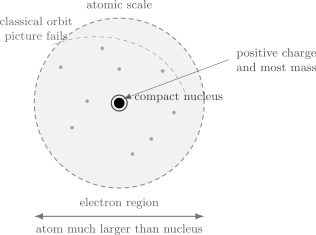
The nuclear atom concentrates positive charge and most mass in a compact center. The diagram is a scale-and-concept schematic, not a literal modern picture of electron trajectories.
Typical nuclear radii are of order femtometers, while atomic radii are of order angstroms. As an order-of-magnitude statement,
That scale separation explains why most alpha particles in Rutherford-type experiments pass through thin foils with small deflections, while rare close encounters can produce large-angle scattering.
Coulomb Center
Section titled “Coulomb Center”Once positive charge is concentrated in a nucleus, the electron-nucleus interaction is a Coulomb attraction. For an electron near a point nucleus of charge , the leading nonrelativistic potential is
This potential becomes the starting point for hydrogenic quantum mechanics. The modern formal pages treat it as a Hamiltonian problem; historically, however, the immediate question was more basic: how can electrons remain in stable atoms at all?
The nuclear atom made the charge distribution clearer but made the classical dynamics harder to accept.
Classical Stability Problem
Section titled “Classical Stability Problem”In a classical planetary picture, an electron orbiting the nucleus is an accelerated charge. Classical electrodynamics predicts that accelerated charges radiate. For nonrelativistic acceleration , the Larmor power scale is
If an electron continuously radiates, it loses mechanical energy and should spiral inward. A compact nucleus intensifies this problem because the electron is bound by a strong central Coulomb attraction.
Real atoms are stable. They do not continuously radiate away their binding energy. They also emit and absorb light at sharply defined frequencies. These facts cannot be explained by merely replacing a diffuse positive charge with a compact nucleus.
Need for New Atomic Mechanics
Section titled “Need for New Atomic Mechanics”The nuclear atom required a mechanics that could explain at least four facts:
- stable atomic ground states;
- discrete line spectra;
- finite atomic sizes;
- reproducible chemical and spectroscopic regularities.
Old classical models had no coherent way to provide all four. Spectral formulas such as the Balmer Formula and Rydberg Formula showed regular energy scales, while scattering showed a compact center. The missing ingredient was a new rule for microscopic motion and radiation.
Modern quantum mechanics supplies that rule through states, observables, Hamiltonians, and energy spectra. But historically the first bridge was Bohr’s old quantum theory.
Bridge to Bohr Model
Section titled “Bridge to Bohr Model”Bohr’s 1913 model joined the Rutherford nucleus to quantum postulates. In a simplified modern retelling, it asserted:
- certain stationary states do not radiate continuously;
- angular momentum is quantized in the allowed orbits;
- radiation occurs in transitions satisfying .
This was not yet modern quantum mechanics, but it was a major step. It explained the hydrogen Rydberg pattern and gave a reason that atomic radiation frequencies are tied to energy differences rather than to ordinary orbital frequencies.
The Bohr model should therefore be read as a response to the nuclear atom’s pressure: Rutherford supplied the compact center, while Bohr supplied old quantum rules to keep the atom from collapsing and to reproduce hydrogen spectra.
Modern Reconstruction
Section titled “Modern Reconstruction”In wave mechanics, the nuclear atom becomes a Hamiltonian eigenvalue problem. For hydrogen, after separating center-of-mass motion, the relative-coordinate Hamiltonian is
Normalizable solutions give discrete bound-state energies. The ground state is stable because it is the lowest energy eigenstate, not because an electron follows a non-radiating classical orbit.
This modern reconstruction should not be read backward too aggressively. Rutherford’s nuclear atom was not the Schrödinger equation. It was the empirical charge-distribution step that made the later quantum Coulomb problem the right problem to solve.
Common Mistakes
Section titled “Common Mistakes”- Treating the nuclear atom as already equivalent to the Bohr model.
- Treating the Bohr model as already equivalent to modern wave mechanics.
- Drawing electron orbits as literal modern trajectories.
- Saying the atom is “mostly empty” without explaining the compact charge evidence behind the statement.
- Forgetting that the nuclear atom made classical stability worse, not better.
- Assuming all nuclear details are relevant for ordinary atomic spectra. Many gross spectral features are controlled by the electron-nucleus Coulomb field, with nuclear size entering as a correction.
Cross-Links
Section titled “Cross-Links”- Atomic Structure and Spectra
- Thomson Model
- Rutherford Scattering
- Bohr Model
- Line Spectra
- Classical Models of Matter
- Where Classical Physics Failed
- Coulomb Potential
- Hydrogen Atom
- Energy Eigenstates
References
Section titled “References”- E. Rutherford, “The Scattering of α and β Particles by Matter and the Structure of the Atom,” Philosophical Magazine 21, 669-688 (1911), DOI: 10.1080/14786440508637080.
- H. Geiger and E. Marsden, “On a Diffuse Reflection of the α-Particles,” Proceedings of the Royal Society A 82, 495-500 (1909), DOI: 10.1098/rspa.1909.0054.
- N. Bohr, “On the Constitution of Atoms and Molecules,” Philosophical Magazine 26, 1-25 (1913), DOI: 10.1080/14786441308634955.
- M. Jammer, The Conceptual Development of Quantum Mechanics, 2nd ed., American Institute of Physics, 1989.
- H. Haken and H. C. Wolf, The Physics of Atoms and Quanta, 7th ed., Springer, 2005.
Exercises
Section titled “Exercises”- If a typical atomic radius is and a typical nuclear radius is , what is the ratio of nuclear to atomic size?
Solution
The ratio is
The nucleus is therefore about one hundred thousand times smaller in radius than the atom on this crude scale.
- Why did the nuclear atom sharpen the classical stability problem?
Solution
The compact nucleus creates a strong central Coulomb attraction. A classical electron bound to that center would be accelerated, and accelerated charges radiate. Continuous radiation would make the electron lose energy and spiral inward. The nuclear atom explains scattering but does not explain why atoms are stable.
- Write the leading electron-nucleus Coulomb potential for a nucleus of charge and explain the sign.
Solution
The electron charge is , so the product of charges is . The potential energy is therefore
The negative sign means the interaction is attractive.
- Distinguish Rutherford’s nuclear atom, Bohr’s model, and the modern hydrogen atom in one sentence each.
Solution
Rutherford’s nuclear atom identifies a compact positive nucleus from scattering evidence. Bohr’s model adds old quantum stationary states and transition rules to explain hydrogen spectra. The modern hydrogen atom is a Schrödinger Hamiltonian eigenvalue problem whose states are wavefunctions, not literal classical orbits.