Line Spectra
Line spectra are the sharp emission or absorption lines produced when atoms interact with light at definite frequencies. They were among the strongest empirical clues that atomic systems do not exchange radiation energy continuously across arbitrary frequencies.
The historical importance of line spectra is simple: before there was a quantum theory of atoms, spectroscopy showed that atoms had reproducible internal structure.
Emission and Absorption Spectra
Section titled “Emission and Absorption Spectra”An emission spectrum is observed when a low-density excited gas radiates light at particular wavelengths. Instead of a smooth continuum, the spectroscope shows bright lines at characteristic positions.
An absorption spectrum is observed when broadband light passes through cooler gas. The gas removes light at particular wavelengths, leaving dark lines against a continuous background.
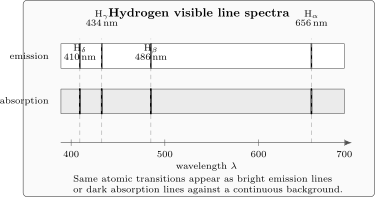
The same atomic transition frequencies can appear as bright emission lines or dark absorption lines. The visible hydrogen Balmer lines are a historically central example of discrete spectral regularity.
The key point is that the line positions are reproducible. Sodium, hydrogen, mercury, and other elements do not emit arbitrary colors under ordinary line-spectrum conditions. They emit and absorb at characteristic frequencies.
Discrete Lines
Section titled “Discrete Lines”Real spectral lines have finite width because of lifetime broadening, Doppler broadening, collisions, apparatus resolution, and other effects. But the central empirical fact remains: the spectrum is organized around sharply defined line frequencies rather than a featureless continuum.
Using the light-quantum relation, a line of frequency corresponds to photon energy
Modern quantum mechanics interprets an emitted line as an energy difference between atomic states:
This modern interpretation should not be read backward too quickly. Nineteenth-century spectroscopy discovered the lines before the energy-eigenstate picture existed. The empirical regularity came first; the quantum explanation came later.
Chemical Identification
Section titled “Chemical Identification”Line spectra became powerful because they act like chemical fingerprints. If a material’s spectrum contains the same characteristic lines as a known element, that element is present under the conditions being observed.
This made spectroscopy a tool for:
- identifying elements in laboratory samples;
- analyzing flames and gas discharges;
- reading solar and stellar composition from absorption lines;
- discovering new elements from previously unmatched spectral lines;
- comparing atomic regularities across chemical species.
The point for quantum mechanics is not merely that spectroscopy was useful. It showed that atoms of the same element have reproducible internal frequency scales. A classical continuum picture of radiation from arbitrary charged motion did not explain why those scales should be so sharp and universal.
Spectral Regularities
Section titled “Spectral Regularities”Hydrogen was especially important because its visible lines show a simple numerical pattern. Balmer found that the visible hydrogen wavelengths could be organized by a formula. In modern notation, the Balmer series can be written
Rydberg later generalized spectral regularities using formulas involving inverse wavelengths. The detailed Balmer and Rydberg pages own those formulas. Here the lesson is that line spectra were not just collections of isolated measurements; they had mathematical order before the correct atomic theory existed.
This is one of the recurring patterns in the history of quantum mechanics: empirical formulas appear first, then a model explains part of them, and finally a deeper theory explains why the model worked and where it failed.
Why Lines Challenged Classical Pictures
Section titled “Why Lines Challenged Classical Pictures”Classical electromagnetic theory explains that accelerating charges radiate. A classical atom with orbiting electrons might therefore be expected to radiate, but it gives the wrong qualitative picture:
- stable atoms should not persist if classical orbiting charges continuously radiate away energy;
- arbitrary mechanical motion would not naturally produce universal sharp frequencies for each element;
- spectral regularities such as the Balmer and Rydberg formulas have no natural place in a naive classical atom;
- line intensities and selection rules require more than allowed frequencies.
The quantum lesson is not that every energy in nature is discrete. Free particles and scattering states often have continuous spectra. The lesson is narrower and stronger: bound atomic systems have discrete transition frequencies, and those frequencies point to structured energy differences.
Modern Interpretation
Section titled “Modern Interpretation”In modern language, line spectra come from transitions between energy eigenstates of an atomic Hamiltonian. If the atom moves from an initial state of energy to a final state of energy , the emitted photon has
Absorption reverses the logic: incoming light of the right frequency can drive a transition upward. Selection rules determine which transitions are strong, weak, or forbidden in a given approximation.
The modern formal home for spectra as operator structure is Discrete and Continuous Spectra. The modern hydrogen calculation lives in Hydrogen Atom. This historical page only explains why spectral lines made such a calculation necessary.
Common Mistakes
Section titled “Common Mistakes”- Treating line spectra as if the Bohr model had already explained them from the start.
- Saying discrete spectral lines prove that all energies are discrete.
- Ignoring absorption spectra; the same transition frequencies can appear in emission and absorption.
- Treating line positions and line intensities as the same problem. Frequencies and intensities require different theoretical inputs.
- Drawing spectral lines as infinitely sharp. Real lines have finite widths, even when their centers are sharply defined.
Cross-Links
Section titled “Cross-Links”- Atomic Structure and Spectra
- Bohr Model
- Atomic Spectra Reference
- Discrete and Continuous Spectra
- Energy Eigenstates
- Hydrogen Atom
- Hydrogen Spectrum
- Evidence Map
- Planck’s Constant
References
Section titled “References”- G. Kirchhoff and R. Bunsen, “Chemical Analysis by Spectrum-Observations,” Philosophical Magazine 20, 88-109 (1860).
- J. J. Balmer, “Notiz ueber die Spectrallinien des Wasserstoffs,” Annalen der Physik und Chemie 25, 80-87 (1885).
- J. R. Rydberg, “Recherches sur la constitution des spectres d’emission des elements chimiques,” Kungliga Svenska Vetenskapsakademiens Handlingar 23, 1-177 (1890).
- N. Bohr, “On the Constitution of Atoms and Molecules,” Philosophical Magazine 26, 1-25 (1913), DOI: 10.1080/14786441308634955.
- H. Haken and H. C. Wolf, The Physics of Atoms and Quanta, 7th ed., Springer, 2005.
- B. H. Bransden and C. J. Joachain, Physics of Atoms and Molecules, 2nd ed., Pearson, 2003.
Exercises
Section titled “Exercises”- Explain why a discrete emission line suggests an energy difference rather than an arbitrary classical radiation frequency.
Solution
If emitted light comes only at certain frequencies, and each photon has energy , then the atom appears to release only certain energy amounts in the process. Modern quantum mechanics identifies those amounts with differences between atomic energy eigenvalues. A purely arbitrary classical motion would not naturally give universal, element-specific line frequencies.
- What is the difference between an emission line and an absorption line?
Solution
An emission line is light radiated at a characteristic frequency, often by an excited low-density gas. An absorption line is a missing frequency in broadband light after it passes through material that absorbs that frequency. The same atomic transition can appear as emission or absorption depending on the physical setup.
- Why is it misleading to say that line spectra prove “energy is discrete” without qualification?
Solution
Line spectra show that bound atomic systems have discrete transition frequencies under the relevant conditions. They do not imply that every quantum system has only discrete energies. Free particles and ionized scattering states can have continuous spectra, and real atoms can have both discrete bound lines and continuum processes.