Rutherford Scattering
Rutherford scattering is the alpha-particle scattering evidence that atomic positive charge is concentrated in a tiny nucleus rather than spread diffusely through the atom. It was a turning point between the Thomson Model and the Nuclear Atom.
The quantum-mechanics importance is indirect but deep: Rutherford’s interpretation made the atom a Coulomb problem with a compact center. That created the classical stability crisis that the Bohr Model and later wave mechanics had to address.
Alpha-Particle Scattering Setup
Section titled “Alpha-Particle Scattering Setup”The experiment used fast alpha particles from radioactive sources, collimated them into a beam, and sent them through a very thin metal foil, famously gold. Scattered alpha particles were detected by scintillations on a zinc sulfide screen.
Most alpha particles passed through the foil with little deflection. The crucial observation was that a small but real fraction scattered through large angles, including angles greater than .
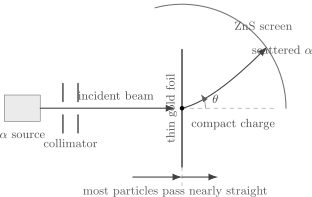
Rutherford scattering tests the spatial distribution of atomic charge. A rare large-angle deflection is naturally produced by a close encounter with a compact positive center, not by a smooth positive charge spread across the atom.
Expected Result in Diffuse Charge Models
Section titled “Expected Result in Diffuse Charge Models”In a diffuse positive-charge model, such as Thomson’s atom, the positive charge fills the atomic volume. A fast alpha particle entering the atom then encounters a comparatively weak electric field spread over atomic distances.
The qualitative expectation is many small deflections, not strong backward scattering. The projectile may be nudged by distributed charge and by electrons, but electrons are too light to reverse an alpha particle’s direction. A large-angle deflection of a massive positive alpha particle points to a strong localized repulsive field.
This is the central diagnostic idea: scattering angle is a probe of charge concentration.
Large-Angle Scattering
Section titled “Large-Angle Scattering”Large-angle scattering means that the alpha particle leaves the foil at a substantial angle relative to its incident direction. Backward or near-backward events are especially informative because they require a large momentum transfer.
The alpha particle is much heavier than an electron. Electron collisions cannot easily turn it around. A compact positive charge, however, can produce a strong Coulomb repulsion during a close encounter.
Rutherford’s interpretation was therefore not just “some particles scattered.” The important point was that the angular distribution demanded rare close encounters with a small, massive, positively charged center.
Nuclear Atom Interpretation
Section titled “Nuclear Atom Interpretation”Rutherford proposed that the atom contains a central charge occupying a very small fraction of the atomic volume. Most of the atom is empty on the scale probed by the alpha particle, which explains why most particles pass through. The compact positive center explains the rare large deflections.
This was the nuclear atom:
- most positive charge is concentrated in a nucleus;
- much of the atomic mass is also concentrated there;
- electrons occupy the surrounding atom;
- the atom is mostly empty space compared with the nuclear scale.
The nuclear atom replaced the diffuse positive-charge assumption, but it did not complete atomic theory. A classical electron bound to a compact positive nucleus should radiate and collapse. Quantum mechanics was needed to explain stable bound states and discrete spectra.
Scattering Formula Overview
Section titled “Scattering Formula Overview”For a repulsive Coulomb interaction,
classical mechanics gives a relation between impact parameter , kinetic energy , and scattering angle :
Large angles therefore correspond to small impact parameters. The closer the alpha particle comes to the compact charge, the more strongly it is deflected.
The differential cross section has the Rutherford form
The distinctive angular dependence,
was a powerful signature of Coulomb scattering from a concentrated charge. The detailed classical and quantum scattering formalism belongs to Coulomb Scattering.
Why This Matters for Quantum Mechanics
Section titled “Why This Matters for Quantum Mechanics”Rutherford scattering did not directly introduce Hilbert spaces, wavefunctions, or the Schrödinger equation. Its role was more structural. It fixed the central charge distribution that later atomic theory had to use.
Once the nucleus is compact, the electron problem becomes a Coulomb binding problem. Classical mechanics and electrodynamics then run into the stability problem: an orbiting electron is accelerated and should radiate energy. The observed atom is stable and has sharp spectral lines.
The path to quantum mechanics therefore runs through two linked facts:
- Rutherford scattering supports a compact nuclear Coulomb center;
- atomic stability and spectra cannot be explained by classical electron orbits around that center.
Bohr’s old quantum theory was the first successful bridge for hydrogen spectra. Modern wave mechanics later replaced orbits with energy eigenstates of the Coulomb Hamiltonian.
Bridge to Modern Scattering Theory
Section titled “Bridge to Modern Scattering Theory”Modern scattering theory describes experiments using amplitudes, cross sections, conservation laws, and asymptotic states. Rutherford’s formula remains a central reference case because the Coulomb potential is exactly solvable and experimentally decisive.
There is also a caution: the Coulomb potential is long-ranged. Its scattering theory has special features such as forward-angle divergence and long-range phases. Those details are not needed to understand the historical inference, but they matter for the modern formal treatment.
Common Mistakes
Section titled “Common Mistakes”- Saying Rutherford scattering showed that atoms are “mostly empty” but omitting the decisive large-angle evidence for a compact positive charge.
- Treating the nuclear atom as a complete quantum theory of atoms. It fixed the charge distribution but did not solve stability or spectra.
- Assuming the experiment directly observed a nucleus as an image. The nucleus was inferred from scattering behavior.
- Forgetting that electrons are too light to explain large alpha-particle backscattering.
- Using the Rutherford formula without noting its Coulomb and thin-target assumptions.
Cross-Links
Section titled “Cross-Links”- Atomic Structure and Spectra
- Thomson Model
- Nuclear Atom
- Bohr Model
- Classical Models of Matter
- Where Classical Physics Failed
- Coulomb Scattering
- Coulomb Potential
- Hydrogen Atom
- Cross Sections
- Evidence Map
References
Section titled “References”- H. Geiger and E. Marsden, “On a Diffuse Reflection of the α-Particles,” Proceedings of the Royal Society A 82, 495-500 (1909), DOI: 10.1098/rspa.1909.0054.
- E. Rutherford, “The Scattering of α and β Particles by Matter and the Structure of the Atom,” Philosophical Magazine 21, 669-688 (1911), DOI: 10.1080/14786440508637080.
- H. Geiger and E. Marsden, “The Laws of Deflexion of α Particles through Large Angles,” Philosophical Magazine 25, 604-623 (1913).
- J. J. Thomson, “On the Structure of the Atom,” Philosophical Magazine 7, 237-265 (1904), DOI: 10.1080/14786440409463107.
- M. Jammer, The Conceptual Development of Quantum Mechanics, 2nd ed., American Institute of Physics, 1989.
- H. Haken and H. C. Wolf, The Physics of Atoms and Quanta, 7th ed., Springer, 2005.
Exercises
Section titled “Exercises”- Why are large-angle alpha-scattering events more informative than small deflections?
Solution
Small deflections can arise from weak distributed fields or many small interactions. A large-angle deflection of a heavy alpha particle requires a large momentum transfer. That is naturally produced by a close encounter with a compact positive charge, so large-angle events probe charge concentration.
- Use the relation to explain why backscattering implies close approach.
Solution
For fixed energy and Coulomb strength , the right side grows when the impact parameter becomes small. Large means large , so it corresponds to small . Near-backward scattering therefore comes from alpha particles passing very close to the compact positive center.
- Starting from , derive the Rutherford angular dependence, where .
Solution
The differential cross section for central-force scattering is
With
one has
Using gives
- Explain why the nuclear atom made the classical stability problem sharper.
Solution
The nuclear atom places negative electrons near a compact positive Coulomb center. A classical orbiting electron is accelerated, and accelerated charges radiate. The electron would lose energy and spiral inward. Thus the nuclear atom explains scattering but makes stable atoms impossible without new quantum rules or wave-mechanical bound states.