Thomson Model
The Thomson model is a pre-nuclear classical model of the atom in which negative electrons are embedded in, or move within, a diffuse positive charge distribution. It is often called the plum-pudding model, although that nickname should not be mistaken for Thomson’s own technical language.
The model matters because it was a serious attempt to combine electron discovery, charge neutrality, and classical stability before Rutherford Scattering revealed that atomic positive charge is concentrated in a compact nucleus.
Electron Discovery Context
Section titled “Electron Discovery Context”J. J. Thomson’s cathode-ray work showed that cathode rays behaved as negatively charged particles with a very large charge-to-mass ratio. The crucial implication for atomic structure was that atoms were not indivisible classical units. They contained lighter charged constituents.
Two constraints then became unavoidable:
- atoms are usually electrically neutral;
- atoms contain negative corpuscles, later called electrons.
A model of the atom therefore needed some positive charge to balance the electrons. Before the nucleus was known, it was natural to consider a diffuse positive distribution spread throughout the atomic volume.
Plum-Pudding Model
Section titled “Plum-Pudding Model”In its simplest teaching form, the Thomson atom consists of:
- a roughly spherical distribution of positive charge;
- electrons placed inside or moving within that positive distribution;
- total negative electron charge equal in magnitude to the positive charge.
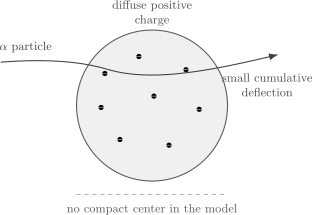
The Thomson model placed electrons in a diffuse positive charge distribution. Such a model naturally suggests many small deflections for a fast charged projectile, not rare large-angle scattering from a compact center.
The model was not merely a cartoon. Thomson studied possible electron arrangements and oscillations in the positive background. One rough classical motivation is easy to see: inside a uniformly charged sphere of radius and total positive charge , Gauss’s law gives
An electron displaced from the center therefore feels a restoring force from the positive background:
This looks like a harmonic restoring force before electron-electron repulsion and radiation are included. That is why the model could appear attractive to a classical physicist trying to build stable matter from charges and forces.
Classical Atom Model Assumptions
Section titled “Classical Atom Model Assumptions”The Thomson model rests on assumptions that were plausible before scattering experiments forced a different picture:
- positive charge is spread through the atomic volume rather than localized in a tiny region;
- electrons are classical charged particles with definite positions or motions;
- mechanical equilibrium or periodic motion can explain atomic stability;
- optical spectra might come from electron oscillations or rearrangements;
- atomic mass and charge structure can be understood without a compact nucleus.
Each assumption has a modern replacement. Positive charge is concentrated mostly in nuclei. Electrons are quantum states, not classical beads in a medium. Spectra arise from energy differences and transition amplitudes. Stability is a consequence of quantum bound states and the Pauli principle, not a classical electrostatic packing arrangement.
Experimental Vulnerabilities
Section titled “Experimental Vulnerabilities”The model had several vulnerabilities even before it was abandoned.
First, spectroscopy was too rigid and too orderly. The Balmer Formula and Rydberg Formula suggested integer-structured spectral series. Classical electron oscillations in a diffuse charged sphere did not naturally explain hydrogen’s inverse-square pattern.
Second, radiation was a serious problem. Accelerating classical charges radiate. A model with moving electrons must explain why atoms are stable and why they do not radiate continuously over arbitrary frequencies.
Third, scattering tests probe charge distribution directly. A diffuse positive sphere gives relatively weak electric fields spread over atomic distances. A fast alpha particle passing through such an atom should normally receive many small deflections. Rare large-angle deflections are difficult to obtain unless the atom contains a much more concentrated positive charge.
Rutherford Scattering as Turning Point
Section titled “Rutherford Scattering as Turning Point”Geiger and Marsden’s alpha-scattering observations, interpreted by Rutherford, showed that some alpha particles were scattered through large angles. Rutherford explained this by placing nearly all positive charge and much of the atomic mass in a tiny nucleus.
This did not immediately solve atomic physics. It created a sharper problem: if electrons are bound to a compact positive nucleus, then classical electrodynamics makes the stability problem worse. A classical electron orbiting a nucleus is accelerated and should radiate. Bohr’s model later imposed stationary states and transition frequencies to address hydrogen spectra within old quantum theory.
The Thomson model therefore failed in a productive way. It made clear what a pre-nuclear classical atom could and could not do, and it set the stage for the nuclear atom and the quantum stability problem.
Modern Status
Section titled “Modern Status”Modern quantum mechanics keeps none of the literal Thomson picture. There is no diffuse positive pudding filling the atom, and electrons are not classical corpuscles embedded in it. The positive charge is nuclear, while electronic structure is described by wavefunctions, spin, antisymmetry, and Hamiltonian eigenstates.
Still, the model deserves a careful historical reading. It was not foolish; it was constrained by the evidence available before alpha scattering. Its failure illustrates how experimental probes of charge distribution can overturn a plausible mechanical picture.
Common Mistakes
Section titled “Common Mistakes”- Treating the Thomson model only as a joke. It was a serious model built from electron discovery and charge neutrality.
- Saying Rutherford scattering merely improved the Thomson model. It replaced the diffuse positive charge assumption with a compact nucleus.
- Imagining Thomson electrons as fixed raisins. Thomson’s own models involved dynamical corpuscles and stability calculations.
- Assuming the nuclear atom solved all problems at once. It explained scattering but intensified the classical stability problem.
- Reading modern quantum orbitals into pre-quantum atom models.
Cross-Links
Section titled “Cross-Links”- Atomic Structure and Spectra
- Classical Models of Matter
- Where Classical Physics Failed
- Line Spectra
- Balmer Formula
- Rydberg Formula
- Rutherford Scattering
- Nuclear Atom
- Bohr Model
- Coulomb Scattering
- Hydrogen Atom
- Atomic Spectra Reference
References
Section titled “References”- J. J. Thomson, “Cathode Rays,” Philosophical Magazine 44, 293-316 (1897).
- J. J. Thomson, “On the Structure of the Atom: an Investigation of the Stability and Periods of Oscillation of a number of Corpuscles arranged at equal intervals around the Circumference of a Circle; with Application of the Results to the Theory of Atomic Structure,” Philosophical Magazine 7, 237-265 (1904), DOI: 10.1080/14786440409463107.
- Nobel Prize Outreach, J. J. Thomson Facts.
- E. Rutherford, “The Scattering of α and β Particles by Matter and the Structure of the Atom,” Philosophical Magazine 21, 669-688 (1911), DOI: 10.1080/14786440508637080.
- C. Baily, “Early Atomic Models - From Mechanical to Quantum (1904-1913),” arXiv: 1208.5262.
- M. Jammer, The Conceptual Development of Quantum Mechanics, 2nd ed., American Institute of Physics, 1989.
Exercises
Section titled “Exercises”- Why did the discovery of the electron force atom models to include positive charge?
Solution
Atoms are usually electrically neutral. If they contain negative electrons, then they must also contain enough positive charge to balance the electron charge. Before the nucleus was known, a diffuse positive charge distribution was a natural classical possibility.
- Use Gauss’s law to show that the electric field inside a uniformly charged sphere is proportional to .
Solution
Let the sphere have radius and total charge . The charge enclosed by a Gaussian sphere of radius is
Gauss’s law gives
Therefore
The field is linear in distance from the center.
- Why did large-angle alpha scattering create trouble for the Thomson model?
Solution
In a diffuse positive charge distribution, a fast alpha particle mostly feels weak fields spread over the atomic volume, so the expected deflections are small and cumulative. Large-angle scattering suggests a strong localized Coulomb field, which points to a compact concentration of positive charge rather than a diffuse positive sphere.
- Explain why Rutherford’s nuclear atom did not by itself solve the quantum problem of atomic stability.
Solution
The nuclear atom explains how a compact positive center can produce large-angle scattering. But a classical electron bound to that compact center is accelerated and should radiate energy. Without quantum stationary states or wave-mechanical bound states, a classical nuclear atom is unstable.