Wave Packets
Matter waves created an immediate interpretive problem. A single de Broglie wave with definite momentum is spread over all space, but experiments prepare beams, tracks, spots, and localized detections. Wave packets were the bridge: localized quantum states can be built by superposing many plane-wave components with nearby wavelengths.
This page is the historical bridge from de Broglie Matter Waves to wave mechanics. The detailed Fourier construction belongs to Fourier Wave Packets, and detailed free-particle dynamics belongs to Free Motion and Wave Packets.
Plane Waves and the Localization Problem
Section titled “Plane Waves and the Localization Problem”The de Broglie relation assigns a wavelength to a momentum:
A plane-wave component has the schematic form
It is useful because it has definite wave number and definite momentum. But it does not describe a localized particle on the full line. Its probability density is constant:
There is no packet center, no finite spatial width, and no localized bump to track. This was not a small technical inconvenience. If matter waves were to describe electrons arriving at finite regions of detectors, the theory needed localized states.
Superposition of Waves
Section titled “Superposition of Waves”A wave packet solves the localization problem by superposing many wave components:
The function gives the amplitude for different wave numbers. If is concentrated near , the packet has a fairly well-defined mean momentum. If is broad, the packet can be localized more sharply in space. The tradeoff is the physical content behind the later Position-Momentum Uncertainty relation.
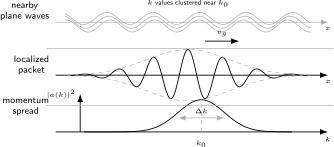
A localized matter-wave packet is built from a spread of wave numbers. Narrowing the spatial envelope requires a broader momentum distribution, while the packet center moves approximately with the group velocity.
This is the key conceptual move. The wave nature of matter is not represented by one infinite sinusoid. Physical localized states are superpositions. The individual wave components are mathematical building blocks; the packet is the normalizable state that can approximate a localized particle.
Group Velocity
Section titled “Group Velocity”The packet center is governed by the dispersion relation . If is sharply peaked near , expand :
Keeping this linear approximation, the packet envelope moves with group velocity
For a nonrelativistic free particle,
so
The group velocity is therefore
That is exactly the classical velocity of a free particle with momentum . This agreement was one reason wave packets made matter waves physically intelligible: a localized envelope could move like a particle even though it was built from waves.
The phase velocity of an individual component is different:
The carrier phase does not move at the particle velocity. The envelope does. This distinction remains a common source of confusion.
Wave Packet Spreading
Section titled “Wave Packet Spreading”The same dispersion relation that gives the group velocity also causes spreading. A better expansion is
The constant term gives an overall phase. The linear term translates the packet center. The quadratic term changes the relative phases of nearby wave-number components and therefore changes the shape of the envelope.
For a nonrelativistic free particle,
so generic free packets spread. A sharply localized packet has a broad spread of momenta, and those momentum components have different velocities. This does not mean probability is lost; unitary time evolution preserves total probability. It means the probability density becomes wider.
The detailed spreading formulas live in Wave Packet Spreading and Gaussian Wave Packets. The historical lesson is simpler: a wave account of matter can recover particle-like motion only as an approximation, and the limits of that approximation are physically meaningful.
Historical Role in Interpreting Matter Waves
Section titled “Historical Role in Interpreting Matter Waves”Wave packets helped early quantum theory avoid two false extremes.
One false extreme was to identify an electron with a single plane wave. That made momentum simple but localization impossible. The other was to treat the electron as a tiny classical corpuscle with a mysterious wavelength attached. That preserved localization but missed interference and diffraction.
The packet picture showed how both features could appear in one description:
- phase and wavelength explain diffraction and interference;
- localized envelopes explain beams and approximate trajectories;
- momentum spread explains why localization has a cost;
- dispersion explains why free quantum localization is not permanent;
- detection probabilities require an additional interpretive rule, later sharpened by Born’s probability interpretation.
This is why wave packets sit between the historical evidence pages and the modern formalism. They make the route from matter waves to the Time-Dependent Schrödinger Equation plausible without replacing the full Hilbert-space theory.
Common Mistakes
Section titled “Common Mistakes”- Treating a plane wave as a localized particle. A plane wave is a momentum eigenstate idealization, not a normalizable localized state.
- Saying a packet is a small classical wave of matter. The packet is a quantum state whose squared magnitude gives probabilities.
- Identifying phase velocity with particle velocity. The packet envelope moves with group velocity.
- Forgetting that localization requires momentum spread.
- Treating packet spreading as a failure of probability conservation.
- Assuming a packet always moves like a rigid classical object. That is an approximation controlled by dispersion, mass, packet width, and time scale.
Cross-Links
Section titled “Cross-Links”- Matter Waves and Wave Mechanics
- de Broglie Matter Waves
- Schrödinger’s Wave Mechanics
- Electron Diffraction
- G. P. Thomson Experiment
- Interference With Matter
- Fourier Wave Packets
- Momentum Representation
- Free Particle
- Group Velocity and Phase Velocity
- Wave Packet Spreading
- Gaussian Wave Packets
- Probability Amplitudes
References
Section titled “References”- L. de Broglie, “Recherches sur la théorie des quanta,” Annales de Physique 10, 22-128, 1925, DOI: 10.1051/anphys/192510030022.
- E. Schrödinger, “Quantisierung als Eigenwertproblem,” Annalen der Physik 79, 361-376, 1926, DOI: 10.1002/andp.19263840404.
- M. Born, “Zur Quantenmechanik der Stoßvorgänge,” Zeitschrift für Physik 37, 863-867, 1926, DOI: 10.1007/BF01397477.
- M. Jammer, The Conceptual Development of Quantum Mechanics, 2nd ed., American Institute of Physics, 1989.
- R. Shankar, Principles of Quantum Mechanics, 2nd ed., Springer, 1994.
- D. J. Griffiths and D. F. Schroeter, Introduction to Quantum Mechanics, 3rd ed., Cambridge University Press, 2018.
Exercises
Section titled “Exercises”- Why can a single full-line plane wave not represent a localized particle?
Solution
A plane wave has the form , so its probability density is
That density is constant in space. There is no finite-width region where the particle is localized, and the state is not square-normalizable on the full line.
- Derive the group velocity for a nonrelativistic free-particle packet centered at .
Solution
For a nonrelativistic free particle,
Therefore
Since , this gives
the classical free-particle velocity.
- Explain qualitatively why a sharply localized packet tends to spread rapidly.
Solution
Sharp localization requires many Fourier components, which means a broad momentum distribution. For a free nonrelativistic particle, different momentum components have different velocities . Those components separate over time, so the spatial probability distribution broadens.
- In what sense do wave packets reconcile particle-like motion with wave-like diffraction?
Solution
The components of the packet carry phases and wavelengths, so the state can diffract and interfere. The superposed envelope can still be localized enough to move with an approximate center and group velocity. Thus the packet gives particle-like motion as an approximation built from wave-like amplitudes, not as a return to classical particles.