Interference With Matter
Matter-wave interference is not a special trick of electrons in crystals. It is a general quantum phenomenon: if a material system can be prepared coherently, given distinguishable-in-principle alternatives that remain physically indistinguishable, and later recombined, its amplitudes can interfere.
This page connects Electron Diffraction and the Double-Slit Experiment to broader matter-wave interferometry. It is a historical and conceptual bridge, not the canonical derivation of scattering theory, atom optics, or decoherence.
Common Interferometer Logic
Section titled “Common Interferometer Logic”The shared mathematical structure is simple. Two coherent alternatives contribute amplitudes and to the same class of outcome:
Expanding the probability gives
The cross term is the interference term. In a path interferometer, its phase is often summarized by an action difference:
Different platforms create and measure this phase in different ways. Electron interferometers may use electrostatic biprisms or crystal diffraction. Neutron interferometers may use perfect-crystal beam splitters. Atom interferometers may use optical gratings or laser pulses. Molecule interferometers often use material, optical, or time-domain gratings.
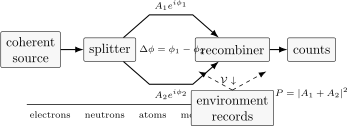
Matter-wave interferometers differ in hardware, but their logic is shared. A coherent state is split into alternatives, the alternatives accumulate relative phase, and recombination converts phase into a measurable intensity or count-rate pattern. Environmental records reduce the interference visibility.
Electrons
Section titled “Electrons”Electrons supplied the first decisive matter-wave evidence because their de Broglie wavelengths are naturally comparable to atomic spacings at accessible energies:
Crystal electron diffraction showed that electrons scattered from periodic matter can form interference maxima. Later electron interferometry made the single-particle aspect especially vivid: localized detection events accumulate into an interference pattern over many runs.
The lesson is not that the electron becomes a classical wave of charge. The beam is described by amplitudes with phases, while detections remain localized. Electron interference also made it clear that coherence is fragile. Energy spread, source size, uncontrolled fields, sample disorder, and path information can reduce fringe visibility.
Electron experiments are therefore a bridge between historical matter waves and modern amplitude language:
- diffraction from crystals confirms in a periodic scattering geometry;
- biprism and two-beam electron interferometers show controllable path interference;
- single-electron accumulation experiments show that the pattern is not produced by classical interactions among many electrons in the beam.
Neutrons
Section titled “Neutrons”Neutrons are electrically neutral, massive, spin- particles. Their neutrality makes them valuable interferometer probes because electric stray fields affect them much less directly than they affect electrons. Their mass and magnetic moment also make them sensitive to gravitational, inertial, and magnetic phase shifts.
Perfect-crystal neutron interferometers split a coherent neutron beam using Bragg diffraction inside a carefully cut crystal. The paths can separate macroscopically and then recombine. A schematic phase shift from a potential-energy difference is
The Colella–Overhauser–Werner experiment used neutron interferometry to observe a gravitationally induced quantum phase. In a simple uniform-gravity geometry with enclosed area and neutron speed , the scale of the phase is
The exact coefficient depends on the interferometer geometry and orientation, but the physical point is robust: gravity can shift quantum phase even when the observed output is an interference count rate. This made neutron interferometry a clean way to test how quantum phases respond to classical fields.
Neutron experiments also helped clarify that matter-wave interference is not tied to electric charge or to an electron-specific wave picture. Neutral composite particles interfere too.
Atoms are heavier and internally richer than electrons or neutrons. They have internal energy levels, polarizabilities, magnetic sublevels, and strong interactions with light. Those features complicate coherence, but they also provide tools.
Atom interferometers often use gratings or laser pulses as beam splitters and mirrors. In light-pulse interferometry, absorption and stimulated emission can transfer momentum to an atom coherently, splitting and recombining wave packets. The phase can then depend on acceleration, rotation, gravitational gradients, internal-state evolution, and laser phases.
For an atom with two alternatives that recombine, the same amplitude rule applies:
What changes is the engineering of coherence. Atomic sources must control velocity spread, internal states, wave-packet separation, phase noise, and environmental scattering. Laser cooling and coherent light-matter interactions made atom interferometry a precision tool rather than only a conceptual demonstration.
Historically, atom interferometry helped move matter-wave interference from proof-of-principle quantum mechanics into controlled quantum measurement. It is now used in gravimetry, inertial sensing, tests of fundamental symmetries, and measurements of constants. Those applications are important, but they should not obscure the basic quantum lesson: whole atoms, not just elementary particles, can interfere.
The modern platform treatment, including Raman and Bragg beam splitters, light-pulse phase bookkeeping, acceleration and rotation response, wave-packet closure, and sensor calibration, belongs to Atom Interferometry.
Molecules
Section titled “Molecules”Molecule interferometry pushes the question further. Molecules are composite objects with rotations, vibrations, internal excitations, polarizability, and many environmental decoherence channels. If molecules display interference, the phenomenon cannot be dismissed as a peculiarity of simple particles.
Large-molecule experiments often use near-field interferometry rather than a simple far-field double slit. A useful scale is the Talbot scale, which grows like
where is a grating period. Different conventions include factors of order unity, but the scaling explains why long wavelengths, fine gratings, and careful collimation matter.
For fullerene molecules such as , the de Broglie wavelength is tiny compared with optical wavelengths and often tiny compared with the molecule’s own size. The interference pattern is therefore not a wave in the everyday visual sense. It is an amplitude effect: the center-of-mass quantum state has phase coherence over alternatives in the apparatus.
Molecule interference also makes decoherence concrete. Thermal photon emission, background-gas collisions, uncontrolled internal excitations, and which-path marking can suppress fringes. The larger and warmer the molecule, the harder it is to preserve coherence. That is a practical limitation, not a change in the quantum rule.
Modern Matter-Wave Experiments
Section titled “Modern Matter-Wave Experiments”Modern matter-wave experiments share several design questions:
- How is a sufficiently coherent input state prepared?
- What device splits amplitudes without recording which path was taken?
- What phase is accumulated between alternatives?
- How are the alternatives recombined?
- Which environmental degrees of freedom can carry path information?
- What visibility is expected after averaging over source and detector imperfections?
The answer depends strongly on the platform.
| Platform | Common splitter or grating | Typical lesson |
|---|---|---|
| electrons | crystals, electrostatic biprisms, nanofabricated gratings | charge does not prevent coherent matter-wave interference, but fields and source coherence matter |
| neutrons | perfect-crystal Bragg beam splitters | neutral massive particles acquire measurable gravitational, magnetic, and inertial phases |
| atoms | material gratings, standing light waves, Raman or Bragg laser pulses | internal structure and light-matter coupling can be used to control center-of-mass amplitudes |
| molecules | near-field material, optical, or time-domain gratings | composite objects can interfere when environmental records are controlled |
This breadth is one reason matter-wave interference remains foundational. It is not just an analogy with light. The same amplitude logic applies across systems with very different masses, charges, internal structures, and interactions.
Bridge to Quantum Coherence and Decoherence
Section titled “Bridge to Quantum Coherence and Decoherence”Interference requires coherence between alternatives. A compact way to model reduced coherence is to insert a complex visibility factor into the interference term:
When , the alternatives are fully coherent. When , the cross term is absent and probabilities add. Intermediate values give partial visibility.
This factor can represent many physical effects: imperfect source coherence, averaging over velocities, uncontrolled phase noise, collisions with background gas, thermal radiation, vibrational coupling, detector resolution, or genuine path records in an environment. The formal treatment belongs to Decoherence Preview, but matter interferometers show the mechanism in experimentally tangible terms.
The conceptual boundary is important:
- Loss of interference does not require consciousness.
- It does not require a large mechanical disturbance.
- It does require the physical conditions for coherent amplitude addition to fail.
In that sense, matter-wave experiments are a practical laboratory for the transition from quantum coherence to classical-looking statistics.
What This Page Does Not Claim
Section titled “What This Page Does Not Claim”Matter-wave interference does not prove that every object will show visible fringes in ordinary conditions. Coherence can be extremely difficult to prepare and maintain, especially for warm, large, or strongly interacting systems.
It also does not mean that particles are secretly classical waves. The recurring pattern is more precise: quantum states carry amplitudes and phases, alternatives can interfere, and measurements register outcomes with probabilities determined by those amplitudes.
Finally, modern matter-wave interferometry is not a replacement for the formal postulates. It is evidence and intuition for why the postulates need amplitudes, phases, unitary evolution, measurement probabilities, and a careful account of coherence.
Common Mistakes
Section titled “Common Mistakes”- Treating electron diffraction as the end of the matter-wave story.
- Assuming neutral particles should not show interference because they do not feel ordinary electric forces.
- Saying molecule interference means a molecule is a smeared classical object.
- Forgetting that internal states can carry which-path information.
- Confusing loss of visibility with mere lack of experimental skill; sometimes the environment really has acquired path information.
- Overstating modern interferometry as a settled route to macroscopic superpositions in everyday objects.
- Adding probabilities when the alternatives are coherent and indistinguishable.
Cross-Links
Section titled “Cross-Links”- Matter Waves and Wave Mechanics
- de Broglie Matter Waves
- Electron Diffraction
- Davisson–Germer Experiment
- G. P. Thomson Experiment
- Wave Packets
- Interpreting the Wavefunction
- Double-Slit Experiment
- Probability Amplitudes
- Decoherence Preview
- Scattering Amplitude
- Wave Packets and Scattering
References
Section titled “References”- A. Tonomura, J. Endo, T. Matsuda, T. Kawasaki, and H. Ezawa, “Demonstration of single-electron buildup of an interference pattern,” American Journal of Physics 57, 117-120, 1989, DOI: 10.1119/1.16104.
- H. Rauch, W. Treimer, and U. Bonse, “Test of a single crystal neutron interferometer,” Physics Letters A 47, 369-371, 1974, DOI: 10.1016/0375-9601(74)90041-7.
- R. Colella, A. W. Overhauser, and S. A. Werner, “Observation of gravitationally induced quantum interference,” Physical Review Letters 34, 1472-1474, 1975, DOI: 10.1103/PhysRevLett.34.1472.
- O. Carnal and J. Mlynek, “Young’s double-slit experiment with atoms: a simple atom interferometer,” Physical Review Letters 66, 2689-2692, 1991, DOI: 10.1103/PhysRevLett.66.2689.
- D. W. Keith, C. R. Ekstrom, Q. A. Turchette, and D. E. Pritchard, “An interferometer for atoms,” Physical Review Letters 66, 2693-2696, 1991, DOI: 10.1103/PhysRevLett.66.2693.
- M. Kasevich and S. Chu, “Atomic interferometry using stimulated Raman transitions,” Physical Review Letters 67, 181-184, 1991, DOI: 10.1103/PhysRevLett.67.181.
- M. Arndt, O. Nairz, J. Vos-Andreae, C. Keller, G. van der Zouw, and A. Zeilinger, “Wave-particle duality of molecules,” Nature 401, 680-682, 1999, DOI: 10.1038/44348.
- A. D. Cronin, J. Schmiedmayer, and D. E. Pritchard, “Optics and interferometry with atoms and molecules,” Reviews of Modern Physics 81, 1051-1129, 2009, DOI: 10.1103/RevModPhys.81.1051.
- K. Hornberger, S. Gerlich, P. Haslinger, S. Nimmrichter, and M. Arndt, “Colloquium: Quantum interference of clusters and molecules,” Reviews of Modern Physics 84, 157-173, 2012, DOI: 10.1103/RevModPhys.84.157.
Exercises
Section titled “Exercises”- Estimate the de Broglie wavelength of a nonrelativistic electron with kinetic energy using .
Solution
For an electron accelerated through ,
This is comparable to atomic spacings, which explains why crystals can diffract such electrons.
- Suppose two equal-amplitude alternatives have coherence factor with . What is the ideal fringe visibility?
Solution
For equal path intensities, the probability can be written
Then
- In the approximate neutron gravitational phase , how does the phase change if is doubled while , , and are held fixed?
Solution
The phase is proportional to , so doubling the enclosed area doubles the approximate phase:
This is why interferometer geometry matters for phase sensitivity.
- A molecule emits a thermal photon that carries enough information to distinguish the two interferometer paths. What happens to the interference term?
Solution
The emitted photon becomes correlated with the molecule’s path. If the photon states associated with the two paths are distinguishable, their overlap is small, and the effective coherence factor is reduced. The interference term
is therefore suppressed. In the limit of perfect path information, and the probabilities add without fringes.