Schrödinger’s Wave Mechanics
Schrödinger’s wave mechanics turned de Broglie’s matter waves into a calculational theory. Instead of adding quantum restrictions to classical orbits, it described a system by a wavefunction obeying a differential equation. For atoms, this changed the central question from “which classical orbit is allowed?” to “which wavefunctions satisfy the Hamiltonian eigenvalue problem and boundary conditions?”
This page explains the historical emergence and conceptual role of wave mechanics. The modern equation of motion is developed in Time-Dependent Schrödinger Equation, the stationary eigenvalue problem in Time-Independent Schrödinger Equation, and the hydrogen solution in Hydrogen Atom.
Motivation From Matter Waves
Section titled “Motivation From Matter Waves”The de Broglie relations connect energy and momentum with frequency and wave number:
For a nonrelativistic free particle,
Combining these gives the free-particle dispersion relation
That relation is exactly the one needed by the free Schrödinger wave equation. A plane wave
has derivatives
The two sides agree when . This is not a full derivation of quantum mechanics, but it shows why a wave equation for matter was natural once de Broglie waves were taken seriously.
Equation as Wave Equation for Matter
Section titled “Equation as Wave Equation for Matter”For a single spinless nonrelativistic particle in a scalar potential, wave mechanics uses
The Hamiltonian operator is
The equation is linear, so superpositions of solutions are again solutions. This made interference, diffraction, and wave packets part of the same mathematical structure rather than separate add-ons.
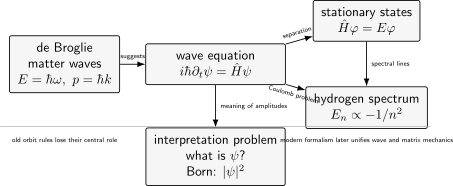
Schrödinger’s wave mechanics converted matter-wave relations into a differential-equation program. Stationary states explained spectra, while the physical meaning of required a separate probability interpretation.
The potential term was the crucial step beyond a free wave. It let old mechanical problems be translated into wave equations: wells, barriers, oscillators, rotors, and the Coulomb field of the hydrogen atom.
Hydrogen Atom Success
Section titled “Hydrogen Atom Success”Hydrogen was the decisive early test. The Bohr model had reproduced the gross hydrogen energy pattern, but it used stationary classical orbits selected by old quantum rules. Wave mechanics replaced orbits with normalizable solutions of the Coulomb Hamiltonian:
where is the reduced mass. The stationary equation
gives bound-state energies
This recovered the gross Balmer-Rydberg pattern while replacing the orbit picture with quantum numbers, angular wavefunctions, radial functions, and boundary conditions. It also explained why the same energy formula can survive even when the classical image supporting it is discarded.
The success did not mean the early wave theory had already solved all atomic physics. Spin, fine structure, identical particles, relativistic effects, radiative corrections, and many-electron atoms required further ideas. But the hydrogen calculation showed that wave mechanics was not just a metaphor for matter waves; it was a working mechanics.
Stationary States
Section titled “Stationary States”For a time-independent Hamiltonian, separated solutions have the form
Substituting into the time-dependent equation gives the stationary eigenvalue problem
The probability density of a single stationary state is time independent:
This gave a new meaning to the old phrase “stationary state.” A stationary state is not an electron moving around a classical orbit without radiating. It is an energy eigenstate whose measurable position density is stationary, while the state still carries a time-dependent phase.
Superpositions of different stationary states generally have time-dependent densities because their relative phases evolve:
The frequency associated with the relative phase is
This connects naturally to the spectral rule that transition frequencies are determined by energy differences.
Wavefunction Interpretation Problem
Section titled “Wavefunction Interpretation Problem”Wave mechanics made calculations possible before the meaning of the wavefunction was fully settled. Schrödinger initially explored wave-like physical interpretations, including analogies with charge density. But a literal charge-density reading quickly runs into trouble: detections occur as localized events, multi-particle wavefunctions live on configuration space, and scattering probabilities require a rule for outcomes.
Born’s probability interpretation supplied the lasting rule:
for position probability density in the simplest one-particle case. In modern language, is a probability amplitude, not an ordinary material wave. This distinction is why wave mechanics could survive even after literal wave pictures failed.
The interpretation problem deserves its own page because it is easy to overstate either direction. Schrödinger’s equation is a precise dynamical law for amplitudes, but the equation alone does not say what a measurement outcome is.
Relation to Modern Formalism
Section titled “Relation to Modern Formalism”Modern quantum mechanics does not treat wave mechanics as a separate theory from Hilbert-space quantum mechanics. A wavefunction is a representation of an abstract state:
The coordinate-space equation is the position representation of the abstract Schrödinger equation
This modern perspective also explains the relation between matrix mechanics and wave mechanics. Matrix mechanics emphasized observables and transitions; wave mechanics emphasized differential equations and wavefunctions. They became understood as equivalent representations of a deeper operator-state formalism.
Wave mechanics remains indispensable because many physical systems are naturally modeled in coordinate space. But its concepts should be placed within the broader structure: states, operators, spectra, amplitudes, and unitary time evolution.
Common Mistakes
Section titled “Common Mistakes”- Treating the Schrödinger equation as a direct consequence of classical mechanics. It is a quantum postulate motivated by matter waves and validated by experiment.
- Saying wave mechanics merely repaired the Bohr model. It replaced the orbit ontology with wavefunctions and operators.
- Forgetting that the time-independent equation is derived from the time-dependent equation only when the Hamiltonian is time independent.
- Treating as a classical material wave in ordinary space for all systems.
- Thinking the hydrogen success included spin, fine structure, Lamb shifts, or many-electron chemistry from the start.
- Reading modern probability-amplitude language back into Schrödinger’s first papers without historical caution.
Cross-Links
Section titled “Cross-Links”- Matter Waves and Wave Mechanics
- de Broglie Matter Waves
- Wave Packets
- Electron Diffraction
- Bohr Model
- Limits of Old Quantum Theory
- Time-Dependent Schrödinger Equation
- Time-Independent Schrödinger Equation
- Hydrogen Atom
- Stationary States
- Interpreting the Wavefunction
- Equivalence of Matrix and Wave Mechanics
- Probability Amplitudes
- Schrödinger Picture
References
Section titled “References”- E. Schrödinger, “Quantisierung als Eigenwertproblem,” Annalen der Physik 79, 361-376, 1926, DOI: 10.1002/andp.19263840404.
- E. Schrödinger, “An Undulatory Theory of the Mechanics of Atoms and Molecules,” Physical Review 28, 1049-1070, 1926, DOI: 10.1103/PhysRev.28.1049.
- E. Schrödinger, The Fundamental Idea of Wave Mechanics, Nobel Lecture, 1933.
- Nobel Prize Outreach, The Nobel Prize in Physics 1933.
- M. Born, “Zur Quantenmechanik der Stoßvorgänge,” Zeitschrift für Physik 37, 863-867, 1926, DOI: 10.1007/BF01397477.
- M. Jammer, The Conceptual Development of Quantum Mechanics, 2nd ed., American Institute of Physics, 1989.
- J. Mehra and H. Rechenberg, The Historical Development of Quantum Theory, Springer, 1982-2001.
- R. Shankar, Principles of Quantum Mechanics, 2nd ed., Springer, 1994.
Exercises
Section titled “Exercises”- Show that the free Schrödinger equation gives the de Broglie free-particle dispersion relation for a plane wave.
Solution
For ,
and
The free Schrödinger equation requires these to be equal, so
Thus
which is equivalent to with and .
- Why did the hydrogen atom matter so much for wave mechanics?
Solution
Hydrogen was the simplest real atomic bound-state problem and already had precise spectral data. Wave mechanics recovered the gross energy pattern by solving a differential eigenvalue problem with boundary conditions, rather than by imposing old quantum orbit rules. That made wave mechanics a working theory of atomic structure, not just a qualitative matter-wave idea.
- Explain why a stationary state is not the same thing as a static wavefunction.
Solution
A stationary state has the form
The wavefunction has a time-dependent phase. The probability density is time independent because the phase cancels:
So stationary means time-independent measurable density for a single energy eigenstate, not absence of all time dependence.
- Why was Born’s probability interpretation needed in addition to Schrödinger’s equation?
Solution
Schrödinger’s equation tells how evolves, but by itself it does not say how to connect to observed detection frequencies. A literal material-wave interpretation does not handle localized detections and multi-particle configuration-space wavefunctions cleanly. Born’s rule identifies as probability density in the one-particle position case, turning the wavefunction into a probability amplitude.