Interpreting the Wavefunction
Wave mechanics gave quantum theory a vivid object: the wavefunction . But it did not immediately settle what meant. Was it a real physical wave in ordinary space? A spread-out charge density? A calculational device? Or something whose squared magnitude gives probabilities?
The modern answer is precise but historically nontrivial: a wavefunction is a probability amplitude in a chosen representation. In one-particle position space, the Born rule assigns the probability density
This page traces why that interpretation mattered. The canonical probability rule lives in Born Rule, while the coordinate-space working version lives in Wavefunctions and Probability Density.
Is ψ a Physical Wave?
Section titled “Is ψ a Physical Wave?”Schrödinger’s wave mechanics made it tempting to regard as an ordinary physical wave. That temptation was understandable. Classical waves have amplitudes, phases, interference, diffraction, normal modes, and boundary conditions. Wave mechanics had all of those features too.
The analogy was productive but incomplete. A classical wave in ordinary space has a directly measurable field value, such as pressure, displacement, or electromagnetic field strength. A wavefunction is different:
- its overall complex phase is not directly observable;
- its squared magnitude gives probabilities, not an ordinary field intensity by itself;
- multi-particle wavefunctions live on configuration space, not ordinary three-dimensional space;
- detections occur as localized outcomes, even when the amplitude was spread out.
For a one-particle state, writing can hide the problem because the argument looks like an ordinary position. For two particles, the wavefunction is
a function on six-dimensional configuration space. That is hard to read as one ordinary material wave in physical space.
Charge-Density Interpretations
Section titled “Charge-Density Interpretations”One early idea was to read the electron wave as a charge density. For a single electron, one might try
This expression is not useless in every context. Charge-density expectations are meaningful in many calculations, and later many-body physics often works with density fields, expectation values, and effective densities.
The problem is treating this as the fundamental interpretation of an individual electron. Experiments record localized electron events, not a fraction of an electron’s charge arriving everywhere in proportion to a smooth cloud. Electron diffraction, for example, builds up a pattern from discrete detections. The pattern is wave-like, but the individual registration events are localized.
The many-particle problem is even sharper. For two electrons, is a joint probability density on configuration space. It cannot be interpreted as a simple charge density in ordinary space without additional constructions such as marginal densities.
Born’s Probability Interpretation
Section titled “Born’s Probability Interpretation”Born’s 1926 interpretation changed the status of . In scattering, he treated wave amplitudes as determining probabilities for outcomes. The enduring lesson is that the wavefunction is not an ordinary material wave; it is an amplitude whose squared magnitude gives probabilities after the measurement question has been specified.
For a normalized one-particle wavefunction in a spatial region ,
For a discrete measurement with eigenstate ,
More generally, if is the projector associated with an outcome,
This probability interpretation did not make the wave character disappear. It explained what the wave character is for: amplitudes carry phase, amplitudes superpose, and probabilities come after amplitudes are combined.
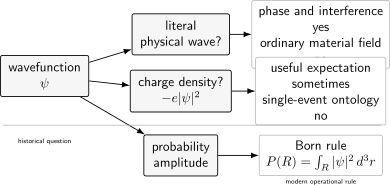
Early readings of as a literal material wave or charge density captured some intuition but failed as fundamental interpretations. Born’s probability interpretation made a probability amplitude whose squared magnitude is tied to specified measurement outcomes.
Modern Probability Amplitude Language
Section titled “Modern Probability Amplitude Language”Modern quantum mechanics expresses the same point representation-independently. The state is an abstract vector, ray, or density operator, depending on the presentation. A wavefunction is one representation:
The quantity is an amplitude for position, not a probability. The probability density is its squared modulus:
The phase of matters because amplitudes add before probabilities are formed. In a two-alternative setup,
The interference term is why a probability-amplitude theory differs from ordinary classical probability. If the alternatives are physically distinguishable, the cross term is suppressed or absent; if they are coherent and indistinguishable, it remains.
This is the language that connects wave mechanics to the Double-Slit Experiment, electron diffraction, scattering amplitudes, and the abstract Probability Amplitudes page.
Why Interpretation Matters
Section titled “Why Interpretation Matters”The interpretation of is not decorative philosophy. It changes how one reads calculations.
If were an ordinary material wave, then a spread-out wavefunction would suggest a spread-out object in the same classical sense as a water wave or electromagnetic field. But the formalism predicts localized detections with probabilities. It also predicts interference when alternatives remain coherent, even when individual events are localized.
If were merely ignorance about a pre-existing classical position, then interference terms would be mysterious. Classical ignorance probabilities add; quantum amplitudes add first. The phase of an amplitude has operational consequences.
If the measurement context is ignored, the Born rule is easy to misuse. A wavefunction written in the position representation answers position questions directly. A momentum, spin, or energy measurement requires the corresponding representation or projector.
The modern reading is therefore disciplined:
- specify the state;
- specify the measurement or question;
- compute amplitudes or projections;
- square moduli or norms to obtain probabilities;
- avoid treating the amplitude itself as a classical object.
What This Page Does Not Settle
Section titled “What This Page Does Not Settle”The probability-amplitude interpretation is the operational core used throughout standard quantum mechanics. It does not by itself settle every foundations question. It does not choose between interpretations of quantum theory, solve the measurement problem by slogan, or explain why one outcome is experienced in a given run. Those issues belong to foundations pages with their own assumptions and care.
For the working theory, however, the shift from material-wave language to probability-amplitude language is indispensable. It is what lets wave mechanics describe both diffraction patterns and localized detection events without forcing either into a classical mold.
Common Mistakes
Section titled “Common Mistakes”- Saying is “just a probability” and forgetting that it is complex and can interfere.
- Saying is an ordinary physical wave in space for every system.
- Treating as the probability of exactly in a continuous problem. It is a density.
- Applying the Born rule without specifying the measurement.
- Ignoring configuration space for multi-particle wavefunctions.
- Treating charge density expectations as the fundamental ontology of a single electron.
- Assuming Born’s rule eliminates all interpretive questions.
Cross-Links
Section titled “Cross-Links”- Matter Waves and Wave Mechanics
- Schrödinger’s Wave Mechanics
- Wave Packets
- Electron Diffraction
- Double-Slit Experiment
- Born Rule
- Probability Amplitudes
- Born Rule for Continuous Spectra
- Wavefunctions and Probability Density
- Wavefunctions as Representations
- What the Postulates Do Not Say
References
Section titled “References”- M. Born, “Zur Quantenmechanik der Stoßvorgänge,” Zeitschrift für Physik 37, 863-867, 1926, DOI: 10.1007/BF01397477.
- E. Schrödinger, “Quantisierung als Eigenwertproblem,” Annalen der Physik 79, 361-376, 1926, DOI: 10.1002/andp.19263840404.
- E. Schrödinger, The Fundamental Idea of Wave Mechanics, Nobel Lecture, 1933.
- M. Jammer, The Conceptual Development of Quantum Mechanics, 2nd ed., American Institute of Physics, 1989.
- J. Mehra and H. Rechenberg, The Historical Development of Quantum Theory, Springer, 1982-2001.
- L. E. Ballentine, Quantum Mechanics: A Modern Development, 2nd ed., World Scientific, 2014.
Exercises
Section titled “Exercises”- Why is a problem for interpreting the wavefunction as an ordinary physical wave in three-dimensional space?
Solution
The arguments and specify a point in six-dimensional configuration space. An ordinary physical wave in three-dimensional space has one spatial position argument. Therefore a two-particle wavefunction is not naturally an ordinary material wave in physical space; it is better read as a joint probability amplitude.
- For a normalized one-dimensional wavefunction, what is the probability of finding the particle in ?
Solution
The probability density is , so
The value at a single point is a density, not a probability by itself.
- Let two coherent alternatives have amplitudes and for the same outcome. What is the probability contribution?
Solution
Add amplitudes first:
Then square the modulus:
This cancellation would be missed if one added the probabilities .
- Give one reason charge-density language can be useful and one reason it cannot be the fundamental interpretation of a single electron wavefunction.
Solution
It can be useful because expectation values and effective densities often describe how charge is distributed on average in a state or many-body approximation. It is not fundamental for a single electron because detections occur as localized events, and multi-particle wavefunctions live on configuration space rather than ordinary three-dimensional space.