Electron Diffraction
Electron diffraction is the observation that electron beams scattered by crystals produce angular maxima characteristic of wave interference. It transformed de Broglie’s Matter Waves from a bold hypothesis into an experimentally tested principle: material particles have wave-like propagation governed by the wavelength-momentum relation.
The page is an overview. The detailed apparatus stories belong to pages such as the Davisson–Germer Experiment and the G. P. Thomson Experiment; here the goal is to explain why diffraction is wave evidence, why electrons made that surprising, and how crystal lattices act as microscopic diffraction gratings.
Diffraction as Wave Evidence
Section titled “Diffraction as Wave Evidence”Diffraction is a wave phenomenon in which coherent contributions from different parts of an aperture, grating, or periodic structure add with phases. For a crystal, the periodic spacing of atoms selects particular outgoing directions where scattered waves add constructively.
For electrons, the key input is the de Broglie relation:
If electrons are accelerated through a voltage and remain nonrelativistic, their kinetic energy is approximately
so
For electrons accelerated through tens of volts, the wavelength is of order an angstrom:
That is comparable to atomic spacings in crystals. A crystal can therefore scatter electrons in a way analogous to how an optical grating scatters visible light.
Why Electron Diffraction Was Surprising
Section titled “Why Electron Diffraction Was Surprising”Before quantum mechanics, electrons were known as charged particles: cathode rays could be deflected by electric and magnetic fields, and J. J. Thomson’s measurements had identified the electron as a subatomic constituent of matter. A classical particle picture would expect electrons to scatter from atoms through collisions and electromagnetic forces, but not to form stable interference maxima determined by a wavelength .
The surprising point was not merely that electrons scattered. Charged particles scatter easily. The surprising point was that the scattered intensity had the directional structure of a wave diffracted by a periodic lattice.
This made electron diffraction complementary to photon evidence:
| Light-quanta evidence | Matter-wave evidence |
|---|---|
| light, known as a wave, shows particle-like energy-momentum transfer | electrons, known as particles, show wave-like interference |
| photoelectric and Compton effects | crystal diffraction and later electron interference |
| photon-like quanta | de Broglie wavelength and quantum amplitudes |
Together these results undermined the idea that “wave” and “particle” were mutually exclusive classical categories.
Crystal Lattices as Diffraction Gratings
Section titled “Crystal Lattices as Diffraction Gratings”A crystal is not just a collection of scattering centers. It is a periodic array. Waves scattered from different lattice planes can interfere constructively or destructively depending on path difference.
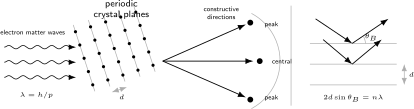
Electron diffraction occurs when electron matter waves scatter coherently from a crystal. Constructive directions appear when the path difference between waves from neighboring planes matches an integer number of de Broglie wavelengths.
In the simplest Bragg-like picture, adjacent lattice planes are separated by distance . Constructive interference occurs when
where is the Bragg angle. This formula is a useful first orientation, especially for seeing why the electron wavelength must be comparable to interatomic spacings.
Modern crystallography usually uses reciprocal-lattice language. Elastic diffraction from a periodic lattice satisfies a momentum-space condition
where is a reciprocal-lattice vector. This says that the crystal can transfer discrete crystal momenta while conserving the electron’s kinetic energy in elastic scattering.
Davisson–Germer and G. P. Thomson Routes
Section titled “Davisson–Germer and G. P. Thomson Routes”Two landmark experimental routes made electron diffraction historically decisive.
Davisson and Germer studied electrons scattered from a nickel crystal. The angular intensity peaks matched the wavelength expected from the electron acceleration voltage and de Broglie’s formula. Their experiment is often described as reflection diffraction from a crystal surface.
G. P. Thomson and collaborators observed electron diffraction through thin films. In that geometry, many small crystallites can produce ring patterns, analogous to powder diffraction. This provided an independent transmission-style confirmation of electron wave behavior.
The two routes were especially persuasive together:
- one used scattering from a single-crystal-like nickel target;
- the other used transmission through thin films;
- both gave patterns interpretable with de Broglie wavelengths;
- both involved electrons, already strongly established as material particles.
The historical irony is sharp: J. J. Thomson helped establish the electron as a particle, while his son G. P. Thomson helped establish electron diffraction.
Bragg-Like Interpretation
Section titled “Bragg-Like Interpretation”The Bragg relation is not the whole theory of electron diffraction. Electrons interact strongly with matter, and real electron diffraction can involve multiple scattering, surface reconstruction, finite crystal size, inelastic losses, and dynamical diffraction effects.
For the historical argument, however, the simplified Bragg picture is enough to see the logic:
- de Broglie predicts ;
- an accelerating voltage fixes ;
- the predicted is comparable to crystal spacings;
- the observed angular maxima match constructive-interference conditions.
That is why electron diffraction was strong evidence for matter waves. It did not merely fit a curve. It connected beam energy, wavelength, lattice spacing, and scattering angle.
Modern Interpretation
Section titled “Modern Interpretation”Modern quantum mechanics does not treat the electron as a classical wave of charge spread through the apparatus. An electron beam is described by quantum states with momentum components, phases, and amplitudes. A periodic crystal potential scatters those components coherently.
For a single electron, the detection event is localized. Across many identically prepared electrons, the distribution of detections reveals the probability pattern:
where is a scattering amplitude. Peaks occur where amplitudes from many lattice sites add constructively.
This is the same structural lesson later emphasized by the Double-Slit Experiment and broadened in Interference With Matter: coherent alternatives add as amplitudes before probabilities are formed.
What Electron Diffraction Does Not Mean
Section titled “What Electron Diffraction Does Not Mean”Electron diffraction does not mean electrons are tiny classical waves. It also does not mean the electron stops being detected as a localized event. The lesson is subtler and more powerful: the quantum state propagates with phase, and probabilities come from amplitudes whose phases can interfere.
It also does not mean every electron beam automatically diffracts visibly. Coherence, energy spread, beam collimation, sample quality, thickness, and detector geometry all matter.
Common Mistakes
Section titled “Common Mistakes”- Saying electrons became “waves instead of particles.” The evidence is for quantum amplitudes with wave-like propagation and particle-like detection events.
- Treating the Bragg formula as exact for all electron diffraction. It is a useful first model, not a complete dynamical scattering theory.
- Forgetting that charged particles already scatter classically; the distinctive evidence is the interference pattern tied to .
- Ignoring the role of crystal periodicity. A random target would not produce the same sharp diffraction maxima.
- Confusing electron diffraction with the double-slit experiment. Both show interference, but the geometry and historical roles are different.
- Using relativistic corrections only when convenient. High-voltage electron diffraction requires relativistic momentum corrections.
Cross-Links
Section titled “Cross-Links”- Matter Waves and Wave Mechanics
- de Broglie Matter Waves
- Davisson–Germer Experiment
- G. P. Thomson Experiment
- Double-Slit Experiment
- Interference With Matter
- Davisson–Germer Experiment Reference
- Momentum Eigenstates
- Plane Waves and Delta Normalization
- Wave Packets
- Fourier Wave Packets
- Probability Amplitudes
- Scattering Amplitude
- Evidence Map
References
Section titled “References”- L. de Broglie, “Recherches sur la théorie des quanta,” Annales de Physique 10, 22-128, 1925, DOI: 10.1051/anphys/192510030022.
- C. Davisson and L. H. Germer, “Diffraction of Electrons by a Crystal of Nickel,” Physical Review 30, 705-740, 1927, DOI: 10.1103/PhysRev.30.705.
- G. P. Thomson, “Experiments on the Diffraction of Cathode Rays,” Proceedings of the Royal Society A 117, 600-609, 1928, DOI: 10.1098/rspa.1928.0022.
- Nobel Prize Outreach, The Nobel Prize in Physics 1937.
- H. Haken and H. C. Wolf, The Physics of Atoms and Quanta, 7th ed., Springer, 2005.
- M. Jammer, The Conceptual Development of Quantum Mechanics, 2nd ed., American Institute of Physics, 1989.
Exercises
Section titled “Exercises”- Estimate the de Broglie wavelength of a nonrelativistic electron accelerated through , using .
Solution
Substitute :
This is comparable to interatomic spacings, so crystal diffraction is plausible.
- A crystal plane spacing is and the electron wavelength is . Estimate the first-order Bragg angle.
Solution
For ,
so
Thus
- Why is an angular diffraction maximum stronger evidence for matter waves than ordinary electron scattering?
Solution
Ordinary scattering only shows that electrons interact with matter, which charged particles already do classically. A diffraction maximum tied to shows coherent phase addition from a periodic lattice. The measured angle depends on wavelength and lattice spacing, which is the wave-like part of the evidence.
- Why does electron diffraction not imply that an electron is just a classical wave packet of charge?
Solution
The diffraction pattern comes from quantum amplitudes and phases, but detections occur as localized events. A classical charge wave would suggest continuous charge distribution at the detector. Quantum mechanics instead uses a state whose amplitudes determine the probability distribution for discrete detection events.