Projective Hilbert Space
Projective Hilbert space is the space of rays in a complex Hilbert space. It is the natural state space for pure quantum states after two redundancies have been removed: the norm of a nonzero representative and its global phase.
If is a Hilbert space, a physical pure state is not one vector . It is the whole complex line
where . The set of all such rays is
The precise state-identification theorem—including equivalence with rank-one projectors and the symmetry-theory transition invariant—is owned by Physical States as Rays. Rays and Global Phase gives the operational first pass. This page retains the extended projective geometry: quotient fibers, charts, Fubini–Study distance, the Bloch sphere, and connections to geometric dynamics.
Four Spaces That Must Not Be Confused
Section titled “Four Spaces That Must Not Be Confused”The same pure state appears in several related spaces.
| Space | Typical element | What it contains |
|---|---|---|
| Hilbert space | vectors, including , with linear addition | |
| Unit sphere | normalized vector representatives | |
| Projective space | physical pure states or rays | |
| Density-operator state space | pure and mixed states in one convex set |
The Hilbert space is linear. The unit sphere and projective space are not linear subspaces. The density-operator state space is convex, but projective space is only its pure-state subset when rays are represented by rank-one projectors.
The Equivalence Relation
Section titled “The Equivalence Relation”For nonzero vectors, define
for some . This is an equivalence relation:
- Reflexive: .
- Symmetric: if , then .
- Transitive: if and , then .
Each equivalence class is a one-dimensional complex subspace with its zero vector omitted. Geometrically, it is a complex line through the origin; the projective point records the line, not a preferred point on it.
Why the Zero Vector Is Excluded
Section titled “Why the Zero Vector Is Excluded”The zero vector cannot represent a quantum state because it cannot be normalized and assigns zero weight to every measurement outcome. It also belongs to every complex line through the origin, so including it would make the equivalence classes intersect.
The restriction
therefore comes before the quotient. The notation does not denote a point of projective Hilbert space.
From Nonzero Vectors to Normalized Rays
Section titled “From Nonzero Vectors to Normalized Rays”Every nonzero vector has a normalized representative
Normalization removes the positive magnitude of the complex scale. If and are normalized and belong to the same ray, then
Thus projective Hilbert space can equally be written
where
The two-stage reduction is shown below.
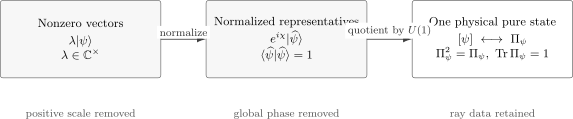
Normalization removes positive scale. Quotienting the normalized sphere by the remaining phase orbit produces one ray , equivalently one rank-one projector .
The Quotient Map and Its Fibers
Section titled “The Quotient Map and Its Fibers”The canonical projection
forgets complex scale. Restricted to normalized vectors, it becomes
The preimage of one projective point is its phase orbit:
This set is a copy of . Choosing one normalized ket for each ray is choosing a representative from each fiber. Such a choice is useful for calculation but is not extra physical state data.
Rank-One Projectors as Phase-Free Representatives
Section titled “Rank-One Projectors as Phase-Free Representatives”A ray has a canonical operator representative:
It is unchanged by every nonzero complex rescaling:
For a normalized representative,
The projector satisfies
Conversely, every positive rank-one operator of trace one projects onto a unique ray. Therefore the maps
are one-to-one. The projector removes phase without choosing coordinates and connects the ray picture directly to Density Operators.
Pure-State Projectors Among Density Operators
Section titled “Pure-State Projectors Among Density Operators”A density operator represents a pure state exactly when
or, equivalently for a positive trace-one operator,
Such an operator has spectrum
and equals for one ray. A mixed state has more than one nonzero eigenvalue and does not define a point of .
This distinction matters: projective Hilbert space is the state space of pure states, not the full quantum state space. Mixtures require the convex set of density operators.
Finite-Dimensional Projective Space
Section titled “Finite-Dimensional Projective Space”If
then
The notation means the space of one-dimensional complex subspaces of . The superscript counts the complex dimension of the projective space, not the dimension of the original Hilbert space.
For example,
A one-dimensional Hilbert space has only one pure-state ray. A two-dimensional Hilbert space has the Bloch sphere of rays. A three-dimensional Hilbert space has the four-real-dimensional manifold , not an ordinary sphere.
Dimension Counting
Section titled “Dimension Counting”A vector in has real parameters. A normalized vector obeys one real constraint, leaving
real parameters. Removing one global-phase parameter leaves
Equivalently,
This count explains why a pure qubit needs two real parameters and a pure qutrit needs four. It also shows why an arbitrary normalized state vector contains one redundant real parameter beyond the physical pure-state data.
Homogeneous Coordinates
Section titled “Homogeneous Coordinates”Choose a basis and write a nonzero vector as
The associated projective point is written in homogeneous coordinates as
All proportional coordinate lists represent the same point:
for . The all-zero list is forbidden.
Homogeneous coordinates retain the linear-algebra convenience of amplitudes while displaying the quotient explicitly. They are coordinates of a ray, not ordinary coordinates of a vector.
Local Projective Charts
Section titled “Local Projective Charts”No single amplitude ratio covers every ray. On the region where , define local coordinates
Rescaling all by the same nonzero leaves every ratio unchanged. The chart contains complex coordinates, matching the complex dimension of .
For the chart , a normalized representative can be chosen as
Rays with are not missing from projective space; they lie outside this particular chart and are covered by another denominator choice.
Chart Transitions
Section titled “Chart Transitions”Suppose both and are nonzero. On the overlap of the two charts,
with the denominator coordinate treated appropriately. These nonlinear transition functions are one sign that projective space is a manifold rather than a vector space.
Changing projective charts is not changing the physical state. It is changing which nonzero amplitude is used to fix the local complex scale.
Projective Space Is Not a Vector Space
Section titled “Projective Space Is Not a Vector Space”There is no basis-independent addition law
on rays. To see why, choose different representatives of the same input rays:
The ray of their sum generally changes with the relative phase :
Quantum superposition is formed in the Hilbert space using representatives and physically specified relative amplitudes. Only after the linear combination is formed does one pass to its ray. Projective space records physical pure states; it does not replace the linear Hilbert space used to construct superpositions.
Transition Probabilities Are Projective Data
Section titled “Transition Probabilities Are Projective Data”For normalized representatives, the transition probability is
Under independent phase changes,
the overlap changes by one phase,
so its absolute square is unchanged. In projector language,
Transition probabilities therefore live naturally on pairs of projective points. Their operational interpretation is developed in Transition Probabilities.
Identical, Distinct, and Orthogonal Rays
Section titled “Identical, Distinct, and Orthogonal Rays”For normalized representatives,
The limiting cases have direct projective meaning:
Orthogonal rays are distinct projective points. Quotienting by phase does not identify opposite measurement outcomes or collapse all basis vectors into one state.
A Distance Between Pure States
Section titled “A Distance Between Pure States”The Hilbert-space inner product induces a natural projective distance. In one common convention,
for normalized representatives. It obeys
Identical rays have distance zero, while orthogonal rays have distance . Some references multiply this metric or distance by ; the convention-independent quantity is the transition probability .
For a normalized infinitesimal variation, the corresponding line element is
The subtraction removes motion along the phase fiber. The full metric, symplectic form, and complex structure belong to Fubini–Study Geometry.
The Qubit: CP¹ as the Bloch Sphere
Section titled “The Qubit: CP¹ as the Bloch Sphere”For a two-level system,
Every qubit ray has a normalized representative
where
The associated Bloch vector is
The rank-one projector is
Thus is a two-sphere. The sphere is the projective pure-state space, not the vector space itself.
Projective Coordinates and Stereographic Coordinates
Section titled “Projective Coordinates and Stereographic Coordinates”On the qubit chart where , define
A normalized representative is
Comparing with the angular form gives
This is the stereographic coordinate on the Bloch sphere. The state has and corresponds to the point in this chart; it is regular in the complementary chart .
The detailed Pauli-coordinate and spin interpretation belongs to Bloch Sphere Geometry and Bloch Sphere.
Antipodes Are Orthogonal, Not Equivalent
Section titled “Antipodes Are Orthogonal, Not Equivalent”If two qubit pure states have Bloch vectors and , then
Antipodal points satisfy , so their transition probability is zero. They are orthogonal rays. Global-phase identification acts before the Bloch-vector description and does not identify antipodes.
If is the ordinary angle between the Bloch vectors, then
under the distance convention used above. The factor of one half is the familiar spinor half-angle relation.
Why Higher-Dimensional Pure-State Spaces Are Not Spheres
Section titled “Why Higher-Dimensional Pure-State Spaces Are Not Spheres”The qubit identification
is exceptional. A qutrit pure-state space is , which has four real dimensions. Although a normalized vector in lies on , quotienting by the phase circle does not produce .
Higher-dimensional density matrices can be expanded in generalized generator coordinates, but their positivity region is not a Euclidean ball and their pure-state boundary is not an ordinary sphere. The Bloch sphere should not be extrapolated unchanged to qutrits or general -level systems.
Basis Changes Act as Coordinate Changes on Rays
Section titled “Basis Changes Act as Coordinate Changes on Rays”Let a unitary basis change send a normalized component column to
Because is invertible and norm-preserving, proportional columns remain proportional:
The basis change therefore induces a well-defined coordinate change on projective space. The abstract ray remains fixed in a passive change of basis; only its homogeneous or local coordinates change. See Change of Basis.
Unitary Dynamics Descends to Rays
Section titled “Unitary Dynamics Descends to Rays”An active unitary maps rays by
This action is well-defined because
Two unitaries differing by an overall phase induce the same projective action:
In projector language,
where the phase of cancels automatically.
Stationary Rays and Energy Shifts
Section titled “Stationary Rays and Energy Shifts”For an energy eigenstate,
Schrödinger evolution gives
The ket changes, but its ray and projector are constant:
More generally, replacing by multiplies every evolving ket by a common time-dependent phase and leaves projective motion unchanged. This is why the choice of zero energy does not affect closed-system ray dynamics.
The phase-free dynamical formulation belongs to the Quantum Dynamics page Projective Hilbert Space.
Symmetries Naturally Act on Rays
Section titled “Symmetries Naturally Act on Rays”A physical symmetry preserves transition probabilities between pure states, so its most direct action is on projective Hilbert space. Under the assumptions of Wigner’s theorem, such a ray transformation is implemented by a unitary or antiunitary operator on Hilbert-space representatives.
The implementing operator is not unique: multiplying it by a common phase does not change its action on rays. This is why a symmetry can be represented projectively on vectors even when its action on physical rays is perfectly well-defined. The theorem and group-law consequences belong to Wigner Theorem Preview and Projective Representations.
Composite Systems
Section titled “Composite Systems”For a bipartite system,
the full pure-state space is
A product ray has the form
Independent rescalings do not change it:
for nonzero and . Product rays form a special subset of the full projective space. The remaining rays are entangled.
For two qubits, the full pure-state space is
with six real dimensions. Product pure states form a four-real-dimensional subset parameterized by two Bloch spheres. The extra projective directions include entangled states and cannot be represented by a pair of single-qubit Bloch vectors. See Entangled States.
Projective Space Is Not Convex
Section titled “Projective Space Is Not Convex”Given two rays and , there is no projective analogue of a classical probabilistic mixture that remains a pure ray. The mixture
is generally a mixed density operator, not a point of .
This distinguishes two operations:
- a coherent superposition is formed linearly from vector representatives and normally gives another pure ray;
- an incoherent probabilistic mixture is formed convexly from projectors and normally gives a mixed state.
Projective pure-state geometry and convex mixed-state geometry answer different questions.
The Qubit Sphere and Bloch Ball
Section titled “The Qubit Sphere and Bloch Ball”For a qubit, pure-state projectors have the form
General density operators have
The sphere surface is , the pure-state projective space. The ball interior consists of mixed states and is not part of projective Hilbert space. This is the cleanest finite-dimensional picture of the pure-versus- mixed distinction.
Infinite-Dimensional Hilbert Spaces
Section titled “Infinite-Dimensional Hilbert Spaces”The quotient definition remains meaningful for an infinite-dimensional Hilbert space:
Normalized rays still correspond to rank-one orthogonal projectors, and transition probabilities still depend only on rays. What changes is the geometry’s dimension and analytic setting: there is no finite parameter count like , and questions of topology, differentiability, operator domains, and convergence require care.
Generalized eigenkets such as ideal position or momentum kets are not normalizable vectors in and therefore are not literal points of . They belong to an extended distributional framework; see Generalized Eigenvectors.
Superselection Caveat
Section titled “Superselection Caveat”The mathematical space contains a ray for every nonzero vector in . Physical restrictions can make some coherent superpositions operationally unavailable. If a superselection rule divides the theory into sectors,
then relative phases between different sectors may be unobservable under the allowed observable algebra.
In that setting, simply declaring all of to be one operational pure-state manifold can overstate what can be prepared or distinguished. The scope and assumptions of such restrictions belong to Superselection Sectors Preview.
Local Phase Choices and Gauge Language
Section titled “Local Phase Choices and Gauge Language”A normalized representative of a ray is not unique:
For a family of rays labeled by parameters , one may choose a different phase at every point:
This is a gauge freedom in the choice of vector representatives. It does not make arbitrary relative phases unphysical; it says that one common phase at each ray is coordinate data rather than state data.
For a qubit, the normalized vectors form and the ray space is :
This is the Hopf fibration. Its detailed bundle structure belongs to U(1) Bundles and Quantum Phase.
Geometric Phase Preview
Section titled “Geometric Phase Preview”Suppose a normalized state follows a path whose ray closes:
A chosen vector lift may return only up to phase:
There is no contradiction. Instantaneous global phase is redundant, but a phase obtained by comparing lifts around a closed path can be a gauge-invariant holonomy and can affect interference with a reference history.
This page stops at that structural statement. Adiabatic Berry phase, connections, curvature, and parameter-space loops are treated in Berry Phase and Relation to Berry Geometry.
What Projective Hilbert Space Does and Does Not Do
Section titled “What Projective Hilbert Space Does and Does Not Do”Projective Hilbert space does:
- identify vector representatives of the same physical pure state;
- provide phase-independent pure-state coordinates through rank-one projectors;
- make transition probability and pure-state distinguishability geometric;
- give a natural setting for unitary and symmetry actions on rays;
- explain why the qubit pure-state space is the Bloch sphere.
Projective Hilbert space does not:
- replace the linear Hilbert space needed for superposition and tensor products;
- include mixed states as additional projective points;
- identify orthogonal states;
- remove relative phases from coherent superpositions;
- make generalized continuum eigenkets normalizable;
- by itself supply the full apparatus of differential geometry or dynamics.
A Projective-State Audit
Section titled “A Projective-State Audit”When a calculation claims to describe a pure physical state, check:
- Nonzero representative: is the vector nonzero and normalizable?
- Scale invariance: do predictions survive after normalization?
- Phase invariance: does a common phase cancel from all probabilities and expectation values?
- Relative phase: has physically meaningful phase between components been retained?
- Projector test: does satisfy and ?
- State type: is the object really pure, or is a density operator needed?
- Chart validity: is the denominator used for a projective coordinate nonzero?
- Operational restrictions: are superselection sectors or distributional states relevant?
Common Mistakes
Section titled “Common Mistakes”- Treating as the same space as .
- Including the zero vector as a projective point.
- Calling a normalized ket itself the physical state without acknowledging its phase redundancy.
- Removing relative phase along with global phase.
- Assuming rays can be added without choosing representatives and a relative phase.
- Calling antipodal Bloch-sphere points equivalent; they are orthogonal.
- Generalizing the Bloch sphere unchanged to qutrits or larger systems.
- Treating mixed density operators as points of projective Hilbert space.
- Confusing a passive basis change with motion through projective space.
- Treating geometric phase as an observable instantaneous global phase.
- Applying finite-dimensional parameter counts to infinite-dimensional state spaces.
- Treating ideal position or momentum eigenkets as ordinary projective Hilbert points.
Further Connections
Section titled “Further Connections”- Rays and Global Phase
- Pure States
- Normalization
- Transition Probabilities
- Density Operators
- Bloch Sphere Geometry
- Projective Hilbert Space for Dynamics
- Fubini–Study Geometry
- Geometric Quantum Mechanics Overview
- U(1) Bundles and Quantum Phase
References
Section titled “References”- P. A. M. Dirac, The Principles of Quantum Mechanics, 4th ed., Oxford University Press, 1958.
- J. von Neumann, Mathematical Foundations of Quantum Mechanics, Princeton University Press, 1955.
- A. Peres, Quantum Theory: Concepts and Methods, Kluwer, 1995.
- T. W. B. Kibble, “Geometrization of quantum mechanics,” Communications in Mathematical Physics 65, 189–201, 1979, doi:10.1007/BF01225149.
- J. P. Provost and G. Vallée, “Riemannian structure on manifolds of quantum states,” Communications in Mathematical Physics 76, 289–301, 1980, doi:10.1007/BF02193559.
- J. Anandan and Y. Aharonov, “Geometry of quantum evolution,” Physical Review Letters 65, 1697–1700, 1990, doi:10.1103/PhysRevLett.65.1697.
- A. Ashtekar and T. A. Schilling, “Geometrical formulation of quantum mechanics,” in On Einstein’s Path, Springer, 1999; arXiv:gr-qc/9706069.
- I. Bengtsson and K. Życzkowski, Geometry of Quantum States, 2nd ed., Cambridge University Press, 2017.
Exercises
Section titled “Exercises”1. Verify the ray relation
Section titled “1. Verify the ray relation”Prove that proportionality by a nonzero complex scalar defines an equivalence relation on . Why does the proof fail if the scalar is allowed to be zero?
Solution
Reflexivity follows from
If
then exists and
which proves symmetry. If additionally
then
and , proving transitivity.
If zero scalars were allowed, every vector could be mapped to the zero vector, but the relation would not be symmetric because a nonzero vector cannot be a scalar multiple of zero. The proposed classes would also all share .
2. Characterize a pure-state projector
Section titled “2. Characterize a pure-state projector”Let be a positive operator satisfying
Show that projects onto one ray.
Solution
An idempotent self-adjoint operator has eigenvalues only or . Positivity ensures self-adjointness in the present density-operator setting, and the trace is the sum of eigenvalues. Since
exactly one eigenvalue is . Therefore the range of is one-dimensional. Choose a normalized vector spanning that range. Then
Replacing by a phase multiple leaves unchanged, so identifies one ray and no preferred phase.
3. Count pure-state parameters
Section titled “3. Count pure-state parameters”How many independent real parameters describe a pure state in ? Apply the result to a qubit, a qutrit, and two qubits.
Solution
A vector in contains real parameters. Normalization removes one real parameter, and global phase removes another. Hence
For a qubit, , so there are real parameters. For a qutrit, , so there are . For two qubits, , so there are .
The two-qubit count exceeds the four parameters of two independent Bloch spheres because the full space also contains entangled rays.
4. Convert a projective qubit coordinate
Section titled “4. Convert a projective qubit coordinate”For
find a normalized qubit representative, its Bloch-sphere angles, and its Bloch vector.
Solution
Use
Since ,
From
one finds
Therefore
5. Compute a Fubini–Study distance
Section titled “5. Compute a Fubini–Study distance”Consider
Compute their transition probability and Fubini–Study distance in the convention used on this page.
Solution
The overlap is
Hence the transition probability is
The projective distance is
The Bloch vectors are separated by angle , twice the projective distance under this convention.
6. Why ray addition is not well-defined
Section titled “6. Why ray addition is not well-defined”Let and denote the rays of and . Show that choosing different representatives before adding them can produce physically distinct output rays.
Solution
One representative choice gives
Rephase only the representative of the second input ray and add again:
Their overlap has absolute square
The output rays are therefore distinct. A coherent sum requires a specified relative phase between representatives; the pair of input rays alone does not provide one.
7. Projective action of a unitary
Section titled “7. Projective action of a unitary”Show that and induce the same transformation of pure-state rays and pure-state projectors.
Solution
On rays,
because the two output vectors differ by one nonzero scalar. On projectors,
Thus the common phase of an implementing unitary is invisible to its action on projective pure states.
8. Product rays inside the two-qubit space
Section titled “8. Product rays inside the two-qubit space”Compare the real dimension of the full two-qubit pure-state space with that of the product-ray subset. What does the difference represent?
Solution
The two-qubit Hilbert space has complex dimension , so
A product ray is specified by one ray in each qubit Hilbert space:
Each factor has real dimension , so the product subset has real dimension . The remaining two dimensions are not a separate add-on coordinate pair globally, but the dimension difference reflects that generic two-qubit rays have entanglement structure unavailable to product states.