Interconnects and Transduction
An interconnect moves quantum information or distributes entanglement between declared module boundaries. A transducer changes the physical carrier, frequency band, or encoding used along that path. The two concepts overlap, but they are not synonyms: a cryogenic microwave waveguide can interconnect superconducting modules without changing carrier, while a microwave–optical transducer can be tested on one bench without yet providing a useful link between processors.
The ideal is not merely detectable output power. It is a channel that preserves the intended quantum information while meeting a system contract for loss, noise, bandwidth, temporal mode, directionality, latency, heat, stability, and throughput. A converter with high internal efficiency may have poor fibre-to-chip efficiency. A low-noise device may still replace most inputs by vacuum. A coherent classical tone can survive conversion even when an arbitrary single-photon state would not.
Interconnect claims therefore begin at the source module’s accepted quantum state and end at the target module’s usable state or at a herald that certifies a declared resource. Pumps, filters, cables, fibre, switches, memories, detectors, clocks, classical acknowledgements, reset, and rejected attempts belong inside the resource ledger.
Purpose and Canonical Scope
Section titled “Purpose and Canonical Scope”This page is the canonical hardware-level home for:
- direct quantum interconnects between modules;
- coherent conversion between carrier types or frequency bands;
- input–output and scattering descriptions of transducers;
- internal, device, and end-to-end efficiency;
- added noise, thermal occupation, mode mismatch, and backaction;
- bandwidth, latency, directionality, pump heat, stability, and duty cycle;
- optical-frequency, microwave, electro-optic, mechanical, atomic, and spin-mediated conversion;
- deterministic transfer, heralded links, and entanglement-first interfaces;
- system integration and dated transduction evidence.
It does not rederive every material interaction. Cavity QED and Circuit QED Overview own the corresponding light–matter physics. Quantum Memories owns write–store–read channels. Quantum Teleportation owns the protocol identity. Modular Architectures owns module contracts, topology, resource inventory, scheduling, distributed error correction, and fault domains. Quantum Repeaters owns long-chain generation and memory-age scheduling, while Quantum Network Architectures owns end-user services, routing, control planes, and multidomain trust.
The Complete Link Contract
Section titled “The Complete Link Contract”A physical link can be represented as a composition of channels:
Here prepares an outgoing excitation or entangled state, couples it into a travelling mode, changes carrier when needed, describes propagation and switching, absorbs or measures the received mode, and decodes the result into the target logical interface.
This notation is intentionally modular. A direct microwave link may set to the identity. An optical heralding architecture may replace coherent capture by photon detection and a classical success record. An entanglement-plus-teleportation service may consume a previously distributed Bell pair rather than move the data qubit through the physical channel.
The minimum interface declaration includes:
- the input state ensemble and physical reference plane;
- the accepted spatial, spectral, polarization, and temporal modes;
- the direction and whether operation is reciprocal;
- deterministic, heralded, or postselected semantics;
- the output state, detector event, or entangled resource;
- every efficiency and noise reference plane;
- the clock, phase reference, feed-forward, and acknowledgement path;
- pump power, dissipation, cooling load, and operating duty cycle;
- tuning range, calibration age, and drift interval;
- the uncertainty and acceptance criteria for a successful use.
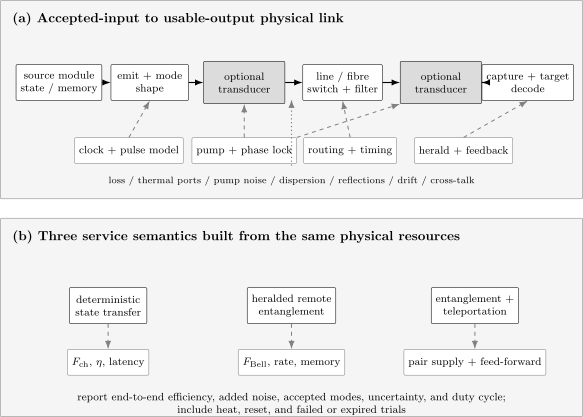
The physical channel is only the centre of the contract. Source and target coupling, mode preparation, pumps, thermal ports, filtering, phase references, control, heralding, and reset determine the usable link channel and accepted service rate.
Interconnects Are Not All the Same Service
Section titled “Interconnects Are Not All the Same Service”The hardware must be judged against the service it supplies.
Deterministic coherent transfer
Section titled “Deterministic coherent transfer”A shaped excitation leaves one node and is absorbed by another. Ideally,
where the known phase is calibrated or tracked. Loss generally becomes amplitude damping, and thermal or pump noise can create false excitations. Deterministic transfer is attractive for low-latency modular gates, but it requires high capture efficiency and a stable temporal mode.
Heralded entanglement
Section titled “Heralded entanglement”Each node emits a photon correlated with a local memory. A joint photonic measurement heralds remote memory entanglement. Loss lowers the success rate but, when loss is cleanly heralded, need not directly corrupt every accepted state. Dark events, multiphoton emission, distinguishability, detector error, and memory decoherence do corrupt accepted states.
The distinction is operational:
Heralding moves part of the problem from fidelity to rate, memory lifetime, and scheduling. It does not make loss free.
Entanglement plus teleportation
Section titled “Entanglement plus teleportation”An interconnect may first distribute and verify entanglement. The data qubit then remains local until a Bell measurement and classical feed-forward teleport it into the remote node. This separates data handling from a probabilistic optical attempt and can support modular fault-tolerance, but it adds entangled-pair factories, memories, purification or error detection, Bell measurements, classical latency, and Pauli-frame management.
Transported matter
Section titled “Transported matter”Ions, neutral atoms, electrons, or spin excitations can be physically moved between zones. No carrier conversion is required, yet motional heating, leakage, trap crossings, valley or orbital excitation, path-dependent phase, loss, and traffic contention become interconnect errors. A transport fidelity measured without subsequent gates does not by itself certify the transported qubit as a usable architecture resource.
Temporal Modes and the Scattering Description
Section titled “Temporal Modes and the Scattering Description”Travelling quantum information occupies a mode, not an abstract frequency label. For a normalized envelope ,
A receiver matched to captures the intended wave packet with overlap
Frequency conversion can preserve photon number while distorting this envelope through finite bandwidth, group-delay dispersion, pump shaping, or filtering. Reporting total energy conversion without temporal-mode overlap can therefore hide a poor qubit interface.
For a stationary linear converter, one output port may be written
where represent loss, thermal, pump-induced, or unused ports. Preservation of bosonic commutators constrains the complete scattering matrix; omitted ports do not disappear merely because they are not measured.
For a passive converter,
If an active process supplies gain, creation operators can enter the input–output relation, and quantum mechanics requires accompanying noise. Quantum Channels and Noise supplies the general channel language; Erasure and Loss Channels separates attenuation from flagged erasure.
Frequency Conversion as a Beam-Splitter Interaction
Section titled “Frequency Conversion as a Beam-Splitter Interaction”Many pump-linearized converters reduce near resonance to
The interaction exchanges excitations between modes and while a strong classical pump supplies the energy difference and phase reference. For interaction time ,
At , the ideal closed system swaps the two modes. Real travelling-wave and resonator devices are open systems. For a common three-mode converter with two signal modes coupled through an intermediate mode, an idealized on-resonance internal efficiency is
where and are the two cooperativities. Large cooperativity is not enough by itself: the conversion legs must also be impedance matched.
External coupling and propagation give, schematically,
Every factor needs a reference plane. Internal efficiency can exclude coupling to a cable or fibre. On-chip efficiency can exclude packaging and filters. Device efficiency can exclude source and receiver capture. End-to-end efficiency should begin and end at the stated module interfaces.
Added Noise and Thermal Occupation
Section titled “Added Noise and Thermal Occupation”The Bose–Einstein occupation of a mode at angular frequency and temperature is
Optical modes are effectively in their ground state at ordinary laboratory temperatures. A few-gigahertz microwave or mechanical mode is not unless it is well thermalized at millikelvin temperature. Pump absorption can raise its local occupation far above the refrigerator thermometer’s reading.
For a declared input mode, an input-referred added-noise number can be defined as
where is the excess output occupation when the signal input is vacuum, after the stated baseline and detection-chain corrections. Conventions differ, so a paper must say whether vacuum noise, detector noise, dark events, and filtering are included.
The phrase quantum enabled is often used when a converter operates with less than one input-referred added photon in a specified mode. That is a useful milestone, not a complete quantum-channel certificate. If but , most inputs are still replaced by vacuum.
For cascaded stages with power transmissions and stage-local input-referred noise , the total noise referred to the first input is
Late-stage noise is magnified when referred through earlier loss. This is why record transducers cannot be combined with unrelated record couplers and filters to infer a record link.
Performance Vector
Section titled “Performance Vector”No scalar ranks every interconnect. A useful record is
where is a task-appropriate channel fidelity, is accepted bandwidth, is latency, is accepted resource rate, is duty cycle, is applied pump power, is heat deposited at the relevant stage, and records uncertainty and drift.
Efficiency
Section titled “Efficiency”Report internal, external, and end-to-end efficiency separately. State whether the number is photon-number efficiency, energy efficiency, field-amplitude transfer, or a conditional survival probability. Microwave and optical photon energies differ by orders of magnitude, so power efficiency and photon-number efficiency are not interchangeable without frequency factors.
Added noise
Section titled “Added noise”Noise must be measured in the same temporal and spectral mode used for the signal. A broadband noise spectral density cannot be compared directly with a per-pulse added occupation without integration and filter definitions. Pump leakage, Raman scattering, spontaneous parametric processes, thermal mechanical occupation, amplifier noise, and detector dark events have different scaling and mitigation.
State and channel fidelity
Section titled “State and channel fidelity”Conditional state fidelity omits failed transfers. For a qubit carried by the vacuum and one-excitation subspace, a pure-loss channel with survival probability acts like amplitude damping. Its average fidelity to the identity over uniformly distributed pure qubit states is
This formula assumes vacuum environment, perfect mode match, no phase error, and no added excitation. It is a useful baseline, not a universal transducer metric. Process tomography, entanglement fidelity, or a task-specific benchmark is stronger when the accepted ensemble differs.
Bandwidth and mode capacity
Section titled “Bandwidth and mode capacity”A broad converter can support short pulses and frequency multiplexing, but only if efficiency, phase, and noise remain controlled across the band. A narrow resonator may improve interaction strength while demanding long pulses and stringent frequency matching. Quote the accepted bandwidth together with the temporal-mode family and tuning time.
Latency and accepted rate
Section titled “Latency and accepted rate”The relevant latency includes emission, propagation, conversion, capture, detection, classical acknowledgement, and reset. For a heralded link with attempt period and accepted probability ,
Multiplexing can raise the accepted rate, but only if independent modes, switching, memory capacity, detector load, and controller throughput are counted.
Directionality, isolation, and reciprocity
Section titled “Directionality, isolation, and reciprocity”Reciprocal conversion is useful for bidirectional state exchange, but a processor may need directional emission to prevent reflections and backaction. Circulators, isolators, chiral couplings, or measurement-based feed-forward can supply directionality. Their insertion loss, footprint, magnetic compatibility, and bandwidth remain part of the link.
Pump and thermal budget
Section titled “Pump and thermal budget”A pump applied at room temperature can deposit heat at a millikelvin device through absorption, quasiparticle generation, dielectric loss, or imperfect filtering. Quote average and peak pump power, repetition rate, local temperature or occupation, recovery time, and any degradation of adjacent qubits. Optical control is not automatically low heat at the quantum device.
Stability and calibration
Section titled “Stability and calibration”Two nominally identical resonators are not necessarily frequency matched. Frequency drift, pump phase, path delay, polarization, impedance, and filter alignment can all age. A credible result includes tuning range, lock method, calibration interval, and held-out validation. Control, Readout, and Calibration develops this operating loop.
Optical Quantum Frequency Conversion
Section titled “Optical Quantum Frequency Conversion”Optical nodes often emit outside the low-loss telecom window or at mutually different wavelengths. A strong pump can drive three-wave or four-wave mixing so that
subject to phase matching. After treating the pump classically, the desired interaction again has beam-splitter form. Periodically poled lithium niobate, other second-order nonlinear media, and third-order waveguides are common implementations.
Quantum frequency conversion must preserve every degree of freedom carrying information:
- polarization converters need matched transfer and phase in both polarization paths;
- time-bin converters need pump coherence and stable relative delay;
- frequency-bin converters need calibrated spectral phases and low cross-talk;
- indistinguishable-photon applications need output linewidth, wave packet, polarization, and arrival time to overlap;
- entanglement distribution requires a state-level test after conversion, not only classical modulation transfer.
Strong pumps introduce leakage, Raman background, spontaneous parametric fluorescence, and detector saturation. Filters lower noise but also reduce efficiency and can distort the temporal mode. The converter can nevertheless be valuable even when lossy if the output wavelength reduces fibre attenuation enough to improve the full entanglement rate.
Direct Microwave and Cryogenic Interconnects
Section titled “Direct Microwave and Cryogenic Interconnects”Superconducting circuits naturally emit and absorb gigahertz photons. Coplanar lines, coaxial cables, rectangular waveguides, package modes, and on-chip buses can connect modules without changing carrier. Shaped emission and time-reversed capture implement coherent transfer; tunable couplers control when the qubit interacts with the travelling mode.
These links avoid microwave–optical conversion loss at short range, but they must remain cold. Thermal photons, cable attenuation, package reflections, standing modes, connector repeatability, impedance mismatch, nonreciprocal components, and refrigerator-to-refrigerator thermalization matter. Propagation delay becomes dynamically relevant when it approaches emission or gate times.
Direct microwave links can be:
- bus-like, where modules couple to a shared standing mode;
- itinerant, where shaped photons propagate in a line;
- chiral, where interference selects an emission direction;
- measurement mediated, where detected radiation heralds a remote operation;
- teleportation based, where the line first creates a reusable entangled resource.
A link that transfers one excitation does not automatically support arbitrary multi-qubit traffic. Parallelism, collisions, routing, isolation, and error-detected operation must be demonstrated at the intended module count.
Electro-Optic Conversion
Section titled “Electro-Optic Conversion”The Pockels effect couples an optical field to a microwave electric field in a second-order nonlinear material. With a strong optical pump, a triply resonant device can convert between a microwave mode and an optical sideband. Thin-film lithium niobate and aluminium nitride are prominent because they combine electro-optic response with integrated photonics.
Advantages include:
- no required mechanical intermediary;
- potentially broad and fast response;
- direct phase-coherent conversion;
- compatibility with integrated optical routing.
Challenges include weak single-photon coupling, demanding optical and microwave resonance matching, pump-induced heating, parasitic optical modes, microwave loss, sideband asymmetry, packaging, and low external coupling. High cavity quality increases interaction time but narrows bandwidth and tightens frequency-control requirements.
Electro-optic devices can also move classical control and readout signals between temperature stages. That is useful cryogenic engineering, but classical control transfer is not evidence of a quantum state channel.
Electro-Optomechanical and Piezo-Optomechanical Conversion
Section titled “Electro-Optomechanical and Piezo-Optomechanical Conversion”A mechanical mode can couple to a microwave resonator through capacitance or piezoelectricity and to an optical cavity through radiation pressure. The conversion path is
Mechanical confinement can produce strong interactions in compact devices. The intermediary also introduces thermal occupation, mechanical damping, fabrication sensitivity, and pump-heating memory. Ground-state cooling, sideband resolution, impedance matching, and pulse shaping must hold during the conversion window, not only in a separate characterization.
Pulsed operation can reduce average heat and separate a conversion event from pump background. Continuous operation can simplify networking and rate accounting. Neither is universally better: compare added noise, efficiency, repetition rate, recovery, and neighbouring-qubit disturbance under the same task.
Atomic, Spin, and Rare-Earth Transducers
Section titled “Atomic, Spin, and Rare-Earth Transducers”Multilevel atoms or ions can couple microwave or millimetre-wave transitions to optical transitions through Raman-like processes. Candidate media include Rydberg atoms, rare-earth-ion ensembles, color centres, and magnons.
Their appeal includes strong or narrow atomic resonances, reproducible transition frequencies, storage within the conversion sequence, and direct optical access. Their costs can include inhomogeneous broadening, optical pumping, finite population preparation, magnetic-field control, limited bandwidth, cavity requirements, fluorescence background, and reset time.
An ensemble can increase collective coupling as roughly , but inhomogeneity and mode overlap determine how much of that coupling is useful. An atomic transition shared by different devices can ease frequency matching, yet fabrication, strain, fields, and resonators still shift the complete device response.
Matter–Photon Interfaces
Section titled “Matter–Photon Interfaces”A module may map a stationary qubit onto a photon without a separate frequency converter. Cavity-enhanced emission, Raman processes, and spin-selective optical transitions can generate a photon whose polarization, time bin, frequency, or presence is entangled with the matter qubit.
The relevant end-to-end probability can be decomposed as
Indistinguishability is as important as brightness when photons from independent nodes interfere. Spectral diffusion, phonon sidebands, timing jitter, polarization drift, and multiphoton emission lower a Bell-state measurement’s fidelity. Photonic Qubits owns the flying-qubit and detector architecture; Defect and Solid-State Spin Qubits owns representative spin–photon nodes.
Link Composition and Network Timing
Section titled “Link Composition and Network Timing”Suppose two identical microwave–optical transducers connect remote superconducting modules through fibre. Ignoring noise,
Two transducers and a path yield only end-to-end transmission. If the protocol instead heralds entanglement from two emitted photons, probabilities may depend quadratically on source-to-detector transmission. The exact exponent and prefactor depend on the protocol.
The memory must survive at least the relevant random wait and acknowledgement:
This is a service requirement, not a universal inequality. A one-way measurement protocol may need less storage; nested repeaters and asynchronous modular gates can need much more. Quantum Memories develops the storage-side contract.
Accepted throughput
Section titled “Accepted throughput”For independent modes, each succeeding with probability , the probability of at least one success in a round is
This gain is real only if the hardware can prepare, distinguish, route, store, and reset those modes. Counting spectral bins generated by a source is not the same as demonstrating independently usable network channels.
Noise and Failure Ledger
Section titled “Noise and Failure Ledger”Loss and imperfect capture
Section titled “Loss and imperfect capture”Loss arises at connectors, package transitions, resonators, couplers, filters, switches, fibre splices, free-space collection, and receiver absorption. Localize each loss to a reference plane. Otherwise improvements cannot be assigned or reproduced.
Thermal excitation
Section titled “Thermal excitation”Microwave and mechanical baths create false excitations and stimulated processes. Thermal anchoring, infrared shielding, pump absorption, cable attenuation, and local nonequilibrium populations must be characterized under operation.
Pump-generated noise
Section titled “Pump-generated noise”Strong optical or microwave pumps can cause Raman scattering, spontaneous pair generation, fluorescence, sideband leakage, quasiparticles, heating, Stark shifts, and intermodulation. Noise measured with the pump off is not the operating noise floor.
Mode distortion
Section titled “Mode distortion”Finite bandwidth, dispersion, ringing, imperfect pulse shaping, and frequency-dependent phase rotate information into orthogonal temporal modes. Energy can be conserved while receiver capture fails.
Phase and frequency drift
Section titled “Phase and frequency drift”Coherent transfer needs stable detuning and phase. Resonator drift, temperature shifts, path-length noise, and pump-reference error can turn a nominal state transfer into dephasing or coherent rotation.
Reflection and backaction
Section titled “Reflection and backaction”Impedance mismatch returns radiation to the source. Pump fields or thermal noise can propagate backwards into a qubit. Isolation that protects one direction may add loss in the other.
Leakage and multiphoton error
Section titled “Leakage and multiphoton error”An emitter can populate unwanted levels or release more than one photon. Transducers can create sidebands or pairs outside the logical subspace. Postselecting one detector pattern does not prove that leakage was absent.
Nonstationarity
Section titled “Nonstationarity”Efficiency, noise, frequency matching, and phase can drift on different timescales. A record trace acquired after hand tuning should not be presented as sustained service without uptime and recalibration data.
Technology Comparison
Section titled “Technology Comparison”| Interconnect or converter | Physical mechanism | Natural strength | Principal liabilities | Decisive system test |
|---|---|---|---|---|
| direct microwave line | shaped itinerant photons in cold cable or waveguide | deterministic local transfer; no carrier change | cryogenic path, thermal photons, reflections, range | arbitrary-state transfer and remote entanglement including line loss |
| optical quantum frequency conversion | pumped second- or third-order nonlinearity | telecom compatibility; mature fibre routing | pump noise, filtering loss, polarization and mode fidelity | entanglement or interference preserved after conversion |
| electro-optic | Pockels coupling between microwave and optical resonances | direct coherent conversion; integrated photonics | weak vacuum coupling, pump heat, resonance matching | simultaneous efficiency, sub-photon noise, and state benchmark |
| electro-optomechanical | microwave–mechanical–optical chain | compact strong interactions; tunable interfaces | thermal mechanical mode, pump heating, narrow band | end-to-end state transfer under operating duty cycle |
| atomic or Rydberg | multilevel Raman-like conversion | strong dipoles; optical access; atomic frequency reference | preparation, cavities, bandwidth, cryogenic or vacuum complexity | external efficiency and noise with accepted single-photon mode |
| rare-earth or spin ensemble | collective microwave and optical transitions | narrow resonances; possible storage; frequency reproducibility | inhomogeneity, pumping, low bandwidth, reset | two-device interference or entanglement with complete coupling loss |
| matter–photon interface | state-dependent emission and capture | natural remote-entanglement primitive | collection, indistinguishability, spectral diffusion | heralded matter–matter entanglement at declared distance and rate |
| transported matter | physical motion of ions, atoms, electrons, or spins | no photon conversion; local deterministic routing | motional excitation, loss, path phase, traffic | post-transport gates or logical cycles with routing overhead |
Evidence Through August 2026
Section titled “Evidence Through August 2026”The following examples are milestones, not a ranking. Their denominators and tasks differ.
Direct microwave interconnects
Section titled “Direct microwave interconnects”- In 2018, shaped microwave photons enabled deterministic state transfer and remote entanglement between superconducting nodes on one cryogenic apparatus. Related work transferred states between remote microwave cavity memories.
- In 2020, superconducting circuits in two dilution refrigerators separated by about were connected by a cold microwave waveguide. The reported average state-transfer fidelity was , and the target remote entangled-state fidelity was . This established a refrigerator-scale microwave quantum link, not a room-temperature or metropolitan link.
- In 2025, a directional microwave interface emitted and absorbed photons between separately packaged modules and generated a remote four-qubit state with about fidelity in either direction. Propagation loss remained the main limitation in that experiment.
These results show coherent microwave networking inside carefully engineered cryogenic systems. Scaling still requires lower insertion loss, parallel channels, routing, packaging repeatability, isolation, and logical protocols.
Optical frequency conversion and matter nodes
Section titled “Optical frequency conversion and matter nodes”- In 2012, frequency downconversion produced telecom-wavelength photons entangled with a quantum-dot electron spin.
- In 2018, ion–photon and ensemble–photon experiments preserved entanglement through polarization-compatible conversion to telecom wavelengths.
- In 2022, two independently trapped atoms were heraldedly entangled through up to of telecom fibre using converters with reported external device efficiency.
- In 2024, silicon-vacancy memory nodes used bidirectional conversion in a telecom network experiment.
- In 2026, a fibre-integrated to converter reported about total efficiency and pump-induced noise. Its fidelity beyond was a modelled projection for an NV-centre source, not a demonstrated entangled link.
These experiments establish that optical conversion can preserve quantum correlations. The full link rate still depends on source brightness, collection, converter loss, fibre loss, filtering, detector efficiency, memory lifetime, and protocol.
Microwave–optical conversion
Section titled “Microwave–optical conversion”- A 2014 mechanically mediated device demonstrated coherent bidirectional conversion of classical microwave and optical signals with roughly peak efficiency. Its operating temperature and noise did not yet support arbitrary quantum-state transfer.
- In 2020, a superconducting qubit excitation was converted through a mechanical mode to an optical photon, and qubit Rabi oscillations were observed through optical photon detection. Limited photon counts prevented full output-state characterization.
- A 2023 cold-rubidium device reported internal millimetre-wave-to-optical efficiency, bandwidth, and added thermal photons. Internal efficiency did not include every external coupling loss.
- Microwave–optical entanglement and nonclassical pair generation were demonstrated in 2023–2024, providing state-level evidence beyond coherent tone conversion.
- A 2025 silicon electro-optomechanical transducer reported continuous operation with input-referred and an upconversion rate of –.
- A 2025 ytterbium-doped crystal device reported percent-level efficiency, input-referred added noise as low as photons, and interference between light from two simultaneously operated transducers.
- A 2025 electro-optic device reached up to conversion efficiency with low added microwave noise and used converted optical drive signals to produce Rabi oscillations in a superconducting qubit.
- In 2026, frequency-matched aluminium-nitride electro-optic transducers in separate dilution refrigerators carried a coherent signal through of telecom fibre. The paper reported an efficiency improvement over commercial modulators. It did not demonstrate arbitrary quantum-state transfer or remote entanglement across that link.
The frontier is no longer described by efficiency alone. The decisive target is simultaneous low loss, low added noise, state-level validation, frequency matching, pump compatibility, and sustained link operation.
Claim Audit
Section titled “Claim Audit”| Claim | What would support it | What does not suffice |
|---|---|---|
| efficient transducer | declared photon-number efficiency at internal, device, and end-to-end planes | a fitted internal cooperativity alone |
| low-noise transducer | input-referred noise in the accepted mode under operating pumps | pump-off detector noise |
| quantum-enabled conversion | low added noise together with a declared efficiency and mode | the adjective without calibrated reference planes |
| quantum state transfer | tomography, entanglement fidelity, or task benchmark including failures | a coherent classical tone or output Rabi oscillation alone |
| bidirectional link | characterized transfer and noise in both directions | a reciprocal material response |
| scalable interconnect | repeatable packaging, tuning, multiplexing, thermal budget, routing, and logical compatibility | one high-performing device |
| kilometre quantum link | nonclassical state transfer or entanglement over the kilometre path | coherent classical signal transfer over fibre |
| telecom advantage | improved end-to-end accepted rate or fidelity after conversion and fibre | lower fibre attenuation considered without converter loss |
Design and Reporting Workflow
Section titled “Design and Reporting Workflow”- Name the service. Choose deterministic transfer, heralded entanglement, entanglement distribution, readout, control delivery, or another explicit task.
- Choose reference planes. Mark the source output, converter ports, propagation path, filters, detector or capture port, and target logical interface.
- Declare the mode. Give centre frequency, bandwidth, temporal envelope, polarization, spatial mode, and repetition rate.
- Measure loss by stage. Preserve internal, external, and end-to-end numbers instead of replacing them by the best one.
- Measure operating noise. Include pumps, neighbouring channels, thermal recovery, and the same filters used for the signal.
- Validate the state. Use a benchmark appropriate to the intended ensemble, with uncertainty and any postselection explicit.
- Exercise timing. Include clocks, phase locks, tuning, switching, acknowledgements, memories, reset, and controller backlog.
- Stress the system. Test drift, duty cycle, repeated operation, multi-channel cross-talk, and calibration transfer.
- Report accepted throughput. Count failed, expired, and rejected trials.
- Separate observation from projection. Simulated network distance or logical rate is not a demonstrated link.
Common Mistakes
Section titled “Common Mistakes”Equating internal and end-to-end efficiency
Section titled “Equating internal and end-to-end efficiency”Internal conversion can exclude the dominant coupling and filter losses. Always propagate the full efficiency product.
Calling low added noise high fidelity
Section titled “Calling low added noise high fidelity”Low noise does not compensate for severe loss. Efficiency and noise jointly define the channel.
Measuring the wrong mode
Section titled “Measuring the wrong mode”A broadband power meter can count converted energy that the target temporal mode cannot absorb.
Confusing coherent tones with quantum states
Section titled “Confusing coherent tones with quantum states”Classical phase coherence is necessary for coherent quantum transfer, but it does not test single-photon statistics, entanglement, or arbitrary-state fidelity.
Treating heralding as deterministic operation
Section titled “Treating heralding as deterministic operation”Heralding identifies successful trials. It also introduces a waiting-time distribution, detector system, classical message, and memory requirement.
Ignoring the return direction
Section titled “Ignoring the return direction”A reciprocal link can feed pump noise or reflections into a fragile source. A directional link can incur extra insertion loss.
Quoting refrigerator temperature as mode temperature
Section titled “Quoting refrigerator temperature as mode temperature”Optical absorption and imperfect thermalization can leave a local microwave or mechanical mode much hotter than the mixing chamber.
Combining unrelated records
Section titled “Combining unrelated records”Best internal efficiency, best added noise, broadest bandwidth, and longest distance may come from incompatible devices and operating points.
Calling a projection a demonstration
Section titled “Calling a projection a demonstration”A modelled entanglement fidelity after is not a measured link.
Exercises
Section titled “Exercises”1. Build an end-to-end loss budget
Section titled “1. Build an end-to-end loss budget”A source emits into a line with probability . Input coupling to a converter is , internal conversion is , output coupling and filtering together are , fibre transmission is , and target capture is . Find the end-to-end transmission.
Solution
The reference-plane factors multiply:
Only about of source-module trials produce a captured target excitation. Quoting the internal conversion alone would overstate the link transmission by nearly a factor of ten.
2. Refer cascaded noise to the source
Section titled “2. Refer cascaded noise to the source”Two stages have , , and input-referred added noises , . What is the total added noise referred to the first input?
Solution
For two stages,
The second stage’s noise is magnified by the first stage’s loss. The second stage does not contribute merely when the result is referred to the original source.
3. Compare microwave thermal occupations
Section titled “3. Compare microwave thermal occupations”Using , estimate the thermal occupation of a mode at and at .
Solution
The dimensionless ratio is
At the ratio is , so
At the ratio is , so
The same frequency is nearly in its ground state at a well-thermalized port and highly occupied at .
4. Test cooperativity matching
Section titled “4. Test cooperativity matching”Evaluate the idealized internal efficiency for and .
Solution
For matched cooperativities,
For the mismatched case,
One strong conversion leg cannot compensate for a poorly matched second leg.
5. Convert pure loss to average qubit fidelity
Section titled “5. Convert pure loss to average qubit fidelity”An otherwise ideal single-rail transfer has survival probability . Find the average fidelity to the identity for uniformly distributed input qubit states.
Solution
Because ,
This includes the amplitude-damping effect of loss. A fidelity conditioned on detecting the surviving excitation could be much higher while describing a different task.
6. Quantify temporal-mode mismatch
Section titled “6. Quantify temporal-mode mismatch”The emitted and accepted modes are normalized and have overlap . What fraction of the emitted excitation is in the accepted mode? What does the phase mean?
Solution
The mode efficiency is
About lies in the accepted mode. The phase radians is a coherent phase shift of that mode. It can be corrected if stable and calibrated; random drift would instead cause dephasing.
7. Estimate a two-photon heralding rate
Section titled “7. Estimate a two-photon heralding rate”Each node produces a usable photon with probability per attempt. Each path and detector together transmit with probability . A linear-optical Bell measurement succeeds for half of the two-photon arrivals. Attempts occur at . Ignore dark events and dead time. Find the heralding rate.
Solution
The probability for one node to deliver a detected photon is
The two-photon acceptance probability is
Therefore
The quadratic dependence makes modest source or path losses expensive.
8. Evaluate multiplexed availability
Section titled “8. Evaluate multiplexed availability”Each of independent frequency bins succeeds with probability in one round. Find the probability of at least one success and compare it with the small- approximation.
Solution
The exact probability is
The linear approximation gives . It overestimates the exact result because it neglects rounds in which more than one bin succeeds.
9. Audit a quantum-enabled claim
Section titled “9. Audit a quantum-enabled claim”A paper reports photons and . The fibre-to-chip input coupling is , output coupling is , and no state-level test is reported. What can be concluded?
Solution
The low input-referred noise is meaningful in its declared operating mode, and the internal conversion is strong. The external device efficiency is at most
Thus only of input photons reach the external output under those couplings. The experiment supports low-noise internal conversion, not high-fidelity arbitrary-state transfer or a useful end-to-end link. Those would require the complete channel and a state-level benchmark.
10. Classify four interconnect statements
Section titled “10. Classify four interconnect statements”Classify each statement as a component result, a channel result, a service result, or an unsupported extrapolation:
- a resonator pair shows fitted internal conversion;
- tomography gives process fidelity from accepted input to usable output;
- a heralded link supplies Bell pairs per second with stated memory and acknowledgement constraints;
- a coherent tone crosses , so arbitrary microwave qubits can now be networked over cities.
Solution
- This is a component result because external coupling, noise, and the full channel are not specified.
- This is a channel result, assuming failures, state ensemble, and uncertainty are included in the declared process.
- This is a service result because it reports an accepted resource rate under timing and memory constraints.
- This is an unsupported extrapolation. Coherent classical transfer is a prerequisite, but arbitrary-state preservation, low added noise, capture, and city-scale quantum operation were not established.
References
Section titled “References”- J. I. Cirac, P. Zoller, H. J. Kimble, and H. Mabuchi, “Quantum State Transfer and Entanglement Distribution among Distant Nodes in a Quantum Network,” Physical Review Letters 78, 3221–3224 (1997), doi:10.1103/PhysRevLett.78.3221.
- H. J. Kimble, “The Quantum Internet,” Nature 453, 1023–1030 (2008), doi:10.1038/nature07127.
- N. Lauk et al., “Perspectives on Quantum Transduction,” Quantum Science and Technology 5, 020501 (2020), doi:10.1088/2058-9565/ab788a.
- E. Zeuthen, A. Schliesser, A. S. Sørensen, and J. M. Taylor, “Figures of Merit for Quantum Transducers,” Quantum Science and Technology 5, 034009 (2020), doi:10.1088/2058-9565/ab8962.
- X. Han, W. Fu, C.-L. Zou, L. Jiang, and H. X. Tang, “Microwave-Optical Quantum Frequency Conversion,” Optica 8, 1050–1064 (2021), doi:10.1364/OPTICA.425414.
- A. A. Clerk, K. W. Lehnert, P. Bertet, J. R. Petta, and Y. Nakamura, “Hybrid Quantum Systems with Circuit Quantum Electrodynamics,” Nature Physics 16, 257–267 (2020), doi:10.1038/s41567-020-0797-9.
- C. W. Gardiner and M. J. Collett, “Input and Output in Damped Quantum Systems: Quantum Stochastic Differential Equations and the Master Equation,” Physical Review A 31, 3761–3774 (1985), doi:10.1103/PhysRevA.31.3761.
- C. M. Caves, “Quantum Limits on Noise in Linear Amplifiers,” Physical Review D 26, 1817–1839 (1982), doi:10.1103/PhysRevD.26.1817.
- A. S. Holevo and R. F. Werner, “Evaluating Capacities of Bosonic Gaussian Channels,” Physical Review A 63, 032312 (2001), doi:10.1103/PhysRevA.63.032312.
- P. Kurpiers et al., “Deterministic Quantum State Transfer and Remote Entanglement Using Microwave Photons,” Nature 558, 264–267 (2018), doi:10.1038/s41586-018-0195-y.
- C. J. Axline et al., “On-Demand Quantum State Transfer and Entanglement between Remote Microwave Cavity Memories,” Nature Physics 14, 705–710 (2018), doi:10.1038/s41567-018-0115-y.
- P. Magnard et al., “Microwave Quantum Link between Superconducting Circuits Housed in Spatially Separated Cryogenic Systems,” Physical Review Letters 125, 260502 (2020), doi:10.1103/PhysRevLett.125.260502.
- Y. P. Zhong et al., “Deterministic Multi-Qubit Entanglement in a Quantum Network,” Nature 590, 571–575 (2021), doi:10.1038/s41586-021-03288-7.
- L. D. Burkhart et al., “Error-Detected State Transfer and Entanglement in a Superconducting Quantum Network,” PRX Quantum 2, 030321 (2021), doi:10.1103/PRXQuantum.2.030321.
- J. Niu et al., “Low-Loss Interconnects for Modular Superconducting Quantum Processors,” Nature Electronics 6, 235–241 (2023), doi:10.1038/s41928-023-00925-z.
- B. Kannan et al., “On-Demand Directional Microwave Photon Emission Using Waveguide Quantum Electrodynamics,” Nature Physics 19, 394–400 (2023), doi:10.1038/s41567-022-01869-5.
- A. Almanakly et al., “Deterministic Remote Entanglement Using a Chiral Quantum Interconnect,” Nature Physics 21, 825–830 (2025), doi:10.1038/s41567-025-02811-1.
- S. Tanzilli et al., “A Photonic Quantum Information Interface,” Nature 437, 116–120 (2005), doi:10.1038/nature04009.
- K. De Greve et al., “Quantum-Dot Spin–Photon Entanglement via Frequency Downconversion to Telecom Wavelength,” Nature 491, 421–425 (2012), doi:10.1038/nature11577.
- M. Bock et al., “High-Fidelity Entanglement between a Trapped Ion and a Telecom Photon via Quantum Frequency Conversion,” Nature Communications 9, 1998 (2018), doi:10.1038/s41467-018-04341-2.
- R. Ikuta et al., “Polarization Insensitive Frequency Conversion for an Atom–Photon Entanglement Distribution via a Telecom Network,” Nature Communications 9, 1997 (2018), doi:10.1038/s41467-018-04338-x.
- T. van Leent et al., “Entangling Single Atoms over 33 km Telecom Fibre,” Nature 607, 69–73 (2022), doi:10.1038/s41586-022-04764-4.
- C. M. Knaut et al., “Entanglement of Nanophotonic Quantum Memory Nodes in a Telecom Network,” Nature 629, 573–578 (2024), doi:10.1038/s41586-024-07252-z.
- R. W. Andrews et al., “Bidirectional and Efficient Conversion between Microwave and Optical Light,” Nature Physics 10, 321–326 (2014), doi:10.1038/nphys2911.
- W. Jiang et al., “Efficient Bidirectional Piezo-Optomechanical Transduction between Microwave and Optical Frequency,” Nature Communications 11, 1166 (2020), doi:10.1038/s41467-020-14863-3.
- M. Forsch et al., “Microwave-to-Optics Conversion Using a Mechanical Oscillator in Its Quantum Ground State,” Nature Physics 16, 69–74 (2020), doi:10.1038/s41567-019-0673-7.
- M. Mirhosseini, A. Sipahigil, M. Kalaee, and O. Painter, “Superconducting Qubit to Optical Photon Transduction,” Nature 588, 599–603 (2020), doi:10.1038/s41586-020-3038-6.
- R. Sahu et al., “Quantum-Enabled Operation of a Microwave-Optical Interface,” Nature Communications 13, 1276 (2022), doi:10.1038/s41467-022-28924-2.
- R. D. Delaney et al., “Superconducting-Qubit Readout via Low-Backaction Electro-Optic Transduction,” Nature 606, 489–493 (2022), doi:10.1038/s41586-022-04720-2.
- R. Sahu et al., “Entangling Microwaves with Light,” Science 380, 718–721 (2023), doi:10.1126/science.adg3812.
- A. Kumar et al., “Quantum-Enabled Millimetre Wave to Optical Transduction Using Neutral Atoms,” Nature 615, 614–619 (2023), doi:10.1038/s41586-023-05740-2.
- J. Rochman et al., “Microwave-to-Optical Transduction with Erbium Ions Coupled to Planar Photonic and Superconducting Resonators,” Nature Communications 14, 1153 (2023), doi:10.1038/s41467-023-36799-0.
- S. Meesala et al., “Non-Classical Microwave–Optical Photon Pair Generation with a Chip-Scale Transducer,” Nature Physics 20, 871–877 (2024), doi:10.1038/s41567-024-02409-z.
- S. Meesala et al., “Quantum Entanglement between Optical and Microwave Photonic Qubits,” Physical Review X 14, 031055 (2024), doi:10.1103/PhysRevX.14.031055.
- M. J. Weaver et al., “An Integrated Microwave-to-Optics Interface for Scalable Quantum Computing,” Nature Nanotechnology 19, 166–172 (2024), doi:10.1038/s41565-023-01515-y.
- H. Zhao et al., “Quantum-Enabled Microwave-to-Optical Transduction via Silicon Nanomechanics,” Nature Nanotechnology 20, 602–608 (2025), doi:10.1038/s41565-025-01874-8.
- T. Xie, R. Fukumori, J. Li, and A. Faraon, “Scalable Microwave-to-Optical Transducers at the Single-Photon Level with Spins,” Nature Physics 21, 931–937 (2025), doi:10.1038/s41567-025-02884-y.
- H. K. Warner et al., “Coherent Control of a Superconducting Qubit Using Light,” Nature Physics 21, 831–838 (2025), doi:10.1038/s41567-025-02812-0.
- Y. Zhou et al., “A 1-km Photonic Link Connecting Superconducting Circuits in Two Dilution Refrigerators,” Nature Photonics 20, 579–585 (2026), doi:10.1038/s41566-026-01866-7.
- J. Ramette, J. Sinclair, N. P. Breuckmann, and V. Vuletić, “Fault-Tolerant Connection of Error-Corrected Qubits with Noisy Links,” npj Quantum Information 10, 58 (2024), doi:10.1038/s41534-024-00855-4.
- Z. Liao et al., “Fiber-Integrated Quantum Frequency Conversion for Long-Distance Quantum Networking,” npj Quantum Information 12, 83 (2026), doi:10.1038/s41534-026-01225-y.
Further Connections
Section titled “Further Connections”- Communication with Quantum Systems supplies the task, assistance, error, rate, and constraint contract that turns a physical interconnect into a communication service.
- Hardware Overview supplies the platform-neutral module and evidence contract.
- Metrics for Quantum Hardware develops channel, logical, throughput, and workload metrics with uncertainty.
- Control, Readout, and Calibration owns waveform delivery, detector inference, drift, feedback, and calibration dependencies.
- Quantum Memories owns write–store–read channels and the timing buffer needed by probabilistic links.
- Modular Architectures composes link services into a machine through topology, inventory, scheduling, fault management, and end-to-end acceptance.
- Photonic Qubits develops flying-qubit encodings, sources, interference, switching, and detection.
- Superconducting Qubits develops microwave modules, cryogenic packaging, and modular processor constraints.
- Trapped-Ion Qubits develops shuttling and photonic modular links for ion registers.
- Continuous-Variable Platforms develops Gaussian mode conversion, feed-forward, loss, and non-Gaussian resource requirements.
- Cavity and Circuit QED Frontiers maintains the broader dated frontier assessment for hybrid converters, waveguide QED, and bosonic interfaces.