Trapped-Ion Qubits
Purpose and Canonical Scope
Section titled “Purpose and Canonical Scope”Trapped-ion processors store quantum information in long-lived internal states of atomic ions suspended by electromagnetic fields. Coherent optical, microwave, or radio-frequency fields rotate those states; quantized collective motion mediates local entangling gates; resonant fluorescence supplies state-dependent measurement. Scaling then asks how to preserve those operations while the machine acquires more ions, motional modes, beams, electrodes, trapping zones, detectors, and classical decisions.
This page is the canonical architecture-level guide. It owns the connections among:
- hyperfine, Zeeman, and optical qubit encodings;
- optical and microwave control;
- phonon-mediated entangling gates and their connectivity contract;
- initialization, sympathetic recooling, fluorescence readout, and reset;
- linear registers, quantum charge-coupled devices, and photonic modules;
- noise, transport, optical integration, scheduling, and fault-tolerant use.
It does not duplicate the platform physics. Ion Traps owns Paul-trap confinement, Mathieu stability, secular motion, micromotion, and Coulomb-crystal normal modes. Trapped-Ion Control owns the Lamb–Dicke expansion, carrier and sideband matrix elements, sideband cooling, and closed-loop entangling-gate derivations. The open-system application map owns fluorescence backaction, master-equation models, electric-field-noise heating, and quantum trajectories. Here those ingredients are assembled into a processor contract.
Because this is an active hardware field, record qubit counts and fidelities are dated evidence, not definitions. Comparisons should use Metrics for Quantum Hardware and state the device, protocol, operating context, uncertainty, and date.
The Architecture Contract
Section titled “The Architecture Contract”A trapped ion is an unusually reproducible physical object, but a processor is not specified by an isotope alone. It must implement a complete map
The required objects include:
| Layer | Required specification |
|---|---|
| atom | species, isotope, level structure, branching ratios, wavelengths, magnetic sensitivity |
| encoding | computational states, leakage states, phase convention, memory and active encodings |
| confinement | trap geometry, secular spectrum, micromotion, mode participation, heating |
| control | laser or microwave fields, beam geometry, native rotations and entanglers, addressing |
| observation | cycling transition, collection optics, detector, classifier, crosstalk, latency |
| movement | shift, split, merge, reorder, junction transport, excitation and recooling |
| graph | pair reachability, simultaneous gate sets, routing cost, disabled zones |
| infrastructure | vacuum, RF and DC delivery, optics, magnetic control, thermal management |
| operations | calibration graph, scheduler, feedback, drift policy, data provenance |
Several counts must remain separate: ions loaded, ions trapped, ions used as qubits, coolant or helper ions, calibrated qubits, simultaneously operable qubits, and qubits participating in a reported circuit. Likewise, pairwise reachability is not the same as parallel connectivity.
Atomic Encodings
Section titled “Atomic Encodings”Internal and motional degrees of freedom
Section titled “Internal and motional degrees of freedom”For qubit ions and a selected set of harmonic normal modes, a useful uncoupled model is
is an internal transition frequency, while labels a collective secular mode. Along a chosen axis, the displacement of ion can be written schematically as
The mode vector depends on the equilibrium crystal, confinement, ion masses, and normalization convention. In a mixed-species crystal, mass weighting must be stated explicitly. The internal state is the durable storage degree of freedom; motion is usually a temporary communication bus, a cooling diagnostic, or a simulator degree of freedom. A gate that returns the bus to its starting state can preserve the internal qubits even when the bus was transiently entangled with them.
Encoding families
Section titled “Encoding families”There is no single trapped-ion qubit. Common choices include:
| Encoding | Typical states | Strength | Architectural pressure |
|---|---|---|---|
| hyperfine clock qubit | two ground-state hyperfine levels near a field-insensitive point | long memory; microwave or Raman control | needs an isotope with nuclear spin; Raman scattering and magnetic curvature remain |
| Zeeman qubit | magnetic sublevels in one manifold | simple level structure and control | first-order magnetic sensitivity unless encoded or dressed |
| optical qubit | ground state and metastable excited state | direct narrow-line optical control; simple shelving | laser coherence and finite excited-state lifetime |
| dressed or dual-type qubit | field-dressed states or two encodings in one species | can separate memory and gate sensitivities | extra drives, conversions, calibration, and leakage paths |
For a nominal clock transition expanded about a bias ,
the first derivative vanishes at , but quadratic magnetic noise remains. Laser-induced differential Stark shifts, motion-dependent shifts, collisions, and leakage are not removed by the clock condition.
Atomic reproducibility is a major strength: two ions of the same isotope have the same bare spectrum. It does not make two processor locations identical. Local magnetic fields, micromotion, optical intensity, beam phase, trap frequency, and neighboring ions still require calibration.
Species is a system choice
Section titled “Species is a system choice”An ion species fixes more than the qubit frequency. It determines useful cooling and repumping transitions, laser wavelengths, metastable lifetimes, hyperfine structure, photon collection options, and compatibility with integrated photonics. Common experimental species include isotopes of Be, Mg, Ca, Sr, Ba, Yb, and others; naming one without its isotope and encoding is usually incomplete.
Mixed-species registers can assign different jobs to different ions. One species stores qubits while another is laser cooled, carrying away motional energy without directly scattering resonant light from the data qubits. This sympathetic cooling is valuable after transport and between circuit segments, but it introduces mass-ratio-dependent modes, more wavelengths, species-dependent loading, and collision or reordering constraints.
Preparation and Cooling
Section titled “Preparation and Cooling”A typical preparation sequence contains physically distinct operations:
- neutral atoms are delivered and isotope-selectively photoionized;
- Doppler cooling captures and cools the secular motion;
- optical pumping prepares a chosen internal state;
- resolved-sideband, electromagnetically induced transparency, or sympathetic cooling reduces selected motional occupations when the gate requires it;
- diagnostic pulses verify internal population and motional temperature.
For mode , the Lamb–Dicke parameter seen by ion is
where is the effective wavevector and is the mode direction. The usual small-excursion condition is
Ground-state cooling is not automatically required for every entangling gate. Some geometric gates tolerate a thermal distribution when the Lamb–Dicke, mode-resolution, and phase-space-closure conditions hold. Yet lower usually reduces sensitivity to nonlinear terms and calibration errors. A platform claim should therefore report the modes cooled, their inferred occupations, the thermometry model, and when in the schedule cooling occurs.
Initialization is also not synonymous with cooling. Optical pumping can prepare the internal state while leaving motion hot; sideband cooling can prepare motion while imperfect repumping leaves internal-state error. Reset after measurement must account for both, especially when an ancilla is reused inside a repeated error-correction cycle.
One-Qubit Control
Section titled “One-Qubit Control”An ideal resonant rotation is
The physical meaning of the amplitude and phase depends on the control method.
Direct optical and Raman control
Section titled “Direct optical and Raman control”An optical qubit can be driven directly by a phase-coherent laser near the qubit transition. A hyperfine or Zeeman qubit is often driven by two optical fields whose frequency difference is near . Far from an intermediate state, a schematic Raman rate is
while an off-resonant scattering scale behaves approximately as
These expressions suppress Clebsch–Gordan coefficients, polarization, fine-structure interference, and multiple excited levels. They expose the tradeoff: larger detuning suppresses scattering but requires more optical power for a fixed gate speed. Beam pointing, wavefront phase, intensity noise, spontaneous scattering, and differential Stark shifts enter the error budget.
Focused beams can address individual ions in a stationary chain. Acousto-optic or electro-optic modulators set amplitude, frequency, and phase; beam-steering hardware or multichannel optics chooses targets. The effective addressing matrix, including tails on neighboring ions, is a calibration object rather than a geometric assumption.
Microwave and radio-frequency control
Section titled “Microwave and radio-frequency control”Ground-state qubits can also be rotated with long-wavelength fields. A spatially uniform microwave field naturally addresses many ions; individual control can use magnetic-field gradients, local near-field electrodes, frequency shifts, or physical transport to a dedicated zone. Microwave control avoids spontaneous optical scattering on the qubit transition and can exploit mature electronic sources. Its free-space wavelength is too long to provide strong ion-scale spatial selectivity or appreciable ordinary recoil, so local gates and spin–motion coupling require additional engineering.
No control technology is intrinsically calibration-free. The relevant tests include phase coherence across channels, amplitude and detuning drift, off-resonant response, simultaneous operation, leakage, and consistency after transport.
Motional Entangling Gates
Section titled “Motional Entangling Gates”Spin-dependent force picture
Section titled “Spin-dependent force picture”For selected ions and modes, a bichromatic optical or magnetic-gradient drive can produce a spin-dependent force. A schematic interaction is
The evolution can be organized as spin-dependent mode displacements followed by spin–spin phases,
At the gate time , a spin-only operation requires closure for every relevant mode,
while the target pair accumulates the desired . This is the architecture-level meaning of a Mølmer–Sørensen or related geometric-phase gate. The Trapped-Ion Control page derives the sidebands, displacement loops, and approximations in detail.
What must be calibrated
Section titled “What must be calibrated”A native entangler is specified by more than a unitary label. The control stack must track:
- mode frequencies and drifts;
- mode participation and Lamb–Dicke factors;
- optical or microwave phase at each ion;
- differential Stark shifts and carrier terms;
- pulse transfer functions and intensity imbalance;
- residual displacement of every spectator mode;
- spectator-ion response and crosstalk;
- motional occupation before the gate;
- leakage and spontaneous scattering;
- behavior under simultaneous gates.
Pulse shaping can reduce sensitivity to mode-frequency drift, close several mode trajectories, suppress off-resonant carrier excitation, or distribute the phase across a wider spectral band. It does not remove the need to validate the actual mode spectrum and thermal state.
The original Cirac–Zoller proposal used a selected motional quantum as a conditional bus. Modern processors more commonly use geometric gates that do not require deterministic population of one phonon and can be less sensitive to the initial motional number. Both rely on controlled spin–motion coupling; they are not interchangeable pulse recipes.
Measurement, Reset, and Mid-Circuit Use
Section titled “Measurement, Reset, and Mid-Circuit Use”State-dependent fluorescence maps an internal state to a photon-count record. A bright state participates in an approximately cycling transition while a dark state is shelved or far from resonance. The full measurement is
Each arrow can fail. Preparation and measurement reports should separate optical-pumping error, mapping-pulse error, bright-state depumping, dark-state decay or off-resonant pumping, photon shot noise, detector background, classifier error, and crosstalk onto ions that are not being measured.
Fluorescence is naturally strong but not automatically quantum nondemolition. Many photons are scattered, and recoil strongly disturbs motion. A repeated label can also agree because of classifier memory or a repeated error. Claims about conditional state preservation need an instrument-level test, not only an assignment matrix.
Mid-circuit measurement adds architectural requirements:
- hide or spatially separate spectator qubits from resonant light;
- collect enough photons within the error-correction timing budget;
- return the measured ion to a known internal state;
- recool motion if scattering or transport disturbed it;
- transmit the result to low-latency classical logic;
- update later gates, frames, routing, or the decoder conditionally.
Shelving can protect neighboring qubits or expose leakage as a third outcome. Multiple outcomes are useful only if the classifier, reset policy, and decoder actually retain that information.
What All-to-All Connectivity Means
Section titled “What All-to-All Connectivity Means”In a single Coulomb crystal, every ion participates to some degree in shared normal modes. Focused fields can therefore mediate an entangling operation between many chosen pairs without inserting a chain of nearest-neighbor SWAP gates. For qubits, the pair-reachability graph may contain
edges. This useful capability is often called all-to-all connectivity.
Three qualifications are essential.
- Reachability is not simultaneity. At most disjoint two-qubit gates fit in one abstract layer, and available beams, mode spectra, optical crosstalk, and control electronics may impose a much smaller simultaneous set.
- The bus changes with register size. Longer crystals have denser mode spectra, more spatial variation, structural-instability constraints, and more spectator modes to close. A pulse calibrated on a short chain does not transfer unchanged to a longer chain.
- Transport-based reachability has latency. In a quantum charge-coupled device, arbitrary pairs can be brought together, but sorting, shuttling, splitting, merging, cooling, and finite operation-zone capacity determine the schedule.
Connectivity should therefore be reported as at least three objects:
| Object | Question |
|---|---|
| reachability graph | which pairs can eventually receive a calibrated gate? |
| concurrency graph | which gates can run together at their quoted performance? |
| weighted schedule graph | what time, transport, cooling, and error cost realizes each interaction? |
A complete compiler target is the weighted schedule graph, not a picture with every pair joined by a line.
Scaling Architectures
Section titled “Scaling Architectures”Stationary linear registers
Section titled “Stationary linear registers”The simplest processor keeps one crystal in one trapping region and uses individual optical addressing. This gives a compact system with flexible pairwise gates and no routing transport during a circuit. It is valuable for small processors, precision demonstrations, analog simulation, and algorithms whose connectivity would otherwise require many SWAPs.
Its scaling limits are not set by one number. As the register grows, axial modes become more closely spaced, the chain length and optical field of view increase, the transverse zigzag instability approaches, and pulse design must control more spectator modes. Individual addressing and parallel beam delivery also become harder. Dividing a large register into smaller operational units trades these spectral problems for routing and interconnect problems.
Quantum charge-coupled devices
Section titled “Quantum charge-coupled devices”The quantum charge-coupled device, or QCCD, uses segmented electrodes to move ions through a network of zones. Logical state is carried by internal levels while electric potentials translate the ions. Typical primitives are:
- shift: translate an ion or crystal along one segment;
- split and merge: separate or combine crystals;
- reorder or rotate: change the order of species or qubits;
- junction transport: route through a branch or intersection;
- stage: hold ions near an operation region;
- recool: remove motional excitation before a sensitive gate.
Ideally, transport acts as
so the internal superposition is preserved even if motion changes. Real transport can add phase through magnetic or optical gradients, excite modes, reorder ions, or expose the crystal to anomalous fields. For a mode treated as a displaced oscillator, a useful diagnostic relation is
where is the coherent displacement left by the waveform. This does not include parametric squeezing, heating, mode mixing, or anharmonicity.
Splitting, merging, and junction crossing are generally more demanding than a straight translation because normal-mode frequencies and equilibrium positions change substantially. Waveform design, electrode filtering, voltage range, stray-field compensation, and recooling must be included in the reported operation.
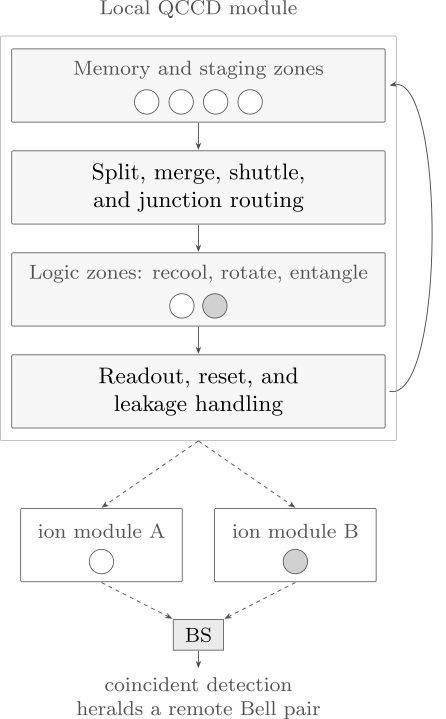
A scalable trapped-ion design separates storage from scarce high-fidelity operation resources. Inside a QCCD module, ions are routed among memory, logic, cooling, and readout zones. Between modules, emitted photons can be interfered and detected to herald remote ion–ion entanglement. Local phonon links are deterministic after calibration; photonic links are usually probabilistic and require buffering, multiplexing, and feed-forward.
The QCCD changes the compiler problem. Qubit placement is dynamic, the order of ions in a crystal matters, and route conflicts resemble constrained traffic through a small network. Parallel logic zones improve throughput only when the control system can route, cool, illuminate, detect, and recalibrate them concurrently.
Photonic modular architectures
Section titled “Photonic modular architectures”Separate traps can be connected by photons. Each ion becomes entangled with an emitted photonic degree of freedom; photons from remote modules interfere; selected detector outcomes herald an ion–ion Bell pair. Local gates use shared motion, while remote gates consume or build heralded entanglement.
For a simple two-photon protocol, collect all one-arm efficiencies into
An idealized success probability has the scale
where the factor and acceptance probability depend on the Bell-state analyzer and encoding. At attempt rate , the mean waiting time is approximately
This quadratic collection penalty is why high numerical aperture, cavities, low-loss frequency conversion, efficient detectors, and multiplexed attempts matter. The herald turns photon loss mainly into waiting time rather than an unflagged gate error, but detector dark counts, distinguishability, recoil, phase drift, and memory decoherence still affect conditional fidelity.
Photonic modularity is not simply a longer-range local gate. It introduces a stochastic resource layer: links must be generated, verified, stored, routed, possibly purified, and consumed. Network rate, conditional fidelity, erasure flags, memory lifetime, and local-gate overhead belong in one budget.
Modular Architectures develops that resource layer across platforms, including topology, pair inventory, queueing, scheduling, intermodule checks, fault domains, and availability.
Noise and Error Mechanisms
Section titled “Noise and Error Mechanisms”Trapped-ion qubits combine long-lived internal states with a mechanically and optically elaborate control system. The dominant error channel therefore depends strongly on the operation and schedule.
| Context | Important mechanisms | Diagnostic evidence |
|---|---|---|
| idle memory | magnetic noise, local-oscillator phase noise, differential Stark shifts, collisions | Ramsey and echo data versus duration, location, and transport history |
| one-qubit gate | amplitude and detuning error, phase transients, addressing crosstalk, leakage | randomized or gate-set tests, spectator tomography, long coherent sequences |
| entangling gate | mode drift, residual displacement, motional heating, laser noise, spontaneous scattering, off-resonant terms | mode spectroscopy, thermometry, phase-space closure, leakage and simultaneous-gate tests |
| transport | coherent excitation, mode mixing, qubit phase, crystal reordering, loss | before-and-after thermometry, interferometry, survival, repeated-route stress tests |
| measurement | optical pumping, finite counts, state decay, spectator scattering, recoil | assignment matrix, leakage-aware outcomes, state-preservation and crosstalk tests |
| module link | photon loss, indistinguishability, recoil, interferometer drift, dark counts | heralding rate, conditional Bell fidelity, erasure accounting, stability versus time |
Internal-state decoherence
Section titled “Internal-state decoherence”For a qubit frequency controlled by a fluctuating parameter , low-frequency noise produces a frequency fluctuation
Clock states suppress a selected first derivative, and dynamical decoupling filters selected frequency bands. Neither protects during every driven gate or against noise operators that do not commute with the encoding. A coherence number measured on stationary, echoed ions should not be inserted unchanged into a transported, illuminated schedule.
Optical qubits also inherit the metastable-state lifetime and the phase noise of the optical local oscillator. Hyperfine qubits avoid spontaneous decay within the ground manifold but Raman gates can scatter through excited states. The appropriate comparison is an operation-level error budget, not a claim that one encoding is universally longer lived.
Motional heating and mode drift
Section titled “Motional heating and mode drift”Electric-field noise near a mode frequency increases . Surface electrodes, technical voltage noise, RF pickup, patch potentials, and background-gas collisions can contribute. Heating matters most during gates that temporarily couple spin and motion, and after transport if the schedule does not recool.
The heating rate alone is incomplete. A gate budget needs the rate at the actual mode frequency, the time between cooling and the gate, the mode’s participation in the pulse, and sensitivity to nonthermal or coherent excitation. Frequency drift can leave a residual displacement even when the mean occupation remains small.
For two spin branches whose final motional states differ by displacement , tracing out a thermal mode gives the coherence factor
This compact relation explains why imperfect loop closure becomes more costly at larger . It is not a complete gate-error formula: several modes, spin operators, coherent phase errors, and nonthermal states require the full model.
Spontaneous scattering and optical error
Section titled “Spontaneous scattering and optical error”Raman gates can suffer Raman scattering that changes the qubit state and Rayleigh scattering that carries phase information. The scaling with detuning depends on the complete excited-state structure and polarization; treating an ion as one isolated excited level can predict the wrong asymptotic behavior. Intensity noise, beam-pointing drift, optical phase noise, and differential AC Stark shifts can instead dominate a technically limited implementation.
Direct optical-qubit gates avoid Raman scattering through a virtual excited manifold but require a narrow, phase-stable laser and remain constrained by the metastable state’s lifetime. Integrated photonics can stabilize beam delivery and reduce bulk-optics scaling, while fabrication disorder, loss, polarization, charging, and thermal tuning become new system variables.
Correlation, leakage, and erasure
Section titled “Correlation, leakage, and erasure”Shared control creates shared failures. One beam can illuminate several ions; one mode-frequency error can affect many gates; one voltage transient can excite every ion in a transported crystal; one resonant measurement beam can dephase neighboring memories. Such events need not fit an independent Pauli model.
Population outside the computational pair may be detectable by shelving or a multi-outcome measurement. Ion loss is also physically conspicuous in many setups. Turning leakage or loss into a reliable erasure flag can help a decoder, but only if the event is detected with known false-positive and false-negative rates, localized, and followed by a recovery or reload protocol. A detectable failure is not automatically a harmless failure.
Infrastructure and Integration
Section titled “Infrastructure and Integration”Vacuum, fields, and thermal environment
Section titled “Vacuum, fields, and thermal environment”Long ion lifetimes require ultrahigh vacuum and controlled neutral-atom sources. Collisions can heat, reorder, chemically react with, or eject ions. Reloading one missing ion without disturbing a long register is an architectural operation, not merely a vacuum statistic.
Cryogenic and Vacuum Infrastructure turns pressure, residual-gas composition, conductance, collision rates, cryopumping, service cycles, and array interruption into one resource ledger.
The trap needs a stable RF source for radial confinement and many filtered DC electrodes for axial potentials and shuttling. Electrode voltage noise couples directly to motion; filter bandwidth also limits how quickly transport waveforms can be delivered. Surface flashover, dielectric charging, RF dissipation, feedthrough count, and waveform synchronization become more important as a trap acquires zones and junctions.
Trapped ions can operate in room-temperature or cryogenic vacuum systems. Cryogenic operation may reduce some electric-field noise and improve pumping, but adds thermal contraction, limited cooling power, optical-access, wiring, and serviceability constraints. Unlike superconducting qubits, millikelvin operation is not inherent to the encoding.
Optical system
Section titled “Optical system”The optical stack may include sources for photoionization, Doppler cooling, repumping, optical pumping, Raman or optical-qubit gates, sideband cooling, state mapping, and fluorescence. Each wavelength needs frequency references, switching, power control, routing, polarization control, and diagnostics.
Scaling is therefore often limited by optical channels and stable delivery rather than by the physical size of one ion. Relevant integration paths include:
- on-chip waveguides and grating emitters;
- fiber delivery and multicore routing;
- micro-optics and high-numerical-aperture collection;
- integrated photodetectors;
- local microwave conductors and magnetic-gradient structures;
- co-packaged control electronics outside the highest-noise region.
Integration must be evaluated in operation. A waveguide demonstration is not yet a processor optical stack unless it supports the required wavelengths, power, phase stability, crosstalk, and trap lifetime.
Classical control and calibration
Section titled “Classical control and calibration”A QCCD controller solves a coupled real-time problem. It selects ion routes, generates electrode waveforms, tracks qubit identities after reordering, updates optical phases by location, schedules cooling and gates, classifies measurements, and branches on outcomes. Calibration data form a dependency graph: changing a trap frequency can invalidate transport, cooling, and gate parameters at once.
Control, Readout, and Calibration develops the hardware-neutral closed loop. For trapped ions, especially useful health signals are motional frequencies, heating rates, micromotion compensation, optical power and pointing, magnetic field, photon-count histograms, transport excitation, and zone-to-zone gate variation.
Throughput and Scheduling
Section titled “Throughput and Scheduling”Long coherence is valuable only when the architecture can use it. Consider a QCCD that processes gates in batches. If routing for the next batch can overlap cooling and gates in the current one, an approximate critical path is
Without pipelining, the same work would take roughly
These are lower-bound scheduling models, not universal timing formulas. Junction conflicts, unequal route lengths, measurement branches, recooling failures, and calibration pauses create additional latency.
For a stationary chain, the analogous bottleneck may be the number of independent addressing channels and mode-compatible simultaneous gates. For modular machines, it may be entanglement-link availability. In every case, the useful metric is a workload distribution of completed, verified operations per unit time, including retries and feedback, rather than the duration of one isolated pulse.
Fault-Tolerant Fit
Section titled “Fault-Tolerant Fit”Trapped-ion hardware offers several ingredients attractive for fault-tolerant circuits:
- high-fidelity local operations;
- long-lived memory relative to gate times;
- flexible pair reachability within a register or QCCD;
- mid-circuit measurement, reset, and classical feed-forward;
- detectable leakage or loss in some encodings;
- native multiqubit interactions in some control schemes.
Those strengths do not select one error-correcting code automatically. All-to-all reachability can reduce routing for color codes, Bacon–Shor codes, quantum low-density parity-check codes, or teleported operations. A QCCD can also arrange repeated local checks for a surface-code-like schedule. The best mapping depends on gate locality, parallelism, measurement speed, correlated errors, transport, leakage, and classical latency.
Repeated correction requires more than a high-fidelity Bell-state experiment. The processor must sustain a full cycle containing ancilla preparation, entangling gates, measurement, reset, transport or reordering, decoding, and conditional action. Error propagation through shared modes and global beams must match the code’s fault model closely enough for logical suppression.
Dated evidence
Section titled “Dated evidence”The evidence base has advanced rapidly and should be read with exact scope.
- In 2021, Pino and collaborators integrated transport, parallel operation zones, cooling, mid-circuit measurement, and programmable control in a six-qubit cryogenic QCCD demonstration.
- In 2021 and 2022, trapped-ion experiments demonstrated fault-tolerant logical primitives and a fault-tolerant universal logical gate set on small encoded registers. These were decisive control demonstrations, not large-scale logical memories.
- In June 2026, Ransford and collaborators reported a 98-qubit QCCD processor with transport-mediated all-to-all pair reachability. Across its operation zones, the paper reported mean infidelities of for one-qubit gates, for two-qubit gates, and for state preparation and measurement. These are protocol-defined results for that device and date; they do not imply 98-way simultaneous gates or identical performance on every compiled workload.
- Also in 2026, Paetznick and collaborators reported logical-error improvements from -fold to -fold over several matched physical circuit baselines using 12-qubit and 16-qubit code constructions on a QCCD. The result is evidence that encoding, correction, and detection can improve selected processor tasks. It does not alone establish asymptotic scaling, universal logical computation at arbitrary depth, or a complete resource-efficient fault-tolerant machine.
For thresholds, decoders, logical metrics, and the distinction between a memory experiment and universal fault-tolerant computation, see Surface Code and the surrounding error-correction chapter.
Advantages and Bottlenecks
Section titled “Advantages and Bottlenecks”Durable advantages
Section titled “Durable advantages”- Atomic uniformity: bare ions of one isotope do not have fabrication spread in their internal spectrum.
- Long-lived storage: clock-state and other protected encodings can have coherence far longer than individual gate and transport operations.
- Flexible interaction graph: shared modes or physical transport can bring many pairs into direct interaction without long SWAP chains.
- High-quality measurement: cycling transitions can produce strong, leakage-aware readout with appropriate collection and shelving.
- Multiple architectural scales: stationary chains, QCCDs, and photonic modules offer different balances of local complexity and connectivity.
- Rich internal structure: one species can support memory, active, optical, and communication roles, and mixed species can separate qubit and cooling functions.
Persistent bottlenecks
Section titled “Persistent bottlenecks”- Optical complexity: many stable wavelengths, beams, modulators, and collection channels must operate for long periods.
- Gate speed and mode complexity: phonon-mediated gates are constrained by secular frequencies, mode resolution, and trajectory closure.
- Parallelism: pair reachability can be much larger than the set of gates that run concurrently at quoted fidelity.
- Transport and recooling: QCCD routing adds waveform, junction, reordering, and scheduling costs.
- Surface and vacuum engineering: heating, charging, contamination, collisions, loading, and ion loss affect availability.
- Control scaling: electrode channels, optical phases, calibration dependencies, real-time branching, and decoder latency grow with the machine.
- Remote-link rate: photonic entanglement is commonly probabilistic and collection-limited even when conditional fidelity is high.
The central architectural trade is therefore not simply fidelity versus qubit count. It is the balance among spectral complexity, motion, optics, routing, parallel resource zones, and classical orchestration.
Worked Architecture Audit
Section titled “Worked Architecture Audit”Consider an illustrative QCCD with six equivalent two-ion logic zones. A circuit layer requests 12 disjoint entangling gates, so at least two batches are needed. Suppose the measured schedule costs are
With perfect routing–operation overlap, one batch requires at least
Two batches therefore need at least . A serial schedule would instead need
This does not prove a workload speedup. The first batch must be staged, the last must be returned or measured, routes may conflict, and some ions may need extra cooling. But it identifies what should be measured: utilization of each logic zone, overlap actually achieved, tail latency, recooling failures, and error versus route history.
If a memory experiment gives , a naive exponential dephasing estimate over is
That small number does not make the layer error . It omits 12 entangling gates, transport phases, cooling light, crosstalk, measurement, and the mismatch between a stationary coherence protocol and the compiled schedule. The audit shows why component coherence and system throughput must be evaluated on the same timeline without being conflated.
Evidence and Reporting Ledger
Section titled “Evidence and Reporting Ledger”A mature trapped-ion hardware report should provide:
| Claim layer | Minimum evidence |
|---|---|
| encoding | exact states, bias point, spectrum, leakage levels, coherence protocols |
| confinement | geometry, secular modes, micromotion compensation, heating by zone |
| preparation | internal populations, motional occupations, sequence duration, coolant role |
| one-qubit control | field geometry, phase convention, crosstalk, leakage, simultaneous tests |
| entangling control | target unitary, gate duration, modes, pulse, thermometry, residual motion, spectators |
| measurement | assignment matrix, leakage outcomes, crosstalk, latency, reset and state-preservation tests |
| transport | route primitive, duration, excitation, phase, survival, repetition and zone distribution |
| processor | active ions, role counts, reachability, concurrency, zone yield, uptime and drift |
| photonic link | attempt rate, herald probability, conditional fidelity, erasures, memory and multiplexing context |
| error correction | complete repeated schedule, decoder, postselection, logical uncertainty and matched baselines |
Best-case component values should be accompanied by distributions across ions, pairs, zones, days, and simultaneous contexts. When a result uses postselection or error detection, report both conditional quality and retained fraction. When a proprietary processor omits waveform, calibration, or disabled zone details, the conclusion should stay within the evidence that is public.
Common Mistakes
Section titled “Common Mistakes”- Calling the ion itself the qubit. The isotope, selected states, bias, leakage manifold, and control fields define the qubit.
- Treating motion as a permanently occupied data bus. Many gates use virtual or transient spin–motion entanglement and must close the motional trajectory.
- Assuming all-to-all means all-at-once. Pair reachability, parallel gates, and weighted schedule cost are different objects.
- Assuming atomic uniformity removes calibration. Local fields, motion, optics, and trap zones remain inhomogeneous.
- Equating optical pumping with motional cooling. Internal and motional preparation are separate channels.
- Demanding the ground state for every gate. The correct requirement is gate- and model-dependent, though lower occupation often improves robustness.
- Treating microwave gates as automatically local. Long wavelengths make ordinary spatial selectivity difficult without gradients, near fields, shifts, or transport.
- Ignoring spectator modes. Closing one phase-space loop does not close all modes in a multi-ion crystal.
- Calling fluorescence readout nondestructive. Internal-state assignment may be excellent while motion is heated and spectators are disturbed.
- Counting shuttling as free connectivity. Routing, split–merge operations, junctions, phase, excitation, and recooling affect both time and error.
- Treating a heralded link’s fidelity as its throughput. Attempt rate, collection loss, acceptance, memory, and retries determine useful rate.
- Comparing record fidelities without protocol context. State-preparation correction, leakage handling, simultaneous operation, and confidence intervals can change the interpretation.
- Calling a small logical improvement a complete fault-tolerant computer. Code scale, repeated depth, universal operations, resources, and availability remain separate claims.
Exercises
Section titled “Exercises”1. Check a clock point
Section titled “1. Check a clock point”Suppose
Find the first- and second-order magnetic sensitivities at . What has and has not been protected?
Solution
Differentiating,
so the first derivative vanishes at . The curvature is
The transition is first-order insensitive to magnetic fluctuations about the bias point, not independent of magnetic field. Quadratic magnetic noise, bias error, AC Stark shifts, oscillator phase noise, relaxation, and control errors remain.
2. Estimate a Lamb–Dicke parameter
Section titled “2. Estimate a Lamb–Dicke parameter”A ion has a mode frequency . A beam is aligned with the mode, and take . Estimate and .
Solution
Using ,
The wave number is
so
For a Raman transition one must use the projected wavevector difference, and for a multi-ion mode include the appropriate participation factor.
3. Infer a thermal occupation
Section titled “3. Infer a thermal occupation”In the Lamb–Dicke and weak-excitation limits, the red-to-blue sideband strength ratio is
Find when .
Solution
Solving for gives
The inference assumes a thermal distribution, resolved sidebands, comparable probe conditions, and negligible saturation. A coherent or nonthermal state cannot be summarized by this ratio alone.
4. Separate reachability from concurrency
Section titled “4. Separate reachability from concurrency”A 20-ion register can implement a calibrated gate on any selected pair. How many pair edges are reachable? What is the maximum number of disjoint two-qubit gates in one abstract layer?
Solution
The complete pair graph has
edges. A disjoint matching can contain at most
gates. Optical channels, shared modes, crosstalk, and pulse compatibility may reduce actual concurrency below ten. Thus 190 reachable pairs does not mean 190 simultaneous gates.
5. Quantify imperfect mode closure
Section titled “5. Quantify imperfect mode closure”Two spin branches finish a gate with relative mode displacement . If the mode has , estimate the thermal coherence factor
Solution
The exponent is
Therefore
The corresponding coherence loss is about . This is only the contribution of the specified residual displacement and thermal mode, not the total entangling-gate infidelity.
6. Compare serial and pipelined QCCD schedules
Section titled “6. Compare serial and pipelined QCCD schedules”Use the four timings in the worked audit. Find the time for three batches with the idealized pipeline and with a fully serial schedule.
Solution
The pipelined lower bound per batch is
Three batches require at least
The serial estimate is
The difference is a scheduling opportunity, not guaranteed runtime. Initial staging, final return, route conflicts, branching, and retries must be added.
7. Estimate a photonic-link rate
Section titled “7. Estimate a photonic-link rate”For each arm of a two-photon link, take
Using and an attempt rate of , estimate the heralding rate and mean waiting time.
Solution
One-arm success is
Thus
The idealized rate and waiting time are
Dead time, photon indistinguishability, detector acceptance windows, dark counts, and unsuccessful state-reset cycles can reduce the useful rate.
8. Bound measurement crosstalk
Section titled “8. Bound measurement crosstalk”During one ancilla measurement, suppose each of 15 spectator ions has an independent probability of an unwanted optical-pumping event. Estimate the probability that at least one spectator is affected.
Solution
Under the stated independence model,
That is about per ancilla measurement. Repeated rounds can make the aggregate risk important. Shared scattering or beam leakage would violate the independence assumption and requires a correlated-error measurement.
9. Build a first-order operation budget
Section titled “9. Build a first-order operation budget”A circuit uses 40 entangling gates with infidelity , 120 one-qubit gates with infidelity , and 20 measurements with assignment error . Estimate the sum of fault opportunities and explain why it is not the circuit failure probability.
Solution
The first-order sum is
For independent stochastic faults, would be a rough no-fault probability. Actual circuit success depends on which errors matter to the output, coherent accumulation, leakage, correlations, state-dependent measurement, transport, idle time, and error correction. Average gate infidelity is not literally an independent Bernoulli failure probability.
10. Audit an all-to-all processor claim
Section titled “10. Audit an all-to-all processor claim”A report describes a 98-qubit QCCD as having all-to-all connectivity. List the questions needed to turn that statement into a workload prediction.
Solution
Ask whether every pair was calibrated or whether reachability is inferred from routing; how many operation zones exist; which one- and two-qubit operations can run simultaneously; how ions are batched, sorted, and transported; the latency and error of shifts, splits, merges, junction crossings, cooling, and handoff; how performance varies by zone and pair; and how measurement, feedback, and dynamic branches affect the route schedule.
Also request the active-qubit and helper-ion counts, disabled regions, benchmark protocol, uncertainty, leakage treatment, postselection, calibration date, and representative compiled workloads. The claim can validly mean that any requested pair is eventually brought to a logic zone; it does not by itself specify simultaneous connectivity or time to solution.
References
Section titled “References”- J. I. Cirac and P. Zoller, “Quantum computations with cold trapped ions,” Physical Review Letters 74, 4091–4094 (1995), doi:10.1103/PhysRevLett.74.4091.
- D. J. Wineland et al., “Experimental issues in coherent quantum-state manipulation of trapped atomic ions,” Journal of Research of the National Institute of Standards and Technology 103, 259–328 (1998), doi:10.6028/jres.103.019.
- D. Leibfried, R. Blatt, C. Monroe, and D. Wineland, “Quantum dynamics of single trapped ions,” Reviews of Modern Physics 75, 281–324 (2003), doi:10.1103/RevModPhys.75.281.
- H. Häffner, C. F. Roos, and R. Blatt, “Quantum computing with trapped ions,” Physics Reports 469, 155–203 (2008), doi:10.1016/j.physrep.2008.09.003.
- R. Ozeri, “The trapped-ion qubit tool box,” Contemporary Physics 52, 531–550 (2011), doi:10.1080/00107514.2011.603578.
- C. D. Bruzewicz, J. Chiaverini, R. McConnell, and J. M. Sage, “Trapped-ion quantum computing: Progress and challenges,” Applied Physics Reviews 6, 021314 (2019), doi:10.1063/1.5088164.
- A. Sørensen and K. Mølmer, “Entanglement and quantum computation with ions in thermal motion,” Physical Review A 62, 022311 (2000), doi:10.1103/PhysRevA.62.022311.
- C. J. Ballance, T. P. Harty, N. M. Linke, M. A. Sepiol, and D. M. Lucas, “High-fidelity quantum logic gates using trapped-ion hyperfine qubits,” Physical Review Letters 117, 060504 (2016), doi:10.1103/PhysRevLett.117.060504.
- J. P. Gaebler et al., “High-fidelity universal gate set for ion qubits,” Physical Review Letters 117, 060505 (2016), doi:10.1103/PhysRevLett.117.060505.
- T. P. Harty et al., “High-fidelity preparation, gates, memory, and readout of a trapped-ion quantum bit,” Physical Review Letters 113, 220501 (2014), doi:10.1103/PhysRevLett.113.220501.
- R. Bowler et al., “Coherent diabatic ion transport and separation in a multizone trap array,” Physical Review Letters 109, 080502 (2012), doi:10.1103/PhysRevLett.109.080502.
- S. Srinivas et al., “High-fidelity laser-free universal control of trapped ion qubits,” Nature 597, 209–213 (2021), doi:10.1038/s41586-021-03809-4.
- D. Kielpinski, C. Monroe, and D. J. Wineland, “Architecture for a large-scale ion-trap quantum computer,” Nature 417, 709–711 (2002), doi:10.1038/nature00784.
- J. M. Pino et al., “Demonstration of the trapped-ion quantum CCD computer architecture,” Nature 592, 209–213 (2021), doi:10.1038/s41586-021-03318-4.
- P. L. W. Maunz et al., “Heralded quantum gate between remote quantum memories,” Physical Review Letters 102, 250502 (2009), doi:10.1103/PhysRevLett.102.250502.
- C. Monroe et al., “Large-scale modular quantum-computer architecture with atomic memory and photonic interconnects,” Physical Review A 89, 022317 (2014), doi:10.1103/PhysRevA.89.022317.
- D. Hucul et al., “Modular entanglement of atomic qubits using photons and phonons,” Nature Physics 11, 37–42 (2015), doi:10.1038/nphys3150.
- L. J. Stephenson et al., “High-rate, high-fidelity entanglement of qubits across an elementary quantum network,” Physical Review Letters 124, 110501 (2020), doi:10.1103/PhysRevLett.124.110501.
- S. Saha et al., “High-fidelity remote entanglement of trapped atoms mediated by time-bin photons,” Nature Communications 16, 2533 (2025), doi:10.1038/s41467-025-57557-4.
- K. K. Mehta et al., “Integrated optical multi-ion quantum logic,” Nature 586, 533–537 (2020), doi:10.1038/s41586-020-2823-6.
- R. J. Niffenegger et al., “Integrated multi-wavelength control of an ion qubit,” Nature 586, 538–542 (2020), doi:10.1038/s41586-020-2811-x.
- K. R. Brown et al., “Materials challenges for trapped-ion quantum computers,” Nature Reviews Materials 6, 892–905 (2021), doi:10.1038/s41578-021-00292-1.
- L. Egan et al., “Fault-tolerant control of an error-corrected qubit,” Nature 598, 281–286 (2021), doi:10.1038/s41586-021-03928-y.
- C. Ryan-Anderson et al., “Realization of real-time fault-tolerant quantum error correction,” Physical Review X 11, 041058 (2021), doi:10.1103/PhysRevX.11.041058.
- L. Postler et al., “Demonstration of fault-tolerant universal quantum gate operations,” Nature 605, 675–680 (2022), doi:10.1038/s41586-022-04721-1.
- A. Ransford et al., “A 98-qubit trapped-ion quantum computer with all-to-all connectivity,” Nature 655, 81–86 (2026), doi:10.1038/s41586-026-10676-4.
- A. Paetznick et al., “Improved quantum processor logical error rates via correction and detection,” Nature 654, 349–355 (2026), doi:10.1038/s41586-026-10628-y.
Further Connections
Section titled “Further Connections”- Hardware Overview compares trapped ions with superconducting circuits, neutral atoms, photons, spins, bosonic modes, and topological proposals under one system contract.
- Metrics for Quantum Hardware defines coherence, operation, leakage, crosstalk, throughput, logical, and workload metrics.
- Control, Readout, and Calibration develops waveform validation, detector inference, dependency-aware calibration, drift monitoring, and feedback.
- Quantum Memories supplies the accepted-input-to-usable-output contract for ion registers used as storage or repeater nodes.
- Modular Architectures compares QCCD transport and photonic ion modules through service contracts, stochastic supply, scheduling, error correction, and fault containment.
- Cryogenic and Vacuum Infrastructure develops the gas-load, collision, cryopumping, thermal, vibration, diagnostic, recovery, and availability contract behind an ion-trap installation.
- Materials and Fabrication Interface connects electrode materials, surface contamination, anomalous heating, trap and package fabrication distributions, screening, and module-level acceptance.
- Ion Traps supplies the exact and pseudopotential confinement models, micromotion, secular quantization, and crystal modes.
- Trapped-Ion Control derives carrier and sideband interactions, cooling thermometry, and spin-dependent-force gates.
- Trapped Ions in Open Systems develops fluorescence backaction, heating, dephasing, engineered dissipation, and trajectories.
- Hyperfine Structure and Zeeman Effect in Atoms explain the internal-state spectrum beneath common encodings.
- Atomic Selection Rules organizes polarization, branching, and allowed couplings used in pumping, gates, and readout.
- Surface Code provides one canonical framework for repeated stabilizer extraction, decoding, thresholds, logical operations, and overhead.