Why Quantum Error Correction Is Possible
Short Answer
Section titled “Short Answer”Quantum error correction is possible because it does not copy an unknown quantum state and does not measure its logical amplitudes. It instead:
- embeds the logical state isometrically into a larger physical Hilbert space;
- stores redundancy in correlations among physical degrees of freedom;
- arranges correctable errors so that they alter an error label, or syndrome, without revealing the logical state;
- uses that syndrome to reverse the error or update a tracked correction.
The exact mathematical test is the Knill–Laflamme condition. If projects onto a code subspace and is a set of errors, then the set is exactly correctable if and only if
for a matrix independent of the encoded state. This says that the environment and syndrome degrees of freedom may learn which correctable error sector occurred, but they cannot learn which logical state was encoded.
The result resolves three apparent obstacles at once:
| Apparent obstacle | Resolution |
|---|---|
| Unknown states cannot be cloned | Encoding creates one distributed logical state, not independent copies |
| Measurement generally disturbs a state | Syndrome measurements distinguish error sectors, not logical alternatives |
| Physical errors vary continuously | Linearity reduces an operator-valued continuum to a correctable operator span |
These are statements about an ideal code and a declared error set. They do not by themselves show that noisy correction circuitry is fault tolerant, that a device is below threshold, or that the logical error rate is useful.
Encoding Is Not Cloning
Section titled “Encoding Is Not Cloning”Let be a logical Hilbert space and a larger physical Hilbert space. An encoding is an isometry
Its image
is the code subspace, with projector
For a logical qubit,
is encoded as
The amplitudes and still describe one quantum state. They have not been placed into several independent systems, each in state . Physical subsystems can be entangled, and their reduced states generally do not equal the original logical state.
For example, the bit-flip repetition encoding gives
Tracing out any two carriers removes the phase coherence from the remaining carrier:
Thus no physical qubit is an independent copy of the unknown input. The encoded correlations carry information that no one carrier carries alone. Bits, Qubits, Qudits, and Modes gives the worked bit-flip-code example; the later code pages own its complete stabilizer and recovery analysis.
This distinction is exactly compatible with No-Cloning and No-Signaling. No-cloning forbids a universal map
not an isometric change of representation
An encoding can also preserve entanglement with an external reference :
Preserving this reference entanglement is essential. A memory that reproduces isolated basis states but destroys their coherence is not a quantum error-correcting memory.
Measure the Error Sector, Not the Logical State
Section titled “Measure the Error Sector, Not the Logical State”Suppose a collection of errors moves the code into mutually orthogonal sectors while acting identically on the logical information. In an ideal nondegenerate form, normalized error operators obey
Then each maps the code isometrically into an orthogonal subspace. A coherent syndrome-extraction operation can implement
where the ancilla label identifies the error sector. Crucially, the same label is produced for every in the code. A conditional inverse can then restore the data:
The syndrome register may be measured to obtain classical data, or retained coherently in a larger recovery circuit. Either way, the logical amplitudes do not appear in the syndrome distribution.
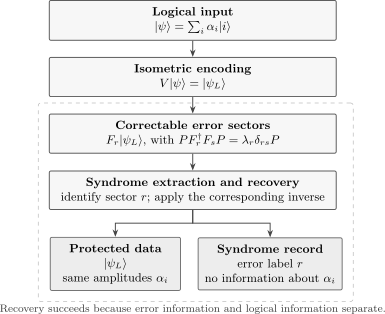
Information separation in exact quantum error correction. After diagonalizing the Knill–Laflamme matrix, correctable errors occupy orthogonal sectors labeled by . Recovery returns every sector to the same logical state while a syndrome record retains but no information about the amplitudes .
A physical syndrome circuit is itself imperfect. Ancilla faults can propagate to the data, measurements can be wrong, and repeated rounds can be correlated. Designing the extraction so that a small number of component faults cannot become an uncorrectable data error is a problem of fault tolerance, not a consequence of ideal syndrome measurability.
The Exact Correction Criterion
Section titled “The Exact Correction Criterion”Let the physical noise channel have a Kraus representation
The code is exactly correctable for when there is a completely positive trace-preserving recovery channel such that
for every density operator supported on . The Knill–Laflamme theorem states that such a recovery exists if and only if
for every pair .
In an orthonormal logical basis , the same condition is
This has two complementary meanings:
- the factor prevents correctable errors from confusing distinct logical basis states;
- the coefficient is independent of , so error records cannot reveal the logical basis label.
The matrix is positive semidefinite. It need not be diagonal, and the errors need not create distinct syndrome outcomes. The condition is also independent of the chosen Kraus representation because changing Kraus operators only changes the spanning set by a linear isometry.
Why the environment must learn nothing logical
Section titled “Why the environment must learn nothing logical”A Stinespring representation of the noise can be written as
After tracing out the physical system, the environment state is
If the Knill–Laflamme condition holds, then
which is independent of . The environment may contain error information, but it contains no logical information. This is the information-theoretic heart of exact correction.
Conversely, if the environment can distinguish two logical inputs, some logical information has leaked out. A recovery acting only on the physical output cannot in general reconstruct arbitrary entanglement with a reference while also erasing that leaked distinguishability.
Why the Criterion Is Sufficient
Section titled “Why the Criterion Is Sufficient”The recovery can be constructed conceptually from the Knill–Laflamme matrix. Diagonalize by a unitary change of error basis:
so that
For every , define the partial isometry on the code by
Then
The ranges of the are therefore orthogonal error sectors, and each sector is an isometric image of the entire code. A recovery can:
- project onto those sectors;
- record the sector label ;
- apply on sector ;
- map any unmodeled orthogonal remainder to a declared fallback state.
Every correctable branch is returned to the code with its logical amplitudes intact. Directions with have no action on the code and require no correction.
This construction is a proof of existence, not automatically a practical circuit. Efficient syndrome extraction, decoding, locality, ancilla preparation, and fault propagation depend on the code and hardware.
Linearity Makes Continuous Errors Correctable
Section titled “Linearity Makes Continuous Errors Correctable”The phrase “quantum errors are continuous” sounds fatal only if every possible operator must be corrected separately. Operators form a vector space. For one qubit, any linear operator can be expanded as
If a code corrects a basis of errors , it corrects every error in their linear span. Indeed, for
the Knill–Laflamme condition gives
The new coefficient is still independent of the logical state.
A coherent small rotation
Section titled “A coherent small rotation”Consider a small unwanted rotation on physical carrier :
Suppose the code corrects both and . An ideal coherent recovery can act as
The logical state factors from the syndrome. If the syndrome is measured, the two outcomes occur with probabilities
independent of , , or any reference entanglement. The continuous angle changes the branch amplitudes, not the requirement to enumerate infinitely many separate corrections.
This reasoning does not mean that the physical noise secretly was a classical Pauli fault. Before syndrome extraction, the and branches can be coherent. Exact recovery works on their linear span; replacing the process by a stochastic Pauli channel is a separate modeling approximation.
A non-Pauli channel
Section titled “A non-Pauli channel”For amplitude damping on one qubit,
These operators lie in the Pauli span:
Therefore a code that exactly corrects every one-qubit Pauli operator on carrier also corrects the full one-qubit amplitude-damping channel there under the ideal channel model. Device-level relaxation, leakage, simultaneous faults, and imperfect recovery still require a larger model.
Distance Turns Locality into a Guarantee
Section titled “Distance Turns Locality into a Guarantee”An -qubit code encoding logical qubits is commonly labeled . Its distance can be defined as the minimum weight of a Pauli operator that is not detectable:
Here is the number of physical qubits on which acts nontrivially. Thus every Pauli error of weight less than is detectable.
To correct arbitrary errors on at most unknown qubits, the Knill–Laflamme condition must hold for every product of two such errors. That product can have weight as large as . Hence
is sufficient, or equivalently
A distance- code therefore:
- detects arbitrary errors on up to qubits;
- corrects arbitrary errors on up to unknown locations;
- corrects erasure of up to known locations, subject to the code and erasure model.
The distinction between known and unknown locations matters. An erasure flag supplies location information, so the recovery does not have to distinguish all pairs of possible damaged supports.
Distance is not a complete performance prediction. Equal-distance codes can have very different syndrome circuits, degeneracy, decoder behavior, thresholds, logical biases, connectivity requirements, and finite-size error rates.
Degeneracy Is Allowed
Section titled “Degeneracy Is Allowed”Classical intuition suggests that every correctable error should have a unique syndrome. Quantum codes need not obey that rule. A code is degenerate when distinct physical errors have the same action on the code.
If
then no measurement can distinguish from on encoded states, but none is needed. The same recovery corrects both. In a stabilizer code, errors that differ by a stabilizer act identically on code states, up to an irrelevant phase.
This is why in the Knill–Laflamme condition may have off-diagonal entries or reduced rank. Diagonalizing identifies independent error actions on the code, not necessarily the original laboratory labels.
Degeneracy can be useful, but it does not make all correlated or high-weight errors harmless. A decoder must reason over equivalence classes and choose a correction whose product with the actual error is logically trivial.
Exact Correction, Approximate Correction, and Fault Tolerance
Section titled “Exact Correction, Approximate Correction, and Fault Tolerance”The exact Knill–Laflamme condition is a structural theorem. Real devices usually operate in an approximate, repeated, and noisy regime.
| Layer | What it does | What it does not establish by itself |
|---|---|---|
| Error detection | Flags departure from a chosen sector or violated checks | A recovery exists or accepted states are unbiased |
| Error mitigation | Reduces estimator bias or suppresses selected effects without a protected logical memory | Arbitrarily long reliable computation |
| Exact QEC | Restores every code state for a declared channel or error span | The recovery circuit tolerates its own faults |
| Approximate QEC | Optimizes a fidelity or distance when exact correction is impossible or inefficient | A universal hardware-independent performance level |
| Fault tolerance | Limits how component faults propagate through logical preparation, gates, measurement, and recovery | A particular device is below threshold |
Approximate correction replaces exact equality by an operational error criterion, often worst-case entanglement fidelity or a channel distance after optimized recovery. Small violations of Knill–Laflamme can be tolerable, but matrix-element closeness must be connected to a declared metric and input set.
Decoherence-Free Subspaces provide a related passive mechanism. There the relevant noise acts trivially on the protected subsystem, so active syndrome extraction may be unnecessary while the symmetry holds. Active QEC is broader because it can reverse errors that move states into distinct sectors.
Fault tolerance adds the crucial fact that correction components are noisy. A useful architecture must control:
- faults that spread through multi-qubit gates;
- wrong or missing syndrome bits;
- measurement and reset latency;
- leakage and seepage outside the modeled code space;
- spatial, temporal, and common-mode correlations;
- decoder approximation and backlog;
- logical state preparation and destructive measurement;
- implementation of logical gates without defeating the code;
- entropy removal when ancillas are reset.
The Noise in Quantum Information taxonomy and Common Noise Models model cards should be read before turning a code-distance statement into a hardware claim.
Noise, Channels, and Error Mitigation supplies the broader model-to-decision record. Error Mitigation Overview owns the estimator-level boundary among suppression, filtering, mitigation, encoded correction, and fault tolerance, including total-resource and validation tests; this page retains the error-subspace logic, Knill–Laflamme criterion, correctability proofs, distance, degeneracy, and approximate-correction boundary.
Limits of Error Mitigation owns when loss of distinguishability, sampling cost, model error, or matched-budget evidence requires a finite mitigation claim to narrow, stop, or escalate; this page retains encoded correctability, recovery, and fault-tolerant protection.
Quantum Error Correction and Fault Tolerance places this page’s correctability certificate inside the broader extraction, decoding, logical-operation, evidence, threshold, and resource record; this page retains the no-cloning resolution, Knill–Laflamme criterion, distance, degeneracy, and exact-to-approximate correction boundary.
Pauli Group and Stabilizers turns a small signed Pauli list into a phase-safe compatibility, independence, dimension, and commutation-signature audit; this page retains the Knill–Laflamme correctability theorem, distance, degeneracy, and exact-to-approximate correction boundary.
Three-Qubit Codes realizes the bit- and phase-flip repetition examples as explicit codewords, checks, syndrome cosets, and ideal recoveries; this page retains their general Knill–Laflamme justification and operator-span boundary.
Five-Qubit Code owns the code-specific sixteen-error Knill–Laflamme matrix, Hamming-bound packing equality, and Singleton-bound application; this page retains the general correctability theorem and its assumptions.
Shor Code owns the degenerate code-specific matrix , its rank, and the operator-span application for the nine-qubit construction; this page retains the general theorem and its assumptions.
Steane Code owns the nondegenerate code-specific matrix and its operator-span application for the seven-qubit construction; this page retains the general theorem and its assumptions.
A Practical Correctability Audit
Section titled “A Practical Correctability Audit”For a proposed code and noise model, ask:
- What is encoded? State the logical Hilbert space, encoding isometry, code projector, and physical Hilbert space.
- What is the error set? Give Kraus operators, an operator span, a locality class, or a controlled approximation with parameter range.
- Does the Knill–Laflamme test hold? Evaluate for every required pair.
- What information reaches the environment? Check whether the complementary output depends on the logical input.
- How is the syndrome obtained? Specify ancillas, interactions, measurement schedule, repeated rounds, and classical record.
- What is the recovery? State the correction map or decoder-to-frame-update rule.
- Which faults occur during recovery? Include propagation, leakage, crosstalk, reset, measurement, and latency.
- What is the metric? Use logical channel error, entanglement fidelity, memory lifetime, or another task-matched quantity.
- What is the scaling evidence? Compare code sizes or distances at fixed physical conditions and report uncertainty.
Passing the algebraic test establishes ideal correctability for the declared errors. Passing the full audit is what begins to support an engineering claim.
Common Mistakes
Section titled “Common Mistakes”- Saying QEC “copies the state many times.” It creates one encoded state with structured correlations.
- Saying syndrome measurement avoids disturbance because it is weak. Ideal syndrome measurement can be projective; what matters is that it reveals no logical information.
- Treating every distinct physical error as requiring a distinct syndrome. Degenerate errors can share a correction.
- Claiming that continuous errors invalidate discrete-error codes. Correctability applies to an operator span.
- Assuming a Pauli expansion turns coherent noise into a stochastic Pauli channel.
- Saying distance corrects arbitrary unknown-location errors. It corrects at most such errors.
- Equating successful postselection with deterministic correction.
- Ignoring entanglement with a reference when defining recovery fidelity.
- Inferring a threshold from the Knill–Laflamme condition alone.
- Quoting a physical error rate without specifying locations, correlations, cycle time, leakage, and the decoder.
Exercises
Section titled “Exercises”1. Encoding versus cloning
Section titled “1. Encoding versus cloning”For
compute the reduced state of the first qubit. Compare it with and explain why the encoding is not a cloning operation.
Solution
The encoded density operator contains diagonal terms and two cross terms. Tracing over qubits 2 and 3 gives
The original state has off-diagonal terms and its adjoint. Except in special cases, . For , each physical qubit is maximally mixed even though the three-qubit state is pure. The phase information resides in correlations.
2. Correcting an operator span
Section titled “2. Correcting an operator span”Assume
Show directly that every pair of operators is also Knill–Laflamme correctable.
Solution
For two linear combinations,
where
The coefficient is independent of the logical state, so the span satisfies the same criterion.
3. A continuous rotation
Section titled “3. A continuous rotation”Suppose and produce orthogonal correctable sectors. For
find the two ideal syndrome probabilities and show that neither depends on the encoded state.
Solution
Expanding the rotation,
Orthogonal syndrome extraction sends the two branches to orthogonal ancilla states. The Born probabilities are therefore
No overlap involving remains because each branch acts isometrically on the whole code. The angle controls the error-sector probabilities, while the logical amplitudes factor out.
4. Knill–Laflamme test for bit flips
Section titled “4. Knill–Laflamme test for bit flips”Let
and consider . Show that for this error set.
Solution
For , , so
For , the product is either one bit flip or two bit flips . Every such operator maps both and to computational-basis states orthogonal to the code. Hence
when . Therefore , and the set, together with its linear span, is exactly correctable.
5. Why the repetition code misses phase flips
Section titled “5. Why the repetition code misses phase flips”Use the Knill–Laflamme condition to show that the same code does not correct the set .
Solution
The cross term is
On the logical basis,
Thus
which is a logical operator and is not proportional to . The environment could distinguish logical basis states through this error action, so the set fails the criterion.
6. Derive the distance bound
Section titled “6. Derive the distance bound”Assume a code detects every Pauli operator of weight less than . Show that it corrects every error supported on at most unknown qubits when .
Solution
Expand each error on at most carriers in the Pauli basis. It is enough to test Pauli errors and of weight at most . Their product satisfies
If , every product is detectable, so
The Knill–Laflamme condition then holds for the entire operator span. Solving for integer gives
7. Degenerate errors
Section titled “7. Degenerate errors”Let satisfy , and let . Show that and have identical action on the code. Why should a decoder not try to distinguish them?
Solution
Using ,
The two physical operators therefore produce exactly the same corrupted code state for every logical input. Any recovery that corrects one corrects the other. Attempting to distinguish them cannot improve the logical action and may be impossible. A decoder should identify the relevant equivalence class and choose a correction whose product with the actual error acts trivially on the code.
8. Logical information in the environment
Section titled “8. Logical information in the environment”Starting from
derive the environment density operator and prove that it is independent of when the Knill–Laflamme condition holds.
Solution
The joint state projector is
Tracing over the physical system gives
Because and
normalization implies
Therefore
with no dependence on the logical state. The environment stores only correctable error information.
Further Connections
Section titled “Further Connections”- No-Cloning and No-Signaling
- Bits, Qubits, Qudits, and Modes
- Noise in Quantum Information
- Common Noise Models
- Threshold Theorem
- Quantum Channels and Noise
- Decoherence-Free Subspaces
- Stabilizer States Preview
- Stabilizer Formalism
- Entanglement Distillation shows the distributed Bell-pair version of syndrome extraction and explains the equivalence between one-way purification protocols and quantum codes.
- Surface Code
- Noise and Decoherence in Metrology explains how sensing codes must correct dominant errors while preserving a nontrivial logical signal, including the Lindblad-span criterion.
- QEC Glossary Entry
References
Section titled “References”- P. W. Shor, “Scheme for reducing decoherence in quantum computer memory,” Physical Review A 52, R2493–R2496, 1995, doi:10.1103/PhysRevA.52.R2493.
- A. M. Steane, “Error correcting codes in quantum theory,” Physical Review Letters 77, 793–797, 1996, doi:10.1103/PhysRevLett.77.793.
- C. H. Bennett, D. P. DiVincenzo, J. A. Smolin, and W. K. Wootters, “Mixed-state entanglement and quantum error correction,” Physical Review A 54, 3824–3851, 1996, doi:10.1103/PhysRevA.54.3824.
- E. Knill and R. Laflamme, “Theory of quantum error-correcting codes,” Physical Review A 55, 900–911, 1997, doi:10.1103/PhysRevA.55.900.
- R. Laflamme, C. Miquel, J. P. Paz, and W. H. Zurek, “Perfect quantum error correcting code,” Physical Review Letters 77, 198–201, 1996, doi:10.1103/PhysRevLett.77.198.
- E. Knill, R. Laflamme, and L. Viola, “Theory of quantum error correction for general noise,” Physical Review Letters 84, 2525–2528, 2000, doi:10.1103/PhysRevLett.84.2525.
- D. Gottesman, “An introduction to quantum error correction and fault-tolerant quantum computation,” in Quantum Information Science and Its Contributions to Mathematics, Proceedings of Symposia in Applied Mathematics 68, 13–58, 2010, arXiv:0904.2557.
- B. M. Terhal, “Quantum error correction for quantum memories,” Reviews of Modern Physics 87, 307–346, 2015, doi:10.1103/RevModPhys.87.307.
- C. Bény and O. Oreshkov, “General conditions for approximate quantum error correction and near-optimal recovery channels,” Physical Review Letters 104, 120501, 2010, doi:10.1103/PhysRevLett.104.120501.
- M. A. Nielsen and I. L. Chuang, Quantum Computation and Quantum Information, 10th anniversary ed., Cambridge University Press, 2010, doi:10.1017/CBO9780511976667.
- J. Preskill, Quantum Error Correction, Chapter 7 of the Caltech quantum computation lecture notes, updated 2026, course materials.
Summary
Section titled “Summary”Quantum error correction does not evade quantum mechanics. It exploits its linear and tensor-product structure. An encoding is one distributed logical state, not a collection of clones. Correctable errors alter a syndrome sector while leaving the logical amplitudes inaccessible to both syndrome and environment. The Knill–Laflamme condition,
is the exact statement of that separation.
Linearity then explains why a finite operator basis can cover continuous coherent errors and non-Pauli channels. Code distance turns detectability into a locality guarantee, while degeneracy allows distinct physical faults to share one logical action. These ideal facts make QEC possible; fault-tolerant circuits, realistic decoders, repeated noisy measurements, and demonstrated logical scaling determine whether it works in hardware.