CSS Codes
Calderbank–Shor–Steane, or CSS, codes turn a compatible pair of binary linear codes into a quantum stabilizer code whose checks are purely -type or purely -type. That separation makes the construction unusually transparent. Commutation becomes one binary matrix product, logical Paulis become quotient spaces, and ideal syndromes split into two classical-looking parity equations. The separation is algebraic, however, not a promise that physical noise, decoding, or fault-tolerant operations split into independent problems.
This page develops the family rather than one celebrated member. It fixes one row-vector convention for and , translates it into nested classical codes, constructs normalized coset states, derives exact - and -logical quotients and distances, and specializes Pauli correctability to CSS language. A deliberately unequal five-qubit detection fixture keeps every convention auditable without duplicating the exact Shor Code, Steane Code, or perfect non-CSS Five-Qubit Code.
The construction emerged independently through Calderbank and Shor’s existence construction and Steane’s code-theoretic construction, with a fuller classical-code recipe in Steane’s subsequent treatment. The language below uses the stabilizer synthesis developed systematically by Gottesman and the standard presentation of Nielsen and Chuang.
Required background. Stabilizer Formalism supplies Pauli supports, stabilizer groups, normalizers, logical cosets, syndromes, and full-Pauli distance.
Helpful background. Classical Information Review supplies parity-check and binary-code orientation. Why Quantum Error Correction Is Possible supplies the general Knill–Laflamme theorem. Every binary-space convention needed below is nevertheless declared here.
Two Classical Codes and One Commuting Stabilizer
Section titled “Two Classical Codes and One Commuting Stabilizer”One declared binary and Pauli convention
Section titled “One declared binary and Pauli convention”All vectors are binary row vectors, arithmetic is over , and a length- string is read from qubit one on the left to qubit on the right. For , define
is a phase-free representative. On one qubit , so a physical has although its global phase is discarded in the binary record. That phase suppression is legitimate for commutation, syndrome, stabilizer-coset, and distance calculations; it would not be legitimate in a calculation whose output depends on an operator’s signed action.
The ordinary binary inner product controls the cross-commutation:
Thus two supports commute exactly when their overlap has even cardinality. The convention table records the objects used throughout. “Positive check” means that the code occupies the eigenspace of the associated Pauli, not that the binary entries have a sign.
| Quantity | Frozen definition | Role |
|---|---|---|
| Binary support vectors | , written as row vectors | Locate physical and factors |
| Phase-free Pauli representative | with | Suppress irrelevant global phase while retaining both components |
| X-check matrix | Each row supports one positive stabilizer generator | |
| Z-check matrix | Each row supports one positive stabilizer generator | |
| Cross-commutation | Make every check commute with every check | |
| Independent check ranks | , | Remove redundant parity equations |
| Encoded qubits | Give code-space dimension | |
| X-logical quotient | Identify nontrivial pure- logical supports | |
| Z-logical quotient | Identify nontrivial pure- logical supports | |
| Axis distances | are minimum nontrivial quotient weights | Resolve asymmetric pure-axis protection |
| Ordered syndrome | List -check bits before -check bits |
The two halves of a binary Pauli record should not be confused with two independent physical errors. They are coordinates of one operator. In particular, the same microscopic event can populate both halves, as does, and a physical prior may correlate supports at different qubits as well.
The check-matrix commutation condition
Section titled “The check-matrix commutation condition”Let
For a row of , use the positive check ; for a row of , use the positive check . Checks within either sector commute automatically. A cross-sector pair obeys
Consequently, the entire proposed generating set commutes exactly when
This equation says that every -row support meets every -row support in an even number of coordinates. It is both a construction rule and a fast audit: one nonzero matrix entry identifies a pair of anticommuting proposed checks, so no common code space with the declared signs exists.
The row counts need not equal the numbers of independent checks. Experimental schedules and decoder inputs often retain redundant checks because they can expose measurement faults or improve inference. Algebraically the code depends on the row spaces. If
then there are independent commuting Pauli constraints and
Duplicating a row changes or but changes neither rank nor code space. Replacing ranks by row counts can therefore produce a negative or otherwise false value of . Row reduction is only a mathematical simplification; it does not declare a redundant physical measurement useless.
All check signs here are positive. A general signed stabilizer presentation can describe another joint eigenspace with the same binary supports, but its sign consistency belongs to the general stabilizer formalism. The CSS construction in this page starts from positive and generators and uses the binary matrices to specify their supports.
Nested classical codes without label ambiguity
Section titled “Nested classical codes without label ambiguity”The same construction can be expressed as a nested pair of classical linear codes. Freeze
The matrix equation is then exactly
Taking binary orthogonal complements gives
These familiar row-space, kernel, and duality identities are standard classical coding theory; MacWilliams and Sloane give the broader theory. They also make the converse construction immediate. Starting from , choose rows of spanning and rows of spanning . Orthogonality then guarantees commuting CSS checks.
| Classical object | Frozen identity | CSS role |
|---|---|---|
| Supports stabilizers and translations within one logical coset | ||
| Contains computational strings satisfying every check | ||
| Supports stabilizers | ||
| Contains supports commuting with every check | ||
| Labels -logical translations and logical basis cosets | ||
| Labels -logical phases |
Names such as and are not uniform across the literature: one author may name a code for the errors it corrects, another for the checks it supports, and a third for the logical operators it contains. This page avoids that ambiguity by treating as primary and freezing , . Translating another source requires checking its definitions, not merely replacing subscripts.
There is a second translation hazard. A classical parity-check matrix has a kernel as its code, whereas the rows of here directly generate quantum checks. Thus is a parity-check matrix for , while is a generator matrix for in the frozen dictionary. Both are called “check matrices” at the quantum level because every row becomes a measured stabilizer. Keeping the row-space and kernel identities visible prevents a classical generator matrix from being mistaken for the wrong quantum check sector.
Code Space and Logical Quotients
Section titled “Code Space and Logical Quotients”Independent checks and encoded dimension
Section titled “Independent checks and encoded dimension”An CSS code is the simultaneous eigenspace of the positive checks generated by the two row spaces. Because a nonidentity commuting Pauli constraint halves the retained Hilbert-space dimension, independent constraints leave
This dimension count agrees with the classical quotient:
The agreement is structural. The stabilizer count says how many quantum degrees of freedom remain; the quotient says how many binary coset labels are available for an orthonormal logical basis.
Redundant rows do not add constraints. Suppose a matrix contains the same row twice. Both listed operators can be measured, and comparing their records may be useful in a noisy circuit, but the second row does not halve the ideal code space again. Similarly, multiplying existing generators produces another stabilizer without raising the independent rank. A code parameter statement must therefore report ranks or an independently verified generating set.
The formula also exposes an invalid proposal quickly. Cross-commutation alone is not enough if someone declares more independent rows than the ambient dimension permits; row reduction resolves the true ranks. With the positive CSS presentation used here, the two sectors contribute additively because a nonidentity pure- Pauli cannot equal a pure- Pauli.
Dependencies among rows have their own binary witnesses. A nonzero vector in the left kernel of identifies a product of listed checks equal to identity; the analogous statement holds for . Removing those dependencies produces a minimal algebraic generating set, but retaining them can still be operationally useful. If , the construction gives a stabilizer state rather than an encoded logical register. The same formulas remain valid, while both logical quotient spaces become trivial.
Normalized coset-state basis
Section titled “Normalized coset-state basis”For a coset , define
Changing the representative from to with merely relabels the summation variable, so the state depends only on the coset. Every computational basis string appears with the same amplitude and there are distinct strings. Therefore the prefactor normalizes the state. Distinct cosets are disjoint subsets of the computational basis, which makes their states orthogonal.
An check supported on translates every summand:
Since permutes , the sum is invariant. A check supported on contributes the phase
because both and lie in . Thus every coset state is stabilized by both sectors. There are cosets, so these orthonormal states fill the entire code space.
This construction does not select a unique computational labeling of the logical qubits. A basis for supplies that additional choice. Different quotient bases describe the same encoded subspace but change which products of physical Paulis are called . Such changes are logical coordinate changes, not new codes.
X- and Z-logical quotient spaces
Section titled “X- and Z-logical quotient spaces”A pure- operator commutes with every check exactly when . It is an stabilizer exactly when . Hence nontrivial pure- logical supports are the quotient
The operator translates the coset label:
Likewise, a pure- operator commutes with the checks when , and it is a stabilizer when . Therefore
For in that kernel, the phase on a coset state is constant:
because for every .
Both quotient spaces have dimension . Choose row representatives for quotient bases so that
The diagonal ones make corresponding logical and representatives anticommute, while off-diagonal zeros make different logical-qubit pairs commute. Such paired bases exist because the induced bilinear pairing between the two quotient spaces is nondegenerate. If a proposed quotient class paired trivially with every class, its support would lie in and would therefore be trivial.
Adding a row of to an representative or a row of to a representative changes the physical Pauli by a stabilizer. The logical action is unchanged, although physical weight and hardware convenience can change. This equivalence is why a decoder seeks the right logical class rather than a unique microscopic error.
Asymmetric distances and full distance
Section titled “Asymmetric distances and full distance”Freeze the convention that refers to a nontrivial pure- logical and to a nontrivial pure- logical:
If the corresponding nontrivial logical-axis set is empty, take the minimum to be . For a nontrivial CSS code both logical quotients have dimension , and the full Pauli distance is
To see why mixed Paulis cannot lower this minimum, let be a normalizer element. Its support belongs to and its support belongs to . If both components are stabilizer supports, the whole operator is a stabilizer up to phase. Otherwise at least one component is a nontrivial logical class whose weight is at least or , while the weight of the union support cannot be smaller than that component’s weight.
The quotient exclusions are essential. The classical distance of is the minimum weight of any nonzero word in , but that word could belong to and therefore be an stabilizer rather than a logical operator. Thus raw classical distances can provide useful bounds yet need not equal the exact quantum axis distances. Quotient enumeration or an equivalent proof must exclude stabilizers explicitly.
CSS does not mean symmetric protection. It is possible to have , a useful feature when one noise component dominates. The labels themselves are not universal across sources, so the support-based definitions above accompany every parameter claim. A code of distance detects every Pauli of weight below and corrects every arbitrary Pauli set of weight at most ; degeneracy can make selected higher-weight sets correctable without changing the distance definition.
The two axis distances can also support a more refined task statement. A known-location erasure is correctable when no nontrivial logical support fits entirely inside the erased set, so the actual support geometry matters in addition to its size. A biased-noise design may deliberately make one axis distance larger, but quoting only that favorable value would overstate full-Pauli protection. The parameter always uses the smaller axis distance; a more informative asymmetric report gives together with the page’s frozen label convention.
Syndromes and Correctability
Section titled “Syndromes and Correctability”Separate algebraic syndrome sectors
Section titled “Separate algebraic syndrome sectors”For , a check detects the component and an check detects the component. Order the syndrome by check type:
Here means “bits produced by the ordered checks,” not “syndrome of a error.” This naming removes a common ambiguity. In the same convention, a single produces column of in the first sector, a single produces column of in the second, and produces both.
The equations are linear:
where an irrelevant product phase is suppressed. A syndrome therefore specifies an affine set of candidate supports. It rarely identifies a unique fault location, and it never by itself supplies a probability distribution over candidates.
Physical extraction is a separate layer. The equations assume ideal outcomes for the declared checks. Ancilla preparation, controlled-gate order, measurement faults, repeated rounds, and detector construction belong to Syndrome Measurement. Using a matrix as an ideal parity map does not certify a circuit that measures it safely.
Degeneracy in CSS language
Section titled “Degeneracy in CSS language”Consider two phase-free Pauli errors and . Their syndromes are equal exactly when
Equivalently, lies in the Pauli normalizer of the stabilizer. Equal syndrome is therefore weaker than equal action on the code. There are two possibilities. If
then the difference is a stabilizer up to phase. The errors are harmlessly degenerate: one correction class reverses both. If either quotient class is nontrivial, the difference is a logical Pauli. The errors then have the same syndrome but require incompatible logical corrections.
This is the CSS specialization of the Knill–Laflamme condition,
If the product anticommutes with a check, the projected operator is zero. If it is a stabilizer, it is scalar on the code. If it is a nontrivial normalizer element, it acts logically and is not scalar, so an error set containing both members is not exactly correctable.
For a proposed phase-free recovery , the residual succeeds on the code precisely when
This condition allows a recovery to differ from the microscopic error by any stabilizer. Demanding and would discard degeneracy and impose an unnecessary identification task.
For a fixed syndrome, choosing one representative identifies an affine normalizer coset. Quotienting that set by the stabilizer leaves the possible logical residual classes. The syndrome tells which check eigenspace contains the corrupted state; it does not select among those logical classes. This separation explains both sides of degeneracy: many physical representatives inside one stabilizer class are harmless, while two representatives in different logical classes remain indistinguishable to the checks. A decoder must use a noise model or additional records to choose among them.
When separate decoding loses information
Section titled “When separate decoding loses information”The check equations split, but a probabilistic model need not. Let be the posterior over binary components. Independent half-decoding is exact only under assumptions strong enough to factor the relevant posterior or preserve its optimum after marginalization. A physical is one event with ; CSS algebra does not determine whether that event arises from correlated or independently sampled components.
For example, with a one-qubit prior
the marginal probabilities that the and components are present are and . Multiplying them would assign to their joint presence, more than a factor of ten below the true probability . The parity equations remain correct; the factorized statistical assumption does not.
Correlations can also come from multi-qubit mechanisms, common controls, leakage followed by return, or a syndrome circuit whose one fault propagates to several data qubits. Degeneracy adds another distinction: the desired posterior is over logical recovery classes, so probabilities of many physical representatives should be combined rather than compared one by one.
Decoders owns those likelihoods, correlations, algorithm families, confidence measures, throughput, and latency. This page supplies the algebraic interface: the two syndrome equations, stabilizer row spaces, logical quotients, and the criterion by which a candidate residual is judged.
An Unequal-Matrix Five-Qubit Detection Fixture
Section titled “An Unequal-Matrix Five-Qubit Detection Fixture”Frozen check matrices and stabilizers
Section titled “Frozen check matrices and stabilizers”Consider the deliberately unnamed pair
Every cross-row overlap has size two, so
Both matrices have rank two. The four independent positive stabilizer generators, in declared row order, are
They define a code with
This is a compact CSS fixture constructed for the present audit. It is not the cyclic perfect Five-Qubit Code, whose mixed-Pauli generators, sixteen one-error sectors, and distance-three correction are owned by that page.
The matrices are intentionally unequal. An all-ones even-parity detector would make every location share one syndrome and every location another. The present pair remains completely enumerable while exercising two-bit check sectors, a nontrivial nested coset basis, paired quotient representatives, and several same-syndrome logical collisions.
Logical basis and paired representatives
Section titled “Logical basis and paired representatives”The -check row space is
Solving gives
Thus has two cosets. Their normalized states are
Translation by swaps the two cosets, so a convenient logical operator is
The support lies in but not in . Its phase is even on the first coset and odd on the second, so
Their binary pairing is
which gives the required logical anticommutation. Adding an -check row to or a -check row to produces another representative of the same logical operator.
Enumeration of the two quotient spaces gives no weight-one nontrivial class. Both displayed representatives have weight two, so
Complete single-Pauli syndrome ledger
Section titled “Complete single-Pauli syndrome ledger”Apply the frozen order
The ledger includes identity and every single-qubit phase-free Pauli:
| Error | Z-check bits | X-check bits | Ordered syndrome |
|---|---|---|---|
00 | 00 | 00|00 | |
10 | 00 | 10|00 | |
01 | 00 | 01|00 | |
01 | 00 | 01|00 | |
10 | 00 | 10|00 | |
11 | 00 | 11|00 | |
00 | 10 | 00|10 | |
00 | 10 | 00|10 | |
00 | 11 | 00|11 | |
00 | 11 | 00|11 | |
00 | 01 | 00|01 | |
10 | 10 | 10|10 | |
01 | 10 | 01|10 | |
01 | 11 | 01|11 | |
10 | 11 | 10|11 | |
11 | 01 | 11|01 |
The first half of each row is column of ; the second half of each row is column of . Each row is their concatenation. This column rule reconstructs the table without multiplying five-qubit matrices explicitly.
Identity and the fifteen weight-one Paulis occupy twelve syndrome sectors: one zero sector, three pure- sectors, three pure- sectors, and five mixed sectors. Every nonidentity row has nonzero syndrome, so every weight-one Pauli is detected. Detection does not imply that all such errors are jointly correctable.
Detection without arbitrary one-qubit correction
Section titled “Detection without arbitrary one-qubit correction”The repeated syndromes reveal the obstruction. For example,
but
Likewise,
These pairs differ by nontrivial logical operators, not stabilizers. and form the other repeated pairs and differ by the same logical classes times stabilizers. A recovery selected from a repeated sector must therefore fail on at least one member of the corresponding pair.
The result agrees with : the code detects all weight-one Paulis but cannot correct the complete arbitrary one-qubit set. This distinction is stronger than saying that a syndrome is “ambiguous.” Harmless degeneracy would allow the same correction to work for both candidates; a logical collision violates the scalar Knill–Laflamme condition.
Complete enumeration provides useful cross-checks. Four independent generators produce a phase-free stabilizer of size . Its Pauli normalizer has size , split into four logical Pauli cosets of sixteen elements each. Searching the normalizer outside the stabilizer finds weight-two representatives in both pure axes and none at weight one. Searching all phase-free Paulis reproduces every ledger entry and collision class without changing the analytic conclusion.
Algebraic Operations and Their Limits
Section titled “Algebraic Operations and Their Limits”Bitwise CNOT between identical blocks
Section titled “Bitwise CNOT between identical blocks”Take two blocks with the same convention and apply CNOT from each physical control qubit to the corresponding target qubit. Conjugation gives
An stabilizer on the control becomes the product of the same stabilizer on control and target; an stabilizer on the target remains there. A stabilizer on the target becomes the corresponding product, and a control stabilizer remains there. The joint two-block stabilizer group is therefore preserved for every CSS code.
The action is especially direct on coset states. Computational CNOT adds the control string into the target string. Summing over the two cosets and relabeling the target summation variable gives
After choosing paired quotient bases, this is a logical CNOT between corresponding logical qubits. A different quotient basis can compose that action with a logical linear coordinate change, which is why conventions must be fixed before naming individual logical wires.
This statement is algebraic. It assumes the ideal tensor product of physical CNOTs and says how stabilizers and logical classes transform. Whether one fault in the physical layer remains correctable, whether all pairings are available, and how syndrome extraction surrounds the operation are separate gadget questions.
Hadamard and phase gates need extra structure
Section titled “Hadamard and phase gates need extra structure”Tensorwise Hadamard obeys
It swaps the - and -check row spaces. Bare preserves the same frozen code when those row spaces agree; it can also implement a logical operation if an explicit qubit permutation or other code equivalence returns the swapped presentation. CSS structure alone does not provide that equivalence. In the five-qubit fixture, , so bare does not preserve the declared stabilizer.
For the phase gate, the tensorwise identities are
An -check support must therefore have the necessary support inside the -check row space, and its weight-dependent phase must reproduce the declared positive stabilizer sign. These are containment and divisibility conditions beyond CSS commutation. Logical phases then depend on the weights and pairings of quotient representatives. The Steane code supplies one exact, convention-sensitive example; it should not be promoted into a theorem about all CSS codes.
Nor does CSS structure grant a tensorwise gate. Special divisible or otherwise structured CSS families can admit transversal operations higher in the Clifford hierarchy, so the opposite slogan—“CSS transversal gates are only Clifford”—would also be false. Every claimed operation needs a code-specific stabilizer and logical-action audit.
Algebraic preservation is not fault tolerance
Section titled “Algebraic preservation is not fault tolerance”A physical operation may normalize a stabilizer perfectly in the absence of faults while failing as a protected gadget. A complete certificate must state the allowed input errors and internal faults, propagate them through the circuit, include ancillas and measurements, and show that every accepted output differs from the intended logical action by a correctable residual in each block. Connectivity, common-mode faults, leakage, waits, decoder timing, and surrounding correction rounds can all matter.
Bitwise CNOT has a useful containment structure because one faulty pairwise location touches at most one qubit in each block under a local fault model. That observation is not itself a proof for a particular device or syndrome schedule. Fault-Tolerant Gates owns the gadget criterion, fault-spread audits, code switching, and universal completion.
Eastin and Knill prove, under their exact finite-dimensional assumptions, that a nontrivial code detecting arbitrary errors on each physical subsystem cannot possess a universal set of transversal encoded unitaries. The theorem does not say transversal subsets are unimportant, forbid measurements or resource states, or prove that a particular algebraic transversal gate is fault tolerant under a device noise model. CSS structure and transversality answer different questions.
Chain-Complex Dictionary
Section titled “Chain-Complex Dictionary”Boundary maps and zero composition
Section titled “Boundary maps and zero composition”The commutation equation can be displayed as two short chain complexes:
The first composition is ; the second is its transpose. Images are therefore contained in kernels, exactly as stabilizer supports are contained among normalizer supports.
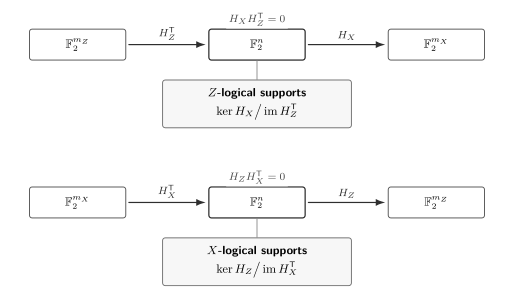
The CSS commutation equation supplies two zero compositions. The middle-space quotients are for -type logical supports and for -type logical supports. This is an algebraic dictionary: it asserts neither a spatial lattice nor a sparse Tanner graph.
Using keeps the displayed maps valid when a check matrix contains dependent rows. The dimensions of the images are the ranks , so the middle homology dimensions still equal . Replacing each check matrix by a full-row-rank basis produces a smaller presentation of the same CSS code with the same middle quotients; it discards the endpoint kernels that record relations among redundant checks.
Redundant rows appear at the ends of these sequences as nontrivial kernels of the transpose maps. They encode relations among checks rather than additional logical qubits. In a repeated-measurement setting such relations can become useful consistency constraints on outcomes, but that temporal use requires a measurement model not contained in the static complex. The middle quotient continues to describe ideal logical Pauli classes even when the endpoint spaces retain every redundant check.
Logical quotients without geometry or sparsity
Section titled “Logical quotients without geometry or sparsity”The middle homology of the first sequence is
while the second gives
This dictionary is useful because many code constructions can be organized by maps whose composition vanishes. It does not, by itself, supply a spatial cellulation, a boundary type, a local check schedule, or a sparse graph.
Surface Code owns the geometry of chains, boundaries, logical strings, detector graphs, and planar patches. Quantum LDPC Codes owns bounded check weight and qubit degree, Tanner graphs, redundant sparse checks, product constructions, asymptotic rate–distance results, and qLDPC-specific decoding and scheduling. A finite CSS matrix can be dense and nonlocal; the equation alone says nothing about low density or hardware locality.
Canonical Owners and Boundaries
Section titled “Canonical Owners and Boundaries”What this page owns and where to continue
Section titled “What this page owns and where to continue”This page owns the general conversion among positive binary check matrices, nested classical codes, normalized coset states, logical quotient spaces, axis distances, ordered CSS syndromes, and the Pauli correctability classification. It also owns the algebraic statement that bitwise CNOT preserves identical CSS blocks and the extra-structure warnings for Hadamard and phase gates.
Stabilizer Formalism retains general Pauli and symplectic algebra, projectors, normalizers, Cliffords, and tableaus. Why Quantum Error Correction Is Possible retains the general exact and approximate correctability theorems. Shor and Steane retain their complete finite code conventions, ledgers, recoveries, distance proofs, and code-specific operations; Five-Qubit Code retains the perfect non-CSS comparison.
Syndrome Measurement owns physical check instruments and detector records; Decoders owns probabilistic logical-class inference; Fault-Tolerant Gates owns protected gadgets and universal completion. Surface Code retains patch geometry and lattice surgery, while Quantum LDPC Codes retains sparsity, Tanner graphs, product families, asymptotics, and architecture evidence.
Color Codes owns 2-colex face checks, colored boundaries, topological logical representatives, and family-specific gate and decoder tradeoffs. Topological Codes owns local-check topology, homological syndromes, and active-versus-passive protection. Subsystem Codes owns gauge centers, bare and dressed logical quotients, gauge-derived syndromes, and Bacon–Shor constructions. This page retains the shared CSS matrix and subspace-code algebra rather than duplicating either specialization.
The same boundary applies to claims about performance. A valid pair and a large algebraic distance do not establish a threshold, decoder runtime, hardware overhead, or experimental advantage. Those claims need a code family, extraction circuit, fault model, decoder, logical task, and evidence at the appropriate layer. Conversely, a hardware demonstration of one CSS block does not redefine the general construction. The matrices and quotients here are the stable interface through which those specialized owners state their additional assumptions.
Exercises
Section titled “Exercises”1. Convert a nested pair into CSS checks
Section titled “1. Convert a nested pair into CSS checks”For the five-qubit fixture, take
and the displayed eight-word
. Construct from a spanning list in which 11110 is deliberately
repeated, construct from a basis of , and determine
. Explain why the repeated physical parity equation may be
recorded but does not encode one fewer logical qubit.
Solution
One permitted matrix is
Every row of lies in , so . The listed row counts are , but the first and third rows of coincide. Hence and
The repeated row does not enlarge and therefore does not add a stabilizer constraint. Measuring it twice could create two noisy records for inference, but the ideal common eigenspace is unchanged. Using in the dimension formula would incorrectly give .
2. Normalize the coset-state basis
Section titled “2. Normalize the coset-state basis”For arbitrary , prove that
is independent of the representative , is normalized, is orthogonal to states from different cosets, and is stabilized by and .
Solution
If with , then permutes , so the two sums are identical. The map is injective, giving distinct orthonormal computational states; the squared norm is therefore . Distinct cosets are disjoint, so their computational supports have zero overlap.
For , sends the summand labeled by to the one labeled by , another permutation of the sum. For ,
because , so gives phase to every summand. The coset states are common eigenstates of all declared checks. Their number is , so they form a full logical basis.
3. Construct paired logical quotient bases
Section titled “3. Construct paired logical quotient bases”Show that the pairing between and is well defined and nondegenerate. Then use and to construct the paired basis for the fixture.
Solution
The pairing is . Adding to does not change it because . Adding to does not change it because . It is therefore well defined on quotient classes.
If an class pairs to zero with every class, its representative is orthogonal to . Hence it belongs to
and is the trivial class. The same argument with sectors exchanged proves nondegeneracy on the other side. Equal quotient dimensions then permit bases with .
For the fixture, both quotients have dimension one. , so the single-row matrices and already satisfy the required identity.
4. Rebuild the unequal-matrix detection fixture
Section titled “4. Rebuild the unequal-matrix detection fixture”Starting only from the four generators
reconstruct , verify commutation and ranks, find and , and derive the two logical basis states and both axis distances.
Solution
Reading supports gives
The four cross inner products vanish, and each matrix has rank two. Thus . Spanning the rows gives
Solving adds the coset
Uniform normalized sums over these two cosets give the displayed and . The supports and represent nontrivial paired logical and operators of weight two. Direct kernel enumeration finds no weight-one nontrivial class in either quotient, so .
5. Diagnose a same-syndrome logical collision
Section titled “5. Diagnose a same-syndrome logical collision”Reconstruct the complete sixteen-entry identity-plus-single-Pauli ledger from the columns of . Then compare with and with . Apply the Pauli-specialized Knill–Laflamme condition to explain why the complete weight-one Pauli set is not correctable even though every nonidentity member has nonzero syndrome.
Solution
Identity gives 00|00. The five rows copy the ordered columns of
into the first half:
The five rows copy the columns of into the second half:
Each row concatenates the corresponding two columns. This reconstructs all sixteen rows in the displayed order and gives twelve occupied sectors: identity, three pure-, three pure-, and five mixed sectors.
The two errors both have syndrome , while the two errors both have syndrome . Their pairwise products are
Both products commute with every stabilizer, as equality of syndromes requires, but neither belongs to the stabilizer. They act nontrivially on the logical qubit. Consequently is a logical Pauli restricted to the code rather than a scalar multiple of .
In this fixture every nonidentity weight-one Pauli has nonzero syndrome, so each is detectable. More generally, a stabilizer error has zero syndrome but is also detectable in the Knill–Laflamme sense because it acts scalarly on the code. Correction of an entire set additionally requires every pair either to have distinct syndromes or to differ by a stabilizer. These repeated sectors fail that pairwise condition, consistently with distance two.
6. Retain correlations between CSS syndrome halves
Section titled “6. Retain correlations between CSS syndrome halves”For the one-qubit prior
compute the marginal probabilities that the binary and components are present. Compare the product of those marginals with the true joint probability, and state what this does and does not imply about CSS decoding.
Solution
The component is present for physical or , so its marginal is
The component is present for or , giving
If the components were independent, their joint probability would be . The actual joint event is physical , with probability . The product model understates it by a factor .
Nothing is wrong with the CSS equations and ; they remain exact. What fails is the extra factorized prior. Separate decoders are optimal only under appropriate noise and decision assumptions. A general decoder should retain joint information and sum probabilities over stabilizer-equivalent physical representatives when comparing logical classes.
7. Test algebraic transversal operations
Section titled “7. Test algebraic transversal operations”Prove that bitwise CNOT preserves two identical CSS blocks. Then decide what bare tensorwise Hadamard and phase gates do to the five-qubit fixture, and explain why none of these algebraic calculations alone establishes a fault-tolerant universal gate set.
Solution
Under bitwise CNOT, a control becomes on both blocks and a target becomes on both blocks. These products remain in the joint stabilizer, while target and control remain unchanged. The logical cosets transform as , so paired quotient bases see logical CNOT.
Hadamard swaps the two row spaces. The fixture has
, so bare
does not preserve its exact stabilizer. Tensorwise maps
to . The first support
11110 has weight four and lies in , but the second,
00111, has weight three and is not in . Its image
therefore fails both the required -support containment and the positive
stabilizer phase/sign condition. Bare does not preserve the
fixture.
Even a preserving tensor product must be audited under faults, ancillas, measurements, and recovery. Eastin–Knill also forbids a universal transversal unitary set under its assumptions. Algebraic normalization, fault tolerance, and universality are three distinct claims.
8. Audit a chain complex and its ownership boundary
Section titled “8. Audit a chain complex and its ownership boundary”For general , verify both zero compositions, identify the two middle homologies, and list one additional assumption needed to infer each of: geometric locality, a qLDPC presentation, and a physical extraction circuit.
Solution
The CSS equation gives
and transposition gives
Therefore the middle homologies are
No geometry follows without an embedding or cellulation that assigns the binary coordinates and maps to spatial objects. No qLDPC claim follows without a family of presentations having uniformly bounded row and column weights. No extraction circuit follows without ancillas, a gate schedule, preparation and measurement conventions, and a fault model. The chain complex captures zero composition and logical quotients; Surface Code, Quantum LDPC Codes, and Syndrome Measurement own those three additional layers respectively.
References
Section titled “References”- A. R. Calderbank and P. W. Shor, “Good quantum error-correcting codes exist,” Physical Review A 54, 1098–1105 (1996), doi:10.1103/PhysRevA.54.1098.
- B. Eastin and E. Knill, “Restrictions on transversal encoded quantum gate sets,” Physical Review Letters 102, 110502 (2009), doi:10.1103/PhysRevLett.102.110502.
- D. Gottesman, Stabilizer Codes and Quantum Error Correction, Ph.D. thesis, California Institute of Technology (1997), doi:10.7907/rzr7-dt72, arXiv:quant-ph/9705052.
- E. Knill and R. Laflamme, “Theory of quantum error-correcting codes,” Physical Review A 55, 900–911 (1997), doi:10.1103/PhysRevA.55.900.
- F. J. MacWilliams and N. J. A. Sloane, The Theory of Error-Correcting Codes, North-Holland Mathematical Library 16, North-Holland, Amsterdam (1977), ISBN 978-0-444-85009-6.
- M. A. Nielsen and I. L. Chuang, Quantum Computation and Quantum Information, 10th Anniversary ed., Cambridge University Press (2010), doi:10.1017/CBO9780511976667.
- A. M. Steane, “Error correcting codes in quantum theory,” Physical Review Letters 77, 793–797 (1996), doi:10.1103/PhysRevLett.77.793.
- A. M. Steane, “Simple quantum error-correcting codes,” Physical Review A 54, 4741–4751 (1996), doi:10.1103/PhysRevA.54.4741.