Cat Codes
A cat code encodes logical information in coherent states related by discrete phase-space rotations, or in superpositions of those coherent components. The separation of the components suppresses some transitions, while number-parity or rotation sectors organize the effect of photon loss.
The name covers two constructions that must be distinguished:
- a two-component stabilized cat qubit uses the approximately orthogonal states and as a biased logical basis; one photon loss acts approximately as a logical phase flip and is not corrected inside that two-dimensional manifold;
- a multi-component loss-correcting cat code places the code in selected rotation sectors, so one or more losses move the state into orthogonal syndrome sectors that can be recovered.
Both exploit coherent-state geometry, but they make different claims. Bosonic Codes owns the common channel–code–recovery formalism and Knill–Laflamme conditions. Bosonic Qubits owns physical oscillators, nonlinear ancillas, pumps, measurement chains, and the experimental evidence record.
Quantum Error Correction and Fault Tolerance treats a cat code as one declared oscillator-family choice inside a complete protection record; this page retains coherent-state encodings, parity and stabilization conventions, loss and dephasing tradeoffs, recovery, logical gates, variants, evidence, and resources.
Coherent Components and Parity Cats
Section titled “Coherent Components and Parity Cats”A coherent state is an eigenstate of the annihilation operator:
Opposite coherent states have overlap
They become nearly orthogonal as the mean occupation grows, but they are never exactly orthogonal at finite amplitude.
The normalized even and odd cats are
where
For number parity
the code states obey
Their Fock expansions make the sector structure explicit:
The cats are exactly orthogonal because their number parities differ, even though their coherent components overlap.
Loss swaps parity
Section titled “Loss swaps parity”Using ,
The corresponding mean occupations are
At large , both approach and the two loss amplitudes approach . At finite amplitude they differ, so the environment gains a small amount of logical information from the loss rate. This is one source of approximate rather than exact correction.
State the Logical-Basis Convention
Section titled “State the Logical-Basis Convention”The same physical manifold supports two common logical conventions. They interchange the words “bit flip” and “phase flip.”
| convention | logical basis | parity acts as | one loss acts approximately as |
|---|---|---|---|
| parity basis | $ | 0_L\rangle= | C_\alpha^+\rangle |
| coherent basis | $ | 0_L\rangle=( | C_\alpha^+\rangle+ |
The coherent-basis states are exactly orthonormal and approach and exponentially quickly with . In that basis,
The approximations become accurate when the overlap is small. A paper or experiment that reports a “bit-flip lifetime” without defining its logical basis leaves the physical claim ambiguous.
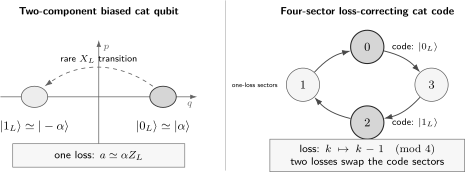
Two uses of cat-state geometry. In the coherent basis, the separated and components form a noise-biased two-component qubit: local faults rarely move between the wells, while one loss acts approximately as . A four-sector code stores logical states in number classes and modulo ; one loss moves them into distinct odd syndrome sectors, while two losses return to the even sectors with a logical ambiguity.
Two-Component Stabilized Cat Qubits
Section titled “Two-Component Stabilized Cat Qubits”Choose the coherent logical basis. The computational states occupy separated regions of phase space:
For a low-degree local oscillator operator , the off-diagonal matrix element typically contains the coherent-state overlap:
Faults that must transfer the state between the two distant components can therefore be exponentially suppressed with cat size under the assumed local noise model. Photon loss behaves differently:
Within the coherent logical basis it records opposite phases and hence acts approximately as . The event rate scales with occupation,
for single-photon decay rate . Increasing the cat size can therefore suppress logical transitions while increasing exposure to logical events. The result is a tunable noise bias, not simultaneous suppression of both Pauli directions.
A useful bias ratio is
but its value is meaningful only after specifying the operation, duration, Pauli-frame convention, leakage treatment, and whether the probabilities come from a Pauli-twirled or full logical channel.
Two-photon dissipative confinement
Section titled “Two-photon dissipative confinement”An idealized two-photon stabilization process uses the jump operator
and master equation
Because
the span of and is a dark manifold. The engineered process damps excursions transverse to that manifold while preserving coherent superpositions inside it in the ideal model.
Single-photon loss is not removed by . It acts within the dark manifold as the dominant logical phase error. Additional dephasing, pump noise, ancilla faults, and terms that break the symmetry can also spoil the ideal bias.
Kerr confinement
Section titled “Kerr confinement”A two-photon-driven Kerr oscillator is commonly described in a rotating frame by
Up to drive-phase and sign conventions, its semiclassical fixed points lie near with . The Kerr and two-photon terms open a spectral separation between the cat manifold and many leakage states. This Hamiltonian confinement can support fast gates without a continuously monitored syndrome.
Hamiltonian and dissipative stabilization are not interchangeable:
- dissipative confinement is governed by a Liouvillian gap and a steady-state manifold;
- Kerr confinement is governed by quasienergy structure and drive-induced dynamics;
- hybrid schemes use both and inherit faults from both.
The protection gap does not automatically make every gate bias preserving. Control waveforms can cross the phase-space barrier, populate leakage states, or convert a dominant fault into an component.
What is autonomously corrected?
Section titled “What is autonomously corrected?”In the coherent-basis convention, the stabilization continuously suppresses some bit-flip-producing excursions and leakage. It does not infer and undo each single-photon loss. An outer repetition or topological code is still needed if the accumulated phase flips must be corrected.
Calling the two-component qubit “autonomously error corrected” is therefore acceptable only with the corrected error set stated explicitly. It is misleading if read as correction of arbitrary logical noise.
Four-Component Loss-Correcting Cat Codes
Section titled “Four-Component Loss-Correcting Cat Codes”A four-component cat code uses four coherent points related by quarter rotations:
It is cleaner to define the code by rotation sectors rather than by pictures of those four points. Let
and define the projector onto number class modulo four:
The normalized sector cats are
Equivalently,
Choose the code space
The codewords are exactly orthogonal because their Fock supports occupy different residue classes.
One loss leaves the code space coherently
Section titled “One loss leaves the code space coherently”Since annihilation lowers number by one,
with sector labels understood modulo four. Therefore
The logical basis states move as
Both outputs have odd parity, remain mutually orthogonal, and preserve the logical amplitudes. A parity syndrome can reveal that an odd number of losses occurred without resolving whether the state occupies sector or . A coherent recovery then maps the entire odd error subspace back to the even code subspace.
At finite , the factors and are not generally equal. The leading loss probabilities therefore retain a small logical-state dependence. The four-component code approaches the single-loss Knill–Laflamme conditions as the coherent components separate, but it is an approximate finite-energy code.
Two losses create a logical ambiguity
Section titled “Two losses create a logical ambiguity”Applying shifts sectors by two:
Up to unequal finite-amplitude factors, two untracked losses act as a logical . Parity has returned to even, so a final parity measurement cannot distinguish two losses from no loss. The code corrects one loss between reliable syndrome updates; it does not correct an arbitrary number of losses merely because every loss flips parity.
Repeated monitoring can time-resolve a sequence of parity changes. Its effective distance then depends on missed detections, false parity flips, ancilla relaxation, measurement cadence, and how faults propagate through the syndrome circuit.
No-jump shrinkage also needs recovery
Section titled “No-jump shrinkage also needs recovery”Under pure loss, the no-jump operator attenuates the components. Up to a state-independent prefactor,
Thus even a trajectory with no detected jump moves the code toward a smaller cat. A complete recovery may need to restore amplitude or deform the code manifold while preserving logical coherence. Counting parity flips alone is not a complete finite-time channel model.
Higher Rotation-Symmetric Cat Codes
Section titled “Higher Rotation-Symmetric Cat Codes”For coherent components, define
Sector cats have Fock support on one number class modulo . A common logical choice uses sectors separated by :
Each loss shifts both sectors by one. The number distance measures how many sector shifts separate the logical supports. Increasing it creates more distinguishable loss sectors, but also requires more coherent components and more demanding preparation, stabilization, and logical control.
Sector separation is only part of correctability. The Knill–Laflamme products
must also be approximately logical-state independent for the corrected values of and . Finite coherent-state overlap and unequal number moments set the residual error. The abstract rotation symmetry does not erase those finite-energy effects.
There is a complementary angular distance in phase space. Widely separated coherent components suppress local transitions between logical regions, while a larger number of components reduces the angular spacing between neighbors. Cat-code design balances number-sector resolution against phase-space separation.
Recovery Architectures
Section titled “Recovery Architectures”Active parity tracking
Section titled “Active parity tracking”An active cycle commonly contains
- a quantum-nondemolition parity mapping to an ancilla;
- ancilla measurement and reset;
- inference of whether a loss occurred;
- a corrective map or tracked logical-frame update;
- amplitude restoration or code-manifold refresh.
Let be the parity record at cycle . A decoder should infer a loss history from the full record
not assume every observed sign change is a physical photon loss. Readout errors produce isolated parity inconsistencies; an ancilla fault can propagate into the oscillator; and two losses inside one interval may leave the same final parity as no loss.
The recovered logical channel must include all of these paths. A trajectory plot conditioned on correctly identified jumps is not by itself an unconditional memory benchmark.
Autonomous multi-photon stabilization
Section titled “Autonomous multi-photon stabilization”A -photon process with idealized jump operator
has the coherent points
as dark states. This can confine a multi-component manifold while parity or modular-number monitoring supplies loss information. High-order nonlinear processes are difficult to engineer cleanly, and lower-order parasitic terms can break the intended rotation symmetry.
Autonomous confinement and active syndrome extraction can be combined. Their error channels must be combined as well.
Teleportation and dissipative recovery
Section titled “Teleportation and dissipative recovery”Recovery can also be implemented by teleporting the logical state into a fresh cat manifold, coupling to an engineered reservoir, or measuring a generalized rotation syndrome. These approaches may restore amplitude and remove entropy without a direct unitary inverse of .
A trace-decreasing successful branch must report its acceptance probability. Conditional fidelity alone cannot be compared with a deterministic recovery.
Logical Operations and Bias Preservation
Section titled “Logical Operations and Bias Preservation”For the two-component coherent basis, useful projected relations are
They suggest physical controls, but a projected identity is not a fault-tolerance proof. A drive that implements the correct code-space rotation can transiently leave the cat manifold and create unsuppressed bit flips.
A gate is bias preserving when dominant phase-type faults before, during, and after the operation remain predominantly phase type at the output. For a controlled gate, this includes propagation between control and target. If a single fault can become a substantial component, the outer repetition code loses the advantage supplied by the idle noise bias.
Bias-preserving operations can use
- adiabatic or holonomic deformation of the stabilized manifold;
- phase-space rotations whose geometric phase implements a logical action;
- engineered couplings that commute with the dominant logical error;
- teleportation through cat-code resource states;
- error-transparent Hamiltonians designed for a declared fault set.
Every implementation must be evaluated with stabilization active, realistic leakage levels, and the same control bandwidth used in the architecture.
Why an outer code is still needed
Section titled “Why an outer code is still needed”A two-component cat qubit can make
A repetition code in the appropriate basis can then correct the dominant errors with comparatively low connectivity. It does not correct the rare faults, so the architecture succeeds only while those faults remain sufficiently suppressed through preparation, measurement, idling, and all logical gates.
More general biased-noise topological codes can protect both directions while exploiting the asymmetry. The relevant input is the complete circuit-level logical channel of the cat module, not one isolated lifetime ratio.
Comparing Cat-Code Variants
Section titled “Comparing Cat-Code Variants”| variant | internal protection claim | dominant information still needed | characteristic cost |
|---|---|---|---|
| two-component dissipative cat | confines the $ | \pm\alpha\rangle$ manifold and suppresses selected transitions | outer correction of accumulated phase flips |
| Kerr-cat qubit | spectrally confines a coherent-state doublet and supports driven gates | bias-preserving control and leakage management | nonlinear oscillator, two-photon drive, quasienergy calibration |
| four-component cat code | detects and approximately corrects one loss per reliable syndrome interval | repeated parity record and amplitude restoration | more components, active ancilla, missed-jump risk |
| higher rotation cat code | separates more loss sectors in number modulo | matched number moments and higher-order recovery | high-order stabilization and denser phase-space components |
These rows describe ideal organizing principles. A device can combine Kerr and dissipative confinement, active parity tracking, and an outer stabilizer code. Its name does not determine its logical channel.
Resource and Performance Ledger
Section titled “Resource and Performance Ledger”Increasing changes several quantities at once:
An optimal cat size is therefore finite and hardware dependent. It depends on the loss rate, dephasing spectrum, confinement strength, gate set, syndrome fidelity, outer code, and target workload.
A serious report should include
- the logical-basis convention and cat amplitude;
- mean occupation and its distribution;
- the full logical process matrix or at least both Pauli directions;
- leakage and return-to-manifold probability;
- stabilization mechanism and gap;
- operation and syndrome durations;
- ancilla, pump, and measurement faults;
- acceptance probability and decoder policy;
- scaling across cat size or outer-code distance.
The Error-Correction Case Studies page owns dated experimental break-even claims. This page supplies the code language needed to interpret them.
Common Mistakes
Section titled “Common Mistakes”Treating every cat code as the same code
Section titled “Treating every cat code as the same code”A two-component biased qubit, a four-component loss-correcting code, and a higher rotation code have different code spaces, syndromes, and logical channels. State the component number and logical basis.
Calling coherent components exactly orthogonal
Section titled “Calling coherent components exactly orthogonal”is small, not zero. Parity cats are exactly orthogonal because they occupy disjoint Fock sectors.
Saying photon loss is suppressed by cat size
Section titled “Saying photon loss is suppressed by cat size”The physical loss-event rate grows approximately as . In a two-component coherent basis, loss becomes the dominant logical phase fault. What can be exponentially suppressed is the opposite logical transition under a suitable local-noise model.
Confusing parity tracking with arbitrary loss correction
Section titled “Confusing parity tracking with arbitrary loss correction”Parity reveals loss number modulo two. Two unobserved losses return parity to its original value, and a faulty parity circuit can create errors of its own.
Omitting the no-jump branch
Section titled “Omitting the no-jump branch”Finite-time attenuation shrinks coherent amplitudes even when no jump is detected. A jump-only trajectory model is not the full channel.
Equating a dark manifold with a fault-tolerant qubit
Section titled “Equating a dark manifold with a fault-tolerant qubit”Engineered dissipation can confine states while single-photon loss acts logically inside the manifold. Preparation, gates, readout, and coupling to other modules must preserve the intended bias.
Quoting one lifetime as full logical performance
Section titled “Quoting one lifetime as full logical performance”A long bit-flip time can coexist with a much shorter phase-flip time. Report both logical axes or the complete logical channel.
Using an outer repetition code without auditing rare faults
Section titled “Using an outer repetition code without auditing rare faults”A repetition code corrects the dominant Pauli direction only. Rare bias-breaking errors, leakage, and correlated events can set the architecture floor.
Exercises
Section titled “Exercises”1. Normalize the parity cats
Section titled “1. Normalize the parity cats”Starting from
derive and verify that the even and odd cats are orthogonal.
Solution
Let . Then
Therefore
Their overlap is
The cancellation is exact and is equivalent to the separation into even and odd number parity.
2. Derive the mean occupations
Section titled “2. Derive the mean occupations”Show that
and obtain the corresponding odd-cat result.
Solution
Using
and ,
For the odd cat, the cross terms change sign:
3. Translate a loss between conventions
Section titled “3. Translate a loss between conventions”At large , take
Show that this is in the parity basis and in the coherent basis.
Solution
In the parity basis,
so swaps logical zero and one and therefore acts as .
In the coherent basis,
Swapping the parity cats leaves invariant and changes the sign of . Thus acts as in that basis.
4. Verify the sector projector
Section titled “4. Verify the sector projector”For
show that vanishes unless modulo four.
Solution
Since
we have
The finite geometric sum equals four when is divisible by four and zero otherwise. Hence projects onto the desired residue class.
5. Track losses modulo four
Section titled “5. Track losses modulo four”Starting with logical sectors and , list the sector pair after zero, one, two, three, and four losses. Which loss counts can final parity alone distinguish?
Solution
Each loss subtracts one modulo four:
| losses | logical-zero branch | logical-one branch | parity |
|---|---|---|---|
| even | |||
| odd | |||
| even | |||
| odd | |||
| even |
Final parity distinguishes only even from odd loss count. It cannot distinguish zero from two or four losses, nor one from three. Time-resolved repeated parity measurements can supply more information if changes are not missed.
6. Optimize a toy cat size
Section titled “6. Optimize a toy cat size”Suppose the per-operation bit-flip contribution is
and the phase-flip contribution is
with . Find the cat size that minimizes when the optimum lies at .
Solution
Differentiate:
The stationary point satisfies
so
This is positive only when ; otherwise the toy objective is minimized at the smallest allowed cat size. The model illustrates why increasing separation indefinitely is not optimal when loss grows with occupation.
7. Two-loss probability between parity checks
Section titled “7. Two-loss probability between parity checks”Assume independent photon losses form a Poisson process with mean
between parity checks. Expand the probability of two or more losses through leading order in .
Solution
For a Poisson process,
Expanding,
and therefore
Shorter intervals suppress this contribution, but more frequent parity checks increase exposure to measurement and ancilla faults.
8. Three-cat outer repetition code
Section titled “8. Three-cat outer repetition code”Three two-component cat qubits each suffer an independent phase flip with probability and a rare bit flip with probability . A three-bit repetition code corrects one phase flip. Find the leading logical phase-failure probability and the leading probability that at least one uncorrected bit flip occurs.
Solution
The repetition decoder fails on two or three phase flips:
Thus the dominant phase error is reduced from first to second order.
The repetition code does not protect the orthogonal Pauli direction. The probability of at least one bit flip is
The architecture gains only while the cat bias makes sufficiently small through every operation, not merely during idle storage.
References
Section titled “References”- P. T. Cochrane, G. J. Milburn, and W. J. Munro, “Macroscopically distinct quantum-superposition states as a bosonic code for amplitude damping,” Physical Review A 59, 2631–2634 (1999), doi:10.1103/PhysRevA.59.2631.
- M. Mirrahimi et al., “Dynamically protected cat-qubits: a new paradigm for universal quantum computation,” New Journal of Physics 16, 045014 (2014), doi:10.1088/1367-2630/16/4/045014.
- Z. Leghtas et al., “Confining the state of light to a quantum manifold by engineered two-photon loss,” Science 347, 853–857 (2015), doi:10.1126/science.aaa2085.
- N. Ofek et al., “Extending the lifetime of a quantum bit with error correction in superconducting circuits,” Nature 536, 441–445 (2016), doi:10.1038/nature18949.
- S. Puri, S. Boutin, and A. Blais, “Engineering the quantum states of light in a Kerr-nonlinear resonator by two-photon driving,” npj Quantum Information 3, 18 (2017), doi:10.1038/s41534-017-0019-1.
- V. V. Albert et al., “Performance and structure of single-mode bosonic codes,” Physical Review A 97, 032346 (2018), doi:10.1103/PhysRevA.97.032346.
- S. Puri et al., “Stabilized cat in a driven nonlinear cavity: a fault-tolerant error syndrome detector,” Physical Review X 9, 041009 (2019), doi:10.1103/PhysRevX.9.041009.
- J. Guillaud and M. Mirrahimi, “Repetition cat qubits for fault-tolerant quantum computation,” Physical Review X 9, 041053 (2019), doi:10.1103/PhysRevX.9.041053.
- A. L. Grimsmo, J. Combes, and B. Q. Baragiola, “Quantum computing with rotation-symmetric bosonic codes,” Physical Review X 10, 011058 (2020), doi:10.1103/PhysRevX.10.011058.
- R. Lescanne et al., “Exponential suppression of bit-flips in a qubit encoded in an oscillator,” Nature Physics 16, 509–513 (2020), doi:10.1038/s41567-020-0824-x.
- A. Grimm et al., “Stabilization and operation of a Kerr-cat qubit,” Nature 584, 205–209 (2020), doi:10.1038/s41586-020-2587-z.
- S. Puri et al., “Bias-preserving gates with stabilized cat qubits,” Science Advances 6, eaay5901 (2020), doi:10.1126/sciadv.aay5901.
- A. S. Darmawan, B. J. Brown, A. L. Grimsmo, D. K. Tuckett, and S. Puri, “Practical quantum error correction with the XZZX code and Kerr-cat qubits,” PRX Quantum 2, 030345 (2021), doi:10.1103/PRXQuantum.2.030345.
- J. Hastrup and U. L. Andersen, “All-optical cat-code quantum error correction,” Physical Review Research 4, 043065 (2022), doi:10.1103/PhysRevResearch.4.043065.
- C. Chamberland et al., “Building a fault-tolerant quantum computer using concatenated cat codes,” PRX Quantum 3, 010329 (2022), doi:10.1103/PRXQuantum.3.010329.
- U. Réglade et al., “Quantum control of a cat qubit with bit-flip times exceeding ten seconds,” Nature 629, 778–783 (2024), doi:10.1038/s41586-024-07294-3.
Further Connections
Section titled “Further Connections”- Bosonic Codes supplies exact and approximate recovery conditions, energy constraints, and the common oscillator error algebra.
- Coherent States in Phase Space develops coherent-state overlap, displacement, rotation, and phase-space geometry without the error-correction specialization.
- Erasure and Loss Channels derives finite-time attenuation and distinguishes unflagged loss from a located erasure.
- Control, Readout, and Calibration develops the measurement, reset, feedback, and drift loop required by active parity tracking.
- Fault-Tolerant Quantum Computing Frontier compares concatenated cat proposals with other architectures under a common systems evidence standard.