Grover Search
Short Definition
Section titled “Short Definition”Grover search finds a marked input of an otherwise unstructured Boolean function using quadratically fewer oracle queries than classical search. If of candidates are marked, then, under the standard coherent-query model, a marked candidate can be found with constant success probability using
queries when . The algorithm alternates two reflections. Their product is a rotation from the uniform initial state toward the marked subspace.
This is the canonical home for the search problem, its exact success formula, and its oracle optimality. Algorithmic Primitives owns the broader pattern language of coherent access, interference, and amplitude amplification. Amplitude Amplification generalizes the construction to arbitrary coherent preparations and good subspaces, with explicit inverse/reflection ledgers and known-, unknown-, exact-, and fixed-point schedule regimes.
The Search Problem
Section titled “The Search Problem”Let
be a predicate available through an oracle. An input is marked when . Write
The task is to output any marked . A complete problem statement must say what is promised about :
- If , there is no valid output.
- If , every output is valid and no search is needed.
- If , the nontrivial task is to increase the probability of observing the marked subset.
- If is known, the iteration count can be chosen near optimally.
- If is unknown, a randomized schedule, counting procedure, or fixed-point construction is needed to avoid systematic over-rotation.
The word unstructured is essential. Apart from querying , the labels carry no exploitable geometry, ordering, algebraic promise, or correlation. Grover search is therefore not binary search on sorted data and not a claim that an ordinary classical database can be searched coherently at unit cost.
Fair classical comparison
Section titled “Fair classical comparison”Sampling a uniformly random candidate succeeds with probability . Independent repetition therefore needs order predicate evaluations for constant success probability. A classical algorithm can avoid repeated candidates, but the asymptotic query complexity remains
for . Grover search changes this to quantum queries. This is a quadratic improvement in the size of the search space, not an exponential one.
Oracle Conventions
Section titled “Oracle Conventions”Two oracle forms are common. The bit oracle acts on an input register and one target qubit:
The clean XOR-to-phase conversion, required minus ancilla, target-return test, and distinction between one abstract query and its implementation cost belong to Phase Kickback. Once that interface is licensed, Grover search uses the resulting phase oracle
Let project onto the marked subspace. Then
Thus the oracle is a reflection: it reverses marked amplitudes and leaves unmarked amplitudes unchanged.
What one query hides
Section titled “What one query hides”Quantum Oracles owns the Boolean access interface, query-domain and encoding promises, full-space action, distinction between a query and its implementation, and oracle-specific fair comparator. This page begins from that fixed record and owns the marked-set promise, search dynamics, stopping rule, success probability, and optimal search-query bound.
In the black-box model, one application of counts as one query regardless of its gate decomposition. In an implementation, however, the predicate may require arithmetic, memory access, comparison, workspace, and error correction. Reversible Computation owns that compute–phase–uncompute workspace contract. The gate cost of that entire procedure must be reported separately from the query count.
The distinction is central. An oracle theorem can be mathematically optimal while an application built from an expensive oracle is impractical. Circuit Model develops the corresponding input-output and resource contracts.
Symmetry Reduces the Dynamics to Two Dimensions
Section titled “Symmetry Reduces the Dynamics to Two Dimensions”Start in the uniform superposition
For , define normalized states in the marked and unmarked subspaces:
They are orthonormal. Introduce an angle by
The initial state becomes
Both the phase oracle and the diffusion operation preserve the plane spanned by and . The full -dimensional calculation therefore collapses to a planar rotation. Equal amplitudes within each class remain equal throughout the ideal algorithm.
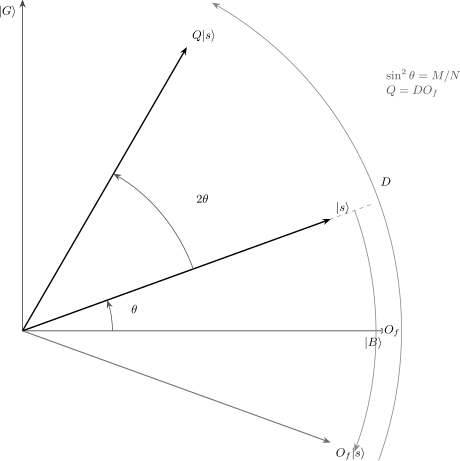
The oracle reflects across the unmarked axis. Reflection about then produces , advancing the state toward by .
Two Reflections Make One Grover Iterate
Section titled “Two Reflections Make One Grover Iterate”The diffusion operator is
It fixes and reverses every vector orthogonal to , so it is reflection about the initial-state axis. One Grover iterate is
In the ordered basis ,
Although the last matrix depends on the chosen coordinate ordering, its action is unambiguous. Write
Each iterate advances the state-angle parameter by toward the marked axis.
Inversion about the mean
Section titled “Inversion about the mean”For , the diffusion operator can be written
If a state has computational-basis amplitudes and mean amplitude
then maps
This explains the traditional name inversion about the mean. It is the same reflection as , expressed component by component. The reflection picture is usually safer than memorizing a circuit sign convention, because multiplying either reflection by an overall phase does not change measurement probabilities.
Exact Success Probability
Section titled “Exact Success Probability”The initial state has angle in the good–bad plane. After Grover iterations,
Measuring in the computational basis therefore returns a marked input with probability
Conditioned on success, each of the marked labels is equally likely in the symmetric version of the algorithm.
Choosing the stopping time
Section titled “Choosing the stopping time”The first probability maximum occurs when
Choose the nonnegative integer nearest to
Rounding changes the final angle by at most , giving
when this first-maximum prescription applies. For a sparse marked set,
so
The probability is oscillatory. Continuing past the optimum rotates amplitude away from the marked subspace. More iterations are not automatically better.
Worked Examples
Section titled “Worked Examples”One marked item among four
Section titled “One marked item among four”For and ,
One iteration gives
This is the smallest familiar example in which the standard -phase reflections land exactly on the marked axis.
One marked item among eight
Section titled “One marked item among eight”For and ,
The nearest stopping time is , and
A third iteration would overshoot:
The comparison makes the coherent rotation, and the need to stop deliberately, concrete.
Multiple or Unknown Marked Inputs
Section titled “Multiple or Unknown Marked Inputs”When is known, the same analysis applies with . More marked inputs mean a larger initial angle and fewer iterations. If , direct measurement already succeeds with probability greater than one half; standard repeated Grover rotations are no longer the useful regime.
When is unknown, a stopping time optimized for the wrong value can fail badly. Boyer, Brassard, Høyer, and Tapp gave an expected-optimal strategy:
- choose an iteration count uniformly from a growing range;
- apply that many Grover iterates;
- measure and verify the candidate;
- enlarge the range geometrically after failure, up to order .
For , this finds a marked item using expected
queries without knowing in advance. Verification is important because each run is probabilistic. If is allowed, a bounded search budget and an explicit no-solution error guarantee are also required; repeated failure alone is not a proof that no solution exists.
Two related approaches serve different contracts:
- Quantum counting uses Amplitude Estimation to estimate the marked fraction through Grover eigenphases; that page owns numerical estimation, while this page retains marked-item search, stopping, and search-specific optimality.
- Fixed-point search replaces the two reflections by designed phase shifts. Given a lower bound on the marked fraction, it can suppress failure monotonically without sacrificing quadratic query scaling, at the cost of a longer phase sequence.
For known , phase-adjusted final iterations can also make the success probability exactly one. These variants modify the basic reflection schedule; they do not invalidate the simple formula for the standard iterate.
Where the Quadratic Speedup Lives
Section titled “Where the Quadratic Speedup Lives”The Quantum Algorithms and Complexity chapter guide supplies the complete claim record needed to distinguish this coherent-query theorem from an end-to-end runtime or application claim.
The speedup is a theorem about coherent oracle queries. A useful resource ledger separates at least four costs:
| Resource | Ideal search accounting | Implementation question |
|---|---|---|
| predicate calls | How many logical gates implement one reversible predicate? | |
| diffusion steps | one per Grover iterate | What is the cost of the multi-controlled phase and state preparation? |
| qubits | enough to label candidates, plus workspace | Can temporary data be uncomputed without excessive ancillas? |
| repetitions | constant for constant target success | What verification and confidence amplification are required? |
If one oracle evaluation costs logical gates, the leading gate count is at least of order
before accounting for diffusion, synthesis, routing, and fault tolerance. Universal Gate Sets explains why an abstract reflection may expand into many native or fault-tolerant operations.
State preparation matters too. The uniform state is easy when , but an application may require a constrained superposition over valid candidates. If preparing or reflecting about that state is expensive, the end-to-end advantage can shrink or disappear.
Optimality in the Oracle Model
Section titled “Optimality in the Oracle Model”The quadratic scaling is not merely the performance of one clever circuit. It is optimal for unstructured black-box search.
Bennett, Bernstein, Brassard, and Vazirani used a hybrid argument to show that finding one marked item with bounded error requires
quantum queries. The argument tracks how little one query can separate states associated with different hidden marked inputs. Boyer and collaborators sharpened the analysis and treated multiple solutions and unknown . Zalka then established a matching optimal bound for any prescribed success probability; for one marked item and near-certain success, the leading query count is .
The corresponding bound with marked inputs is
through the nontrivial sparse regime. No generic quantum algorithm can asymptotically beat Grover search while receiving only the same unstructured oracle access.
Parallel queries do not turn the square-root law into linear parallel speedup. With processors or parallel queries per round, partitioning the candidates gives order
query rounds, and the oracle lower bounds rule out a parametrically better generic strategy. Parallel hardware changes depth and total work differently.
Optimality here does not prove that every problem encoded as a search must take Grover time. An encoding may have algebraic, geometric, or probabilistic structure that supports a different algorithm. The lower bound applies when that structure is withheld and only black-box marking remains.
Query Complexity develops the general polynomial, adversary, and hybrid lower-bound methods and compatible Boolean block-composition statements. This page retains the unstructured-search theorem, its finite success law, and the search-specific constants above.
Applications and Limitations
Section titled “Applications and Limitations”Exhaustive preimage and key search
Section titled “Exhaustive preimage and key search”If a candidate key or preimage can be checked reversibly, Grover search reduces an ideal search over candidates from order checks to order coherent checks. For a -bit search space, this is
which remains exponential in . Concrete cryptanalytic cost also depends on reversible implementation, circuit depth, fault-tolerant overhead, the number of targets, and available parallel hardware. “Quadratic speedup” is not synonymous with “easy attack.”
Minimum finding
Section titled “Minimum finding”The Dürr–Høyer algorithm repeatedly searches for an item smaller than a changing threshold and finds the minimum of an unstructured list in value queries with bounded error. Grover search is the inner primitive, but threshold updates and probabilistic analysis are part of the complete algorithm.
Constraint satisfaction
Section titled “Constraint satisfaction”A Boolean constraint checker can mark satisfying assignments, giving a square-root improvement over naive exhaustive enumeration. For binary variables, however, and the query count is still
Problem-specific classical pruning or quantum algorithms that exploit structure may be more relevant. Grover search supplies a baseline, not a universal solution to combinatorial optimization or NP-complete problems.
Quantum Algorithms for Optimization owns the cross-route comparison among minimum finding, structured tree search, QAOA-like methods, adiabatic and annealing methods, and convex-oracle algorithms after the optimization contract is fixed; this page retains the exact unstructured-search rotation and oracle-optimality theorem.
A database is not automatically an oracle
Section titled “A database is not automatically an oracle”The original phrase “database search” is easy to misread. Grover’s model assumes coherent access to a predicate over address states. Loading an arbitrary classical data set into quantum-addressable memory, maintaining coherence, and implementing a reversible comparison can dominate the search. If the data must first be streamed through a classical interface, the query advantage may not translate into wall-clock advantage.
Measurement returns one candidate
Section titled “Measurement returns one candidate”The uniform superposition does not expose all database entries at once. The algorithm shapes one measurement distribution so that a marked label is likely. Listing all solutions requires additional queries and repeated runs; it is a different output contract.
Common Mistakes
Section titled “Common Mistakes”- Calling the result an exponential speedup because the register has qubits. The query count is still exponential in .
- Counting a complicated reversible predicate as one elementary gate. It is one oracle query, not necessarily one physical operation.
- Forgetting that must act coherently on superpositions and preserve relative phase.
- Applying iterations when there are marked inputs. The relevant scale is .
- Assuming more iterations monotonically improve success. Standard Grover dynamics oscillate.
- Confusing the diffusion reflection with decoherence, thermal relaxation, or measurement. It is a unitary operation.
- Claiming the oracle lower bound rules out all faster algorithms for structured instances.
- Ignoring candidate verification, state preparation, uncomputation, or fault-tolerant cost in an application estimate.
Algorithm Checklist
Section titled “Algorithm Checklist”Before invoking Grover search, specify:
- the candidate set and its size ;
- the marked predicate and any promise on ;
- the reversible implementation and cost of one coherent query;
- the initial-state preparation and its inverse;
- the stopping rule for known or unknown ;
- the candidate-verification procedure;
- query count, gate count, depth, qubits, and target failure probability separately;
- the classical comparator under an equivalent access model.
This checklist is a concrete application of Claims, Hype, and Evidence Standards.
Exercises
Section titled “Exercises”1. Invariant two-dimensional subspace
Section titled “1. Invariant two-dimensional subspace”Show that and map every vector in
back into the same span. Explain why this is sufficient to analyze the uniform-start algorithm in two dimensions.
Solution
The oracle acts as
so it preserves the span. Since lies in the span, for any vector in it,
is also a linear combination of and . The initial state lies in this invariant plane, so every later state does as well.
2. Exact four-item search
Section titled “2. Exact four-item search”For and one marked item, calculate the marked amplitude before and after one Grover iteration.
Solution
Initially,
The marked amplitude in the normalized good direction is . One iterate changes the angle from to , so the marked amplitude becomes
There is only one marked basis state, hence measurement returns it with certainty.
3. Stopping-time guarantee
Section titled “3. Stopping-time guarantee”Let be the integer nearest to . Prove that the final success probability is at least .
Solution
Nearest-integer rounding gives
Multiplying by yields
Write the final angle as , where . Then
Using gives .
4. Several marked inputs
Section titled “4. Several marked inputs”Suppose and . Estimate , the optimal number of standard iterations, and the classical and quantum query scales.
Solution
Here
The real-valued optimum is
so choose . Classical sampling takes order
queries, whereas Grover search takes order
queries, with the leading constant setting the particular stopping time.
5. Over-rotation
Section titled “5. Over-rotation”For and , compare the success probabilities after two and three iterations. Why does this rule out a stopping policy of “continue until success is certain” without knowledge of ?
Solution
With ,
whereas
The unitary evolution rotates rather than relaxes toward the target. It contains no internal signal announcing that the probability has peaked. A stopping rule must use knowledge of , estimation, randomized schedules, or a fixed-point design.
6. Phase oracle and uncomputation
Section titled “6. Phase oracle and uncomputation”Assume the clean phase oracle . Show that . Then explain why a predicate circuit that leaves workspace correlated with must be uncomputed before it can implement that reflection on the search register.
Solution
The projector has eigenvalue on marked basis states and on unmarked basis states. Therefore has eigenvalue when and when , exactly matching .
If evaluating the predicate instead produces
then different values remain correlated with different workspace states. The input register no longer undergoes the intended clean reflection . Reversing the computation after applying the phase restores the workspace to a common state and leaves only the relative phase on .
7. Quadratic is still exponential
Section titled “7. Quadratic is still exponential”An unstructured constraint problem has binary variables and one satisfying assignment. Express the classical and Grover query counts in terms of . What claim is justified?
Solution
There are assignments. Exhaustive classical search requires
predicate queries, while Grover search requires
The justified claim is a quadratic improvement in , or a halving of the exponent in this black-box enumeration model. It is not a polynomial-time algorithm in , and it does not establish an efficient algorithm for arbitrary structured instances.
References
Section titled “References”- L. K. Grover, “A fast quantum mechanical algorithm for database search,” in Proceedings of the 28th Annual ACM Symposium on Theory of Computing, 212–219, 1996, doi:10.1145/237814.237866.
- M. Boyer, G. Brassard, P. Høyer, and A. Tapp, “Tight bounds on quantum searching,” Fortschritte der Physik 46, 493–505, 1998, arXiv:quant-ph/9605034.
- C. H. Bennett, E. Bernstein, G. Brassard, and U. Vazirani, “Strengths and weaknesses of quantum computing,” SIAM Journal on Computing 26, 1510–1523, 1997, doi:10.1137/S0097539796300933.
- C. Zalka, “Grover’s quantum searching algorithm is optimal,” Physical Review A 60, 2746–2751, 1999, doi:10.1103/PhysRevA.60.2746.
- G. Brassard, P. Høyer, M. Mosca, and A. Tapp, “Quantum amplitude amplification and estimation,” Contemporary Mathematics 305, 53–74, 2002, arXiv:quant-ph/0005055.
- T. J. Yoder, G. H. Low, and I. L. Chuang, “Fixed-point quantum search with an optimal number of queries,” Physical Review Letters 113, 210501, 2014, doi:10.1103/PhysRevLett.113.210501.
- C. Dürr and P. Høyer, “A quantum algorithm for finding the minimum,” 1996, arXiv:quant-ph/9607014.
- M. A. Nielsen and I. L. Chuang, Quantum Computation and Quantum Information, 10th anniversary ed., Cambridge University Press, 2010, doi:10.1017/CBO9780511976667.