Universal Gate Sets
Short Definition
Section titled “Short Definition”A universal gate set is a family of bounded-size operations from which every finite-dimensional unitary computation can be synthesized, either exactly or to arbitrarily small error. The word “universal” is incomplete until the contract states:
- the target transformations and whether global phase is identified;
- exact equality or approximation to a tolerance ;
- the distance used to define that tolerance;
- allowed ancillas, measurements, classical feedforward, and gate inverses;
- qubit connectivity and which placements of each gate are available;
- whether the gates are abstract, logical fault-tolerant operations, or physical native controls.
Two standard examples are:
- all one-qubit unitaries together with CNOT, which form a continuous exactly universal family;
- Clifford+, which is a finite alphabet whose circuits are dense and therefore approximately universal.
Universality is a statement about expressive reach. It does not by itself imply short circuits, an efficient compiler, low physical error, fault tolerance, or computational advantage.
This page is the canonical home for exact and approximate universality, Clifford+, Solovay–Kitaev scaling, and the native-versus-logical distinction. Single-Qubit Gates and Multi-Qubit Gates own the individual gate families and matrices. Circuit Model owns circuit semantics and general resource accounting.
State the Universality Contract
Section titled “State the Universality Contract”Let be a gate family whose members act on at most qubits, where is independent of the register size . Write
The finite-support condition matters. Declaring every -qubit unitary to be one elementary gate makes universality immediate but hides the exponentially large description being synthesized.
For isolated unitary evolution, global phase is operationally irrelevant. A convenient distance on projective unitaries is
Other contracts may use a channel distance, average infidelity, or a state-dependent error. Those quantities are not interchangeable without bounds and assumptions.
Exact universality
Section titled “Exact universality”A gate family is exactly universal on qubits, up to global phase, when every has a finite circuit satisfying
for some . A scalable universal family supplies this property for every finite using bounded-arity gates and an allowed placement rule.
Approximate universality
Section titled “Approximate universality”A gate family is approximately universal when, for every , target , and tolerance , there is a finite such that
Equivalently, the closure of the generated projective group is the full projective unitary group. The closure is essential: the target need not itself be a finite word over the gate alphabet.
Universality, efficiency, and robustness
Section titled “Universality, efficiency, and robustness”These claims form a hierarchy:
| Claim | What must be shown | What remains open |
|---|---|---|
| universality | every target is reachable exactly or densely | circuit length and compiler runtime |
| efficient synthesis | resources scale acceptably with and | performance under noise |
| fault-tolerant universality | a universal logical set is implemented with controlled error propagation | total physical overhead |
| useful computation | the complete workflow beats a relevant alternative | data loading, verification, and system costs |
An exact decomposition of a generic -qubit unitary still requires exponentially many parameters and, generically, exponentially many bounded-size gates. Universality does not repeal that parameter count.
Adiabatic Quantum Computation owns polynomial equivalence between a declared closed-system Hamiltonian-path model and uniform circuits under explicit locality, norm, precision, and decoding assumptions. This page retains exact or dense gate-set reachability and synthesis; model equivalence does not imply equal runtime, overhead, noise, or hardware cost.
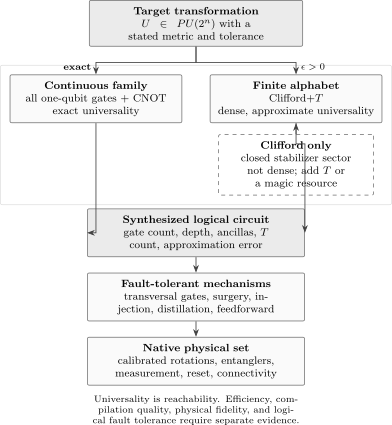
A target unitary may be reached exactly with a continuous family or approximated with a dense discrete alphabet. The synthesized logical circuit must still be realized through code-level mechanisms and native physical controls. Clifford operations occupy a closed stabilizer sector; a resource such as is needed to leave it.
Continuous Universal Sets
Section titled “Continuous Universal Sets”The textbook continuous family consists of arbitrary one-qubit gates and CNOT:
Barenco and collaborators showed that this family exactly generates arbitrary -qubit unitaries. Conceptually, the one-qubit gates provide continuous local control, while CNOT supplies a nonlocal entangling operation. Constructive decompositions reduce a general unitary to controlled operations and then to one- and two-qubit gates.
CNOT is not uniquely privileged. With arbitrary one-qubit unitaries available, any fixed two-qubit gate that can entangle at least one product state is universal. More generally for finite-dimensional qudits, the relevant condition is that the two-system gate be imprimitive: it must not preserve the set of decomposable tensors for every input. SWAP fails this test because
is always a product state. Joint support alone is not enough.
Three qualifications keep the theorem useful:
- “arbitrary one-qubit gates” is a continuous idealization; hardware implements calibrated controls with finite precision;
- a connected but sparse coupling graph may remain universal, but routing adds SWAPs, depth, and noise;
- universality says a decomposition exists, not that a chosen entangler gives the best decomposition for a workload.
Discrete Universal Sets
Section titled “Discrete Universal Sets”A finite alphabet has only countably many finite words:
By contrast, is uncountable. A finite gate set with no continuously adjustable parameters therefore cannot exactly represent every unitary by finite circuits. It can nevertheless be dense: every open neighborhood of every target contains a circuit over the alphabet.
This is not paradoxical. The rational numbers are countable and dense in the real numbers. Density gives arbitrary accuracy, while exact membership remains a stronger arithmetic question.
A discrete universality claim should report at least:
where is the chosen distance. It should also state whether inverses are primitive, synthesized, or unavailable. That detail enters general compilation theorems.
Why Clifford Gates Are Not Universal Alone
Section titled “Why Clifford Gates Are Not Universal Alone”The -qubit Pauli group consists of tensor products of together with phases. The Clifford group is its normalizer:
Hadamard, the phase gate , and CNOT generate the Clifford group. Their conjugation rules close on Pauli operators, for example
Modulo global phase, the Clifford group is finite for fixed . It therefore cannot be dense in the continuous projective unitary group.
There is also an operational limitation. Circuits built from stabilizer-state preparation, Clifford gates, Pauli measurements, and compatible classical control admit efficient classical simulation under the Gottesman–Knill framework. This statement has a precise resource boundary. Clifford gates acting on arbitrary nonstabilizer inputs, or combined with unrestricted non-Pauli measurements, need not remain inside the efficiently simulable stabilizer model.
Clifford operations are not “nearly useless.” They prepare Bell and graph states, propagate Pauli frames, extract many error-correction syndromes, and implement teleportation primitives. The correct conclusion is narrower: the closed stabilizer toolbox is not a universal model for arbitrary unitary quantum computation. The Stabilizer Circuit entry gives the compact model definition, and Stabilizer Identities collects its algebra.
Measurement-Based Quantum Computation owns how adaptive non-Pauli measurements on a declared graph resource leave that closed stabilizer toolbox and realize a universal measurement-pattern model. This page retains the general exact and approximate reachability and synthesis criteria.
Clifford+T
Section titled “Clifford+T”The gate is
Although is Clifford, is not. Conjugating gives
which is not a Pauli operator. Thus leaves the Clifford normalizer.
The finite set
is approximately universal; redundant Clifford generators are often included for convenience. Repeated and operations generate a dense set of one-qubit transformations up to phase, and CNOT supplies entanglement between qubits.
The word “approximately” remains important. Exact Clifford+ matrices occupy a countable arithmetic subset whose entries lie in a ring generated by and . A generic rotation is approximated rather than represented exactly. Specialized synthesis algorithms exploit this number-theoretic structure and can substantially outperform a generic compiler.
In many fault-tolerant stabilizer-code architectures, Clifford operations are comparatively direct while a logical is supplied through a magic state
and an injection gadget. Noisy copies may first be distilled using Clifford operations and measurements. This is why count and depth can be architecture-level costs rather than merely gate-alphabet statistics.
Magic State Distillation derives the injection branches, exact 15-to-1 recurrence, correlated-input caveats, and factory throughput model. Those implementation details are separate from the universality statement established here.
“Non-Clifford” is a resource classification, not a complete universality proof for every computational model. One must still establish density or an exact synthesis theorem under the stated ancilla, measurement, and connectivity rules.
Solovay–Kitaev Theorem
Section titled “Solovay–Kitaev Theorem”One standard form of the Solovay–Kitaev theorem fixes a dimension and assumes that:
- is a finite subset of ;
- the generated subgroup is dense in ;
- the alphabet is closed under inverses, or inverses are available with equivalent cost.
Then any target can be approximated to operator-norm error by a word of length
The standard recursive construction reviewed by Dawson and Nielsen has and a classical compilation time scaling with a smaller polylogarithmic exponent. The theorem extends to fixed higher dimensions under corresponding assumptions.
The mechanism is recursive error correction in the group. A coarse approximation leaves a near-identity residual. That residual is expressed as a group commutator of transformations closer to the identity, each factor is approximated recursively, and the commutator cancels lower-order errors.
Four boundaries are easy to miss:
- The theorem assumes density; it does not prove that a proposed alphabet is dense.
- It concerns a fixed-dimensional target. A large -qubit unitary is first decomposed into bounded-size gates.
- The stated construction is not generally the shortest compiler for a structured alphabet.
- It guarantees approximation, not exact synthesis or physical fault tolerance.
For a finite alphabet, a volume-counting argument gives a lower bound
at fixed dimension. Special number-theoretic compilers can approach this scaling for tasks such as Clifford+ approximation of one-qubit rotations. Solovay–Kitaev is therefore best read as a general polylogarithmic existence and compilation theorem, not a universal claim of optimality.
Allocate a Circuit Error Budget
Section titled “Allocate a Circuit Error Budget”Suppose
and each unitary factor satisfies
Insert and subtract intermediate products. Unitary invariance of the operator norm gives the telescoping bound
Thus assigning is a sufficient, often conservative, synthesis budget. This coherent approximation error is distinct from stochastic gate noise and from the probability that fault-tolerant error correction fails. A complete implementation budget must track all three.
Fault-Tolerant Gate-Set Constraints
Section titled “Fault-Tolerant Gate-Set Constraints”A physical gate set acts on imperfect components. A logical gate set acts on encoded degrees of freedom and must preserve correctability while its implementation faults remain controlled. Abstract universality does not ensure that every gate can be implemented by the same fault-tolerant mechanism.
Fault-Tolerant Gates develops that implementation layer: ideal-decoder and exRec criteria, transversal constructions, code deformation, gauge fixing, pieceable circuits, and teleportation-based gates. The present section fixes only the universality boundary.
A transversal gate couples corresponding physical subsystems across code blocks without coupling subsystems within a block. This limits the spread of a local fault. The Eastin–Knill theorem shows, under its finite-dimensional exact-code assumptions, that a nontrivial code detecting arbitrary errors on each physical subsystem cannot possess a universal set of transversal logical unitaries.
The theorem rules out one especially attractive route, not fault-tolerant universality itself. Architectures complete their logical gate sets using combinations such as:
- magic-state injection and distillation;
- code switching or gauge fixing;
- lattice surgery and code deformation;
- teleportation and adaptive measurement;
- pieceable or otherwise nontransversal fault-tolerant constructions.
The assumptions matter. Approximate codes, subsystem structures, continuous-variable systems, and other generalized settings require their own statements. None of these possibilities licenses the claim that an arbitrary physical operation is fault tolerant.
Continuous-Variable Quantum Computation owns the mode-specific statement: the declared Gaussian toolbox, non-Gaussian completion, operator and energy domain, approximation metric, and model-resource contract. This page retains the general exact and approximate reachability and synthesis criteria.
Topological Quantum Computation owns the anyon-specific statement: the declared fusion-space encoding and projective braid image, protected braid/fusion/measurement alphabet, licensed non-braid completion, approximation and leakage metrics, and braid-resource record. This page retains the general exact and approximate reachability and synthesis criteria.
Bosonic and Encoded Computation Models owns the encoded-family-specific audit that maps a declared physical oscillator alphabet and complete program to induced logical operations, leakage, acceptance, recovery, frames, and completion cost. This page retains the general exact and approximate universality, reachability, synthesis, and target-metric criteria.
Native, Compiled, and Logical Gate Sets
Section titled “Native, Compiled, and Logical Gate Sets”The same word “gate” appears at several layers:
| Layer | Object | Typical question |
|---|---|---|
| algorithm | ideal target unitary or channel | what transformation solves the task? |
| synthesis | circuit over a chosen logical alphabet | what , gate count, depth, and ancillas are required? |
| fault-tolerant mechanism | encoded operation, surgery, injection, or measurement gadget | how do logical error and space-time cost scale? |
| native hardware | calibrated one- and two-body operations and measurements | what connectivity, duration, leakage, and crosstalk apply? |
| controls | pulses, voltages, fields, timing, and classical processing | what waveform and calibration realize the native primitive? |
A processor may have a native entangling gate that is universal with arbitrary local control, yet expose a different software basis. A fault-tolerant stack may compile that native basis into stabilizer operations and then consume distilled states for non-Clifford logical gates. Conversely, a logical CNOT may be implemented by lattice surgery rather than by one physical CNOT pulse.
For a reproducible universality claim, report:
- exact or approximate reachability;
- target group and phase convention;
- error metric and tolerance;
- gate alphabet and inverse availability;
- ancillas, measurements, reset, and feedforward;
- connectivity and parallelism;
- gate count, depth, and non-Clifford resources;
- physical or logical layer;
- approximation, noise, and logical-failure budgets separately.
Worked Comparisons
Section titled “Worked Comparisons”All one-qubit gates plus SWAP
Section titled “All one-qubit gates plus SWAP”This family can move qubits and perform arbitrary product unitaries, but it never creates entanglement from a product input. It is not universal for multi-qubit unitary computation.
All one-qubit gates plus CNOT
Section titled “All one-qubit gates plus CNOT”The continuous local controls cover on each qubit, and CNOT is entangling. The family is exactly universal. On sparse hardware, nonadjacent CNOTs require routing or an equivalent mediated construction.
Clifford gates only
Section titled “Clifford gates only”The alphabet is closed under Pauli conjugation and remains inside the stabilizer model. It is not universal, even though it supports many important entangled states and fault-tolerant primitives.
Clifford+T
Section titled “Clifford+T”The alphabet is finite and cannot exactly cover the unitary continuum. Its generated circuits are dense, so it is approximately universal. The cost of reaching precision depends on the target, compiler, ancillas, and chosen resource metric.
Common Mistakes
Section titled “Common Mistakes”- Saying “universal” without specifying exact or approximate universality.
- Treating a finite alphabet as exactly universal for the full unitary continuum.
- Concluding that any joint two-qubit gate is entangling; SWAP is the standard counterexample.
- Treating density as a guarantee of an efficient or optimal compiler.
- Quoting Solovay–Kitaev without checking inverse closure, density, fixed dimension, or the error metric.
- Calling Clifford circuits universal because they create entanglement.
- Equating a native physical alphabet with a logical fault-tolerant alphabet.
- Combining coherent synthesis error, stochastic gate noise, and logical failure into one unexplained “fidelity.”
- Assuming universality implies a quantum speedup for a particular problem.
Exercises
Section titled “Exercises”1. Countability and density
Section titled “1. Countability and density”Show that finite words over a finite gate alphabet form a countable set. Explain why this forbids exact universality for but does not forbid approximate universality.
Solution
For an alphabet of size , there are at most words of length . Therefore
is a countable union of finite sets and is countable. The projective unitary group contains continuously many rotations and is uncountable, so the two sets cannot be equal.
A countable set can nevertheless be dense in an uncountable one, as is dense in . Approximate universality asks for every target and every neighborhood to contain a circuit, not for every target to be a circuit exactly.
2. Prove that T is non-Clifford
Section titled “2. Prove that T is non-Clifford”Using the matrices for , , and , verify
and conclude that is not Clifford.
Solution
Direct multiplication gives
This result is not proportional to a Pauli operator. Because a Clifford unitary must map every Pauli to a Pauli under conjugation, is non-Clifford.
3. Classify two candidate families
Section titled “3. Classify two candidate families”Classify each family as universal or nonuniversal for multi-qubit unitary computation:
- arbitrary one-qubit gates plus SWAP;
- arbitrary one-qubit gates plus iSWAP.
Solution
SWAP maps every product state to another product state. Composing SWAPs with local unitaries can only permute tensor factors and rotate them independently, so the first family cannot reach entangled states and is nonuniversal.
iSWAP entangles some product inputs. For example, its action on gives a maximally entangled state under the convention used on Multi-Qubit Gates. An entangling two-qubit gate assisted by arbitrary one-qubit gates is universal, so the second family is universal.
4. Bound accumulated synthesis error
Section titled “4. Bound accumulated synthesis error”Prove the two-gate case
for unitary factors, then explain the -gate generalization.
Solution
Insert and subtract :
The triangle inequality and unitary invariance of the operator norm give
Repeating the insertion one factor at a time yields the sum of all factor errors. This is a worst-case coherent bound; cancellation may make the actual error smaller.
5. Interpret Solovay–Kitaev scaling
Section titled “5. Interpret Solovay–Kitaev scaling”Suppose a compiler guarantees
for fixed and . By what asymptotic factor does the bound change when the requested error is replaced by ?
Solution
Because
the new length bound is
Thus squaring the error tolerance changes the polylogarithmic bound by the constant factor , not by a factor proportional to . This illustrates the theorem’s favorable precision dependence at fixed dimension.
6. Diagnose a fault-tolerance claim
Section titled “6. Diagnose a fault-tolerance claim”A code implements every Clifford gate transversally. A report therefore calls the transversal set “universal.” Identify the missing step and give two standard completion strategies.
Solution
The Clifford group is not dense in the unitary group and therefore is not universal. The report must identify a non-Clifford logical resource and show how it is implemented fault tolerantly.
Two standard strategies are:
- inject and, when needed, distill magic states to implement or another non-Clifford gate;
- switch codes or gauges so that complementary protected operations become available.
Lattice surgery, code deformation, and teleportation-based gadgets are other possibilities. Eastin–Knill explains why a universal transversal unitary set cannot simply be assumed for an ordinary exact finite-dimensional error-detecting code.
7. Separate implementation layers
Section titled “7. Separate implementation layers”A device natively implements arbitrary rotations, , and a nearest-neighbor CZ. A fault-tolerant software stack exposes Clifford+. Explain why both sets can be called universal without being the same gate set, and list three costs introduced between them.
Solution
The native continuous controls plus an entangling CZ can generate arbitrary physical circuits, subject to connected routing. The logical Clifford+ alphabet is a discrete approximately universal set acting on encoded qubits. Universality is being asserted at two different abstraction layers.
Costs between the layers can include:
- compiling logical Clifford operations into code deformations, lattice surgery, or native pulses;
- producing logical operations through state injection and magic-state distillation;
- routing nearest-neighbor interactions;
- repeated syndrome extraction, decoding latency, and ancilla preparation;
- synthesis error and logical failure probability.
The physical rotation angle precision is not the same quantity as the logical Clifford+ approximation tolerance.
Where to Go Next
Section titled “Where to Go Next”- Circuit Model defines circuit composition, dynamic operations, and resource accounting.
- Reversible Computation separates universality for classical reversible logic from universality for arbitrary quantum unitaries.
- Controlled Operations audits the semantics, phase conventions, and access assumptions of controlled and SELECT blocks; this page retains universality, while Gate Decomposition owns their constructive synthesis.
- Circuit Intermediate Representations distinguishes a gate alphabet, quantum instruction set, capability profile, target model, and calibrated implementation.
- Gate Decomposition develops the constructive synthesis algorithms, Cartan/KAK and dense-unitary reductions, finite-alphabet approximation, cost objectives, and verification certificates.
- Circuit Optimization explains how Clifford+ costs, phase polynomials, commutation, and verified rewrites improve an already synthesized circuit.
- Quantum Software Stack places synthesis and representation lowering inside the end-to-end path from application intent to execution evidence.
- Single-Qubit Gates gives the matrices, phase conventions, and Euler decompositions used in continuous synthesis.
- Multi-Qubit Gates distinguishes controlled, exchange, entangling, and measured primitives.
- Quantum Fourier Transform supplies a concrete continuous-angle transform circuit and an approximate-QFT cutoff; this page retains the separate problem of compiling those rotations into a declared finite or fault-tolerant alphabet.
- Algorithmic Primitives shows how synthesized gates become coherent access, interference, spectral transformation, amplification, and readout patterns.
- Stabilizer Formalism develops the Clifford subtheory, code spaces, logical operators, measurements, and binary tableaux; Stabilizer Circuit and Stabilizer Identities are compact lookup cards.
- Quantum Gates Formula Card and Quantum Gates Reference Table collect common matrices and conventions.
- Topological Quantum Computation Bridge applies the protected-versus-universal distinction to Ising, Fibonacci, and engineered anyon platforms.
- Quantum Information Roadmap places universality before algorithms, channels, and fault tolerance.
References
Section titled “References”- A. Barenco, C. H. Bennett, R. Cleve, D. P. DiVincenzo, N. Margolus, P. Shor, T. Sleator, J. A. Smolin, and H. Weinfurter, “Elementary gates for quantum computation,” Physical Review A 52, 3457–3467, 1995, doi:10.1103/PhysRevA.52.3457.
- D. Deutsch, A. Barenco, and A. Ekert, “Universality in quantum computation,” Proceedings of the Royal Society A 449, 669–677, 1995, arXiv:quant-ph/9505018.
- J.-L. Brylinski and R. Brylinski, “Universal quantum gates,” in Mathematics of Quantum Computation, Chapman & Hall/CRC, 2002, arXiv:quant-ph/0108062.
- M. J. Bremner, C. M. Dawson, J. L. Dodd, A. Gilchrist, A. W. Harrow, D. Mortimer, M. A. Nielsen, and T. J. Osborne, “Practical scheme for quantum computation with any two-qubit entangling gate,” Physical Review Letters 89, 247902, 2002, doi:10.1103/PhysRevLett.89.247902.
- P. O. Boykin, T. Mor, M. Pulver, V. Roychowdhury, and F. Vatan, “A new universal and fault-tolerant quantum basis,” Information Processing Letters 75, 101–107, 2000, doi:10.1016/S0020-0190(00)00084-3.
- D. Gottesman, “The Heisenberg representation of quantum computers,” in Proceedings of the XXII International Colloquium on Group Theoretical Methods in Physics, 1999, arXiv:quant-ph/9807006.
- S. Aaronson and D. Gottesman, “Improved simulation of stabilizer circuits,” Physical Review A 70, 052328, 2004, doi:10.1103/PhysRevA.70.052328.
- C. M. Dawson and M. A. Nielsen, “The Solovay–Kitaev algorithm,” Quantum Information and Computation 6, 81–95, 2006, doi:10.26421/QIC6.1-6.
- A. W. Harrow, B. Recht, and I. L. Chuang, “Efficient discrete approximations of quantum gates,” Journal of Mathematical Physics 43, 4445–4451, 2002, doi:10.1063/1.1495899.
- N. J. Ross and P. Selinger, “Optimal ancilla-free Clifford+ approximation of -rotations,” Quantum Information and Computation 16, 901–953, 2016, arXiv:1403.2975.
- S. Bravyi and A. Kitaev, “Universal quantum computation with ideal Clifford gates and noisy ancillas,” Physical Review A 71, 022316, 2005, doi:10.1103/PhysRevA.71.022316.
- B. Eastin and E. Knill, “Restrictions on transversal encoded quantum gate sets,” Physical Review Letters 102, 110502, 2009, doi:10.1103/PhysRevLett.102.110502.
- M. A. Nielsen and I. L. Chuang, Quantum Computation and Quantum Information, 10th anniversary ed., Cambridge University Press, 2010, doi:10.1017/CBO9780511976667.