Topological Quantum Computation Bridge
Topological quantum computation encodes information in globally organized degrees of freedom, such as an anyon fusion space or a topological ground-state sector, and processes that information with operations constrained by topology. The aim is not to eliminate every error. It is to make broad classes of local perturbations act trivially, or only exponentially weakly, on the encoded state while retaining controllable initialization, gates, measurement, and active correction.
Four distinct achievements are often compressed into the word “topological”:
- realizing a gapped topological phase or a defect with the required zero modes;
- identifying and controlling a nonlocal encoded Hilbert space;
- performing a braid, fusion, parity measurement, or logical-string operation;
- showing that logical errors decrease as separation, system size, or code distance grows.
They are not interchangeable. A zero-bias peak is not a qubit. A parity measurement is not a braid. A programmed braid algebra is not evidence for intrinsic material anyons. A protected gate primitive is not a fault-tolerant computer.
This page is the bridge between quantum matter and quantum information. Anyons and Braiding owns braid groups, fusion spaces, - and -moves, and adiabatic worldline operations. Topological Superconductors owns Bogoliubov–de Gennes topology, Majorana zero modes, and candidate-material evidence. Fractional Quantum Hall Effect owns Hall-fluid phenomenology and statistics experiments. Topological Qubits owns the complete hardware module, parity-control stack, metrics, resource boundary, and current device-evidence audit. Topological Codes owns the general active-versus-passive protection structure, homological logical classes, and dimensional taxonomy; Surface Code retains stabilizer patches, repeated syndrome extraction, decoding, code thresholds, and lattice surgery.
The canonical scope here is narrower and connective: what protection quantum matter can supply, how Majorana and fractional-Hall platforms compare, how programmed anyon experiments should be classified, and what the dated experimental status does and does not establish. Topological Quantum Computation owns the device-independent information-processing record: declared anyon data and fusion-space encoding, braid/fusion/measurement program, induced projective logical channel, native alphabet and non-braid completion, decoder, approximation and leakage certificates, and resource ledger. Circuit synthesis, algorithms, magic-state factories, decoders, and resource estimates belong to the information-processing side.
Required background. Anyons and Braiding supplies fusion-space operations, and Topological Order supplies the phase-level protection and ground-space structure.
Helpful background. Topological Superconductors and Fractional Quantum Hall Effect supply the two principal material-platform branches compared here.
What Topological Protection Means
Section titled “What Topological Protection Means”Let be a code or fusion subspace with projector . If its logical states are locally indistinguishable, then for an operator supported in a region of diameter much smaller than the separation scale ,
where is a bulk correlation or localization length. To leading order, a local perturbation cannot learn which logical state is present and cannot rotate one logical state into another. The same physics gives an exponentially small residual splitting,
for well-separated defects in an ideal gapped phase.
These equations express passive suppression of local matrix elements. They do not guarantee:
- immunity to operators whose support forms a logical string;
- immunity to thermal creation and diffusion of quasiparticles;
- a correct braid when an unintended anyon lies inside the path;
- adiabatic transport without leakage;
- accurate state preparation or fusion-channel readout;
- a universal native gate set;
- a decoder or decreasing logical error rate under repeated operation.
Three layers that must not be conflated
Section titled “Three layers that must not be conflated”| Layer | Protected object | Strong evidence |
|---|---|---|
| Phase stability | bulk topological order or a topological defect sector | gap, invariant, robust topological data, controlled perturbations |
| Encoded information | fusion channel or global logical sector | local indistinguishability, nonlocal parity, splitting versus separation |
| Computation | operations and measurements on the logical sector | braid/fusion algebra, leakage and readout budgets, logical-error scaling |
A sample can establish the first layer without supplying a practical encoding. A few-site device can support a useful parity qubit without asymptotic topological protection. A programmable processor can accurately synthesize the second and third layers while its microscopic hardware remains an ordinary noisy qubit array.
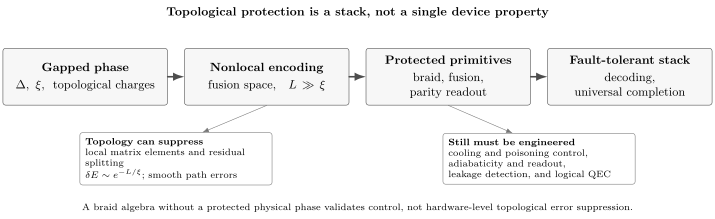
Topological protection is a stack. A gapped phase supplies topological charges and a finite correlation length. Separation creates a nonlocal code space with exponentially small local matrix elements. Braids, fusion measurements, or logical strings provide protected primitives. Cooling, poisoning control, adiabaticity, leakage detection, accurate readout, decoding, and universal gate completion still have to be engineered.
Energy and time scales
Section titled “Energy and time scales”Let be the gap to unwanted excitations, the residual splitting in the code space, a topological-charge or fermion-parity lifetime, and any additional coherence time. An adiabatic operation of duration requires a window of the form
The left inequality suppresses leakage out of the low-energy manifold. The right inequalities suppress unwanted dynamical phases and uncontrolled charge-sector changes. A formal topological model is not an operational platform unless this window is nonempty after realistic temperature, disorder, control bandwidth, and measurement times are included.
At temperature , thermal production of an excitation with energy cost is suppressed schematically by
This is valuable, but it is not a self-correcting memory theorem. In two-dimensional topological phases, a thermally created anyon pair can separate and trace a logical worldline before annihilating. Active syndrome extraction or sufficiently fast detection remains necessary for long computations.
Encoding in a Fusion Space
Section titled “Encoding in a Fusion Space”Suppose non-Abelian anyons have fixed total topological charge . Their protected state space is a fusion space,
Different basis states correspond to allowed intermediate fusion channels, not to locally distinguishable occupations on one site. When the anyons are far apart, changing or measuring those intermediate channels requires an operation whose support connects them or encloses them.
For identical anyons of type , the dimension grows asymptotically as
up to channel-dependent prefactors, where is the quantum dimension. This growing nonlocal space is the computational resource.
One logical qubit is not one pair of Majoranas
Section titled “One logical qubit is not one pair of Majoranas”Two Majorana operators obey
and form one ordinary fermionic mode,
Its occupation changes fermion parity. Because total fermion parity is superselected in an isolated device, arbitrary coherent superpositions of globally even and odd states are not an ordinary qubit encoding. A standard fixed-parity qubit uses four Majoranas. In one convention,
Within a fixed total-parity sector,
The physical degrees of freedom are distributed across four zero modes; the logical Pauli operators are Majorana bilinears rather than local observables at one end. Particle-Number Superselection Preview supplies the broader parity constraint.
Anyon Braiding as Gates
Section titled “Anyon Braiding as Gates”The -strand braid group is generated by exchanges satisfying
An anyon theory supplies a unitary representation
so a braid word implements the logical operation
up to convention-dependent common phases and finite-size corrections. Smoothly deforming the worldlines without collisions, boundary crossings, or gap closure leaves the projective logical action unchanged.
The full construction of from fusion trees, moves, and symbols belongs to Anyons and Braiding. For the bridge, three computational facts are central.
Topological does not imply universal
Section titled “Topological does not imply universal”Ising anyons and Majorana modes. Braiding ideal Ising anyons generates protected Clifford operations. Clifford gates are invaluable for stabilizer error correction but are not universal for quantum computation by themselves. A non-Clifford resource must enter through magic-state preparation and distillation, a calibrated nontopological phase operation, a richer measurement/fusion primitive, or another architecture. Universal Gate Sets gives the canonical exact-versus-approximate and Clifford+ framework.
Fibonacci anyons. On suitable encodings, Fibonacci braid representations are dense in the relevant unitary group. Arbitrary gates can be approximated by braid compilation. The approximation error and braid length are computational costs, while thermal errors and leakage remain physical costs.
Other non-Abelian theories. Some models are not braid-universal but become universal when fusion measurements, ancillas, topology change, or gapped-boundary operations are added. A July 2026 trapped-ion experiment used braiding together with fusion in an engineered topological state to realize a universal logical gate set. That is a major operation-level demonstration, but it does not turn the ions into intrinsic material anyons or establish passive hardware-level error suppression.
Majorana exchange
Section titled “Majorana exchange”For two Majorana zero modes, one braid orientation is represented by
With the corresponding convention,
The minus sign retains worldline information that an ordinary swap would lose. In a wire network, physical exchange can be replaced by an adiabatic sequence of couplings or by projective parity measurements. The computational equivalence holds only if the protocol remains in the intended low-energy sector and the measurements have the assumed quantum-instrument action.
Initialization, Measurement, and Active Correction
Section titled “Initialization, Measurement, and Active Correction”The ideal workflow is
Topology helps most strongly in the middle. The endpoints are not automatic.
Preparation
Section titled “Preparation”Local creation produces charge-neutral combinations such as pairs. Preparing a specific encoded basis state also requires a known total charge, a known fusion tree, and sufficiently low probability of stray quasiparticles. Cooling into a topological phase does not guarantee a clean computational sector.
Fusion and parity measurement
Section titled “Fusion and parity measurement”Fusion readout determines the total topological charge of a selected group of anyons. In Majorana devices this becomes a joint fermion-parity measurement. Interferometers, quantum dots, resonators, charge sensors, or boundary couplings can transduce the channel to an ordinary detector.
The measurement must be described as a quantum instrument, not only as a classical bit:
- which operator or topological charge is measured;
- the assignment error;
- measurement-induced transitions and leakage;
- whether the measurement is quantum nondemolition;
- crosstalk with neighboring sectors;
- the conditional post-measurement state.
Quantum Instruments owns that formalism.
Measurement-only computation
Section titled “Measurement-only computation”Sequences of projective topological-charge measurements can reproduce braid operations without spatially moving the anyons. This can simplify geometry, but it moves engineering demands into ancilla preparation, adaptive feed-forward, repeat-until-success branches, and high-fidelity parity readout. “No physical motion” does not mean “no control error.”
Active error correction
Section titled “Active error correction”Thermal anyons, quasiparticle poisoning, leakage, and measurement faults require monitoring and decoding. A topological code such as the surface code encodes information in global loop operators and uses repeated local syndrome measurements. Its protection is topological at the code level, even when the underlying qubits are not intrinsic anyons.
For a claim of scalable protection, the relevant observable is a logical error rate,
as a function of code distance , anyon separation, or an equivalent scale. Below an appropriate threshold and under a stated noise model, should decrease with increasing . A long physical lifetime at one size is important but does not establish this scaling law.
Majorana Platforms
Section titled “Majorana Platforms”Majorana zero modes are Ising-type defects of a topological superconducting setting. Candidate routes include:
- spin–orbit-coupled semiconductor–superconductor nanowires and planar heterostructures;
- quantum-dot arrays engineered to approximate a Kitaev chain;
- vortices in candidate two-dimensional topological superconductors;
- magnetic-atom chains or islands on superconducting substrates;
- interfaces involving quantum Hall, topological-insulator, and superconducting regions.
The detailed phase criteria and false positives belong to Topological Superconductors. The computational question is whether a platform can pass a sequence of increasingly strong milestones.
Majorana milestone ladder
Section titled “Majorana milestone ladder”| Milestone | What it establishes | What remains |
|---|---|---|
| near-zero state | a low-energy candidate exists | topology, nonlocality, parity protection |
| correlated end response | a state has weight at separated probes | exclusion of extended trivial states |
| bulk gap and phase diagnostic | compatibility with a topological regime | encoded control |
| single-shot parity readout | one computational observable can be measured | coherence and complementary measurements |
| coherent parity control | a qubit-like subspace can be manipulated | topological protection and braiding |
| fusion-rule test | nontrivial channel probabilities | noncommuting exchange |
| braid or equivalent sequence | non-Abelian operation | scaling and universality |
| protection scaling | errors fall with length or distance | full logical architecture |
| repeated logical operations | operational fault tolerance | useful resource scale |
Skipping rungs is the most common source of overclaim.
Long wires and planar hybrids
Section titled “Long wires and planar hybrids”In the ideal nanowire model, spin–orbit coupling, Zeeman splitting, and induced pairing create a class-D topological phase beyond a bulk gap closing. Majorana end modes then have an overlap splitting of the schematic form
Longer separation helps only if the induced gap remains hard, disorder does not create additional low-energy states, and quasiparticle poisoning is controlled. Electrostatic inhomogeneity can produce partially separated Andreev states with many of the same local spectroscopic signatures.
The 2025 interferometric single-shot parity experiment in InAs–Al hybrid devices demonstrated a necessary, time-resolved parity-measurement primitive with a reported optimal assignment error near one percent. The paper explicitly noted that the measurement alone does not uniquely distinguish topological Majorana modes from fine-tuned trivial Andreev states. In June 2026, a peer-reviewed Nature Matters Arising analysis argued that transport data underlying the tune-up were consistent with disordered, apparently gapless regimes; the authors’ published reply disputed that interpretation and argued that the RF parity signal strongly constrains trivial explanations. The topological interpretation therefore remains contested. The conservative conclusion is evidence for a readout architecture, not by itself a fusion-rule or topological-qubit demonstration.
A June 2026 InAs–Pb tetron preprint reported an approximately characteristic parity-switching time in one measured hybrid nanowire, with some intervals reaching minute scale. This is a striking materials and poisoning metric. As of 10 August 2026, it is a preprint, and the measured parity lifetime is not the same as a coherent logical-qubit lifetime, a complementary Pauli measurement, a braid gate, or logical error suppression with increasing distance.
Minimal Kitaev chains
Section titled “Minimal Kitaev chains”Two- and three-site quantum-dot chains can be tuned so that hopping and crossed-Andreev pairing approximate a short Kitaev model. Their end modes are often called poor man’s Majoranas. They exhibit Majorana-like parity structure at a sweet spot, but a two-site chain has no extended bulk and only limited protection. A three-site chain suppresses selected perturbations to higher order and has shown enhanced stability, yet it is still far from an asymptotic exponential-length test.
Experiments have progressed from a two-site realization in 2023 to three-site stability and localization tests, single-shot parity readout published in February 2026, and a July 2026 preprint reporting coherent parity oscillations between two coupled minimal chains. The latest preprint explicitly describes the chains as short and partially protected. It demonstrates qubit-level coherent control in an engineered Majorana basis; it does not report spatial braiding, non-Abelian fusion rules, or scaling to topological protection.
Vortices, atom chains, and intrinsic candidates
Section titled “Vortices, atom chains, and intrinsic candidates”Vortex-core and chain-end zero-bias features have been reported in several material systems. Their computational attraction is physical separation in two dimensions, but their obstacles are equally physical:
- trivial Caroli–de Gennes–Matricon or Yu–Shiba–Rusinov states can lie near zero;
- vortices can pin unpredictably and carry low-lying excitations;
- atom-scale fabrication and motion are difficult to scale;
- local tunneling spectra do not reveal the nonlocal fusion state;
- braiding requires controlled worldlines and basis-sensitive readout.
No such solid-state platform has, as of the review date, produced a broadly accepted topologically protected Majorana braid and fusion experiment.
Fractional Quantum Hall Platforms
Section titled “Fractional Quantum Hall Platforms”Fractional Hall fluids offer intrinsic two-dimensional topological order rather than engineered BdG defects. Their advantages include:
- a many-body gap and deconfined fractionalized quasiparticles;
- long-lived chiral edge channels for interferometry;
- direct access to fractional charge and statistical phases;
- candidate even-denominator phases with non-Abelian anyons.
Their computational obstacles include:
- creating and positioning individual bulk quasiparticles;
- distinguishing electrostatic phase shifts from statistical phases;
- edge reconstruction and neutral-mode decoherence;
- small gaps and demanding temperature scales;
- slow, nonlocal electrostatic control;
- fusion-channel readout and scalable device layout.
Abelian anyons are established but not a non-Abelian computer
Section titled “Abelian anyons are established but not a non-Abelian computer”At Laughlin fillings, fractional charge and Abelian anyonic statistics have been observed through complementary interferometer and collider methods. These experiments establish the physical reality of anyonic statistics and validate essential control ideas.
An Abelian braid acts by a scalar phase,
It does not rotate a multidimensional fusion space and therefore does not supply the standard non-Abelian topological-gate architecture. Abelian Hall anyons are a foundational platform achievement, not a topological quantum computer.
Even-denominator candidates
Section titled “Even-denominator candidates”The Hall plateau and other even-denominator states are leading candidates for Ising-type non-Abelian order. Fractional charge, thermal transport, daughter states, edge structure, and interferometry provide substantial evidence, but competing Pfaffian, anti-Pfaffian, particle–hole-symmetric, disorder-dominated, and reconstructed-edge descriptions can share several observables.
Interference measurements at have reported an even–odd pattern and parity behavior consistent with non-Abelian quasiparticles. In January 2026, a bilayer-graphene experiment demonstrated coherent Aharonov–Bohm interference at two even-denominator states and evidence that added bulk quasiparticles carry charge . Its observed period remained compatible with either a non-Abelian double-winding process or interference of Abelian quasiparticles. The authors identified distinguishing those possibilities as an open requirement.
The status is therefore strong candidate evidence with interpretation-sensitive non-Abelian identification, not a completed gate demonstration. A computational milestone would require controlled creation, basis-sensitive fusion, noncommuting braid words, and logical readout in the same calibrated platform.
Fibonacci routes
Section titled “Fibonacci routes”Fibonacci anyons would provide braid universality, and Read–Rezayi-type phases or engineered fractional-Hall–superconductor interfaces motivate candidate routes. No intrinsic material platform has yet demonstrated a scalable, individually controlled Fibonacci-anyon register. Processor-based Fibonacci simulations test the algebra and compilation problem but belong to a different evidence category.
Programmable-Processor Anyons
Section titled “Programmable-Processor Anyons”A programmable processor can prepare a wavefunction with topological order, create encoded excitations, enact string operators, and measure fusion outcomes. These are genuine quantum simulations and can be stringent tests of non-Abelian algebra. They must be described by the protection mechanism actually present.
What has been demonstrated
Section titled “What has been demonstrated”- In 2023, a superconducting processor demonstrated non-Abelian braiding of engineered graph vertices and encoded logical entanglement.
- In 2024, a trapped-ion processor prepared a non-Abelian topological state, created and fused anyons, and measured a non-Abelian Borromean-ring process.
- In 2024, a superconducting processor simulated Fibonacci anyons and measured braid and fusion data, including a quantum dimension close to the golden ratio. The authors explicitly stated that their gate sequences were not Hamiltonian anyon dynamics and therefore did not inherit natural gap protection.
- In July 2026, a trapped-ion processor prepared a 54-qubit state and combined braiding with fusion to demonstrate a universal logical gate set and topological magic-state preparation.
The 2026 result closes an important control and computational-universality milestone for synthesized topological states. It does not show that the trapped-ion hardware passively suppresses local errors by an intrinsic many-body gap, nor does it establish decreasing logical error with topological distance. The processor supplies high-fidelity gates and measurements used to build the topological state; active verification and hardware error control remain underneath it.
Intrinsic, encoded, and simulated
Section titled “Intrinsic, encoded, and simulated”| Platform | Where topology lives | Native operation | Present protection question |
|---|---|---|---|
| fractional Hall fluid | intrinsic many-body phase | quasiparticle motion and fusion | can individual non-Abelian anyons be controlled and read out? |
| topological superconductor | BdG phase and defects | Majorana coupling, parity measurement, or exchange | are the modes topological and does error fall with separation? |
| surface-code processor | actively stabilized code space | logical strings, lattice surgery, code deformation | does logical error decrease with code distance? |
| programmed string-net or quantum double | prepared encoded wavefunction | compiled strings, braids, fusion measurements | which operations are protected against native hardware noise? |
Calling the last two “fake anyons” would be as misleading as calling them intrinsic quasiparticles. They are encoded topological excitations of a deliberately synthesized state. The correct statement names the substrate, preparation method, Hamiltonian or circuit, and demonstrated protection.
Experimental Status Labels
Section titled “Experimental Status Labels”All status statements below are reviewed through 10 August 2026.
| Status label | Meaning |
|---|---|
| established theory | mathematical model, gate representation, or protection theorem is standard |
| intrinsic phase established | convergent bulk and quasiparticle evidence identifies a topological phase |
| controlled simulation | a programmed platform prepares and probes the intended encoded model |
| ingredient demonstrated | one required element, such as parity readout, has been shown |
| qubit-level control | coherent preparation, operation, and measurement of an encoded two-level sector |
| protected logical operation | error suppression is tied experimentally to topology or distance |
| fault-tolerant architecture | repeated logical operations improve under scaling and correction |
Dated ledger
Section titled “Dated ledger”| Claim | Status on review date | Main missing evidence |
|---|---|---|
| braid-group and fusion-space framework | established theory | none within stated axioms |
| Abelian fractional-Hall anyons | experimentally established | scalable non-Abelian computation is a different claim |
| non-Abelian order in fractional Hall materials | strong, platform-dependent evidence | controlled noncommuting fusion-basis-sensitive braids |
| topological Majorana modes in solid-state hybrids | active and interpretation-sensitive | convergent phase identification, fusion, and braid tests |
| few-site Kitaev-chain parity qubits | readout published; coherent-control preprint | longer-chain protection scaling and non-Abelian operation |
| InAs–Pb tetron parity stability | June 2026 preprint reports long parity switching time | peer review, coherent logical control, complementary measurements |
| processor-synthesized non-Abelian braiding | demonstrated | hardware-level protection and logical-error scaling |
| universal braid-and-fusion gates in synthesized order | demonstrated in July 2026 | fault-tolerant scaling under repeated native noise |
| scalable intrinsic-anyon computer | not demonstrated | full milestone chain |
No row should be promoted because of a press release, one fitted spectrum, or a formal device roadmap. Promotion requires a primary result whose measured observable matches the claim.
Evidence Standard for a Protected Gate
Section titled “Evidence Standard for a Protected Gate”A mature gate claim should report:
- phase identification: the bulk or code space and its gap or stabilizer structure;
- encoding: the logical basis, total charge or parity constraint, and leakage sectors;
- nonlocality: local indistinguishability or correlated separated support;
- operation: the braid word, measurement sequence, or logical deformation;
- basis-sensitive outcome: tomography, fusion statistics, or logical observables that distinguish noncommuting operations;
- controls: contractible paths, reversed orientation, altered enclosed charge, and trivial-phase comparisons;
- error budget: leakage, diabaticity, poisoning, readout, drift, and state-preparation errors;
- scaling: dependence on separation, chain length, gap, temperature, or code distance;
- repetition: logical performance over many cycles, not a postselected one-shot demonstration;
- universality accounting: protected native set, unprotected resources, distillation, decoder, and overhead.
For a braid , a useful comparison is not only a state fidelity but the distance between the implemented logical channel and the ideal unitary channel :
or a practically estimable bound with the same operational interpretation. The error should be decomposed into topologically suppressible and nonsuppressible contributions. Quantum Gates provides the compact gate notation; channel metrics and benchmarking belong to the information-processing volume.
Frontier Questions
Section titled “Frontier Questions”The decisive open questions are engineering questions with sharp physical content:
- Can one platform produce a reproducible non-Abelian phase, individual excitations, fusion readout, and noncommuting braids?
- Does a Majorana qubit’s dephasing or logical error decrease exponentially with chain length over a controlled range?
- Can fractional-Hall interferometers separate statistical phase from charging and edge dynamics while manipulating one quasiparticle at a time?
- Can programmable non-Abelian codes show a logical advantage that improves with distance under native hardware noise?
- Which universal-completion strategy preserves enough of the topological advantage to beat a conventional code stack?
- Can thermal anyons and quasiparticle poisoning be detected and decoded faster than they generate logical worldlines?
- What architecture supports routing, measurement, and calibration without closing the protecting gap?
- Which resource estimates remain favorable after magic states, cryogenics, control wiring, and readout are included?
These questions are more durable than a device name or announced qubit count.
Common Mistakes
Section titled “Common Mistakes”Treating topology as absolute immunity
Section titled “Treating topology as absolute immunity”Topology suppresses selected local errors under a gap and separation assumptions. It does not suppress every long-range, thermal, measurement, or control error.
Calling two Majoranas a qubit without a parity ledger
Section titled “Calling two Majoranas a qubit without a parity ledger”Two Majoranas form one fermionic mode. A fixed-total-parity logical qubit conventionally needs four modes or an equivalent reference sector.
Equating a zero mode with non-Abelian statistics
Section titled “Equating a zero mode with non-Abelian statistics”Zero energy and non-Abelian exchange are different claims. Fusion-space and braid tests are required.
Assuming every non-Abelian anyon is braid-universal
Section titled “Assuming every non-Abelian anyon is braid-universal”Ising braiding is Clifford. Universality requires an added resource or a richer anyon model.
Calling a scalar anyon phase a logical rotation
Section titled “Calling a scalar anyon phase a logical rotation”Abelian statistics changes a phase in a one-dimensional sector. Standard non-Abelian computation requires a multidimensional fusion space.
Calling a programmed braid intrinsic material evidence
Section titled “Calling a programmed braid intrinsic material evidence”A processor experiment can validate encoded topological operations without discovering intrinsic anyons in its substrate.
Dismissing programmed anyons as merely classical simulation
Section titled “Dismissing programmed anyons as merely classical simulation”They are quantum states with nonlocal encoded observables and experimentally enacted operations. The limitation is the source of protection, not the absence of quantum behavior.
Reporting parity lifetime as coherent qubit lifetime
Section titled “Reporting parity lifetime as coherent qubit lifetime”Parity switching, dephasing, leakage, and gate fidelity are distinct timescales and error channels.
Ignoring initialization and readout
Section titled “Ignoring initialization and readout”A protected idle subspace is unusable without state preparation, basis-sensitive measurement, and leakage control.
Claiming fault tolerance from one system size
Section titled “Claiming fault tolerance from one system size”Fault tolerance is a scaling statement. Logical error must improve with code distance, separation, or another declared protection parameter.
Exercises
Section titled “Exercises”1. Local indistinguishability and dephasing
Section titled “1. Local indistinguishability and dephasing”Suppose two logical states satisfy
Explain why a weak local perturbation produces only exponentially small relative phase and mixing within the logical subspace.
Solution
Projecting the perturbation gives
The first term is proportional to the identity and contributes only a common phase. Diagonal differences in produce relative dephasing, while off-diagonal entries produce logical rotations. Both are bounded by
Thus increasing the separation suppresses the logical action of a fixed local perturbation. The argument does not apply to an operator whose support connects the anyons or forms a noncontractible logical string.
2. Is there an operating window?
Section titled “2. Is there an operating window?”A device has
Estimate and . Is an operation lasting parametrically compatible with the ideal window?
Solution
Using
gives
and
Therefore
The nominal timing window is open. This estimate does not include matrix elements, pulse smoothness, readout time, additional excited states, or dephasing channels, so it is necessary but not sufficient.
3. Majorana logical Pauli operators
Section titled “3. Majorana logical Pauli operators”For four Majoranas, verify that
square to the identity and anticommute.
Solution
For ,
Hence
and similarly . Their product is
whereas reversing the order gives
Therefore
Both bilinears preserve total fermion parity, so they act within a fixed-parity logical sector.
4. Why Ising braids need help
Section titled “4. Why Ising braids need help”An ideal Majorana platform supplies topologically protected Clifford gates and parity measurements. Why is this not yet a universal gate set, and name two routes to universality.
Solution
Clifford operations normalize the Pauli group and map stabilizer states to stabilizer states. By the Gottesman–Knill structure, Clifford circuits with stabilizer preparation and Pauli measurement are not a universal model for arbitrary quantum computation.
Two routes are:
- prepare noisy non-Clifford magic states and distill them using protected Clifford operations;
- add a calibrated non-Clifford phase gate, then protect or distill its output.
Other anyon theories or fusion/measurement primitives can also enlarge the native set. The overhead and error model of the added resource must be included in any fault-tolerance claim.
5. Thermal activation is not self-correction
Section titled “5. Thermal activation is not self-correction”Explain why a thermal anyon density proportional to does not guarantee an indefinitely stable two-dimensional topological memory.
Solution
The Boltzmann factor suppresses creation of anyon pairs, so lowering lengthens the waiting time between events. Once a pair is created, however, its members can diffuse. If their worldlines form a noncontractible loop or connect the relevant defects before they annihilate, the process implements a logical operator.
The energy cost need not grow with the separation reached by the diffusing pair, so the memory barrier is not automatically extensive. Active detection and decoding, finite-size optimization, or a different self-correcting mechanism is needed for indefinitely improving storage.
6. Classify three demonstrations
Section titled “6. Classify three demonstrations”Assign the most precise status label to each:
- a transmon processor prepares a string-net wavefunction and compiles a braid sequence, but errors do not decrease with string length;
- a hybrid wire shows a long parity switching time but no coherent complementary-basis control;
- a code experiment shows lower logical error at distance five than at distance three under repeated syndrome extraction.
Solution
- This is a controlled quantum simulation or encoded-operation demonstration. It validates preparation and braid control but not passive topological hardware protection.
- This is an ingredient demonstration, specifically parity stability. It is not yet a complete coherent qubit or protected logical operation.
- This is evidence for protection scaling and, if the protocol and comparison are valid under a stated noise model, progress toward fault-tolerant logical operation.
The labels describe measured achievements, not the ambition of the platform.
7. Audit an even-denominator interferometer
Section titled “7. Audit an even-denominator interferometer”An interferometer at an even-denominator Hall plateau shows a period . Give two interpretations and three additional measurements needed before calling it non-Abelian braiding.
Solution
Two interpretations are:
- a non-Abelian process in which the observable path effectively requires double winding;
- interference of an Abelian quasiparticle with charge .
Useful additional tests include:
- shot-noise determination of the interfering quasiparticle charge;
- controlled addition of individual bulk quasiparticles and tracking the fusion-parity dependence;
- basis-sensitive comparison of noncommuting braid words or an even–odd interference protocol;
- control fillings that isolate Coulomb and area changes;
- temperature and bias scaling that separates charge and neutral modes.
A period alone is not a fusion-space rotation.
8. Design a protection-scaling experiment
Section titled “8. Design a protection-scaling experiment”Design a minimum experiment to test whether a Majorana qubit is becoming topologically protected as chain length increases.
Solution
Fabricate or tune a family of otherwise comparable chains with increasing physical length or number of sites. For each size:
- verify the same bulk topological regime and comparable induced gap;
- measure residual even–odd splitting and its oscillatory dependence on control parameters;
- measure dephasing, relaxation, leakage, and quasiparticle-poisoning times separately;
- perform the same logical idle and gate sequence with calibrated readout;
- fit splitting or dephasing sensitivity against , including uncertainty in ;
- compare to trivial Andreev-state controls and disorder simulations;
- show that the logical metric improves while operation and readout errors do not worsen enough to erase the gain.
Exponential suppression over a controlled range is stronger evidence than a single exceptionally long-lived device.
Connections
Section titled “Connections”- Topological Qubits supplies the complete device-module, readout, error, metric, scaling, and hardware-resource account.
- Quantum Information Roadmap organizes the information-processing path through qubits, gates, algorithms, error correction, hardware, and benchmarking.
- Entanglement and Quantum Information supplies the resource-language bridge from composite systems.
- Surface Code is the canonical architecture page for an actively stabilized topological code; its model card is the compact reference entry.
- Quantum Gates collects standard circuit-gate identities and conventions.
- Decoherence Timescales separates relaxation, dephasing, and other lifetime metrics.
- Quantum Information References provides a wider bibliography for computation, communication, and error correction.
- Topological Phase Transitions explains how the protecting phase is entered or lost.
- Nanostructures for Quantum Technology supplies the broader device-to-architecture ledger for control, readout, calibrated errors, fabrication, and scaling claims.
References
Section titled “References”- A. Y. Kitaev, “Fault-Tolerant Quantum Computation by Anyons,” Annals of Physics 303, 2–30 (2003), doi:10.1016/S0003-4916(02)00018-0.
- C. Nayak, S. H. Simon, A. Stern, M. Freedman, and S. Das Sarma, “Non-Abelian Anyons and Topological Quantum Computation,” Reviews of Modern Physics 80, 1083–1159 (2008), doi:10.1103/RevModPhys.80.1083.
- E. Dennis, A. Kitaev, A. Landahl, and J. Preskill, “Topological Quantum Memory,” Journal of Mathematical Physics 43, 4452–4505 (2002), doi:10.1063/1.1499754.
- M. H. Freedman, M. Larsen, and Z. Wang, “A Modular Functor Which Is Universal for Quantum Computation,” Communications in Mathematical Physics 227, 605–622 (2002), doi:10.1007/s002200200645.
- L. Bonesteel, L. Hormozi, G. Zikos, and S. H. Simon, “Braid Topologies for Quantum Computation,” Physical Review Letters 95, 140503 (2005), doi:10.1103/PhysRevLett.95.140503.
- S. Bravyi, “Universal Quantum Computation with the Fractional Quantum Hall State,” Physical Review A 73, 042313 (2006), doi:10.1103/PhysRevA.73.042313.
- P. Bonderson, M. Freedman, and C. Nayak, “Measurement-Only Topological Quantum Computation,” Physical Review Letters 101, 010501 (2008), doi:10.1103/PhysRevLett.101.010501.
- S. Bravyi and A. Kitaev, “Universal Quantum Computation with Ideal Clifford Gates and Noisy Ancillas,” Physical Review A 71, 022316 (2005), doi:10.1103/PhysRevA.71.022316.
- A. Y. Kitaev, “Unpaired Majorana Fermions in Quantum Wires,” Physics-Uspekhi 44, 131–136 (2001), doi:10.1070/1063-7869/44/10S/S29.
- J. Alicea, Y. Oreg, G. Refael, F. von Oppen, and M. P. A. Fisher, “Non-Abelian Statistics and Topological Quantum Information Processing in 1D Wire Networks,” Nature Physics 7, 412–417 (2011), doi:10.1038/nphys1915.
- D. Aasen et al., “Milestones toward Majorana-Based Quantum Computing,” Physical Review X 6, 031016 (2016), doi:10.1103/PhysRevX.6.031016.
- T. Dvir et al., “Realization of a Minimal Kitaev Chain in Coupled Quantum Dots,” Nature 614, 445–450 (2023), doi:10.1038/s41586-022-05382-w.
- A. Bordin et al., “Enhanced Majorana Stability in a Three-Site Kitaev Chain,” Nature Nanotechnology 20, 726–731 (2025), doi:10.1038/s41565-025-01894-4.
- M. Aghaee et al., “Interferometric Single-Shot Parity Measurement in InAs–Al Hybrid Devices,” Nature 638, 651–655 (2025), doi:10.1038/s41586-024-08445-2.
- N. van Loo, F. Zatelli, G. O. Steffensen et al., “Single-Shot Parity Readout of a Minimal Kitaev Chain,” Nature 650, 334–339 (2026), doi:10.1038/s41586-025-09927-7.
- M. Aghaee et al., “20 Second Parity Lifetime in an InAs–Pb Tetron Device,” arXiv:2606.03884 (2026), arXiv:2606.03884.
- F. Zatelli et al., “Majorana Parity Qubit in Coupled Minimal Kitaev Chains,” arXiv:2607.09511 (2026), arXiv:2607.09511.
- D. Arovas, J. R. Schrieffer, and F. Wilczek, “Fractional Statistics and the Quantum Hall Effect,” Physical Review Letters 53, 722–723 (1984), doi:10.1103/PhysRevLett.53.722.
- G. Moore and N. Read, “Nonabelions in the Fractional Quantum Hall Effect,” Nuclear Physics B 360, 362–396 (1991), doi:10.1016/0550-3213(91)90407-O.
- N. Read and E. Rezayi, “Beyond Paired Quantum Hall States: Parafermions and Incompressible States in the First Excited Landau Level,” Physical Review B 59, 8084–8092 (1999), doi:10.1103/PhysRevB.59.8084.
- J. Nakamura, S. Liang, G. C. Gardner, and M. J. Manfra, “Direct Observation of Anyonic Braiding Statistics,” Nature Physics 16, 931–936 (2020), doi:10.1038/s41567-020-1019-1.
- H. Bartolomei et al., “Fractional Statistics in Anyon Collisions,” Science 368, 173–177 (2020), doi:10.1126/science.aaz5601.
- M. Banerjee et al., “Observation of Half-Integer Thermal Hall Conductance,” Nature 559, 205–210 (2018), doi:10.1038/s41586-018-0184-1.
- R. L. Willett et al., “Interference Measurements of Non-Abelian and Abelian Quasiparticle Braiding,” Physical Review X 13, 011028 (2023), doi:10.1103/PhysRevX.13.011028.
- J. Kim et al., “Aharonov–Bohm Interference in Even-Denominator Fractional Quantum Hall States,” Nature 649, 323–329 (2026), doi:10.1038/s41586-025-09891-2.
- Google Quantum AI and Collaborators, “Non-Abelian Braiding of Graph Vertices in a Superconducting Processor,” Nature 618, 264–269 (2023), doi:10.1038/s41586-023-05954-4.
- M. Iqbal et al., “Non-Abelian Topological Order and Anyons on a Trapped-Ion Processor,” Nature 626, 505–511 (2024), doi:10.1038/s41586-023-06934-4.
- S. Xu et al., “Non-Abelian Braiding of Fibonacci Anyons with a Superconducting Processor,” Nature Physics 20, 1469–1475 (2024), doi:10.1038/s41567-024-02529-6.
- C. F. B. Lo et al., “Universal Gates from Braiding and Fusing Anyons on Quantum Hardware,” Nature 655, 591–597 (2026), doi:10.1038/s41586-026-10709-y.
- A. G. Fowler, M. Mariantoni, J. M. Martinis, and A. N. Cleland, “Surface Codes: Towards Practical Large-Scale Quantum Computation,” Physical Review A 86, 032324 (2012), doi:10.1103/PhysRevA.86.032324.
- H. F. Legg, “On the Robustness of Topological Gap Detection via Transport,” Nature 654, E22–E26 (2026), doi:10.1038/s41586-026-10567-8.
- Microsoft Azure Quantum, M. Aghaee et al., “Reply to: On the Robustness of Topological Gap Detection via Transport,” Nature 654, E27–E29 (2026), doi:10.1038/s41586-026-10568-7.
Further Reading
Section titled “Further Reading”- S. Das Sarma, M. Freedman, and C. Nayak, “Majorana Zero Modes and Topological Quantum Computation,” npj Quantum Information 1, 15001 (2015), doi:10.1038/npjqi.2015.1.
- B. I. Halperin and A. Stern, “Half-Filled Landau Level,” Annual Review of Condensed Matter Physics 15, 349–373 (2024), doi:10.1146/annurev-conmatphys-031620-103412.
- J. Preskill, Lecture Notes on Topological Quantum Computation (2004), Caltech notes.