Symmetry-Protected Topological Phases
A symmetry-protected topological phase is a gapped, symmetry-preserving, invertible phase that cannot be connected to a trivial symmetric product phase by a symmetry-preserving gapped path, but becomes trivial when the protecting symmetry is relaxed. Its bulk has no intrinsic topological order: on a closed space it has no topology-dependent ground-state degeneracy or deconfined anyons. Its nontriviality instead appears through a symmetry obstruction, often as a projective edge action, an anomalous boundary theory, a quantized response, or a nontrivial symmetry-defect process.
Every word in the definition carries an assumption:
- gapped refers to a stable many-body gap in the thermodynamic limit;
- symmetry-preserving requires the symmetry group and its action on microscopic degrees of freedom to be specified;
- invertible means there is a phase that cancels it under stacking;
- trivial is understood after allowing product-state ancillas that transform linearly under the symmetry;
- protected means that the obstruction disappears if the relevant symmetry constraint is removed.
This page owns the general many-body SPT equivalence relation, one-dimensional projective-edge classification, stacking structure, anomalous-boundary logic, interacting examples, and a careful group-cohomology preview. Symmetry-Protected Structure Preview owns the broader perturbation logic that also covers ordinary degeneracies. Topological Phase Transitions explains how a symmetric path must lose its gap and how breaking the protecting symmetry permits a gapped detour. Topological Insulators and Topological Superconductors own their band, BdG, and material evidence. Topological Order Preview owns long-range entanglement, anyons, and topology-dependent ground sectors.
Required background. Phases of Matter in Many-Body Quantum Mechanics and Topology in Quantum Matter supply the gapped-deformation framework, while Schmidt Decomposition supplies the boundary-entanglement capability.
Helpful background. Symmetry-Protected Structure Preview and Unitary Symmetries supply the protection and group-action language, while Matrix Product States Preview supplies the one-dimensional virtual-edge picture.
The Symmetry-Restricted Equivalence Relation
Section titled “The Symmetry-Restricted Equivalence Relation”Consider local Hamiltonians on the same spatial dimension, with . Let act through operators , which may be unitary or antiunitary. A symmetry-preserving path satisfies
for every and every . Two symmetric Hamiltonians are in the same -protected phase when, after adding decoupled trivial degrees of freedom if needed, there is such a local path with a nonzero thermodynamic gap,
The symmetry is part of the equivalence relation. The same endpoints can be distinct in the space of -symmetric Hamiltonians and equivalent in the larger space where may be broken.
Hamiltonians, ground states, and circuits
Section titled “Hamiltonians, ground states, and circuits”For a unique gapped ground state, quasi-adiabatic continuation turns a gapped path into a locality-preserving unitary acting on the ground state. A convenient fixed-point language uses a finite-depth local circuit,
where remains finite as the system size grows and gates within each layer have bounded support. Without symmetry, a short-range-entangled state can be reduced to a product state by such a circuit. With symmetry enforced, the disentangling circuit must itself respect the prescribed symmetry action. A nontrivial SPT is short-range entangled but has no symmetric finite-depth circuit to a symmetric product state.
The circuit statement needs qualifications. It assumes local finite-dimensional degrees of freedom or a controlled analogue, a stable gap, and no symmetry-independent invertible obstruction such as a chiral bosonic phase. For fermions the circuit must preserve fermion parity and use graded locality. For spatial symmetries, a generic local gate does not transform onsite, so the equivalence relation must retain the spatial action.
Stable equivalence
Section titled “Stable equivalence”Adding a decoupled symmetric product degree of freedom should not create a new phase. If
transforms in an allowed linear representation, then
This is stable equivalence. It prevents a classification from depending on a bookkeeping choice such as how many inert orbitals were included in each unit cell. It does not permit adding an already nontrivial lower-dimensional SPT at a boundary for free; that operation can change the boundary realization while leaving the bulk class fixed.
State the symmetry group, not only its name
Section titled “State the symmetry group, not only its name”“Time reversal” or “spin rotation” is not enough information. One must state relations such as
and whether charge conservation, translation, reflection, or other symmetries are also required. The physical fermionic symmetry group contains the central subgroup generated by fermion parity,
Quotienting by fermion parity gives a bosonic symmetry group , but distinct extensions of by can lead to different fermionic classifications.
Short-Range Entanglement, Invertibility, and Stacking
Section titled “Short-Range Entanglement, Invertibility, and Stacking”The phrase “topological phase” covers several logically different structures. A useful ledger is:
| Phase type | Symmetry needed for distinction? | Closed-space ground sector | Boundary obstruction |
|---|---|---|---|
| symmetry-breaking phase | yes, to define the broken pattern | degeneracy from broken symmetry | domain walls or order-parameter textures |
| SPT phase | yes | unique in the ideal invertible setting | anomalous while symmetry is enforced |
| intrinsic topological order | no | topology-dependent sectors may occur | can support anyons and topological edge data |
| symmetry-independent invertible phase | no | unique | may carry chiral or gravitational response |
An SPT is not diagnosed merely by the absence of a local order parameter. A featureless paramagnet is also symmetric and gapped; it is the identity SPT. Conversely, a symmetry-enriched topological phase contains intrinsic topological order and is not an SPT even though symmetry acts nontrivially on its anyons.
Stacking defines a composition law
Section titled “Stacking defines a composition law”Place two decoupled phases side by side:
After allowing symmetric interactions between the layers, the resulting phase is called their stack,
The trivial product phase is the identity . An invertible phase has an inverse satisfying
Under standard assumptions, invertible -protected phases form an Abelian group. The group may be , , or a product of such factors. A label is meaningful only with its dimension, statistics, symmetry action, and interaction assumptions.
Forgetting symmetry
Section titled “Forgetting symmetry”There is a conceptual map
that forgets the action. In a precise modern convention, purely -protected phases lie in the kernel:
This separates an SPT from a phase that remains nontrivial even after is removed. The distinction matters for the bosonic state and other chiral invertible phases. In fermionic systems, fermion parity is structural and is not physically discarded; “forgetting symmetry” means forgetting optional symmetry beyond .
Boundary Obstruction and Anomaly
Section titled “Boundary Obstruction and Anomaly”A nontrivial SPT bulk can be completely featureless on a closed manifold. Its sharpest universal signature often appears at an interface with the trivial phase. The boundary cannot generally realize, by itself in the same dimension and with the same microscopic symmetry action, a unique gapped symmetric short-range-entangled state.
Depending on dimension and symmetry, a nontrivial boundary may instead be:
- gapless while preserving the symmetry;
- gapped by spontaneously breaking the protecting symmetry;
- gapped, symmetric, and intrinsically topologically ordered;
- absorbed by another boundary sector carrying the inverse anomaly.
The third option is available only when the boundary dimension can support intrinsic topological order. A zero-dimensional end cannot hide its anomaly in anyons; it typically carries a protected multiplet or projective symmetry action.
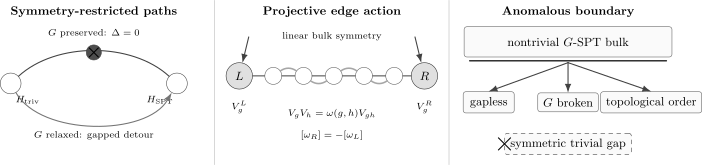
The SPT ledger. Left: within the -symmetric Hamiltonian space, a path between trivial and nontrivial phases must lose the gap; relaxing permits a gapped detour. Center: an open one-dimensional SPT has ordinary linear symmetry in the bulk but projective edge factors . Right: an anomalous boundary may remain gapless, break , or develop intrinsic topological order, but cannot be a standalone symmetric trivial gap under the stated assumptions.
Anomaly inflow
Section titled “Anomaly inflow”Couple the symmetry to a nondynamical background field . The bulk effective action may change under a boundary-supported gauge transformation:
The boundary partition function transforms oppositely,
Only the combined bulk–boundary system is invariant. This is anomaly inflow. Here “anomaly” does not mean that the microscopic symmetry is inconsistent. It means that the boundary symmetry action cannot be regularized as an ordinary standalone local theory in the boundary dimension while retaining all assumptions.
Boundary spectra are not individually universal
Section titled “Boundary spectra are not individually universal”Bulk topology constrains the boundary anomaly, not every microscopic boundary energy. Symmetric boundary perturbations can move, broaden, or reconstruct states. Additional trivial boundary bands can appear. Opposite anomalous sectors can cancel. A physical edge can also break the protecting symmetry even when the bulk Hamiltonian does not.
Thus the robust claim is not
The robust claim is that no allowed boundary completion removes the total anomaly without one of the permitted alternatives above. The dedicated edge-and-surface treatment will own the wider termination and spectroscopy taxonomy.
Defects and interfaces
Section titled “Defects and interfaces”An interface between phases and carries the same obstruction as the boundary of
If , a symmetric trivially gapped interface is generally allowed. If not, the difference phase must be accounted for by interface degrees of freedom. Symmetry twists, fluxes, dislocations, and domain walls can likewise expose lower-dimensional SPT data. This dimensional reduction viewpoint is central to decorated-domain-wall constructions and crystalline SPT phases.
One-Dimensional SPT Phases
Section titled “One-Dimensional SPT Phases”One dimension provides the cleanest interacting classification. Assume a local bosonic chain with:
- a unique gapped ground state on a periodic chain;
- unbroken onsite unitary symmetry ;
- finite correlation length;
- stable equivalence under linear-representation ancillas.
At long distances the ground state is represented faithfully by an injective matrix-product state. If is the onsite physical representation, symmetry acts on an MPS tensor as
The physical action is linear, but the virtual matrices need only be projective:
Associativity produces a cocycle
Section titled “Associativity produces a cocycle”Associating in two ways gives
This is the 2-cocycle condition. Rephasing the virtual action,
changes the factor set to
The two factor sets describe equivalent projective representations. Their equivalence classes form
For the assumptions above, classifies the one-dimensional bosonic SPT factor. Extra one-dimensional representations can encode charge per unit cell or boundary conventions, and translation or symmetry breaking adds further data. Antiunitary and reflection symmetries require twisted versions of the cocycle equations.
Why the two ends carry inverse classes
Section titled “Why the two ends carry inverse classes”For a long open interval, the low-energy symmetry action factorizes approximately:
Each factor can be projective,
while the full microscopic action remains linear. Therefore the right edge carries the inverse class,
The pair can combine to a linear representation. Coupling the two ends through the bulk produces a splitting exponentially small in length,
but a local symmetric perturbation near only one end cannot select a unique state from an irreducible projective multiplet. Attaching an external projective degree of freedom to that end can screen it; the boundary Hilbert space is therefore part of any edge claim.
Stacking multiplies cocycles
Section titled “Stacking multiplies cocycles”For two chains with virtual actions and ,
Their factor sets multiply:
This realizes cohomology addition physically. If a class has order , then copies can be symmetrically disentangled after suitable inter-copy couplings and stable ancillas are allowed.
The Haldane Chain as a Prototype
Section titled “The Haldane Chain as a Prototype”The spin-1 antiferromagnetic chain is the canonical interacting bosonic example. At the Affleck–Kennedy–Lieb–Tasaki fixed point, each spin 1 is represented as two virtual spin- objects projected onto the symmetric onsite subspace. Neighboring virtual spins form singlets. On a periodic chain every virtual spin is paired; on an open chain one spin- remains at each end.
The bulk onsite states transform linearly under , because integer spin is an ordinary representation of . A boundary spin- is projective under . For rotations about orthogonal axes, one may choose
so that
The corresponding physical rotations commute, but their edge representatives commute only up to a phase. This is the nontrivial element of
Two copies have two spin- degrees of freedom at each end. They can combine into an integer-spin singlet, consistent with the stacking law.
Which symmetry protects it?
Section titled “Which symmetry protects it?”The odd-integer-spin Haldane phase can be protected by any one of several symmetry choices, including:
- the dihedral group generated by spin rotations;
- time reversal;
- bond-centered inversion;
- full spin rotation.
These are different classification problems. Breaking one symmetry does not trivialize the phase if another protecting symmetry is still enforced. Conversely, saying “the Haldane phase is protected” without naming the retained group is incomplete.
String order and edge spin are useful diagnostics, but neither alone is the definition. String order can depend on the chosen symmetry and operator. Edge degeneracy can be screened by added boundary degrees of freedom. The invariant information is the bulk symmetric phase class, accessible through the projective action on Schmidt states or an equivalent many-body invariant. Entanglement Spectrum owns the extraction and interpretation of those Schmidt multiplets.
Cluster and dimerized-chain contrasts
Section titled “Cluster and dimerized-chain contrasts”The one-dimensional cluster state gives another bosonic SPT fixed point, commonly protected by a onsite symmetry after a suitable choice of unit cell. Its stabilizer form makes edge logical operators explicit.
The SSH model is a free-fermion dimerized chain. Its winding number relies on a single-particle chiral constraint, while inversion can quantize polarization under different assumptions. Chiral symmetry in a band Hamiltonian is not automatically an ordinary onsite many-body symmetry. The SSH model is excellent band-topology intuition, but its boundary zero energy, boundary charge, and interacting classification must be tied to the exact symmetry and termination.
Free-Fermion SPT Examples
Section titled “Free-Fermion SPT Examples”For a quadratic fermion Hamiltonian, occupied-band or BdG topology gives a powerful first classification. The tenfold way uses time reversal, particle–hole constraints, chiral symmetry, and spatial dimension. Crystalline symmetries refine the problem. Representative examples include:
| System | Protecting structure | Free-fermion label | Canonical treatment |
|---|---|---|---|
| quantum spin Hall insulator | charge and spinful time reversal | two-dimensional class AII | Topological Insulators |
| strong topological insulator | charge and spinful time reversal | three-dimensional class AII | Topological Insulators |
| Kitaev chain | BdG fermion parity, class D constraint | one-dimensional | Topological Superconductors |
| time-reversal Majorana chain | on fermions, class BDI | one-dimensional before interactions | Topological Superconductors |
| crystalline topological phase | reflection, rotation, inversion, glide, or screw | symmetry- and dimension-dependent | Symmetry Classification Preview |
Band invariants diagnose Gaussian ground states. An interacting SPT classification asks a larger question: can two many-body ground states be connected by any local symmetry-preserving interacting path?
Class BDI and the Z8 interaction reduction
Section titled “Class BDI and the Z8 interaction reduction”The class-BDI Majorana chain is the standard warning. Quadratic Hamiltonians have an integer index counting protected end Majoranas. Symmetry-preserving quartic interactions can gap eight end Majoranas without leaving degeneracy, so
in the interacting classification. Values of that differ by eight are not distinct interacting phases.
Class DIII and the Z16 interaction reduction
Section titled “Class DIII and the Z16 interaction reduction”Three-dimensional class-DIII topological superconductors provide a higher-dimensional analogue:
under interactions. These reductions do not mean weak interactions immediately destroy every boundary state. They mean that the global phase-equivalence relation contains symmetric interacting paths absent from the quadratic subspace.
Interactions can also create phases
Section titled “Interactions can also create phases”The opposite phenomenon also occurs. Interactions can produce bosonic or fermionic SPT phases with no free-particle representative. A complete interacting classification therefore cannot be obtained by simply taking a periodic table and adding perturbative corrections.
The safe hierarchy is:
- identify the microscopic symmetry group, including fermion parity;
- determine the free classification if a quadratic description is justified;
- test which labels survive arbitrary symmetry-preserving interactions;
- include intrinsically interacting phases not reachable from free fermions.
Interacting SPT Phases
Section titled “Interacting SPT Phases”An interacting SPT can have no sharp single-particle bands at all. Its universal data may instead appear in many-body response, symmetry defects, entanglement, or anomalous surfaces.
Bosonic integer quantum Hall phase
Section titled “Bosonic integer quantum Hall phase”Two-dimensional bosons with conserved charge can form an SPT with no anyonic bulk excitations and a unique ground state on the torus. Its Hall conductivity is an even integer in natural bosonic units:
The minimal nontrivial state has counterpropagating edge modes whose net chiral central charge vanishes but whose charge response cannot be symmetrically removed. The evenness follows from bosonic locality and the absence of intrinsic topological order, not from a free-boson band Chern number.
Symmetric gapped surfaces with topological order
Section titled “Symmetric gapped surfaces with topological order”A three-dimensional SPT surface need not remain gapless. Strong interactions can generate a symmetric gapped surface with anyons. The symmetry then acts on those anyons in a pattern impossible in a strictly two-dimensional system with the same microscopic assumptions. This is anomalous symmetry enrichment.
Such a surface does not convert the bulk SPT into intrinsic three-dimensional topological order. The bulk remains invertible. The anyons live only in a chosen boundary termination, and a different boundary may be gapless or symmetry breaking.
Gauging as a diagnostic
Section titled “Gauging as a diagnostic”For a finite onsite symmetry, one can promote symmetry twists to dynamical gauge fluxes. Distinct SPTs can then yield distinct braiding or statistics of the flux excitations. Schematically,
Gauging is a diagnostic transformation, not a claim that the original SPT contained deconfined anyons. Before gauging, symmetry defects are extrinsic and require branch cuts or background fields.
Group Cohomology Preview
Section titled “Group Cohomology Preview”Group cohomology organizes a large and important family of bosonic SPT phases with onsite symmetry. The cleanest finite-group statement is formulated in spacetime dimension for a system with spatial dimensions.
Why d plus one appears
Section titled “Why d plus one appears”An -cochain assigns a phase to group arguments. The coboundary operator satisfies
An -cocycle obeys , while an -coboundary has the form . Cohomology is the quotient
For the bosonic onsite-unitary construction,
labels a family of -dimensional SPT fixed points. The shift by one occurs because the cocycle weights a -dimensional spacetime history, not merely a spatial configuration.
Background-field response
Section titled “Background-field response”For a finite group, a flat background gauge field can be represented by a map
where is the classifying space. A cocycle defines a topological phase of the partition function,
Changing by a coboundary changes the closed-manifold action only by a boundary term. On a manifold with boundary, that term is precisely where the anomalous boundary transformation appears.
Antiunitary symmetry and twisted coefficients
Section titled “Antiunitary symmetry and twisted coefficients”For antiunitary symmetry, the coefficients are twisted because antiunitary elements complex-conjugate phases. One writes schematically
For continuous compact groups, Borel group cohomology or equivalently suitable cohomology of supplies the relevant refinement. These statements require care about topology on and about which background bundles are allowed.
What group cohomology does not classify
Section titled “What group cohomology does not classify”The formula must not be presented as the complete classification of every SPT. Its original domain is bosonic phases with onsite internal symmetry, and even there it misses known beyond-cohomology phases in some dimensions. It does not by itself include:
- fermionic statistics and spin-structure dependence;
- all antiunitary or orientation-reversing subtleties;
- all crystalline symmetries;
- symmetry-independent chiral invertible phases;
- every bosonic SPT beyond the cohomology construction.
Fermionic supercohomology captures an important subset of fermionic SPTs. Cobordism and generalized-homology approaches provide broader frameworks. In modern language, an interacting invertible phase defines a deformation class of reflection-positive invertible field theories with specified tangential and symmetry structure. The mathematics is powerful, but the physical input remains essential: dimension, statistics, symmetry extension, orientation or spin structure, and locality.
Bridge to Quantum Field Theory and Mathematical Physics
Section titled “Bridge to Quantum Field Theory and Mathematical Physics”SPT phases connect lattice many-body physics to anomalies and invertible topological quantum field theories. At distances much larger than the correlation length, a gapped bulk has no propagating low-energy modes, yet its partition function can retain a topological phase depending on background gauge fields and geometry.
Electromagnetic theta response
Section titled “Electromagnetic theta response”For a three-dimensional electronic topological insulator, the long-wavelength electromagnetic term is
On a closed spin-compatible spacetime, is periodic modulo . Time reversal sends
so time-reversal-invariant values satisfy
The response represents the strong topological-insulator SPT. If a surface is gapped by breaking time reversal, its Hall response contains the half-integer offset required by the bulk. A purely two-dimensional lattice system cannot realize that isolated offset with the same symmetry and charge assumptions; the bulk supplies the anomaly inflow. The detailed sewing-matrix invariant, surface Dirac cone, and material qualifications live in Topological Insulators.
Anomaly as a classification tool
Section titled “Anomaly as a classification tool”A candidate boundary theory can be tested by asking whether its symmetry can be gauged consistently in its own dimension. A nontrivial obstruction indicates an anomaly and hence a possible SPT bulk one dimension higher. Conversely, not every formal anomaly has a given microscopic condensed-matter realization; the symmetry must act consistently on the actual local Hilbert space.
The bulk–boundary relation can be summarized as
with the understanding that both sides are defined only after specifying background fields, spacetime structure, and local counterterms. Two boundary descriptions with the same anomaly can represent the same bulk even when one is gapless and another has topological order.
From cocycles to cobordism
Section titled “From cocycles to cobordism”Group cocycles provide explicit lattice fixed points and discrete topological actions. Cobordism asks which manifolds with the required structures can bound and which partition-function phases are invariant under bordism. Very schematically, an invertible phase gives a homomorphism
where records orientation, spin, pin, or related tangential structure. This language naturally tracks gravitational responses and fermionic signs that ordinary group cohomology can miss.
The schematic formula is an entry point, not a turnkey classification algorithm. Torsion, extension problems, interaction constraints, and the distinction between state-sum constructions and all invertible phases require careful mathematics.
Diagnostics and Evidence
Section titled “Diagnostics and Evidence”No single edge peak, degeneracy, or band inversion establishes an SPT. A reliable claim joins several layers:
| Layer | Question | Strong evidence |
|---|---|---|
| symmetry | what exactly is , and how does it act? | operator relations, controlled symmetry-breaking perturbations |
| bulk | is the phase gapped and symmetry preserving? | size scaling, correlation length, absence of order, bulk spectroscopy |
| invariant | what distinguishes it from the trivial phase? | projective Schmidt action, many-body response, defect invariant, validated band/BdG index |
| boundary | is the boundary behavior anomalous? | robust multiplet, protected flow, or symmetry-enriched topological order |
| stacking | how do copies combine? | explicit symmetric coupling or invariant addition |
| interaction scope | is the label free or interacting? | stability to general local interactions, not only quadratic perturbations |
Numerical workflow in one dimension
Section titled “Numerical workflow in one dimension”For a matrix-product-state calculation:
- verify convergence in bond dimension and system size;
- verify a nonzero bulk gap or finite correlation length;
- confirm that the ground state does not spontaneously break ;
- extract the symmetry action on the Schmidt space;
- determine the gauge-invariant projective class ;
- test the predicted stacking law or a symmetry-breaking interpolation.
A degenerate entanglement spectrum is supporting evidence, not the invariant by itself. Accidental degeneracy and ordinary irreducible representations can produce similar level multiplicities. The projective multiplication law is the sharper diagnostic.
Experimental claim discipline
Section titled “Experimental claim discipline”In a material or simulator, test:
- whether the protecting symmetry is accurate on the relevant scale;
- whether bulk and boundary signals come from the same phase and sample region;
- whether disorder, reconstruction, or parasitic channels explain the boundary data;
- whether deliberately breaking the symmetry removes the protected structure as predicted;
- whether finite temperature is below both the bulk gap and relevant boundary coherence scales.
An approximate symmetry gives approximate protection. A weak symmetry-breaking term can produce an exponentially or parametrically small gap, but the exact SPT classification applies only to the exact symmetry limit.
Common Mistakes
Section titled “Common Mistakes”Calling every short-range-entangled state trivial
Section titled “Calling every short-range-entangled state trivial”Without symmetry, many SPT states can be disentangled. With symmetry enforced, the required finite-depth circuit may be obstructed.
Calling every topological phase an SPT
Section titled “Calling every topological phase an SPT”Fractional quantum Hall states and toric-code phases have intrinsic topological order. A Chern insulator remains nontrivial without an optional protecting symmetry and is better described as a symmetry-independent invertible phase.
Treating an edge zero mode as the definition
Section titled “Treating an edge zero mode as the definition”Boundary energies depend on termination and attached degrees of freedom. The universal object is the anomaly or projective class of the total boundary realization.
Using the tenfold way as an interacting classification
Section titled “Using the tenfold way as an interacting classification”The tenfold way classifies stable free-fermion Hamiltonians. Interactions can reduce, enlarge, or otherwise reorganize the classification.
Writing group cohomology without its domain
Section titled “Writing group cohomology without its domain”is a major bosonic onsite-symmetry construction, not a universal formula for fermionic, crystalline, antiunitary, and beyond-cohomology phases.
Ignoring stable equivalence
Section titled “Ignoring stable equivalence”Inert linear-representation ancillas do not create new bulk phases. Conversely, adding a projective boundary spin or a lower-dimensional SPT layer can alter boundary data and must be declared.
Confusing a symmetric finite sample with an unbroken phase
Section titled “Confusing a symmetric finite sample with an unbroken phase”A finite system can form a symmetric cat state even when the thermodynamic phase breaks symmetry. Diagnose symmetry breaking through scaling, correlations, and the ground-state sector.
Assuming approximate symmetry gives exact protection
Section titled “Assuming approximate symmetry gives exact protection”Approximate symmetry can make a boundary gap small. It does not define an exact cohomology class for the perturbed Hamiltonian.
Exercises
Section titled “Exercises”1. Symmetry-forbidden and symmetry-allowed paths
Section titled “1. Symmetry-forbidden and symmetry-allowed paths”Consider
with a unitary symmetry imposed when . Compare the endpoints and . Show why every symmetric path between them closes the gap, while a path that permits can remain gapped.
Solution
The symmetry condition is
Therefore a -symmetric Hamiltonian requires . Its eigenvalues are
A continuous symmetric path from to passes through , where the gap closes.
If the symmetry constraint is relaxed, use
Then
The gap remains . This two-level model illustrates the topology of the allowed Hamiltonian space; a many-body SPT additionally requires locality, stable equivalence, and a thermodynamic gap.
2. Derive the projective cocycle condition
Section titled “2. Derive the projective cocycle condition”Starting from
derive the 2-cocycle condition by associating in two ways. Then show how changes under .
Solution
The first association gives
The second gives
Associativity therefore requires
With ,
Thus
which differs by a coboundary and represents the same cohomology class.
3. Projective edge rotations in the Haldane phase
Section titled “3. Projective edge rotations in the Haldane phase”Let and represent rotations at one edge. Evaluate and . Why can this edge action not be a one-dimensional linear representation of the physical dihedral rotation group?
Solution
Using and ,
Hence
The corresponding physical rotations commute in the quotient appropriate to integer spins, but the spin- edge matrices commute only up to the central phase . That phase is invisible in the action on rays yet records a nontrivial projective class. A one-dimensional representation consists of complex numbers and must commute exactly, so it cannot realize this class.
4. Why two Haldane chains can cancel
Section titled “4. Why two Haldane chains can cancel”Stack two chains whose left edges each carry spin . Construct a local -invariant coupling that removes the edge degeneracy, and relate the result to the classification.
Solution
Let and be the two edge spins. The local coupling
is invariant. Since
the antiferromagnetic coupling selects a unique spin singlet. In projective language the two nontrivial factor sets multiply to a coboundary:
The same cancellation occurs at the right edge. With suitable symmetric bulk interchain couplings, the two-copy stack is adiabatically connected to a trivial phase.
5. Audit three possible boundaries
Section titled “5. Audit three possible boundaries”A two-dimensional bosonic SPT has a one-dimensional boundary. For each proposed boundary, state whether it can match a nontrivial SPT anomaly: (a) a stable gapless symmetric theory; (b) a gapped boundary with two symmetry-related ground states; (c) a unique gapped symmetric short-range-entangled boundary.
Solution
(a) A stable gapless symmetric boundary can match the anomaly. Symmetry forbids all perturbations that would produce a unique trivial gap.
(b) The two ground states indicate spontaneous symmetry breaking in the thermodynamic limit. This is another allowed fate: the boundary is gapped but does not preserve the protecting symmetry.
(c) A unique gapped symmetric short-range-entangled boundary would be an ordinary standalone one-dimensional phase. Under the stated assumptions it cannot absorb a nontrivial two-dimensional SPT anomaly. It would imply that the bulk class is trivial or that some assumption, such as the symmetry action or boundary Hilbert space, has changed.
A one-dimensional boundary cannot support intrinsic anyonic topological order, so the higher-dimensional “symmetric topological order” escape route is unavailable here.
6. Time reversal and the theta angle
Section titled “6. Time reversal and the theta angle”Assume the electromagnetic theta angle is periodic under and that time reversal sends . Find the time-reversal-invariant values.
Solution
Time-reversal invariance requires
for some integer . Therefore
Modulo , there are two possibilities:
The value is the ordinary insulator response and is the strong topological-insulator response. This argument classifies the response term under the assumptions; identifying a microscopic material still requires a bulk gap, the correct symmetry, and a validated invariant.
7. Interactions and the BDI stacking law
Section titled “7. Interactions and the BDI stacking law”Free class-BDI chains have integer index . Interactions reduce the classification to . Determine whether stacks with , , and are distinct from the trivial phase and from one another.
Solution
The interacting invariant is
Therefore
The stack is interacting-trivial: eight end Majoranas can be gapped by symmetry-preserving interactions without residual degeneracy. The and stacks represent the same nontrivial interacting phase because they differ by eight. This conclusion concerns the existence of an interacting adiabatic path; it does not say that an arbitrary weak interaction instantly removes eight free-theory boundary modes.
8. Audit an SPT claim
Section titled “8. Audit an SPT claim”A finite chain has a fourfold near-degenerate low-energy manifold and an even-fold entanglement spectrum. The authors call it a SPT without reporting symmetry operators, gap scaling, or projective phases. What is established, and what is missing?
Solution
The observations establish compatible phenomenology: low-energy boundary-like states and entanglement degeneracy. They do not establish the SPT class.
A stronger analysis needs:
- explicit generators of and their onsite action;
- evidence that the thermodynamic bulk is gapped;
- scaling that separates edge splitting from bulk excitations;
- evidence against spontaneous symmetry breaking;
- the symmetry action on the Schmidt space;
- the gauge-invariant commutator or cocycle class;
- stability under symmetry-preserving perturbations;
- a symmetry-breaking perturbation that can remove the obstruction as predicted.
For commuting generators and , a useful projective diagnostic is
In the nontrivial class, in a suitable irreducible Schmidt sector; in the trivial class, . The conclusion must remain stable under bond-dimension and system-size convergence tests.
Connections
Section titled “Connections”- Topology in Quantum Matter supplies the general gapped-path, response, boundary, and evidence ledger.
- Symmetry-Protected Structure Preview compares SPT protection with Kramers degeneracy, gap protection, and ordinary perturbation constraints.
- Phases of Matter in Many-Body QM owns the thermodynamic phase-equivalence framework.
- Matrix Product States Preview develops canonical forms, virtual symmetry actions, and the AKLT representation.
- Entanglement Spectrum owns Schmidt levels, symmetry resolution, projective actions, and numerical extraction.
- Topological Insulators develops class-AII invariants, helical boundaries, theta response, and material evidence.
- Edge and Surface States develops the observable boundary phenomenology, symmetry-breaking mass tests, finite-size hybridization, and experimental evidence ladder.
- Bulk–Boundary Correspondence compares free boundary indices with the interacting options of gaplessness, symmetry breaking, degeneracy, and intrinsic surface order.
- Topological Superconductors develops BdG topology, Majorana modes, interacting caveats, and platform diagnostics.
- Symmetry Classification Preview introduces the free-fermion tenfold way and its dimensional dependence.
- Topological Order Preview distinguishes SPT invertibility from long-range entanglement, anyons, and topology-dependent ground sectors.
- Topological Order supplies the contrasting noninvertible classification through anyon, modular, entanglement, and response data.
- SSH Model is the compact free-fermion dimerized-chain reference.
Further Reading
Section titled “Further Reading”- T. Senthil, “Symmetry-Protected Topological Phases of Quantum Matter,” Annual Review of Condensed Matter Physics 6, 299–324 (2015), doi:10.1146/annurev-conmatphys-031214-014740.
- C.-K. Chiu, J. C. Y. Teo, A. P. Schnyder, and S. Ryu, “Classification of Topological Quantum Matter with Symmetries,” Reviews of Modern Physics 88, 035005 (2016), doi:10.1103/RevModPhys.88.035005.
- X.-G. Wen, Quantum Field Theory of Many-Body Systems, Oxford University Press (2004), Chapters 8–10.
References
Section titled “References”One-dimensional phases and projective symmetry
Section titled “One-dimensional phases and projective symmetry”- F. D. M. Haldane, “Continuum Dynamics of the 1-D Heisenberg Antiferromagnet: Identification with the O(3) Nonlinear Sigma Model,” Physics Letters A 93, 464–468 (1983), doi:10.1016/0375-9601(83)90631-X.
- I. Affleck, T. Kennedy, E. H. Lieb, and H. Tasaki, “Rigorous Results on Valence-Bond Ground States in Antiferromagnets,” Physical Review Letters 59, 799–802 (1987), doi:10.1103/PhysRevLett.59.799.
- F. Pollmann, E. Berg, A. M. Turner, and M. Oshikawa, “Entanglement Spectrum of a Topological Phase in One Dimension,” Physical Review B 81, 064439 (2010), doi:10.1103/PhysRevB.81.064439.
- X. Chen, Z.-C. Gu, and X.-G. Wen, “Classification of Gapped Symmetric Phases in One-Dimensional Spin Systems,” Physical Review B 83, 035107 (2011), doi:10.1103/PhysRevB.83.035107.
- N. Schuch, D. Pérez-García, and I. Cirac, “Classifying Quantum Phases Using Matrix Product States and Projected Entangled Pair States,” Physical Review B 84, 165139 (2011), doi:10.1103/PhysRevB.84.165139.
- F. Pollmann, E. Berg, A. M. Turner, and M. Oshikawa, “Symmetry Protection of Topological Phases in One-Dimensional Quantum Spin Systems,” Physical Review B 85, 075125 (2012), doi:10.1103/PhysRevB.85.075125.
Interacting SPT constructions and boundaries
Section titled “Interacting SPT constructions and boundaries”- X. Chen, Z.-X. Liu, and X.-G. Wen, “Two-Dimensional Symmetry-Protected Topological Orders and Their Protected Gapless Edge Excitations,” Physical Review B 84, 235141 (2011), doi:10.1103/PhysRevB.84.235141.
- X. Chen, Z.-C. Gu, Z.-X. Liu, and X.-G. Wen, “Symmetry-Protected Topological Orders in Interacting Bosonic Systems,” Science 338, 1604–1606 (2012), doi:10.1126/science.1227224.
- X. Chen, Z.-C. Gu, Z.-X. Liu, and X.-G. Wen, “Symmetry Protected Topological Orders and the Group Cohomology of Their Symmetry Group,” Physical Review B 87, 155114 (2013), doi:10.1103/PhysRevB.87.155114.
- M. Levin and Z.-C. Gu, “Braiding Statistics Approach to Symmetry-Protected Topological Phases,” Physical Review B 86, 115109 (2012), doi:10.1103/PhysRevB.86.115109.
- Y.-M. Lu and A. Vishwanath, “Theory and Classification of Interacting Integer Topological Phases in Two Dimensions: A Chern–Simons Approach,” Physical Review B 86, 125119 (2012), doi:10.1103/PhysRevB.86.125119.
- T. Senthil and M. Levin, “Integer Quantum Hall Effect for Bosons,” Physical Review Letters 110, 046801 (2013), doi:10.1103/PhysRevLett.110.046801.
- A. Vishwanath and T. Senthil, “Physics of Three-Dimensional Bosonic Topological Insulators: Surface-Deconfined Criticality and Quantized Magnetoelectric Effect,” Physical Review X 3, 011016 (2013), doi:10.1103/PhysRevX.3.011016.
- D. V. Else and C. Nayak, “Classifying Symmetry-Protected Topological Phases through the Anomalous Action of the Symmetry on the Edge,” Physical Review B 90, 235137 (2014), doi:10.1103/PhysRevB.90.235137.
Fermions, interactions, and mathematical classification
Section titled “Fermions, interactions, and mathematical classification”- L. Fidkowski and A. Kitaev, “Effects of Interactions on the Topological Classification of Free Fermion Systems,” Physical Review B 81, 134509 (2010), doi:10.1103/PhysRevB.81.134509.
- L. Fidkowski and A. Kitaev, “Topological Phases of Fermions in One Dimension,” Physical Review B 83, 075103 (2011), doi:10.1103/PhysRevB.83.075103.
- M. A. Metlitski, L. Fidkowski, X. Chen, and A. Vishwanath, “Interaction Effects on 3D Topological Superconductors: Surface Topological Order from Vortex Condensation, the 16 Fold Way and Fermionic Kramers Doublets,” Physical Review B 92, 125111 (2015), doi:10.1103/PhysRevB.92.125111.
- A. Kapustin, “Symmetry Protected Topological Phases, Anomalies, and Cobordisms: Beyond Group Cohomology,” arXiv:1403.1467 (2014), doi:10.48550/arXiv.1403.1467.
- D. S. Freed and M. J. Hopkins, “Reflection Positivity and Invertible Topological Phases,” Geometry & Topology 25, 1165–1330 (2021), doi:10.2140/gt.2021.25.1165.
- K. Shiozaki and M. Sato, “Topology of Crystalline Insulators and Superconductors,” Physical Review B 90, 165114 (2014), doi:10.1103/PhysRevB.90.165114.
- R. Thorngren and D. V. Else, “Gauging Spatial Symmetries and the Classification of Topological Crystalline Phases,” Physical Review X 8, 011040 (2018), doi:10.1103/PhysRevX.8.011040.