Chern Numbers in Band Theory
The Chern number of a two-dimensional band insulator is the quantized Berry-curvature flux of its occupied Bloch subspace over the Brillouin-zone torus. It is an integer that remains fixed under smooth deformations preserving the occupied–empty gap, and, with the response conventions stated below, it determines the zero-temperature filled-band Hall conductivity:
The important object is , not necessarily the Chern number of each energy-ordered band. Occupied bands may cross and mix among themselves while the total occupied subspace remains smooth and separated from empty states.
Chern Numbers owns the general geometric invariant and its gauge-patch origin. Topology in Quantum Matter owns gapped-phase equivalence and the general boundary-response ledger. This page owns the band-theory specialization: Bloch conventions, occupied projectors, symmetry constraints, the Kubo bridge, a lattice-regulated two-band example, and reliable numerical evaluation.
Flat Bands owns spectral flattening, compact-localization constraints, quantum-metric effects, and the interaction criteria that distinguish a nearly flat Chern band from an established fractional Chern phase.
Required background. Bloch’s Theorem and Brillouin Zones supply the momentum-space bundle, while Berry Curvature and Chern Numbers supply the geometric flux and its quantization.
Helpful background. Topology in Quantum Matter places the occupied-projector invariant inside the wider phase, response, and evidence hierarchy.
Convention Ledger
Section titled “Convention Ledger”Consider a translation-invariant, noninteracting, two-dimensional crystal. Bloch’s theorem gives
with
The cell-periodic states are normalized in one primitive cell. Crystal momentum lies on the oriented Brillouin torus,
For an isolated band, define
and
The band Chern number is
Take the electron charge to be , with , and use the conductivity tensor convention already fixed on Integer Quantum Hall Effect. With the Berry convention above,
The minus sign is part of the complete convention block: it follows from the electron charge, the stated Berry connection, the orientation, and . Reversing the Brillouin-zone orientation reverses . Changing the sign convention for the Berry connection also reverses it and the written Chern-to-Hall bridge. A consistent physical prediction is convention independent.
The Occupied Subspace
Section titled “The Occupied Subspace”Suppose bands are filled. A direct gap separating occupied and empty states means
The gauge-invariant occupied projector is
An arbitrary smooth unitary rotation among occupied states,
leaves unchanged. The occupied Chern number can therefore be written without choosing separate band gauges:
This form remains valid when occupied bands touch one another. Only the gap between the occupied and empty subspaces must remain open.
Non-Abelian connection
Section titled “Non-Abelian connection”Collect the occupied eigenvectors into a matrix
The occupied-space Berry connection and curvature are
Then
If every occupied band is isolated from every other band, this reduces to
If two occupied bands cross, assigning separate values by instantaneous energy order can become meaningless even though their sum remains well defined.
Direct gap versus insulating filling
Section titled “Direct gap versus insulating filling”The direct gap above is enough to define a smooth occupied projector of fixed rank. A band insulator additionally needs an indirect gap,
If
the lower bands define a mathematical bundle, but a physical chemical potential at that filling intersects electron and hole pockets. The system is metallic, and the filled-band quantization formula does not describe its dc Hall response without further qualifications.
Gauge Patches on the Brillouin Torus
Section titled “Gauge Patches on the Brillouin Torus”A Bloch eigenvector can be rephased locally:
The connection changes,
while is unchanged.
A nonzero Chern number obstructs one globally smooth, periodic eigenvector gauge over the Brillouin torus. One may use smooth gauges on overlapping patches and , related by
The Chern number is the winding of this transition phase around patch overlaps. The apparent singularity belongs to the gauge choice, not to the energy spectrum.
For an isolated occupied subspace, nonzero equivalently obstructs an exponentially localized, translation-covariant orthonormal Wannier basis spanning that subspace. Wannier Functions owns the precise composite-band Fourier construction and localization criterion. Wannierization Workflows owns numerical subspace construction and full-zone validation, including the stopping rule that an optimization failure alone does not establish this topological obstruction.
This distinction matters numerically:
- a gauge discontinuity can occur in perfectly smooth, gapped physics;
- an energy degeneracy across the occupied–empty gap makes the occupied projector singular and can change ;
- a degeneracy within the occupied subspace invalidates separate-band gauges but not the total projector.
Opposite edges of a plotted Brillouin polygon are identified. A finite-difference calculation that treats those edges as unrelated open boundaries is not computing curvature on .
A Lattice-Regulated Two-Band Example
Section titled “A Lattice-Regulated Two-Band Example”Consider the square-lattice two-band Hamiltonian
Its energies are
where
The gap closes only when all three components vanish. This occurs at four high-symmetry momenta:
| Momentum | Dirac chirality | Mass |
|---|---|---|
For the occupied lower band and the orientation convention above,
away from the gap-closing points. Therefore
At , the lower-band Chern number is not defined because the gap closes. Topological Phase Transitions explains this invariant transfer through Berry monopoles in extended space and distinguishes the clean mechanism from mobility-gap and many-body transitions.
For a two-band model, the lower-band curvature can be written
so measures the degree of the map
The lattice completion is essential. Each isolated massive Dirac cone suggests a half-integer contribution, but the full Brillouin zone contains all cones and produces an integer.
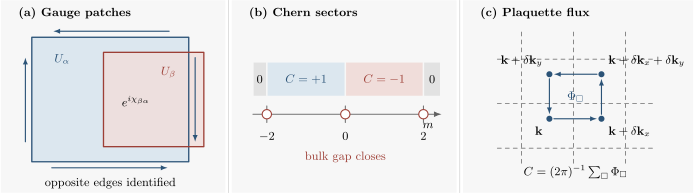
The band Chern ledger. Opposite Brillouin-zone edges are identified and a nonzero requires gauge patching. In the regulated two-band model, gap closings at separate integer sectors. On a numerical mesh, link phases around each oriented plaquette give , and is the total flux divided by .
Hall Conductivity from Band Geometry
Section titled “Hall Conductivity from Band Geometry”The velocity operator in a Bloch fiber is
For a nondegenerate band, first-order eigenvector perturbation theory gives
Substitution into the Berry curvature yields the interband formula
The zero-temperature Kubo formula for a clean insulator can then be reorganized as
Using
and gives
This is the Thouless–Kohmoto–Nightingale–den Nijs relation.
Metals and finite temperature
Section titled “Metals and finite temperature”If the chemical potential intersects a band, the intrinsic clean-limit contribution takes the Fermi-weighted form
The occupation factor no longer covers complete bands, so the result is generally not quantized. At nonzero temperature, even an insulator receives exponentially small carrier corrections when is much smaller than the gap; disorder, inelastic processes, and contacts add platform-specific corrections.
The Integer Quantum Hall Effect develops the mobility-gap and localization mechanism that turns the invariant into robust plateaus in a disordered device. Kubo Formula owns the general response derivation.
Symmetry Constraints
Section titled “Symmetry Constraints”Time reversal
Section titled “Time reversal”For a time-reversal-symmetric occupied subspace,
The trace Berry curvature is odd:
Because the Brillouin zone is inversion symmetric as an integration domain,
This does not make every time-reversal-invariant insulator topologically trivial. Topological Insulators develops the invariant used by quantum spin Hall and three-dimensional strong and weak phases.
Spatial symmetries
Section titled “Spatial symmetries”An orientation-reversing symmetry of the two-dimensional Brillouin zone, such as an in-plane mirror that leaves the Hamiltonian invariant, also forces the scalar curvature flux to cancel and hence forces .
Inversion alone is orientation preserving in two dimensions:
whose Jacobian determinant is . It therefore does not forbid a Chern insulator. With both inversion and time reversal, however, the corresponding curvature constraints often force the Berry curvature to vanish pointwise for an isolated nondegenerate band.
Broken time reversal is necessary for nonzero equilibrium charge Hall conductivity in the ordinary two-dimensional setting, but it is not sufficient. A magnetic band insulator can still have .
Numerical Computation
Section titled “Numerical Computation”Numerical work should compute the occupied subspace, not rely on visually smooth eigenvector phases.
Velocity-matrix integration
Section titled “Velocity-matrix integration”One route evaluates
and integrates it over a dense Brillouin-zone mesh. This can resolve curvature hot spots and is useful for physical interpretation. It becomes numerically delicate near small gaps and requires a consistent treatment of degenerate occupied multiplets.
Gauge-invariant plaquette method
Section titled “Gauge-invariant plaquette method”Let contain an orthonormal basis for all occupied states at mesh point . For a step , define the overlap matrix
and its normalized determinant link
The orientation of this overlap is chosen to match
For the positively oriented plaquette based at , define
where
Then
Gauge phases and arbitrary unitary rotations of the occupied basis cancel around every plaquette. Periodic mesh wrapping implements the torus identifications.
The method is reliable when neighboring occupied subspaces have nonsingular overlap and no plaquette hides more curvature flux than the principal branch can resolve. A useful admissibility check is
Wilson-loop cross-check
Section titled “Wilson-loop cross-check”At fixed , multiply occupied-space links around the cycle. With the link orientation above, the determinant phase
tracks the total hybrid-Wannier center modulo . After phase unwrapping,
A Chern band exhibits spectral flow: the Wilson-loop phase cannot return without an integer winding.
This page retains the static occupied-projector Chern problem on the Brillouin-zone torus. Berry-Phase Polarization and Charge Pumping owns polarization branches and transported charge when a one-dimensional insulator is extended over a closed adiabatic-cycle torus.
Validation checklist
Section titled “Validation checklist”- Verify Hermiticity and eigenpair residuals at every mesh point.
- Compute the minimum occupied–empty direct gap before computing topology.
- Wrap both mesh directions periodically and keep one orientation convention.
- Use the occupied determinant link rather than tracking energy-ordered bands through crossings.
- Refine the mesh until , the gap, and curvature hot spots converge.
- Apply random unitary rotations inside the occupied subspace; the answer must not change.
- Compare plaquette flux, projector integration, or Wilson-loop winding when possible.
- Never round a drifting noninteger result without diagnosing branch cuts, zero overlaps, missing periodic links, or a closing gap.
Common Mistakes
Section titled “Common Mistakes”Confusing local curvature with the invariant
Section titled “Confusing local curvature with the invariant”Berry curvature can be sharply concentrated, sign changing, or nonzero in a topologically trivial band. Only the total flux over the closed Brillouin torus is quantized.
Assigning topology by energy order through a crossing
Section titled “Assigning topology by energy order through a crossing”If occupied bands cross, their labels can exchange. Compute the total occupied projector or a symmetry-resolved subspace whose isolation has been proved.
Ignoring filling
Section titled “Ignoring filling”A nonzero Chern number for a selected band does not imply a quantized Hall response when that band is partially filled or overlapped indirectly by another band.
Treating a gauge jump as a band singularity
Section titled “Treating a gauge jump as a band singularity”Eigenvector phases from a diagonalization routine can jump arbitrarily. Inspect projectors, overlaps, and energy gaps before diagnosing a physical transition.
Forgetting the torus boundary
Section titled “Forgetting the torus boundary”The first Brillouin zone is a fundamental domain with identified edges. Omitting wraparound plaquettes changes the topology of the numerical domain.
Rounding too early
Section titled “Rounding too early”A value such as is not “numerically one.” Refine the mesh and inspect the maximum plaquette flux, overlap determinants, and minimum gap.
Quoting a sign without conventions
Section titled “Quoting a sign without conventions”State the Berry-connection sign, Brillouin-zone orientation, electron-charge convention, and conductivity tensor convention. Magnitudes alone can hide an inconsistent derivation.
Exercises
Section titled “Exercises”1. Gauge invariance of the occupied projector
Section titled “1. Gauge invariance of the occupied projector”Show that is invariant under
where is unitary in the occupied subspace.
Solution
The transformed projector is
Therefore any expression built only from and its derivatives is independent of the chosen occupied basis. This is why the projector formula remains meaningful at crossings within the occupied manifold.
2. Direct and indirect gaps
Section titled “2. Direct and indirect gaps”Suppose
but
Can the lower-band Chern number be defined? Is the system a filled-band Chern insulator at one electron per cell?
Solution
The positive direct gap means band 1 is isolated from band 2 at every , so its line bundle and Chern number can be defined. The negative indirect gap means the top of band 1 lies above the bottom of band 2 at different momenta. At one electron per cell, electron and hole pockets generally occur, so there is no global chemical potential separating the two bands. The system is not a filled-band Chern insulator and its dc Hall conductivity is not forced to equal in this page’s convention.
3. Two-band phase diagram
Section titled “3. Two-band phase diagram”For the regulated model in this page, evaluate
at .
Solution
Using
gives:
The changes occur at , where one or two Dirac masses vanish and the bulk gap closes.
4. Time reversal forces zero charge Chern number
Section titled “4. Time reversal forces zero charge Chern number”Assume
Show that the occupied charge Chern number vanishes.
Solution
The Brillouin torus is invariant under . Pair every point with its time-reversed partner:
A time-reversal-invariant phase can still possess a invariant because that invariant is not the net charge Chern number.
5. Gauge cancellation on a plaquette
Section titled “5. Gauge cancellation on a plaquette”For one occupied band, let
Show that the oriented plaquette product is gauge invariant.
Solution
Write the four corner phases as . The four links contribute
Their product is one. Hence the plaquette phase is gauge invariant modulo .
6. Hall-conductivity normalization
Section titled “6. Hall-conductivity normalization”Starting from
show that a filled band with Chern number contributes in this page’s convention.
Solution
By definition,
Therefore
7. Sum over a complete finite-band basis
Section titled “7. Sum over a complete finite-band basis”In a tight-binding model with a fixed finite set of localized orbitals per cell, explain why the sum of Chern numbers over all bands is zero.
Solution
The full orbital Hilbert space over each has a global -independent basis supplied by the localized orbitals, so the complete vector bundle is trivial. Its projector is
and therefore
The projector Chern formula gives
When all individual bands are isolated, additivity implies
Nonzero Chern number is redistributed among bands rather than created for the complete basis.
8. Diagnose a numerical result
Section titled “8. Diagnose a numerical result”A mesh gives after rounding, but the unrounded curvature integral is , one plaquette has , and the minimum direct gap is in hopping units. Is the result validated?
Solution
No. The largest plaquette flux is nearly the principal-branch boundary , so the mesh can hide unresolved flux. The tiny direct gap requires much finer sampling near the avoided or actual crossing, and the drifting noninteger integral shows nonconvergence.
A valid follow-up should:
- locate and resolve the minimum gap;
- refine the mesh adaptively or globally;
- monitor overlap determinants and plaquette phases;
- check stability under occupied-space gauge rotations;
- compare with a Wilson-loop or projector calculation.
Rounding is the final presentation step, not a convergence test.
Connections
Section titled “Connections”- Bloch’s Theorem supplies the crystal-momentum fibers and cell-periodic states.
- Brillouin Zones explains why the integration domain is a torus with identified boundary pieces.
- Berry Connection and Berry Curvature own the local geometric objects.
- Chern Numbers and the mathematical toolkit treatment own quantization through gauge patching.
- Tight-Binding Models develops lattice Hamiltonians and orbital-basis conventions used in numerical band models.
- Topology in Quantum Matter places in the broader phase, boundary, response, and evidence hierarchy.
- Moiré Topology applies the isolated-projector invariant to tunable minibands, flavor cancellation, interaction-selected Chern states, and fractional Hall phases.
- Bulk–Boundary Correspondence turns relative Chern numbers into oriented edge spectral flow and gives a lattice-regulated strip validation workflow.
- Integer Quantum Hall Effect develops Landau levels, localization, edge channels, flux insertion, plateaus, and metrology.
- Weyl and Dirac Semimetals uses this invariant on two-dimensional momentum slices: its jumps locate Weyl nodes and its boundary spectral flow produces Fermi arcs.
- Berry Curvature Formula Card and Chern Number Formula Card provide compact lookup conventions.
References
Section titled “References”Foundational band topology and Hall response
Section titled “Foundational band topology and Hall response”- D. J. Thouless, M. Kohmoto, M. P. Nightingale, and M. den Nijs, “Quantized Hall Conductance in a Two-Dimensional Periodic Potential,” Physical Review Letters 49, 405–408 (1982), doi:10.1103/PhysRevLett.49.405.
- J. E. Avron, R. Seiler, and B. Simon, “Homotopy and Quantization in Condensed Matter Physics,” Physical Review Letters 51, 51–53 (1983), doi:10.1103/PhysRevLett.51.51.
- M. Kohmoto, “Topological Invariant and the Quantization of the Hall Conductance,” Annals of Physics 160, 343–354 (1985), doi:10.1016/0003-4916(85)90148-4.
- Q. Niu, D. J. Thouless, and Y.-S. Wu, “Quantized Hall Conductance as a Topological Invariant,” Physical Review B 31, 3372–3377 (1985), doi:10.1103/PhysRevB.31.3372.
- F. D. M. Haldane, “Model for a Quantum Hall Effect without Landau Levels: Condensed-Matter Realization of the ‘Parity Anomaly’,” Physical Review Letters 61, 2015–2018 (1988), doi:10.1103/PhysRevLett.61.2015.
- Y. Hatsugai, “Chern Number and Edge States in the Integer Quantum Hall Effect,” Physical Review Letters 71, 3697–3700 (1993), doi:10.1103/PhysRevLett.71.3697.
- J. Bellissard, A. van Elst, and H. Schulz-Baldes, “The Noncommutative Geometry of the Quantum Hall Effect,” Journal of Mathematical Physics 35, 5373–5451 (1994), doi:10.1063/1.530758.
Numerical and computational methods
Section titled “Numerical and computational methods”- T. Fukui, Y. Hatsugai, and H. Suzuki, “Chern Numbers in Discretized Brillouin Zone: Efficient Method of Computing (Spin) Hall Conductances,” Journal of the Physical Society of Japan 74, 1674–1677 (2005), doi:10.1143/JPSJ.74.1674.
- R. Resta, “Macroscopic Polarization in Crystalline Dielectrics: The Geometric Phase Approach,” Reviews of Modern Physics 66, 899–915 (1994), doi:10.1103/RevModPhys.66.899.
- N. Marzari and D. Vanderbilt, “Maximally Localized Generalized Wannier Functions for Composite Energy Bands,” Physical Review B 56, 12847–12865 (1997), doi:10.1103/PhysRevB.56.12847.
Reviews and references
Section titled “Reviews and references”- D. Xiao, M.-C. Chang, and Q. Niu, “Berry Phase Effects on Electronic Properties,” Reviews of Modern Physics 82, 1959–2007 (2010), doi:10.1103/RevModPhys.82.1959.
- M. Z. Hasan and C. L. Kane, “Colloquium: Topological Insulators,” Reviews of Modern Physics 82, 3045–3067 (2010), doi:10.1103/RevModPhys.82.3045.
- X.-L. Qi and S.-C. Zhang, “Topological Insulators and Superconductors,” Reviews of Modern Physics 83, 1057–1110 (2011), doi:10.1103/RevModPhys.83.1057.
- D. Vanderbilt, Berry Phases in Electronic Structure Theory, Cambridge University Press (2018), doi:10.1017/9781316662205.