Flat Bands
A flat band is a family of one-particle eigenstates whose energy is independent of crystal momentum over the Brillouin zone:
The equality may be exact in an ideal lattice Hamiltonian or approximate over a specified momentum and energy window. Exact flatness quenches the usual dispersion-driven group velocity and produces an extensive degeneracy. It does not erase the Bloch wavefunctions, their orbital texture, quantum metric, Berry curvature, topology, or interaction form factors.
That distinction prevents several common overclaims:
| Statement | What follows | What does not follow |
|---|---|---|
| in an ideal band | dispersion-driven group velocity vanishes | every state is a localized atomic orbital |
| is small | residual kinetic competition is weak | interactions choose one universal phase |
| the density of states is large | many states occupy a narrow energy interval | the states carry large current or pair stiffness |
| compact localized states exist | destructive interference traps some eigenstates | those states necessarily span a touching flat band |
| a band has | its projector has a topological obstruction | its energy must be dispersive |
| a flat-band Hubbard model polarizes | theorem-specific hypotheses are satisfied | every experimental narrow band is ferromagnetic |
The durable object is therefore not the bandwidth alone. It is the combination of dispersion, isolation, projector geometry, interactions, disorder, filling, and observables.
Canonical Scope
Section titled “Canonical Scope”This page is the canonical home for flat bands across quantum matter. It owns exact versus approximate flatness, compact localized states, singular band touchings, spectral flattening, the scale hierarchy for projected interactions, quantum metric and Berry curvature in flat bands, Chern-band constraints, and flat-band ferromagnetism.
Wannier Functions owns the Bloch-projector-to-localized-basis construction, localization tests, and obstructions. Tight-Binding Models owns hopping Hamiltonians, embeddings, truncation, and model validation. Density of States owns normalization and spectral counting. Effective Mass owns curvature, cyclotron, optical, and quasiparticle masses. Chern Numbers in Band Theory owns Chern quantization and Hall response.
Moiré Superlattices owns generic mini-zone formation and moiré energy scales, while Twisted Bilayer Graphene owns the Bistritzer–MacDonald mechanism and TBG evidence. This page compares those examples with frustrated lattices, Landau levels, heavy quasiparticles, and artificial wave systems.
Suppressed Kinetic Energy
Section titled “Suppressed Kinetic Energy”Exact, nearly flat, and heavy are different
Section titled “Exact, nearly flat, and heavy are different”For an isolated Bloch band, the semiclassical band velocity is .
An exactly flat band has everywhere that the band is differentiable. Its curvature also vanishes, so assigning an infinite curvature mass is a useful shorthand only when the band is isolated and smooth. At a touching with another band, a single-band effective-mass expansion is not defined.
For a nearly flat band, define the bandwidth
If it is separated from all other bands, useful direct isolation gaps are
A common flatness ratio is
It is meaningful only if and both direct gaps are positive. It says nothing about Berry-curvature uniformity, disorder broadening, or interaction-induced mixing.
A heavy quasiparticle band is conceptually different. Its small velocity may result from a frequency-dependent many-body self-energy and a small quasiparticle residue , not from an exactly degenerate one-electron Hamiltonian. A Landau level is different again: magnetic translations replace ordinary translations, and the degeneracy is tied to flux rather than a zero-field lattice interference pattern.
Density of states is not transport
Section titled “Density of states is not transport”For exactly degenerate one-particle states in volume , the flat-band contribution is distributionally
Finite lifetime, temperature, disorder, instrumental resolution, and residual dispersion broaden the delta function. A peak in tunneling or photoemission is therefore compatible with a flat band but does not establish one without momentum-resolved dispersion and a resolution budget.
Current response contains velocities and interband matrix elements as well as state counting. A large can coexist with a small conventional Drude weight. Conversely, geometric interband matrix elements can support optical response and superfluid weight even when the intraband group velocity vanishes.
Destructive Interference and Compact States
Section titled “Destructive Interference and Compact States”An exactly solvable cross-stitch chain
Section titled “An exactly solvable cross-stitch chain”Consider two orbitals in each one-dimensional cell. Let every orbital in cell hop with amplitude to both orbitals in cells , and let the intracell hopping be . Define . In the basis ,
The symmetric and antisymmetric cell combinations diagonalize the matrix:
Their energies are
The antisymmetric state is exactly flat. In real space,
has support on one cell. The two amplitudes leak toward any neighboring orbital with equal magnitude and opposite sign, so the leakage cancels. This is a compact localized state (CLS): an exact eigenstate with strictly finite support.
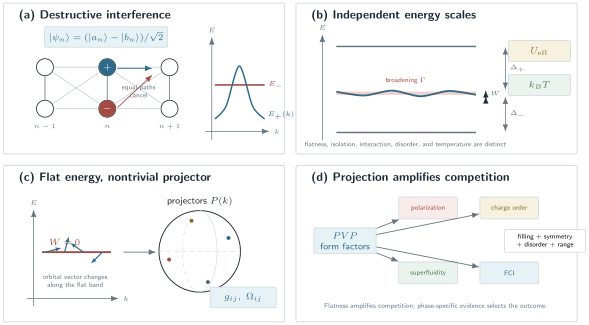
The flat-band ledger. (a) Opposite amplitudes on a cross-stitch cell cancel hopping to its neighbors and produce a compact localized state with . (b) Bandwidth , isolation gaps , broadening , interactions , and temperature are independent scales. (c) Spectral flatness fixes energy but not the projector ; changing Bloch vectors retain quantum metric and Berry curvature . (d) Projected interactions can favor magnetism, charge order, superfluidity, or fractional topology, and each requires phase-specific evidence.
Compact states need not form a complete basis
Section titled “Compact states need not form a complete basis”Translating a CLS through every cell produces many flat-band eigenstates. They are not always linearly independent or complete. If the flat band touches a dispersive band, its normalized Bloch eigenvector can become singular at the touching. The missing states on a torus may be noncontractible loop states that extend around the system.
This separates two cases:
- a nonsingular flat band defines a smooth isolated projector and can admit a complete localized description consistent with its topology;
- a singular flat band touches another band in a way that obstructs a globally smooth one-band eigenvector, so translated CLSs alone do not span the degenerate subspace.
Kagome and Lieb nearest-neighbor models provide canonical singular examples. The band touching is not a minor plotting detail: a perturbation that gaps it can generate dispersion and, when time-reversal symmetry is broken appropriately, a Chern band.
Lattice constructions organize interference
Section titled “Lattice constructions organize interference”Several structures produce flat bands:
| Construction | Core mechanism | Typical caveat |
|---|---|---|
| local symmetry or orbital antisymmetry | a decoupled local combination | generic symmetry breaking restores dispersion |
| line graph | incidence-matrix kernel gives destructive-interference modes | flat band often touches another band |
| sublattice imbalance with chiral hopping | more zero modes than opposite-sublattice constraints | same-sublattice hopping shifts or disperses them |
| Aharonov–Bohm cage | magnetic phases cancel all escape paths | flux detuning releases the cage |
| fine-tuned longer-range hopping | cancels selected Fourier harmonics | parameter errors reduce flatness |
| continuum or moiré interference | multiple scattering paths suppress kinetic energy | relaxation and inhomogeneity reshape the result |
Geometric frustration is common but not a definition. The algebraic question is whether the hopping map has a momentum-independent eigenvalue or a real-space kernel whose boundary amplitudes cancel.
Spectral Flattening
Section titled “Spectral Flattening”Energy and eigenvectors can be varied independently. For isolated-band projectors ,
A spectrally flattened Hamiltonian replaces the dispersions by constants:
The eigenvectors, Berry curvature, Chern numbers, symmetry representations, and the fact that adjacent manifolds remain separated are preserved as long as the chosen constants are distinct; the numerical gap sizes are deliberately changed. This construction is central in topological classification because it shows that topology lives in the projectors, not in the detailed dispersion.
The real-space cost matters. A smooth but nonpolynomial generally Fourier transforms into hopping over arbitrarily long distances, often with exponential decay when the band is analytic and isolated. Exact spectral flattening is therefore not the same as finding a short-range material Hamiltonian with .
For a nonzero-Chern isolated band, there is no complete exponentially localized Wannier basis respecting translation. In particular, exact flatness, strict finite-range hopping, isolation, and nonzero Chern number cannot generically be demanded simultaneously. Nearly flat short-range Chern models and exactly flat long-range parent models realize different compromises.
Enhanced Interactions
Section titled “Enhanced Interactions”Projection removes dispersion, not matrix structure
Section titled “Projection removes dispersion, not matrix structure”Let project onto one flat or nearly flat manifold. A two-body interaction becomes
For a translation-invariant density interaction,
where
The form factor
remembers how the Bloch states vary across momentum. Two bands with identical can therefore have different projected interactions and different many-body phases.
The scale hierarchy controls the projection
Section titled “The scale hierarchy controls the projection”A useful hierarchy compares
The interaction-dominated but single-manifold regime is most controlled when
If , interactions mix remote bands and a one-band projection may fail. If , experiment may be unable to distinguish intrinsic flatness from inhomogeneous broadening. If , arbitrarily weak perturbations act at first order inside the degenerate subspace; “small” must then be defined relative to the next retained scale.
At partial filling, projected interactions can favor:
- spin, valley, or orbital polarization;
- charge order or Wigner crystallization;
- paired and phase-coherent states;
- fractional Chern insulators;
- phase separation or compressibility anomalies;
- disorder-selected localized textures.
Flatness amplifies competition. It does not choose the winner.
Band Geometry
Section titled “Band Geometry”The projector can vary while the energy does not
Section titled “The projector can vary while the energy does not”For an isolated band with normalized cell-periodic state , define
Neighboring projectors differ even when is constant. Their gauge-invariant distance begins as
The quantum geometric tensor is
using the convention
The real symmetric part is the quantum metric. The imaginary antisymmetric part gives the Berry curvature. Both depend only on the projector and survive spectral flattening.
For a rank-one band,
The Brillouin-zone integral of controls the gauge-invariant part of Wannier spread. A band can therefore have zero dispersion but spatially extended or obstructed Wannier functions.
Geometry supports motion of pairs and collective states
Section titled “Geometry supports motion of pairs and collective states”In a conventional isolated dispersive band, superfluid weight contains a contribution related to band curvature. In a multiband flat system, virtual interband motion encoded in can contribute even when that conventional term vanishes. Schematically,
with prefactors and matrix structure determined by the pairing model. A large density of states can enhance pair formation, while quantum geometry helps determine whether those pairs possess phase stiffness. Pairing and superfluidity are not the same criterion.
The pointwise two-dimensional inequality
implies an integrated metric bound for a Chern band. Topology therefore forbids the Bloch states from being geometrically trivial everywhere.
Chern Bands
Section titled “Chern Bands”Flatness imitates one Landau-level ingredient
Section titled “Flatness imitates one Landau-level ingredient”An ideal Landau level combines exact kinetic degeneracy with a nonzero Chern number and highly constrained guiding-center geometry. A nearly flat lattice Chern band aims to reproduce enough of that structure without a net continuum magnetic field.
For an isolated two-dimensional band,
Energy flatness does not determine . A trivial CLS band can have ; a spectrally flattened Chern band retains . What nonzero forbids is a globally smooth periodic eigenvector and a complete exponentially localized Wannier basis for that isolated band.
Fractional phases require more than a large flatness ratio
Section titled “Fractional phases require more than a large flatness ratio”At fractional filling, repulsive interactions in a suitable Chern band can produce a fractional Chern insulator (FCI), the lattice analogue of a fractional quantum Hall phase. Favorable ingredients often include:
- small compared with the many-body interaction gap;
- a positive isolation gap large enough to control remote-band mixing;
- nonzero Chern number;
- Berry curvature and quantum metric not too strongly concentrated;
- projected-density form factors resembling a useful Landau-level algebra;
- disorder and temperature below the many-body gap.
These are diagnostics, not a theorem of existence. Geometry that is nonuniform can favor competing charge order; longer-range interactions can stabilize or destabilize candidate fractions.
Evidence for an FCI should combine a fractional Hall response with a bulk charge gap, ground-state degeneracy or flux-insertion spectral flow in numerics, fractional quasiparticle signatures when available, and tests against conventional symmetry breaking. A fractional filling and resistance minimum are not enough.
Flat-Band Ferromagnetism
Section titled “Flat-Band Ferromagnetism”The Stoner shortcut is suggestive but uncontrolled
Section titled “The Stoner shortcut is suggestive but uncontrolled”The weak-coupling Stoner criterion is often written
An ideal flat band appears to make divergent. But the same degeneracy invalidates ordinary nondegenerate perturbation theory, and the projected interaction depends on wavefunction overlaps. The criterion motivates a polarization tendency; it does not prove a ferromagnetic ground state.
Mielke–Tasaki ferromagnetism has explicit hypotheses
Section titled “Mielke–Tasaki ferromagnetism has explicit hypotheses”For a repulsive Hubbard model,
suppose the flat band is the lowest one-particle band after an energy shift, and suppose a basis of localized flat-band states satisfies a connectivity condition: the states overlap through the physical sites so that the overlap graph is connected. At the theorem’s specified filling, a fully spin-polarized state avoids double occupancy and is a ground state; under the connectivity hypotheses, the only ground-state degeneracy is the spin multiplet.
The overlap condition is essential. If compact states occupy disconnected traps, each trap can choose its spin independently and global ferromagnetism need not follow. Band touching, partial flatness, additional orbitals, longer-range interactions, and nonuniform hopping require theorem-specific extensions rather than a slogan.
Lieb’s theorem is related but distinct. For the repulsive Hubbard model on a bipartite lattice at half filling, under its hypotheses,
Sublattice imbalance often produces a flat band, but the theorem establishes a ferrimagnetic total spin for the full half-filled model. It is not simply the Stoner argument applied to a delta-function density of states.
For a material claim, the Ferromagnetism standard still applies: demonstrate spontaneous magnetization or its thermodynamic equivalent, distinguish spin and orbital contributions, account for domains, and connect the order to the measured active band.
Moiré and Lattice Examples
Section titled “Moiré and Lattice Examples”| Platform | Flattening mechanism | What must be measured or specified |
|---|---|---|
| cross-stitch, stub, Lieb, and kagome lattices | destructive interference and local constraints | hopping graph, touching structure, CLS completeness |
| line-graph Hubbard models | incidence-matrix kernel plus connectivity | filling, repulsion, overlap graph, perturbations |
| Landau levels | cyclotron quantization and magnetic translations | field, degeneracy, disorder broadening, level mixing |
| moiré graphene | interference between rotated Dirac cones | local twist, relaxation, , remote gaps, form factors |
| moiré semiconductors | long-period potential, tunneling, and effective mass | registry, displacement field, screening, valley character |
| heavy-fermion bands | interaction-driven hybridization and small coherence scale | quasiparticle residue, self-energy, temperature window |
| optical, photonic, polaritonic, and circuit lattices | designed couplings and interference | loss, drive, interactions, mode-resolved dispersion |
| artificial electronic lattices | patterned surface potential or atom assembly | local density of states, finite-size effects, substrate coupling |
These platforms obey similar eigenvalue algebra but not identical many-body physics. Photonic and polaritonic systems are driven and lossy; cold atoms have different interaction ranges and probes; electrons carry charge and couple to a Fermi sea, phonons, and long-range Coulomb fields.
Evidence that a band is flat
Section titled “Evidence that a band is flat”A defensible experimental report separates:
- dispersion: momentum-resolved upper and lower energies over the full relevant zone;
- resolution: instrumental, lifetime, thermal, and inhomogeneous broadening;
- isolation: direct gaps to remote bands, including symmetry-enforced touchings;
- state count: integrated spectral weight and internal degeneracy;
- wavefunction structure: sublattice, orbital, layer, polarization, or local-mode texture;
- response: transport, compressibility, optics, or dynamics predicted from the same calibrated band.
A nearly nondispersing spectral peak over one cut can be a saddle point, localized impurity state, matrix-element effect, or unresolved multiplet. Flatness is a statement over a momentum domain.
Common Mistakes
Section titled “Common Mistakes”Equating zero group velocity with no quantum transport
Section titled “Equating zero group velocity with no quantum transport”Single-particle intraband motion is quenched, but interband matrix elements, topology, interactions, and collective motion can remain.
Calling every narrow band flat
Section titled “Calling every narrow band flat”Report , , , and the momentum range. “Flat” without a comparison scale is qualitative.
Treating a density-of-states peak as a dispersion map
Section titled “Treating a density-of-states peak as a dispersion map”A van Hove singularity, lifetime effect, or local state can also create a peak. Momentum resolution and state counting are separate checks.
Assuming compact localized states always span the band
Section titled “Assuming compact localized states always span the band”At a singular touching, translated CLSs are linearly dependent and noncontractible states complete the subspace.
Applying a flat-band ferromagnetism theorem by analogy
Section titled “Applying a flat-band ferromagnetism theorem by analogy”The band ordering, filling, repulsion, positivity, and connectivity assumptions must be checked in the actual orbital basis.
Optimizing only gap divided by bandwidth
Section titled “Optimizing only gap divided by bandwidth”FCIs and geometric superfluids depend on projectors and form factors. A large cannot compensate for uncontrolled band mixing or pathological geometry.
Exercises
Section titled “Exercises”Exercise 1: diagonalize the cross-stitch chain
Section titled “Exercise 1: diagonalize the cross-stitch chain”Diagonalize the cross-stitch Hamiltonian and verify directly that has momentum-independent energy.
Solution
The matrix has equal diagonal entries and equal off-diagonal entries, so its eigenvectors are the symmetric and antisymmetric combinations. Acting on the antisymmetric vector gives
All terms proportional to cancel. The symmetric vector instead has energy .
Exercise 2: flatness and isolation
Section titled “Exercise 2: flatness and isolation”A band has , , , interaction scale , and broadening . Compute and assess the hierarchy.
Solution
The smaller isolation gap is , so
suggests interaction-dominated dispersion, while leaves only a modest separation from remote bands. Moreover , so the intrinsic dispersion is not resolved by a probe with that broadening. A projected model may be useful, but neither the one-band approximation nor the experimental claim of a measured bandwidth is automatically controlled.
Exercise 3: a flat band with nonzero quantum metric
Section titled “Exercise 3: a flat band with nonzero quantum metric”In one dimension, take a normalized flat-band eigenvector
Compute .
Solution
The derivative is
Therefore
Hence
The dispersion can be exactly constant while the orbital composition winds with and gives nonzero quantum distance.
Exercise 4: why spectral flattening becomes long range
Section titled “Exercise 4: why spectral flattening becomes long range”Explain why replacing by a constant while retaining a nontrivial generally introduces long-range hopping.
Solution
Real-space hopping amplitudes are Fourier coefficients of . A finite-range tight-binding Hamiltonian is a finite Laurent polynomial in . The projector
contains momentum-dependent energy denominators. Even when it is smooth, it is generally not a finite Laurent polynomial. Its Fourier series therefore extends to arbitrarily distant cells, with decay set by analyticity and the complex-momentum gap.
Exercise 5: connectivity in flat-band ferromagnetism
Section titled “Exercise 5: connectivity in flat-band ferromagnetism”Two compact orbitals are disjoint in real space and each hosts one electron. Does repulsive onsite select their spins to be parallel?
Solution
No. Each electron already avoids double occupancy, and disjoint orbitals have no shared site on which onsite can compare their spin configuration. Parallel and antiparallel states remain degenerate in this ideal projection. A connectivity condition, residual hopping, exchange, or another interaction is needed to couple the spins and select global order.
Exercise 6: the metric bound of a Chern band
Section titled “Exercise 6: the metric bound of a Chern band”For a two-dimensional isolated band with , use to show a lower bound on the integrated metric.
Solution
Integrating the pointwise inequality gives
The first inequality is geometric; the second is the triangle inequality. Nonzero Chern number therefore forces a nonzero Brillouin-zone-integrated quantum metric.
Summary
Section titled “Summary”- An exact flat band has momentum-independent energy; a nearly flat band requires a stated bandwidth and comparison scale.
- Vanishing dispersion suppresses conventional group velocity but leaves orbital texture, quantum metric, Berry curvature, and interaction form factors.
- Destructive interference can create compact localized states, but singular touching bands require additional noncontractible states.
- Spectral flattening preserves projectors and topology, usually at the cost of long-range hopping.
- A controlled projected-interaction regime separates , disorder, and temperature from interactions, while keeping interactions below the remote-band gap.
- Large density of states enhances competition but does not select ferromagnetism, superconductivity, charge order, or fractional topology by itself.
- Mielke–Tasaki ferromagnetism depends on positivity, filling, and connectivity; Lieb ferrimagnetism is a related but distinct theorem.
- Chern bands cannot be characterized by flatness ratio alone: quantum geometry and many-body evidence are indispensable.
Connections
Section titled “Connections”- Artificial Lattices and Designer Matter compares how optical, photonic, polaritonic, circuit, quantum-dot, and assembled-electron platforms implement and validate flat-band graphs.
- Quantum Materials by Design explains why bandwidth is only one coordinate in a stability, disorder, synthesis, and property-validation problem.
- Wannier Functions develops the projector, frame, localized representation, and obstruction audit; Tight-Binding Models develops hopping matrices, Bloch Hamiltonians, orbital embedding, and model validation.
- Density of States owns delta-function normalization, broadening, van Hove singularities, and projected spectra.
- Effective Mass explains when small curvature can be represented by a heavy mass and when that language fails.
- Moiré Superlattices derives emergent cells, mini Brillouin zones, minibands, and tunable interaction scales.
- Twisted Bilayer Graphene gives the continuum and experimental account of one prominent nearly flat platform.
- Correlated Insulators in Moiré Systems shows how flat-band interaction amplification is separated experimentally into Mott-like, charge-ordered, flavor-ordered, and topological insulating mechanisms.
- Moiré Superconductivity explains how narrow bands reshape pairing scales, phase stiffness, quantum-geometric contributions, and the BCS–BEC crossover.
- Moiré Topology applies band-isolation and quantum-geometry diagnostics to tunable Chern, QAH, and fractional Chern phases.
- Landau Levels derives magnetic kinetic degeneracy and its flux-controlled state count.
- Berry Curvature and Chern Numbers in Band Theory own the geometric invariant and Hall-response derivations.
- Hubbard Physics in Materials gives the active-space and validation workflow for interaction models.
- Ferromagnetism supplies the phase definition and experimental standard beyond model ground-state spin.
- BCS Theory supplies the conventional pairing baseline against which geometric flat-band superfluidity is compared.
Further Reading
Section titled “Further Reading”- B. Sutherland, “Localization of Electronic Wave Functions Due to Local Topology,” Physical Review B 34, 5208–5211 (1986), doi:10.1103/PhysRevB.34.5208.
- E. H. Lieb, “Two Theorems on the Hubbard Model,” Physical Review Letters 62, 1201–1204 (1989), doi:10.1103/PhysRevLett.62.1201.
- A. Mielke, “Ferromagnetic Ground States for the Hubbard Model on Line Graphs,” Journal of Physics A: Mathematical and General 24, L73–L77 (1991), doi:10.1088/0305-4470/24/2/005.
- H. Tasaki, “Ferromagnetism in the Hubbard Models with Degenerate Single-Electron Ground States,” Physical Review Letters 69, 1608–1611 (1992), doi:10.1103/PhysRevLett.69.1608.
- A. Mielke and H. Tasaki, “Ferromagnetism in the Hubbard Model: Examples from Models with Degenerate Single-Electron Ground States,” Communications in Mathematical Physics 158, 341–371 (1993), doi:10.1007/BF02108079.
- H. Tasaki, “From Nagaoka’s Ferromagnetism to Flat-Band Ferromagnetism and Beyond,” Progress of Theoretical Physics 99, 489–548 (1998), doi:10.1143/PTP.99.489.
- A. Mielke, “Ferromagnetism in Single-Band Hubbard Models with a Partially Flat Band,” Physical Review Letters 82, 4312–4315 (1999), doi:10.1103/PhysRevLett.82.4312.
- D. L. Bergman, C. Wu, and L. Balents, “Band Touching from Real-Space Topology in Frustrated Hopping Models,” Physical Review B 78, 125104 (2008), doi:10.1103/PhysRevB.78.125104.
- E. Kapit and E. Mueller, “Exact Parent Hamiltonian for the Quantum Hall States in a Lattice,” Physical Review Letters 105, 215303 (2010), doi:10.1103/PhysRevLett.105.215303.
- S. D. Huber and E. Altman, “Bose Condensation in Flat Bands,” Physical Review B 82, 184502 (2010), doi:10.1103/PhysRevB.82.184502.
- E. Tang, J.-W. Mei, and X.-G. Wen, “High-Temperature Fractional Quantum Hall States,” Physical Review Letters 106, 236802 (2011), doi:10.1103/PhysRevLett.106.236802.
- K. Sun, Z. Gu, H. Katsura, and S. Das Sarma, “Nearly Flatbands with Nontrivial Topology,” Physical Review Letters 106, 236803 (2011), doi:10.1103/PhysRevLett.106.236803.
- T. Neupert, L. Santos, C. Chamon, and C. Mudry, “Fractional Quantum Hall States at Zero Magnetic Field,” Physical Review Letters 106, 236804 (2011), doi:10.1103/PhysRevLett.106.236804.
- N. Regnault and B. A. Bernevig, “Fractional Chern Insulator,” Physical Review X 1, 021014 (2011), doi:10.1103/PhysRevX.1.021014.
- E. J. Bergholtz and Z. Liu, “Topological Flat Band Models and Fractional Chern Insulators,” International Journal of Modern Physics B 27, 1330017 (2013), doi:10.1142/S021797921330017X.
- R. Roy, “Band Geometry of Fractional Topological Insulators,” Physical Review B 90, 165139 (2014), doi:10.1103/PhysRevB.90.165139.
- S. Peotta and P. Törmä, “Superfluidity in Topologically Nontrivial Flat Bands,” Nature Communications 6, 8944 (2015), doi:10.1038/ncomms9944.
- S. Mukherjee et al., “Observation of a Localized Flat-Band State in a Photonic Lieb Lattice,” Physical Review Letters 114, 245504 (2015), doi:10.1103/PhysRevLett.114.245504.
- S. Taie et al., “Coherent Driving and Freezing of Bosonic Matter Wave in an Optical Lieb Lattice,” Science Advances 1, e1500854 (2015), doi:10.1126/sciadv.1500854.
- A. Julku, S. Peotta, T. I. Vanhala, D.-H. Kim, and P. Törmä, “Geometric Origin of Superfluidity in the Lieb-Lattice Flat Band,” Physical Review Letters 117, 045303 (2016), doi:10.1103/PhysRevLett.117.045303.
- F. Baboux et al., “Bosonic Condensation and Disorder-Induced Localization in a Flat Band,” Physical Review Letters 116, 066402 (2016), doi:10.1103/PhysRevLett.116.066402.
- M. R. Slot et al., “Experimental Realization and Characterization of an Electronic Lieb Lattice,” Nature Physics 13, 672–676 (2017), doi:10.1038/nphys4105.
- D. Leykam, A. Andreanov, and S. Flach, “Artificial Flat Band Systems: From Lattice Models to Experiments,” Advances in Physics: X 3, 1473052 (2018), doi:10.1080/23746149.2018.1473052.
- J.-W. Rhim and B.-J. Yang, “Classification of Flat Bands According to the Band-Crossing Singularity of Bloch Wave Functions,” Physical Review B 99, 045107 (2019), doi:10.1103/PhysRevB.99.045107.
- J.-W. Rhim and B.-J. Yang, “Singular Flat Bands,” Advances in Physics: X 6, 1901606 (2021), doi:10.1080/23746149.2021.1901606.
- D. M. Kennes et al., “Moiré Heterostructures as a Condensed-Matter Quantum Simulator,” Nature Physics 17, 155–163 (2021), doi:10.1038/s41567-020-01154-3.
- P. Törmä, S. Peotta, and B. A. Bernevig, “Superconductivity, Superfluidity and Quantum Geometry in Twisted Multilayer Systems,” Nature Reviews Physics 4, 528–542 (2022), doi:10.1038/s42254-022-00466-y.