Twisted Bilayer Graphene
Twisted bilayer graphene (TBG) consists of two graphene monolayers rotated by a small relative angle. Near the first magic-angle regime, the moiré hybridization strongly suppresses the velocity and bandwidth of bands near charge neutrality. Coulomb, phonon, strain, disorder, and substrate energy scales can then compete on unusually equal terms.
That compact description contains claims of very different status:
| Claim | Present status | What establishes it |
|---|---|---|
| a small twist produces a long-period moiré pattern | standard | calibrated real- and reciprocal-space structure |
| near-magic devices possess narrow active bands | established, sample dependent | tunneling, photoemission, compressibility, and transport tied to local angle |
| interactions reconstruct the active bands | established | chemical-potential resets, spectral-weight transfer, flavor-resolved Landau fans, and thermodynamic anomalies |
| every integer-filling resistance peak is a Mott insulator | not established | requires excluding one-body gaps, flavor order, topology, localization, and percolation |
| superconductivity occurs in TBG | established in a subset of near-magic devices | zero resistance together with critical-current, field, phase-stiffness, or spectroscopic evidence |
| the pairing mechanism and order-parameter symmetry are known | unresolved | no single microscopic account explains the full device-dependent record |
| TBG can realize Chern and quantum anomalous Hall states | established in selected regimes | hysteretic orbital magnetism and, in the strongest cases, quantized Hall response with vanishing longitudinal resistance |
The durable lesson is not that one twist angle guarantees one phase diagram. It is that TBG provides a controlled setting in which geometry reshapes a Dirac Hamiltonian and makes spin, valley, sublattice, lattice relaxation, interactions, phonons, and topology experimentally comparable.
Canonical Scope
Section titled “Canonical Scope”This page is the canonical home for TBG-specific theory and evidence: the Bistritzer–MacDonald continuum model, the first magic-angle regime, active-band state counting, the observed correlated and superconducting phases, valley-resolved topology, and the open questions that connect them.
Moiré Superlattices owns generic twist and mismatch geometry, moiré periods and cell areas, mini Brillouin zones, miniband construction, filling conversion, screening, and interaction-versus-kinetic scale estimates. Graphene owns the monolayer Dirac basis and perturbation ledger. van der Waals Heterostructures owns assembly, alignment metrology, gates, contacts, and interface evidence.
Flat Bands owns dispersionless-band mechanisms, projector geometry, Chern-band constraints, and flat-band ferromagnetism across platforms. Correlated Insulators in Moiré Systems owns the cross-platform distinction among Mott-like, generalized Wigner, flavor-ordered, topological, and disorder-driven insulating mechanisms. Moiré Superconductivity owns the cross-platform standards for phase coherence, pairing structure, tuning, and device probes, while Moiré Topology owns topological minibands and integer and fractional Hall classifications. Here those ideas appear only as needed to interpret TBG.
Twist Angle and Structure
Section titled “Twist Angle and Structure”Angle is a field, not only a fabrication setting
Section titled “Angle is a field, not only a fabrication setting”In the idealized construction, layer 1 is rotated by and layer 2 by . Their Dirac points in a fixed valley are separated by
where is graphene’s lattice constant. The corresponding moiré period and cell area are derived at Moiré Superlattices. Around , they are approximately
A real device has a displacement field rather than one global angle. Its symmetric gradient contains heterostrain, while the antisymmetric part changes the local rotation:
Raman spectroscopy, scanning probes, diffraction, and quantum oscillations weight this inhomogeneous field differently. A transport-inferred angle is therefore not automatically the local angle in the region controlling a tunneling spectrum or a weak superconducting link.
Interlayer adhesion also reconstructs the nominally rigid pattern. Near small twist, low-energy AB and BA regions expand, AA regions shrink, and strain concentrates near domain walls. In continuum models this commonly reduces the effective AA-like tunneling amplitude relative to the AB/BA-like amplitude . Corrugation, pressure, dielectric environment, and microscopic parameterization all affect those numbers.
Filling conventions must be stated
Section titled “Filling conventions must be stated”Let be carrier density measured from charge neutrality. The dimensionless filling used most often in TBG is
With spin and valley unresolved, each isolated conduction or valence active band accommodates four carriers per moiré cell. Thus
The conduction and valence active bands together contain eight one-electron states per cell: two band labels times two spins times two valleys. Describing as “half filling” can be convenient, but it is ambiguous unless the reference band and sign convention are named. Density offsets, trapped charge, quantum capacitance, and spatially varying must be included before an integer label is treated as a microscopic fact.
Continuum Hamiltonian
Section titled “Continuum Hamiltonian”One valley couples three nearby momenta
Section titled “One valley couples three nearby momenta”Smooth moiré tunneling transfers momenta much smaller than the separation between graphene’s two valleys. To leading order, the valleys can therefore be modeled independently, while spin is a spectator in the one-electron Hamiltonian. In the layer-sublattice basis, one common continuum convention is
For , the rotated monolayer block is
The Pauli matrices act on sublattice. A different Bloch-phase, valley, or layer-rotation convention moves signs and phases among the terms; spectra are unchanged when the basis is transformed consistently.
The leading interlayer tunneling has three harmonics,
where the three connect nearby layer Dirac points and have magnitude . A useful matrix convention is
and are effective continuum parameters, not bare hopping integrals at one atomic registry. The differences generate the moiré reciprocal lattice. Expanding a Bloch state in the momentum-space network connected by those vectors turns the continuum problem into a matrix eigenvalue problem; convergence must be checked against the plane-wave cutoff.
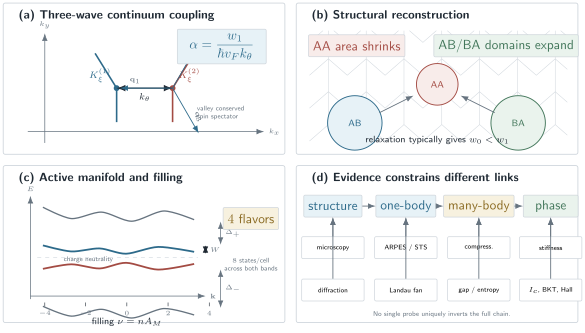
The TBG ledger. (a) Within one valley, three transfers couple the rotated layer Dirac points. (b) Relaxation expands AB/BA regions and suppresses AA-like tunneling relative to AB/BA-like tunneling. (c) The two spin-degenerate, valley-degenerate active bands span to around charge neutrality; narrow bandwidth and remote gaps are separate quantities. (d) Structural calibration, one-electron spectroscopy, thermodynamics, and phase-coherent transport constrain different links in a many-body claim.
The dimensionless coupling organizes the magic regime
Section titled “The dimensionless coupling organizes the magic regime”For the minimal model, the principal dimensionless parameter is
Reducing increases . Weak-coupling perturbation theory gives
so interlayer paths interfere and reduce the Dirac velocity . A full continuum calculation, rather than this truncated series, places the first velocity zero near in the simplest parameterization. In the chiral limit , exactly flat bands occur at discrete couplings; realistic , relaxation, strain, remote hopping, and interactions restore dispersion and particle-hole asymmetry.
This is why the magic angle is not a material constant. A quoted value near or silently assumes values of , , , structural relaxation, and a definition of “magic.” Velocity suppression, minimum bandwidth, maximum remote-band isolation, strongest correlations, and optimal superconductivity need not occur at precisely the same angle.
Magic-Angle Flat Bands
Section titled “Magic-Angle Flat Bands”Flatness is a scale hierarchy
Section titled “Flatness is a scale hierarchy”A useful device report separates at least five scales:
| Scale | Meaning | Why it matters |
|---|---|---|
| active-band bandwidth | residual kinetic dispersion | |
| , | gaps to remote conduction and valence bands | validity of an active-band projection |
| screened Coulomb scale | interaction strength before form factors | |
| disorder and inhomogeneous broadening | whether narrow features are resolved | |
| thermal scale | which gaps and ordered phases survive |
A narrow does not imply that the active bands are isolated, nor that a local-orbital Hubbard model is controlled. The TBG wavefunctions carry layer, sublattice, valley, and momentum-space texture; their projected interaction matrix elements depend on form factors and on screening by gates and remote bands.
For an active-band projection, a representative interaction is
with projected density
Here label active bands, labels spin and valley flavors, and is a Bloch-wave overlap. Discarding discards the quantum geometry and much of the sublattice structure that distinguish TBG from a featureless narrow band.
Flat bands are measured through complementary windows
Section titled “Flat bands are measured through complementary windows”Scanning tunneling spectroscopy can resolve narrow peaks, local gaps, symmetry breaking, and spatial inhomogeneity, but the tunneling matrix element and tip electrostatics affect intensity. Photoemission measures occupied dispersion and replicas but averages over a finite region and may operate at temperatures different from transport. Compressibility accesses , while Landau fans and quantum oscillations constrain degeneracies and Fermi-surface areas. None alone reconstructs the complete interacting spectral function.
Interactions also reshape the bands. Hartree potentials depend strongly on filling and can broaden, invert, or pin portions of the active manifold; exchange can split flavors and alter topology. Agreement between a noninteracting continuum band and one spectrum at one filling is therefore not a license to reuse that band unchanged across the phase diagram.
Correlated Insulating States
Section titled “Correlated Insulating States”Integer filling is a coordinate, not a diagnosis
Section titled “Integer filling is a coordinate, not a diagnosis”The 2018 observation of an insulating state near established that a partially filled narrow manifold could become strongly resistive. Subsequent devices found insulating or semimetallic behavior at several integer fillings, often with Landau-fan resets, compressibility anomalies, or flavor-polarized states. The detailed sequence depends on twist inhomogeneity, strain, screening, substrate alignment, and magnetic or displacement fields.
Calling every such state a Mott insulator is too specific. Competing explanations include:
- interaction-driven flavor polarization that opens a Slater-like or exchange gap;
- intervalley-coherent, valley-polarized, spin-polarized, or sublattice-polarized order;
- a Chern insulator or other topological mass;
- charge order favored by nonlocal interactions;
- a one-electron gap enhanced by interactions;
- disorder localization or percolation through an inhomogeneous gap landscape.
The Mott Insulators page gives the general diagnostic standard. In TBG, the strongest case combines activated transport with a chemical-potential jump or incompressible interval, spectroscopy of a gap and spectral-weight transfer, a consistent broken-symmetry signature, and a model that includes the measured structure.
For density and chemical potential , the inverse electronic compressibility is conventionally written
A jump in across a filling interval is thermodynamic evidence for a charge gap. Negative can occur from exchange without implying instability of the complete gated device, because geometric capacitance and long-range electrostatics contribute to the measured response.
Flavor cascades expose interaction-driven reconstruction
Section titled “Flavor cascades expose interaction-driven reconstruction”In an approximate description, spin rotations and valley charge conservation produce a near-fourfold flavor space. As filling changes, exchange can favor sequential flavor polarization. Compressibility “sawteeth,” chemical-potential resets, changes in Landau-fan degeneracy, and tunneling spectra that reorganize at integer fillings support such cascade physics.
The approximate symmetry is not exact. Lattice-scale intervalley scattering, strain, substrate alignment, remote-band mixing, Zeeman coupling, and phonons select among candidate orders. A flavor count inferred from a Landau fan is also not a direct image of an order parameter: magnetic breakdown, small pockets, and reconstruction can alter the fan.
Entropy supplies another diagnostic. Re-entrant transport and thermodynamic behavior consistent with a Pomeranchuk-like effect indicate that some correlated states carry substantial spin or valley entropy. This supports local-moment-like physics in parts of the phase diagram, but it does not by itself prove a particular lattice model or zero-temperature order.
Superconductivity
Section titled “Superconductivity”What the experiments establish
Section titled “What the experiments establish”Superconducting domes were first reported adjacent to a correlated state in near-magic TBG. Pressure, electrostatic tuning, and subsequent devices showed that superconductivity can also appear when a nearby correlated insulator is weak or absent. The data therefore rule out the universal claim that superconductivity must arise by doping one fixed Mott parent.
Evidence should be graded rather than collapsed into “a resistance drop”:
| Observation | Supports | Important alternatives or missing step |
|---|---|---|
| resistance decreases on cooling | enhanced conduction or pairing fluctuations | current redistribution, metallic percolation, contact effects |
| resistance reaches the experimental floor | a coherent low-resistance path | an inhomogeneous filament can short the device |
| critical current and field suppress the state | collective superconducting response | heating and weak-link networks need calibration |
| nonlinear – scaling near a BKT transition | two-dimensional phase unbinding | finite-size and inhomogeneity can round the scaling |
| tunneling or Andreev gap closes consistently with transport | pairing gap tied to the transition | pseudogaps and junction modeling remain relevant |
| kinetic inductance yields finite superfluid stiffness | condensate phase rigidity | extraction requires circuit and geometry calibration |
For a homogeneous two-dimensional phase with stiffness in energy units, the ideal Berezinskii–Kosterlitz–Thouless jump is
Finite area, disorder, and a distribution of local transition temperatures smear this relation. It is a stringent consistency test, not a universal fitting curve.
Pairing mechanism and gap structure remain open
Section titled “Pairing mechanism and gap structure remain open”The small bandwidth permits several channels to coexist:
| Candidate ingredient | Attractive feature | Unresolved issue |
|---|---|---|
| electronic fluctuations | naturally tied to flavor, nematic, or intervalley correlations | the dominant fluctuation and controlled coupling regime are disputed |
| graphene phonons | provide intervalley and intravalley attraction; replica bands show strong electron–boson coupling in some samples | observed coupling does not establish that phonons dominate pairing |
| screened Coulomb plus phonons | allows retardation and momentum structure | screening and remote-band contributions are device dependent |
| quantum geometry | can contribute to superfluid weight when dispersion is very small | it constrains phase stiffness, not by itself the microscopic pairing glue |
Tunneling and transport have reported anisotropic or nodal behavior in some devices, while other measurements can be fit more simply. Broken rotational symmetry may originate in the normal state, the superconducting state, strain, or their coupling. Pauli-limit comparisons are likewise not decisive without orbital depairing, -factor, spin-orbit, and inhomogeneity analyses.
Micrometre-scale photoemission has observed nearly equally spaced flat-band replicas in superconducting, hBN-unaligned near-magic devices, consistent with strong coupling to an optical phonon. The same study explicitly did not establish that this coupling is the principal pairing mechanism. More recent kinetic-inductance measurements found an anisotropic temperature dependence and a superfluid stiffness larger than a conventional-dispersion estimate, strengthening the case that quantum geometry matters. These are important constraints on a theory, not closure of the mechanism debate.
Topology and Valley Physics
Section titled “Topology and Valley Physics”Approximate symmetries protect the neutral Dirac points
Section titled “Approximate symmetries protect the neutral Dirac points”Neglecting intervalley scattering gives an approximate valley conservation law. Physical time reversal exchanges the two valleys. Within one valley, the antiunitary combination leaves momentum fixed and, in a suitable spinless basis, squares to . Together with threefold rotation, it protects the active-band Dirac crossings at charge neutrality in the ideal continuum model.
The two Dirac cones within one valley have the same chirality. Consequently, a two-band tight-binding model cannot simultaneously use exponentially localized Wannier orbitals and preserve all of the relevant valley, spatial, and antiunitary symmetries in an onsite form. This Wannier obstruction is often described as fragile topology: adding suitable remote trivial bands can remove the obstruction, even though the isolated two-band subspace remains topologically nontrivial in its symmetry representation.
This statement is not “each unbroken TBG band has a nonzero Chern number.” With intact, the valley bands contain protected Dirac crossings and do not form individually isolated Chern bands. The obstruction concerns the connected two-band subspace and its symmetry-compatible localization.
Breaking the protecting symmetry can reveal Chern bands
Section titled “Breaking the protecting symmetry can reveal Chern bands”Alignment with hexagonal boron nitride can break by making the two graphene sublattices inequivalent. The neutral Dirac points can then gap, and valley-resolved bands may acquire nonzero Chern numbers. The values and signs depend on mass conventions, relaxation, remote-band hybridization, and which active band remains isolated.
Interactions can select one valley or flavor and convert valley Berry curvature into a net orbital magnetization and Hall response. The strongest integer quantum anomalous Hall diagnosis requires
at zero applied magnetic field, together with reproducible magnetization reversal and a well-defined insulating gap. Hysteresis or a large anomalous Hall signal alone establishes orbital ferromagnetism more directly than exact topological quantization.
Near , hBN-aligned near-magic devices have shown first a large hysteretic anomalous Hall effect and later an intrinsic quantized anomalous Hall state. Magnetic-field studies have also exposed sequences of interaction-driven Chern insulators. These results establish that topology, valley polarization, and interactions can cooperate in TBG; they do not imply that every integer correlated state is topological.
Evidence Ledger
Section titled “Evidence Ledger”A mature claim should report enough information to connect the following layers:
- structure: local twist, heterostrain, relaxation, hBN alignment, gates, and disorder;
- one-electron model: , , , remote terms, displacement fields, and numerical cutoff;
- active manifold: , , form factors, degeneracies, and filling calibration;
- many-body state: candidate order parameter, competing states, and approximation method;
- observables: transport, capacitance, tunneling, photoemission, magnetism, and phase stiffness;
- reproducibility: spatial variation, cooldown dependence, contact geometry, and device-to-device trends.
A fit at layer 5 cannot uniquely infer layer 4 if layers 1–3 are not constrained. Conversely, disagreement between devices can be scientifically useful when it tracks a measured control such as strain, screening distance, pressure, or substrate alignment.
Common Mistakes
Section titled “Common Mistakes”Treating 1.1° as an exact constant
Section titled “Treating 1.1° as an exact constant”The first magic regime depends on continuum parameters, reconstruction, and the observable being optimized. State the angle uncertainty and the criterion for “magic.”
Equating a narrow density range with a narrow band
Section titled “Equating a narrow density range with a narrow band”Density measures states per area. Bandwidth is an energy. Relating them requires a calibrated cell area, degeneracy, and dispersion.
Calling every resistance maximum a correlated gap
Section titled “Calling every resistance maximum a correlated gap”Resistance is sensitive to scattering, contacts, domains, and percolation. Add thermodynamic or spectroscopic evidence and exclude one-electron gaps.
Calling every integer state a Mott state
Section titled “Calling every integer state a Mott state”TBG supports flavor polarization, intervalley coherence, charge order, and Chern masses as well as local-moment-like regimes. “Correlated insulator” is the safer umbrella unless the mechanism is resolved.
Inferring pairing glue from one correlation
Section titled “Inferring pairing glue from one correlation”A phonon replica, nearby magnetic order, or large quantum-geometric stiffness constrains superconductivity but does not alone identify the attractive kernel.
Confusing valley topology with a measured charge Hall response
Section titled “Confusing valley topology with a measured charge Hall response”Opposite valleys can carry opposite Berry curvature and cancel. A nonzero charge Hall response requires valley imbalance or another time-reversal-breaking mechanism.
Open Questions
Section titled “Open Questions”| Question | What is already constrained | What would materially advance it |
|---|---|---|
| What is the minimal quantitative Hamiltonian? | continuum models capture the gross flat-band structure | one parameter set predicting local structure, spectroscopy, thermodynamics, and transport across filling |
| Which orders occur at each integer filling? | flavor reconstruction and gaps are established in many devices | order-parameter-sensitive probes tied to local strain and topology |
| What pairs the electrons? | superconductivity, anisotropy in some samples, phonon coupling, and geometric stiffness are observed | phase-sensitive gap measurements plus controlled isotope, screening, and strain comparisons |
| How universal is the phase diagram? | device-to-device variation is substantial and partly systematic | shared metrology and multi-probe measurements on the same active region |
| How important are remote bands? | they screen interactions and can alter topology | controlled calculations benchmarked against wide-energy spectroscopy |
| Can fractional topological phases be stabilized reproducibly? | integer Chern states are established | thermodynamic gaps, fractional charge or statistics diagnostics, and edge consistency |
| Which nonequilibrium states are intrinsic? | current, microwave, and optical driving access new regimes | calibrated heating, relaxation, and spatially resolved dynamics |
Annual review is warranted because several entries in this table remain active experimental frontiers.
Exercises
Section titled “Exercises”Exercise 1: density scale of a near-magic device
Section titled “Exercise 1: density scale of a near-magic device”For graphene lattice constant and twist angle , use
to estimate , , the density for one carrier per cell, and the density at .
Solution
With ,
Therefore
These are ideal geometric values. A filling calibration should use the locally measured moiré area and electrostatic offsets.
Exercise 2: a model-dependent magic angle
Section titled “Exercise 2: a model-dependent magic angle”Take , , , and first-magic coupling . Using at small angle and , estimate the corresponding .
Solution
First,
Solving gives
Changing or changes this estimate. That sensitivity is precisely why “the magic angle” must be accompanied by a parameter convention.
Exercise 3: count the active states
Section titled “Exercise 3: count the active states”Explain why the combined valence and conduction active manifold contains eight states per moiré cell, yet the conventional filling range is .
Solution
There are two active band labels, one valence-like and one conduction-like. Each has two spins and two valleys, so
states per cell. Charge neutrality places the valence-like active band filled and the conduction-like active band empty. Removing all four valence states reaches ; adding all four conduction states reaches . The eight-state manifold is therefore traversed over an eight-carrier interval centered at .
Exercise 4: audit an insulating-state claim
Section titled “Exercise 4: audit an insulating-state claim”A device has a resistance peak at and an activation fit over one decade in temperature. What additional evidence is needed before identifying a Mott insulator?
Solution
At minimum, one should seek:
- local twist, strain, and density calibration;
- a chemical-potential jump or incompressible interval;
- spectroscopy showing a many-body gap or spectral-weight transfer;
- Landau-fan or other evidence for the active flavor degeneracy;
- tests against a one-electron gap, flavor-polarized Slater state, Chern state, charge order, and disorder localization;
- consistency under field, displacement field, screening, and device repetition.
An activation fit supports a gap controlling transport. It does not identify the microscopic origin of that gap.
Exercise 5: BKT consistency
Section titled “Exercise 5: BKT consistency”Assuming the ideal jump relation, estimate the phase stiffness immediately below a transition at . Use .
Solution
Rearranging the jump condition,
A measured stiffness far below this value would be inconsistent with a homogeneous ideal BKT transition at . Finite-size and inhomogeneous broadening should be modeled before drawing a stronger conclusion.
Exercise 6: valley cancellation and anomalous Hall response
Section titled “Exercise 6: valley cancellation and anomalous Hall response”Suppose the isolated active band in valley has Chern number and its time-reversed partner in has Chern number . Compare the Hall conductance when both valleys are equally occupied with the case in which one spin-resolved flavor is filled and its partner is empty.
Solution
Equal occupation gives
so the charge Hall conductance cancels even though each valley has nonzero Berry curvature. If interactions select one filled spin-resolved flavor and leave the corresponding flavor empty, that contribution has
Exact quantization additionally requires a bulk charge gap, negligible dissipative conduction, and no other occupied bands contributing a compensating Chern number.
Summary
Section titled “Summary”- TBG is governed by a spatially varying twist, strain, and relaxation texture, not one angle alone.
- The continuum model couples rotated Dirac Hamiltonians through three moiré tunneling harmonics; its parameters and basis convention must be stated.
- The first magic regime is a parameter-dependent region of velocity and bandwidth suppression, not an exact universal angle.
- The active conduction and valence bands contain eight states per cell and span the conventional filling interval .
- Correlated gaps and flavor cascades are well established, but “Mott insulator” is not a universal diagnosis.
- Superconductivity is established in selected near-magic devices; its pairing mechanism and gap symmetry remain unresolved.
- Valley symmetry and same-chirality Dirac cones produce a Wannier obstruction; symmetry breaking and flavor polarization can yield Chern and quantum anomalous Hall states.
- Trustworthy interpretation joins structure, one-electron parameters, thermodynamics, spectroscopy, transport, and reproducibility.
Connections
Section titled “Connections”- Moiré Superlattices derives the generic moiré geometry, mini-zone, miniband, filling, and interaction-scale framework.
- Flat Bands supplies the platform-independent language of bandwidth, isolation, compact localization, projector geometry, Chern bands, and interaction amplification.
- Correlated Insulators in Moiré Systems supplies the filling, compressibility, order, and evidence standards needed to classify TBG insulating states.
- Moiré Superconductivity compares TBG with other moiré platforms through pairing symmetry, superfluid stiffness, BKT coherence, field response, and Josephson evidence.
- Moiré Topology places TBG valley Chern bands, flavor polarization, QAH states, and fractional candidates in the cross-platform evidence hierarchy.
- Graphene supplies the monolayer Dirac basis, valley convention, substrate masses, and strain perturbations.
- van der Waals Heterostructures develops stack assembly, local alignment, pressure, gates, contacts, and tunneling evidence.
- Hubbard Physics in Materials explains active-space projection, interaction tensors, solver validity, and model-to-material validation.
- Mott Insulators distinguishes Mott localization from band, Slater, charge-ordered, and disorder-driven insulating behavior.
- Spectral Functions gives the Green-function language behind tunneling and photoemission lineshapes.
- BCS Theory supplies the conventional pairing baseline whose assumptions are tested in narrow multicomponent bands.
- Josephson Effect develops phase-coherent and current-phase probes of superconductivity.
- Berry Curvature and Chern Numbers in Band Theory provide the geometric and response framework for valley Chern bands.
- Time Reversal explains the antiunitary symmetry that exchanges graphene valleys.
Further Reading
Section titled “Further Reading”- J. M. B. Lopes dos Santos, N. M. R. Peres, and A. H. Castro Neto, “Graphene Bilayer with a Twist: Electronic Structure,” Physical Review Letters 99, 256802 (2007), doi:10.1103/PhysRevLett.99.256802.
- R. Bistritzer and A. H. MacDonald, “Moiré Bands in Twisted Double-Layer Graphene,” Proceedings of the National Academy of Sciences 108, 12233–12237 (2011), doi:10.1073/pnas.1108174108.
- N. N. T. Nam and M. Koshino, “Lattice Relaxation and Energy Band Modulation in Twisted Bilayer Graphene,” Physical Review B 96, 075311 (2017), doi:10.1103/PhysRevB.96.075311.
- L. Balents, “General Continuum Model for Twisted Bilayer Graphene and Arbitrary Smooth Deformations,” SciPost Physics 7, 048 (2019), doi:10.21468/SciPostPhys.7.4.048.
- G. Tarnopolsky, A. J. Kruchkov, and A. Vishwanath, “Origin of Magic Angles in Twisted Bilayer Graphene,” Physical Review Letters 122, 106405 (2019), doi:10.1103/PhysRevLett.122.106405.
- H. Yoo et al., “Atomic and Electronic Reconstruction at the van der Waals Interface in Twisted Bilayer Graphene,” Nature Materials 18, 448–453 (2019), doi:10.1038/s41563-019-0346-z.
- S. Carr, S. Fang, Z. Zhu, and E. Kaxiras, “Exact Continuum Model for Low-Energy Electronic States of Twisted Bilayer Graphene,” Physical Review Research 1, 013001 (2019), doi:10.1103/PhysRevResearch.1.013001.
- Y. Cao et al., “Correlated Insulator Behaviour at Half-Filling in Magic-Angle Graphene Superlattices,” Nature 556, 80–84 (2018), doi:10.1038/nature26154.
- Y. Cao et al., “Unconventional Superconductivity in Magic-Angle Graphene Superlattices,” Nature 556, 43–50 (2018), doi:10.1038/nature26160.
- M. Yankowitz et al., “Tuning Superconductivity in Twisted Bilayer Graphene,” Science 363, 1059–1064 (2019), doi:10.1126/science.aav1910.
- X. Lu et al., “Superconductors, Orbital Magnets and Correlated States in Magic-Angle Bilayer Graphene,” Nature 574, 653–657 (2019), doi:10.1038/s41586-019-1695-0.
- A. Kerelsky et al., “Maximized Electron Interactions at the Magic Angle in Twisted Bilayer Graphene,” Nature 572, 95–100 (2019), doi:10.1038/s41586-019-1431-9.
- Y. Xie et al., “Spectroscopic Signatures of Many-Body Correlations in Magic-Angle Twisted Bilayer Graphene,” Nature 572, 101–105 (2019), doi:10.1038/s41586-019-1422-x.
- Y. Choi et al., “Electronic Correlations in Twisted Bilayer Graphene near the Magic Angle,” Nature Physics 15, 1174–1180 (2019), doi:10.1038/s41567-019-0606-5.
- D. Wong et al., “Cascade of Electronic Transitions in Magic-Angle Twisted Bilayer Graphene,” Nature 582, 198–202 (2020), doi:10.1038/s41586-020-2339-0.
- U. Zondiner et al., “Cascade of Phase Transitions and Dirac Revivals in Magic-Angle Graphene,” Nature 582, 203–208 (2020), doi:10.1038/s41586-020-2373-y.
- A. Rozen et al., “Entropic Evidence for a Pomeranchuk Effect in Magic-Angle Graphene,” Nature 592, 214–219 (2021), doi:10.1038/s41586-021-03319-3.
- Y. Saito et al., “Independent Superconductors and Correlated Insulators in Twisted Bilayer Graphene,” Nature Physics 16, 926–930 (2020), doi:10.1038/s41567-020-0928-3.
- P. Stepanov et al., “Untying the Insulating and Superconducting Orders in Magic-Angle Graphene,” Nature 583, 375–378 (2020), doi:10.1038/s41586-020-2459-6.
- M. Oh et al., “Evidence for Unconventional Superconductivity in Twisted Bilayer Graphene,” Nature 600, 240–245 (2021), doi:10.1038/s41586-021-04121-x.
- C. Chen et al., “Strong Electron–Phonon Coupling in Magic-Angle Twisted Bilayer Graphene,” Nature 636, 342–347 (2024), doi:10.1038/s41586-024-08227-w.
- M. Tanaka et al., “Superfluid Stiffness of Magic-Angle Twisted Bilayer Graphene,” Nature 638, 99–105 (2025), doi:10.1038/s41586-024-08494-7.
- H. C. Po, L. Zou, A. Vishwanath, and T. Senthil, “Origin of Mott Insulating Behavior and Superconductivity in Twisted Bilayer Graphene,” Physical Review X 8, 031089 (2018), doi:10.1103/PhysRevX.8.031089.
- L. Zou, H. C. Po, A. Vishwanath, and T. Senthil, “Band Structure of Twisted Bilayer Graphene: Emergent Symmetries, Commensurate Approximants, and Wannier Obstructions,” Physical Review B 98, 085435 (2018), doi:10.1103/PhysRevB.98.085435.
- J. Kang and O. Vafek, “Symmetry, Maximally Localized Wannier States, and a Low-Energy Model for Twisted Bilayer Graphene Narrow Bands,” Physical Review X 8, 031088 (2018), doi:10.1103/PhysRevX.8.031088.
- H. C. Po, L. Zou, T. Senthil, and A. Vishwanath, “Faithful Tight-Binding Models and Fragile Topology of Magic-Angle Bilayer Graphene,” Physical Review B 99, 195455 (2019), doi:10.1103/PhysRevB.99.195455.
- J. Ahn, S. Park, and B.-J. Yang, “Failure of Nielsen–Ninomiya Theorem and Fragile Topology in Two-Dimensional Systems with Space-Time Inversion Symmetry,” Physical Review X 9, 021013 (2019), doi:10.1103/PhysRevX.9.021013.
- A. L. Sharpe et al., “Emergent Ferromagnetism near Three-Quarters Filling in Twisted Bilayer Graphene,” Science 365, 605–608 (2019), doi:10.1126/science.aaw3780.
- M. Serlin et al., “Intrinsic Quantized Anomalous Hall Effect in a Moiré Heterostructure,” Science 367, 900–903 (2020), doi:10.1126/science.aay5533.
- K. P. Nuckolls et al., “Strongly Correlated Chern Insulators in Magic-Angle Twisted Bilayer Graphene,” Nature 588, 610–615 (2020), doi:10.1038/s41586-020-3028-8.
- E. Y. Andrei and A. H. MacDonald, “Graphene Bilayers with a Twist,” Nature Materials 19, 1265–1275 (2020), doi:10.1038/s41563-020-00840-0.
- P. Törmä, S. Peotta, and B. A. Bernevig, “Superconductivity, Superfluidity and Quantum Geometry in Twisted Multilayer Systems,” Nature Reviews Physics 4, 528–542 (2022), doi:10.1038/s42254-022-00466-y.