Moiré Topology
Moiré topology is the topological structure of minibands and interacting ground states whose essential length scale, symmetry, or wavefunction texture is created by a moiré superlattice. A long moiré period can isolate narrow bands, rearrange Berry curvature, and make topology tunable by twist, displacement field, strain, alignment, pressure, screening, or optical control.
Four terms must be kept distinct:
| term | precise object | minimum justified statement |
|---|---|---|
| topological miniband | an isolated one-particle band or band subspace | a specified invariant is nontrivial under stated symmetries and conventions |
| Chern band | an isolated band with integer Chern number | a completely filled noninteracting band would contribute to |
| Chern insulator or quantum anomalous Hall state | a gapped many-electron state with integer Hall response at zero applied field | time reversal is broken and the occupied state has integer Hall conductance |
| fractional Chern insulator | a partially filled Chern-band phase with intrinsic topological order | the many-body Hall response is fractional and the state is not merely a charge-ordered insulator |
A band Chern number is always an integer. A fractional Hall coefficient belongs to the interacting many-body state, not to a “fractional single-particle Chern number.”
Canonical Scope
Section titled “Canonical Scope”This page is the canonical home for topology specific to moiré platforms: how topological minibands arise, how spin and valley flavors combine, how interactions select integer quantum anomalous Hall phases, how fractional Chern insulators are identified, and how topology competes or coexists with charge and flavor order.
Chern Numbers in Band Theory owns the gauge-invariant definition, occupied-subspace formalism, Hall derivation, symmetry constraints, and numerical algorithms. Berry Curvature owns the underlying geometry. Integer Quantum Hall Effect owns Landau levels, localization, edge transport, and the Středa formula in the magnetic-field problem. Fractional Quantum Hall Effect owns Laughlin states, quasiparticle charge, anyonic statistics, composite fermions, and many-body Hall theory. Topological Order owns ground-state topology, modular data, and entanglement diagnostics.
Moiré Superlattices owns the emergent cell, mini Brillouin zone, filling conversion, and continuum construction. Flat Bands owns spectral flattening, projectors, quantum metric, and generic Chern-band constraints. Twisted Bilayer Graphene and Transition-Metal Dichalcogenides retain their material-specific Hamiltonians and evidence. Here the goal is comparison and inference across platforms.
Topological Minibands
Section titled “Topological Minibands”Moiré folding is not enough
Section titled “Moiré folding is not enough”A generic continuum Hamiltonian for flavor has the form
where are moiré reciprocal vectors and the potential may be a matrix in layer, sublattice, orbital, or spin space. Zone folding alone only relabels states. Nontrivial topology appears when hybridization and symmetry-allowed masses reorganize wavefunctions across the mini Brillouin zone.
Several mechanisms recur:
- Gapped Dirac crossings. A substrate, displacement field, spin–orbit coupling, or spontaneous order gaps crossings and transfers Berry curvature between adjacent minibands.
- Layer-pseudospin textures. Spatially varying registry makes the layer composition wrap a sphere across a moiré cell; the resulting effective flux can produce Chern bands.
- Inherited parent curvature. A moiré potential redistributes Berry curvature already present in massive Dirac or chiral multilayer bands.
- Interaction-driven reconstruction. Exchange can split flavors, move or invert bands, and produce a topological occupied subspace that is not captured by the bare spectrum.
For a two-band Dirac point,
the gap closes when . Changing its sign transfers an integer amount of Chern number once all symmetry-related cones are included. Therefore a computed Chern number is meaningful only after identifying the isolated band or subspace and confirming that its direct gap remains open throughout the parameter sweep.
Valley topology can cancel
Section titled “Valley topology can cancel”Time reversal maps one microscopic valley to the other. With a convention in which labels that pair,
If both valleys are equally occupied, their charge Hall responses cancel. The system can still have valley Hall or quantum spin Hall structure, but it is not automatically a charge Chern insulator. A nonzero zero-field charge Hall response requires time-reversal breaking, unequal occupation of opposite-Chern flavors, or another mechanism that prevents cancellation.
This distinction is central in moiré graphene. The combined symmetry protects Dirac points in an idealized valley sector, so the touching flat bands cannot each be assigned an isolated Chern number. Alignment with hexagonal boron nitride, a suitable layer potential, or interaction-driven symmetry breaking can gap the crossings. Only then can one discuss isolated valley Chern bands, with signs tied to explicit basis and orientation conventions.
In twisted transition-metal dichalcogenide homobilayers, spin–valley locking and a moiré layer texture can generate time-reversed Chern partners. In rhombohedral graphene aligned with boron nitride, the parent chiral bands and moiré potential combine with a displacement field to tune isolation, bandwidth, and Chern number. These routes are physically different even when the resulting low-energy band has the same .
Topology is electrically movable
Section titled “Topology is electrically movable”A topological transition requires a gap closing in the relevant one-particle or many-body spectrum. The control variable may be displacement field , twist angle , strain , pressure , screening length, magnetic proximity, or optical pumping:
A sharp change in anomalous Hall response is useful evidence for such a transition, but it does not by itself locate the gap closing or prove a change of invariant. A trustworthy assignment joins a calibrated phase boundary to spectroscopy or thermodynamics and to a model whose topology is stable under realistic structural uncertainty.
Chern Bands
Section titled “Chern Bands”The invariant belongs to an isolated projector
Section titled “The invariant belongs to an isolated projector”For a nondegenerate miniband,
For entangled or degenerate bands, the trace of the non-Abelian curvature of the isolated subspace replaces . The full derivation and numerical validation belong to Chern Numbers in Band Theory; the moiré-specific lesson is that remote-band gaps, valley conventions, structural relaxation, and interaction-induced self-energies can all alter the relevant projector.
If a set of flavors is completely occupied and adiabatically connected to isolated bands, its ideal Hall response is
This counting is a benchmark, not a universal microscopic explanation. At strong coupling, the self-consistent occupied states may mix bare bands or enlarge the unit cell, so the measured integer need not follow by simply filling a fixed list of noninteracting flavor bands.
Flatness and quantum geometry are separate design axes
Section titled “Flatness and quantum geometry are separate design axes”Let be the active-band width and and its isolation gaps. Projection is most controlled when
although real devices often sit outside this clean hierarchy. A large isolation-to-width ratio helps suppress kinetic competition, but it does not make the band Landau-level-like.
The Berry curvature and quantum metric describe how the projector varies. Two useful diagnostics are
The pointwise metric bound is
Uniform curvature, favorable metric, and form factors resembling a Landau level can stabilize fractional liquids. They are neither necessary-and-sufficient scalar tests nor substitutes for a many-body calculation. Band mixing, dielectric screening, flavor multiplicity, and competing charge order remain decisive.
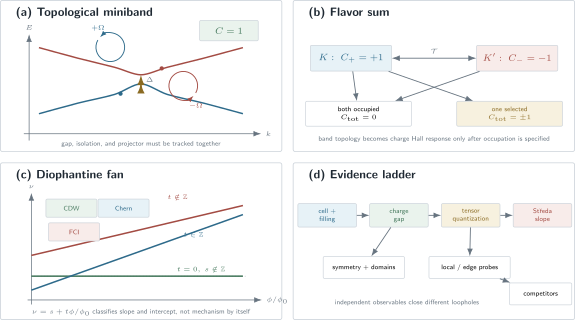
The inference chain in moiré topology. A gapped miniband carries Berry curvature, opposite valleys can cancel, integer or fractional Hall states require an occupied many-body phase, and the Diophantine fan plus transport and thermodynamic probes separates competing interpretations.
Quantum Anomalous Hall States
Section titled “Quantum Anomalous Hall States”Interactions can select an integer topology
Section titled “Interactions can select an integer topology”Suppose opposite valleys carry and . At an integer filling where interactions fully polarize one valley, the occupied state has and breaks time reversal. Reversing the orbital magnetization switches the sign of . This is a common route to a moiré Chern ferromagnet.
The word “ferromagnet” needs qualification. In graphene moiré systems, the dominant moment can be orbital rather than a simple sum of microscopic spin moments. Spin, valley, layer, and orbital polarization can also be entangled. Hysteresis establishes switchable order but does not identify which degree of freedom carries the moment.
Quantization requires the full transport tensor
Section titled “Quantization requires the full transport tensor”Adopt
Then
Only when does the shortcut become controlled. A large hysteretic Hall resistance with substantial longitudinal dissipation is an anomalous Hall state, not yet a quantized anomalous Hall state.
A strong integer QAH claim combines:
- a zero-field Hall plateau near in resistivity or in conductivity;
- a simultaneously small with reported uncertainty and contact geometry;
- magnetic hysteresis or reproducible domain switching;
- thermodynamic incompressibility or a mobility-gap analysis;
- field evolution consistent with the Středa slope;
- edge, nonlocal, or local-magnetization evidence where feasible.
“Zero field” should be operationally stated. A device may be trained by a small field and then measured after the field is removed. That is different from spontaneous domain selection without training, but both can probe a zero-applied-field phase.
Středa slope connects topology and thermodynamics
Section titled “Středa slope connects topology and thermodynamics”Let and , with flux quantum . An incompressible line in a density–field fan obeys
Equivalently,
The intercept counts charge per original moiré cell only when translation symmetry is unbroken. A reconstructed state can have fractional because its physical unit cell is enlarged.
Orbital magnetization supplies a complementary thermodynamic relation,
Local compressibility and magnetometry can therefore test a Hall assignment even where conventional edge transport is complicated by domains or contacts.
Fractional Chern Insulators
Section titled “Fractional Chern Insulators”Partial filling turns geometry into dynamics
Section titled “Partial filling turns geometry into dynamics”Projecting an interaction into one Chern band gives schematically
with
The form factor carries Berry-curvature and metric information. In a favorable limit, the projected densities approximately reproduce the magnetic-translation algebra of a Landau level. Away from that limit, lattice-scale form factors generate new pseudopotentials and stronger competition with charge order.
An FCI is not obtained by fractionally filling any Chern band. It requires an interaction-generated mobility or spectral gap, fractional Hall response, and intrinsic topological order. A finite-size numerical diagnosis normally seeks a quasi-degenerate ground-state manifold, spectral flow under boundary twists, the correct total many-body Chern number, quasihole counting, and an entanglement spectrum. No single item is universally decisive in isolation.
The Diophantine pair separates nearby states
Section titled “The Diophantine pair separates nearby states”Writing an incompressible trajectory as gives a useful experimental taxonomy:
| leading interpretation | essential follow-up | ||
|---|---|---|---|
| fractional | charge-density wave or generalized Wigner state | image or infer translation breaking | |
| integer | integer | integer quantum Hall or Chern insulator | establish zero-field limit and gap |
| integer | fractional | symmetry-broken Chern insulator | determine enlarged cell and Hall plateau |
| fractional | fractional | fractional Chern-insulator candidate | verify fractional Hall response and exclude dissipative or crystalline alternatives |
The labels are inference tools, not proofs by nomenclature. Disorder can bend or fragment trajectories; multiple nearby gaps can exchange strength; and a Hall crystal may combine quantized response with broken translation symmetry.
Evidence must be genuinely fractional
Section titled “Evidence must be genuinely fractional”The strongest present experimental package is:
- a robust fractional plateau in or properly inverted at zero or continuously connected low field;
- small longitudinal dissipation in the same density and temperature interval;
- an incompressibility gap from compressibility, capacitance, or chemical-potential measurements;
- the fractional Středa slope of that same state;
- spontaneous time-reversal breaking for a fractional QAH phase;
- reproducibility across devices and consistency with local disorder maps.
Fractional charge, exchange statistics, and non-Abelian order are stronger claims than fractional Hall quantization. Moiré experiments have established increasingly compelling fractional Chern-insulator responses, but direct quasiparticle-charge and braiding measurements are not yet routine. A particular denominator does not by itself identify an anyon theory.
Platform lessons
Section titled “Platform lessons”In hexagonal-boron-nitride-aligned magic-angle graphene, local compressibility revealed fractional Chern states at modest magnetic field and showed competition with charge-density-wave states. The field helped reshape the quantum geometry of native Chern bands; this is conceptually different from creating an ordinary Landau level from scratch.
Twisted MoTe produced the first converging zero-field package across optical magnetism, thermodynamic incompressibility, Středa slopes, and directly fractionally quantized transport. Local magnetic imaging later resolved spatial variations and sizable thermodynamic gaps. These results make twisted TMDs a leading platform, while also exposing twist and electrostatic inhomogeneity that any microscopic model must confront.
Rhombohedral graphene–boron-nitride superlattices added electrically tunable integer and fractional QAH states. Reports from 2024 through 2026 expanded the observed filling and Chern-number range, including high-Chern responses. Their interpretation is active because interaction-driven band formation, moiré pinning, and anomalous Hall crystallization can be intertwined. A quantized response is secure evidence for topology; the simplest bare-band narrative need not be.
Topology Plus Correlations
Section titled “Topology Plus Correlations”Correlations play more than one role
Section titled “Correlations play more than one role”It is useful to separate three logically different mechanisms:
- Selection: a topological band already exists, and exchange chooses one spin–valley flavor so opposite Chern numbers no longer cancel.
- Renormalization: interactions reshape bandwidth, gaps, Berry curvature, and flavor order while preserving an identifiable band ancestry.
- Generation: the ordered state itself reconstructs the spectrum or unit cell and creates the topological occupied subspace.
The same transport integer can occur in all three cases. Distinguishing them requires spectroscopy, thermodynamics, symmetry information, and a model tied to the actual device.
Translation breaking does not erase topology
Section titled “Translation breaking does not erase topology”A state may carry Hall response and crystalline order simultaneously. If the unit cell enlarges by a factor , a fractional intercept relative to the original moiré cell can coexist with integer . This is a symmetry-broken Chern insulator, not automatically an FCI. Conversely, a fractional signals fractional Hall response but does not say whether additional charge order is absent.
This coexistence is especially relevant in very flat bands, where the same interactions favor both localization and topological coherence. Charge-density waves, generalized Wigner crystals, multiferroics, intervalley coherence, anomalous Hall crystals, and fractional liquids can lie close in energy. Device screening and disorder may reorder them.
An evidence ledger prevents category errors
Section titled “An evidence ledger prevents category errors”| question | useful observable | common overclaim |
|---|---|---|
| is the miniband topological? | gap-resolved model, Berry response, spectroscopy | assigning across an unresolved crossing |
| is time reversal broken? | hysteresis, circular dichroism, local magnetization | equating any Hall signal with ferromagnetism |
| is the state insulating? | , compressibility, activation, nonlinear breakdown | using a resistance peak alone |
| is the Hall response quantized? | full tensor inversion and uncertainty | reading without |
| is translation broken? | fractional intercept, imaging, diffraction, local probes | calling every fractional filling an FCI |
| is there intrinsic topological order? | fractional , many-body diagnostics, quasiparticle probes | inferring anyon statistics from a denominator |
Interpretation Workflow
Section titled “Interpretation Workflow”- Calibrate the moiré cell. Determine locally where possible and state the signed filling convention.
- Specify the active subspace. Report direct and indirect gaps, flavor content, remote-band mixing, and the parameter range over which the projector is isolated.
- Compute robust topology. Converge momentum meshes, check symmetry and orientation conventions, and track gap closings rather than only printing a Chern integer.
- Measure charge and Hall gaps together. Combine transport with compressibility, capacitance, spectroscopy, or magnetometry.
- Use the full density–field fan. Extract both and , including uncertainties and possible unit-cell enlargement.
- Test domains and dissipation. Vary contact geometry, current, sweep direction, temperature, and field-training protocol.
- Compare competing phases. Evaluate charge order, flavor order, and topological order with observables that can falsify each assignment.
Common Mistakes
Section titled “Common Mistakes”Calling Berry-curvature hot spots a Chern band
Section titled “Calling Berry-curvature hot spots a Chern band”Large local curvature is not an invariant. The integral over an isolated band or subspace, with its gaps verified, is what defines .
Forgetting flavor cancellation
Section titled “Forgetting flavor cancellation”Opposite valleys can carry nonzero Chern numbers while the total charge Hall response vanishes. Occupation and symmetry breaking are part of the physical claim.
Equating hysteresis with quantization
Section titled “Equating hysteresis with quantization”Hysteresis demonstrates memory and broken symmetry. It does not guarantee a mobility gap, vanishing longitudinal dissipation, or an integer Hall coefficient.
Treating every fractional filling as fractionalized
Section titled “Treating every fractional filling as fractionalized”Fractional filling naturally supports enlarged-unit-cell charge order. Fractional Hall response and many-body evidence are required to distinguish an FCI.
Using Hall resistance as Hall conductance
Section titled “Using Hall resistance as Hall conductance”When is appreciable, the reciprocal shortcut is wrong. Invert the full tensor.
Treating ideal geometry as a theorem of stability
Section titled “Treating ideal geometry as a theorem of stability”Flat curvature and favorable metric are valuable diagnostics, not a proof that a specific interaction realizes a fractional liquid.
Claiming anyons before measuring them
Section titled “Claiming anyons before measuring them”Fractional quantization is compatible with fractionalized quasiparticles, but charge and statistics require additional experiments.
Exercises
Section titled “Exercises”Exercise 1: valley cancellation and polarization
Section titled “Exercise 1: valley cancellation and polarization”Two time-reversed valleys have and . Find the charge Hall conductivity when both are filled and when only the valley is filled. What symmetry must the latter occupation break?
Solution
For filled flavors,
If , then and the charge Hall response cancels. If and , then and in the adopted sign convention.
Time reversal exchanges the two valleys, so selecting only one breaks time-reversal symmetry. The resulting order may be described as valley or orbital ferromagnetism, but its microscopic spin content requires separate evidence.
Exercise 2: extract a fractional Středa slope
Section titled “Exercise 2: extract a fractional Středa slope”A device has moiré-cell area . An incompressible line satisfies . Using , find and the inferred Hall conductivity.
Solution
From ,
Since ,
Therefore
The inferred response is . This fractional slope is strong evidence only after confirming that the same trajectory is incompressible and not an artifact of changing cell area or unresolved neighboring states.
Exercise 3: invert a dissipative Hall tensor
Section titled “Exercise 3: invert a dissipative Hall tensor”In units of , a candidate state has and . Compute and in units of . Is the shortcut accurate?
Solution
Using dimensionless resistivities ,
The denominator is , so
Thus . The reciprocal shortcut gives the same value to three significant figures here because , but the nonzero still quantifies dissipation and must be reported.
Exercise 4: a topological mass inversion
Section titled “Exercise 4: a topological mass inversion”For two Dirac valleys adopt
Find for and with . What must occur between these regimes?
Solution
For equal positive masses,
For opposite masses,
At least one mass must pass through zero between the two regimes. The corresponding Dirac gap closes, allowing Chern number to transfer between bands. The overall sign depends on the stated chirality and Berry-curvature convention; the change in integer is the convention-independent physical content.
Exercise 5: flatness versus geometry
Section titled “Exercise 5: flatness versus geometry”Band A has , isolation gap , and curvature variation . Band B has , , and . Which looks more favorable for an FCI, and what is still missing?
Solution
The isolation ratios are
Band B is slightly better by this scalar flatness ratio, but Band A has much more uniform Berry curvature. Neither comparison decides the phase. One still needs the full quantum metric and form factors, screened interactions, flavor structure, band mixing, and a many-body calculation that tests fractional liquids against charge order and other competitors.
Exercise 6: audit an FCI claim
Section titled “Exercise 6: audit an FCI claim”At filling , a sample shows a hysteretic Hall signal. The reported is not flat, remains large, and no compressibility or density–field slope is measured. State the strongest justified claim and name three priority tests.
Solution
The data justify a fractional-filling anomalous Hall state with broken-symmetry memory. They do not yet establish a fractional Chern insulator.
Priority tests are:
- measure and accurately enough to invert the full tensor and test fractional quantization;
- establish incompressibility through chemical potential, capacitance, or local compressibility;
- map the trajectory versus perpendicular field and extract the fractional Středa coefficient .
Useful additions include current-bias and temperature scaling, local magnetometry, contact-geometry checks, and probes of translation breaking.
Research Status
Section titled “Research Status”Integer moiré Chern insulators and zero-field QAH transport are established across several graphene and semiconductor platforms. Zero-field fractional QAH responses are now supported by mutually reinforcing transport, thermodynamic, optical, and local-magnetic measurements in twisted MoTe and rhombohedral-graphene superlattices.
The microscopic classification remains active. Current questions include when topology is inherited from a bare miniband versus generated by interactions, how ideal quantum geometry must be, when charge order coexists with fractional response, how disorder and domains control breakdown, and which reported high-Chern fractional states represent phases beyond familiar Landau-level sequences. Direct quasiparticle-charge and braiding measurements remain important future tests.
Summary
Section titled “Summary”- Moiré hybridization can create topological minibands by gapping crossings, winding layer textures, redistributing parent Berry curvature, or enabling interaction-driven reconstruction.
- A valley Chern number does not imply a charge Hall effect; opposite time-reversed flavors cancel unless the many-body state breaks the cancellation.
- A QAH claim requires zero-field integer Hall quantization, small longitudinal dissipation, broken time reversal, and gap evidence.
- The Diophantine pair separates charge order, symmetry-broken Chern insulators, and fractional Hall candidates.
- An FCI is a many-body topologically ordered phase at partial Chern-band filling, not a fractionally occupied band label.
- Flatness, curvature, and metric guide phase stability, but only a full interaction and evidence analysis can classify the state.
Connections
Section titled “Connections”- Moiré Superlattices develops reciprocal mismatch, emergent cells, mini Brillouin zones, minibands, filling, and interaction scales.
- Flat Bands owns spectral flatness, compact localization, projectors, quantum metric, and generic Chern-band constraints.
- Twisted Bilayer Graphene provides the continuum model, valley symmetries, hBN mass, and TBG-specific topological evidence.
- Transition-Metal Dichalcogenides supplies spin–valley locking, layer textures, and semiconductor moiré platforms.
- Correlated Insulators in Moiré Systems distinguishes Mott-like, generalized Wigner, flavor-ordered, topological, and disorder-driven gaps.
- Chern Numbers in Band Theory derives the invariant, Hall response, symmetry constraints, and numerical methods.
- Integer Quantum Hall Effect owns Středa response, mobility gaps, chiral edges, and tensor conventions in the Landau-level setting.
- Fractional Quantum Hall Effect develops fractional charge, statistics, composite fermions, edge theory, and many-body Hall response.
- Topological Order owns long-range entanglement, topological ground spaces, modular data, and finite-size evidence standards.
Further Reading
Section titled “Further Reading”- D. J. Thouless, M. Kohmoto, M. P. Nightingale, and M. den Nijs, “Quantized Hall Conductance in a Two-Dimensional Periodic Potential,” Physical Review Letters 49, 405–408 (1982), doi:10.1103/PhysRevLett.49.405.
- F. D. M. Haldane, “Model for a Quantum Hall Effect without Landau Levels,” Physical Review Letters 61, 2015–2018 (1988), doi:10.1103/PhysRevLett.61.2015.
- D. Xiao, M.-C. Chang, and Q. Niu, “Berry Phase Effects on Electronic Properties,” Reviews of Modern Physics 82, 1959–2007 (2010), doi:10.1103/RevModPhys.82.1959.
- T. Neupert, L. Santos, C. Chamon, and C. Mudry, “Fractional Quantum Hall States at Zero Magnetic Field,” Physical Review Letters 106, 236804 (2011), doi:10.1103/PhysRevLett.106.236804.
- E. Tang, J.-W. Mei, and X.-G. Wen, “High-Temperature Fractional Quantum Hall States,” Physical Review Letters 106, 236802 (2011), doi:10.1103/PhysRevLett.106.236802.
- K. Sun, Z. Gu, H. Katsura, and S. Das Sarma, “Nearly Flatbands with Nontrivial Topology,” Physical Review Letters 106, 236803 (2011), doi:10.1103/PhysRevLett.106.236803.
- D. N. Sheng, Z.-C. Gu, K. Sun, and L. Sheng, “Fractional Quantum Hall Effect in the Absence of Landau Levels,” Nature Communications 2, 389 (2011), doi:10.1038/ncomms1380.
- N. Regnault and B. A. Bernevig, “Fractional Chern Insulator,” Physical Review X 1, 021014 (2011), doi:10.1103/PhysRevX.1.021014.
- X.-L. Qi, “Generic Wave-Function Description of Fractional Quantum Anomalous Hall States,” Physical Review Letters 107, 126803 (2011), doi:10.1103/PhysRevLett.107.126803.
- S. A. Parameswaran, R. Roy, and S. L. Sondhi, “Fractional Quantum Hall Physics in Topological Flat Bands,” Comptes Rendus Physique 14, 816–839 (2013), doi:10.1016/j.crhy.2013.04.003.
- E. J. Bergholtz and Z. Liu, “Topological Flat Band Models and Fractional Chern Insulators,” International Journal of Modern Physics B 27, 1330017 (2013), doi:10.1142/S021797921330017X.
- R. Bistritzer and A. H. MacDonald, “Moiré Bands in Twisted Double-Layer Graphene,” Proceedings of the National Academy of Sciences 108, 12233–12237 (2011), doi:10.1073/pnas.1108174108.
- H. C. Po, L. Zou, A. Vishwanath, and T. Senthil, “Origin of Mott Insulating Behavior and Superconductivity in Twisted Bilayer Graphene,” Physical Review X 8, 031089 (2018), doi:10.1103/PhysRevX.8.031089.
- J. Ahn, S. Park, and B.-J. Yang, “Failure of Nielsen–Ninomiya Theorem and Fragile Topology in Two-Dimensional Systems,” Physical Review X 9, 021013 (2019), doi:10.1103/PhysRevX.9.021013.
- H. C. Po, L. Zou, T. Senthil, and A. Vishwanath, “Faithful Tight-Binding Models and Fragile Topology of Magic-Angle Bilayer Graphene,” Physical Review B 99, 195455 (2019), doi:10.1103/PhysRevB.99.195455.
- Z. Song et al., “All Magic Angles in Twisted Bilayer Graphene Are Topological,” Physical Review Letters 123, 036401 (2019), doi:10.1103/PhysRevLett.123.036401.
- Y.-H. Zhang et al., “Nearly Flat Chern Bands in Moiré Superlattices,” Physical Review B 99, 075127 (2019), doi:10.1103/PhysRevB.99.075127.
- B. L. Chittari et al., “Gate-Tunable Topological Flat Bands in Trilayer Graphene/Boron Nitride Moiré Superlattices,” Physical Review Letters 122, 016401 (2019), doi:10.1103/PhysRevLett.122.016401.
- F. Wu et al., “Topological Insulators in Twisted Transition Metal Dichalcogenide Homobilayers,” Physical Review Letters 122, 086402 (2019), doi:10.1103/PhysRevLett.122.086402.
- A. L. Sharpe et al., “Emergent Ferromagnetism near Three-Quarters Filling in Twisted Bilayer Graphene,” Science 365, 605–608 (2019), doi:10.1126/science.aaw3780.
- M. Serlin et al., “Intrinsic Quantized Anomalous Hall Effect in a Moiré Heterostructure,” Science 367, 900–903 (2020), doi:10.1126/science.aay5533.
- G. Chen et al., “Tunable Correlated Chern Insulator and Ferromagnetism in a Moiré Superlattice,” Nature 579, 56–61 (2020), doi:10.1038/s41586-020-2049-7.
- K. P. Nuckolls et al., “Strongly Correlated Chern Insulators in Magic-Angle Twisted Bilayer Graphene,” Nature 588, 610–615 (2020), doi:10.1038/s41586-020-3028-8.
- S. Wu et al., “Chern Insulators, van Hove Singularities and Topological Flat Bands in Magic-Angle Twisted Bilayer Graphene,” Nature Materials 20, 488–494 (2021), doi:10.1038/s41563-020-00911-2.
- Y. Choi et al., “Correlation-Driven Topological Phases in Magic-Angle Twisted Bilayer Graphene,” Nature 589, 536–541 (2021), doi:10.1038/s41586-020-03159-7.
- J. M. Park et al., “Flavour Hund’s Coupling, Chern Gaps and Charge Diffusivity in Moiré Graphene,” Nature 592, 43–48 (2021), doi:10.1038/s41586-021-03366-w.
- A. T. Pierce et al., “Unconventional Sequence of Correlated Chern Insulators in Magic-Angle Twisted Bilayer Graphene,” Nature Physics 17, 1210–1215 (2021), doi:10.1038/s41567-021-01347-4.
- Y. Xie et al., “Fractional Chern Insulators in Magic-Angle Twisted Bilayer Graphene,” Nature 600, 439–443 (2021), doi:10.1038/s41586-021-04002-3.
- J. Cai et al., “Signatures of Fractional Quantum Anomalous Hall States in Twisted MoTe,” Nature 622, 63–68 (2023), doi:10.1038/s41586-023-06289-w.
- Y. Zeng et al., “Thermodynamic Evidence of Fractional Chern Insulator in Moiré MoTe,” Nature 622, 69–73 (2023), doi:10.1038/s41586-023-06452-3.
- H. Park et al., “Observation of Fractionally Quantized Anomalous Hall Effect,” Nature 622, 74–79 (2023), doi:10.1038/s41586-023-06536-0.
- F. Xu et al., “Observation of Integer and Fractional Quantum Anomalous Hall Effects in Twisted Bilayer MoTe,” Physical Review X 13, 031037 (2023), doi:10.1103/PhysRevX.13.031037.
- W. Zhao et al., “Realization of the Haldane Chern Insulator in a Moiré Lattice,” Nature Physics 20, 275–280 (2024), doi:10.1038/s41567-023-02284-0.
- Z. Lu et al., “Fractional Quantum Anomalous Hall Effect in Multilayer Graphene,” Nature 626, 759–764 (2024), doi:10.1038/s41586-023-07010-7.
- R. A. Melcer et al., “Direct Magnetic Imaging of Fractional Chern Insulators in Twisted MoTe,” Nature 635, 584–589 (2024), doi:10.1038/s41586-024-08153-x.
- Z. Lu et al., “Extended Quantum Anomalous Hall States in Graphene/hBN Moiré Superlattices,” Nature 637, 1090–1095 (2025), doi:10.1038/s41586-024-08470-1.
- J. Xie et al., “Tunable Fractional Chern Insulators in Rhombohedral Graphene Superlattices,” Nature Materials 24, 1042–1048 (2025), doi:10.1038/s41563-025-02225-7.
- O. Huber et al., “Optical Control over Topological Chern Number in Moiré Materials,” Nature 649, 1153–1158 (2026), doi:10.1038/s41586-025-09851-w.
- Z. Li et al., “Fractional High-Chern Insulator in Twisted Rhombohedral Graphene,” Nature 655, 892–898 (2026), doi:10.1038/s41586-026-10762-7.
- P. C. Adak et al., “Tunable Moiré Materials for Probing Berry Physics and Topology,” Nature Reviews Materials 9, 481–498 (2024), doi:10.1038/s41578-024-00671-4.
- K. P. Nuckolls and A. Yazdani, “A Microscopic Perspective on Moiré Materials,” Nature Reviews Materials 9, 460–480 (2024), doi:10.1038/s41578-024-00682-1.
- N. Morales-Durán, J. Shi, and A. H. MacDonald, “Fractionalized Electrons in Moiré Materials,” Nature Reviews Physics 6, 349–351 (2024), doi:10.1038/s42254-024-00718-z.
- A. Abouelkomsan, Z. Liu, and E. J. Bergholtz, “Particle-Hole Duality, Emergent Fermi Liquids, and Fractional Chern Insulators in Moiré Flatbands,” Physical Review Letters 124, 106803 (2020), doi:10.1103/PhysRevLett.124.106803.
- C. Repellin and T. Senthil, “Chern Bands of Twisted Bilayer Graphene: Fractional Chern Insulators and Spin Phase Transition,” Physical Review Research 2, 023238 (2020), doi:10.1103/PhysRevResearch.2.023238.
- P. Wilhelm, T. C. Lang, and A. M. Läuchli, “Interplay of Fractional Chern Insulator and Charge Density Wave Phases in Twisted Bilayer Graphene,” Physical Review B 103, 125406 (2021), doi:10.1103/PhysRevB.103.125406.
- G. Shavit and Y. Oreg, “Quantum Geometry and Stabilization of Fractional Chern Insulators Far from the Ideal Limit,” Physical Review Letters 133, 156504 (2024), doi:10.1103/PhysRevLett.133.156504.