Moiré Superconductivity
Moiré superconductivity is phase-coherent charge- condensation in an electronic structure for which a moiré superlattice materially controls the active bands, interactions, or order parameter. The definition excludes two common overextensions: a resistance anomaly without demonstrated coherence, and ordinary superconductivity in a layer whose moiré modulation is incidental.
Several observations answer different questions:
| observation | what it establishes | what it does not establish alone |
|---|---|---|
| four-terminal zero resistance | a dissipationless transport channel at the applied resolution | bulk homogeneity, pairing symmetry, or microscopic glue |
| critical current and nonlinear current–voltage response | a collective current scale | whether switching is intrinsic rather than thermal |
| perpendicular-field suppression and vortices | orbital response of a two-dimensional condensate | spin structure or gap sign |
| diamagnetism or superfluid stiffness | bulk phase rigidity | which interaction formed the pairs |
| quasiparticle and Andreev gaps | excitation and pair-conversion scales | global phase coherence by themselves |
| Josephson interference and Shapiro locking | long-range phase coherence and pair transport | a unique intrinsic order-parameter symmetry |
The most trustworthy assignment combines several rows in the same calibrated device region.
Canonical Scope
Section titled “Canonical Scope”This page is the canonical home for superconducting phases in moiré materials: their relation to nearby correlated phases, electrical tunability, competing pairing proposals, phase-stiffness constraints, Josephson devices, and the standards for calling the state unconventional.
Use Superfluidity and Superconductivity for the platform-independent distinction among pairing, stiffness, electrodynamics, defects, and weak links; this page owns the moiré-specific evidence and mechanism audit.
BCS Theory owns the reduced pairing Hamiltonian, Bogoliubov spectrum, weak-coupling gap equation, density of states, coherence factors, and conventional benchmark ratios. Ginzburg–Landau Theory owns order-parameter energetics, coherence lengths, critical fields, vortices, and current response near a continuous transition. Josephson Effect owns the phase–current and voltage–frequency relations, Fraunhofer interference, Shapiro steps, SQUIDs, and junction dynamics.
Moiré Superlattices owns geometry, minibands, and filling. Flat Bands owns quantum metric and the geometric contribution to superfluid weight. Material-specific accounts remain with Twisted Bilayer Graphene for graphene continuum physics and with Transition-Metal Dichalcogenides for spin–valley-locked semiconductor bands. This page compares superconducting claims without duplicating those foundations.
Establishing a Superconducting Phase
Section titled “Establishing a Superconducting Phase”Begin with transport, but do not end there
Section titled “Begin with transport, but do not end there”A four-terminal resistance that falls below the voltage resolution over a finite current range is stronger evidence than a partial downturn. The measurement should be repeated across excitation currents, contact pairs, thermal cycles, and magnetic fields. Current bias must remain below the switching scale; otherwise an apparent residual resistance can be self-induced.
Nonlinear differential resistance can reveal a low-bias zero-voltage branch and a switching current. In an ultrathin, high-kinetic-inductance device, however, Joule heating and slow electronic cooling can mimic abrupt switching or hysteresis. A thermal model, pulse measurements, or frequency dependence is needed before interpreting every switching feature as a fundamental critical current.
Perpendicular magnetic field should introduce orbital depairing and vortices. A smoothly vanishing zero-resistance region, reproducible critical-field scale, vortex-flow response, or Josephson interference ties the transport anomaly to superconductivity. The convenient Ginzburg–Landau estimate defines an effective coherence length only near the regime where that theory applies; it is not a microscopic pair-size measurement.
Separate pairing, stiffness, and zero resistance
Section titled “Separate pairing, stiffness, and zero resistance”In a two-dimensional moiré band, the temperature at which a pairing amplitude becomes appreciable need not equal the temperature of global phase coherence. Write the slowly varying phase energy as
The renormalized isotropic stiffness obeys the ideal Berezinskii–Kosterlitz–Thouless jump . Finite size, inhomogeneity, vortex pinning, nonequilibrium heating, and anisotropy round that relation. A current–voltage power law with at an inferred transition is suggestive only when the fitted current window and thermal stability are reported.
Microwave response can determine the sheet kinetic inductance. With the phase-stiffness convention above,
A direct stiffness measurement closes an important gap between transport and thermodynamics: it establishes phase rigidity and tests whether the observed transition is limited by pair breaking or by phase fluctuations.
Spectroscopy measures complementary gaps
Section titled “Spectroscopy measures complementary gaps”Tunneling spectroscopy probes the one-particle density of states, while Andreev reflection probes electron-to-hole conversion at a superconducting interface. Their inferred gap scales need not coincide in a multiband, inhomogeneous, or pseudogapped system. A depletion that survives above the zero-resistance temperature can indicate preformed pairs, a competing order, or a normal-state pseudogap; temperature and magnetic-field evolution are required to distinguish them.
The ratio
equals approximately for the weak-coupling isotropic BCS gap at zero temperature. A larger value signals departure from that narrow benchmark, but it does not uniquely imply electronic pairing: strong electron–phonon coupling, anisotropy, multiple gaps, pseudogap contamination, and an underestimated phase-ordering temperature can all enlarge it.
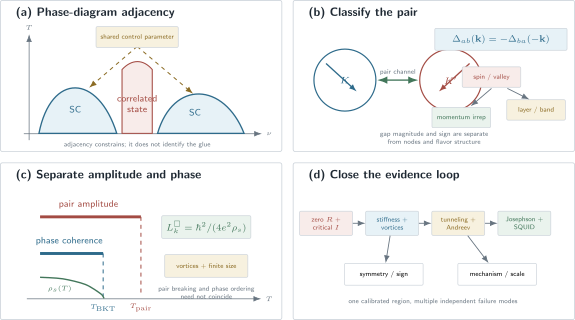
Four distinct ledgers govern a moiré-superconductivity claim. A superconducting dome can border a correlated phase without being caused by it; the antisymmetric pairing matrix must be classified in momentum and flavor space; pair formation and phase coherence can occur at different scales; and transport, stiffness, spectroscopy, and Josephson probes constrain different failure modes.
Superconductivity Near Correlated Phases
Section titled “Superconductivity Near Correlated Phases”Adjacency is a clue, not a mechanism
Section titled “Adjacency is a clue, not a mechanism”The first magic-angle graphene experiments found superconducting domes near interaction-driven insulating states. That resemblance to cuprate phase diagrams made doped-Mott and fluctuation-mediated pictures natural. Later devices showed superconductivity when the nearby correlated insulator was weak or absent, including screened and WSe-proximitized graphene structures. Conversely, strong correlated states need not produce superconductivity.
The logically secure statement is therefore local: in a given device, superconductivity occupies a measured region of filling, displacement field, twist texture, pressure, and screening. Causal connection to a neighboring phase requires more:
- a reproducible covariance under a tuning parameter that does not trivially change the density of states;
- compatible symmetry or fluctuation signatures in the normal and paired states;
- a microscopic calculation using the same band and interaction parameters;
- exclusion of a shared third cause such as a van Hove singularity, strain, or improved sample uniformity.
Recent same-region thermodynamic and transport measurements in twisted graphene have strengthened such comparisons while also showing that correlated-insulator gaps and superconducting strength need not track one another. In twisted WSe, superconducting domes adjoining a bandwidth-tuned antiferromagnetic insulator provide a new, highly tunable correlation, but they still do not by themselves identify the pairing boson or order-parameter symmetry.
The normal state belongs to the claim
Section titled “The normal state belongs to the claim”The superconducting phase emerges from a normal state that can contain flavor polarization, strange-metal transport, nematicity, pseudogaps, van Hove singularities, or multiple Fermi pockets. Those features alter the available Cooper channels.
A pairing theory should reproduce the normal-state Fermi surface and flavor occupancy at the same gate coordinates. Comparing a superconducting dome with a noninteracting band calculated at neutrality, while ignoring interaction-driven flavor reconstruction, can assign the wrong density of states, screening, and gap symmetry.
Tunability by Doping and Displacement Field
Section titled “Tunability by Doping and Displacement Field”Dual gates define coupled coordinates
Section titled “Dual gates define coupled coordinates”For top and bottom gate capacitances per area and , a common electrostatic convention is
Here is an electric displacement with units of charge per area; many papers quote as an equivalent field. Sign conventions vary. Quantum capacitance, trapped charge, screening by nearby bands, and contact-gate geometry can modify this parallel-plate conversion.
Changing moves the chemical potential and can change flavor occupancy. Changing redistributes charge among layers, modifies hybridization and Berry curvature, and can shift van Hove singularities. In real dual-gated devices, the two coordinates are only approximately independent because compressibility and contact regions respond to both.
Twist, pressure, and screening are not scalar bandwidth knobs
Section titled “Twist, pressure, and screening are not scalar bandwidth knobs”Twist angle changes moiré period, tunneling interference, relaxation, wave-function geometry, and inhomogeneity. Hydrostatic pressure changes interlayer tunneling and structural relaxation. A nearby metallic gate shortens the long-range Coulomb tail and may alter the relative importance of repulsion, phonons, and disorder. Proximity to WSe can introduce spin–orbit coupling while also changing dielectric screening and strain.
For that reason a measured should be written schematically as
where represents disorder or broadening. Collapsing this parameter space into one inferred can hide the actual control variable.
Domes can have different boundaries
Section titled “Domes can have different boundaries”A superconducting dome may terminate at a flavor transition, a Lifshitz transition, a competing insulator, a loss of band isolation, a phase-stiffness threshold, or a disorder-dominated region. The same visual shape can therefore arise from different physics. Boundary tracking should combine Hall density, compressibility, spectroscopy, and symmetry probes rather than rely on resistance alone.
Pairing Structure
Section titled “Pairing Structure”Fermionic antisymmetry is the first constraint
Section titled “Fermionic antisymmetry is the first constraint”Let collect spin, valley, layer, orbital, and band labels. The pairing matrix
must be antisymmetric under exchange of the two electrons. Even-parity momentum structure therefore pairs with an antisymmetric internal state, and odd parity with a symmetric one, after all active labels are included. Calling a state “spin singlet” does not fix its valley, layer, or orbital structure.
The superconducting representation must be classified under the actual device symmetry. Heterostrain, substrate alignment, displacement field, and spontaneous normal-state order can reduce the ideal moiré point group. An apparently two-component order parameter in the ideal lattice may split into nondegenerate components in the fabricated device.
The linearized gap problem identifies leading channels
Section titled “The linearized gap problem identifies leading channels”After specifying a normal-state Green function and irreducible pairing interaction, the transition can be organized as an eigenvalue problem:
The leading eigenvalue reaches one at a mean-field instability. The compound index includes flavor and band structure. This calculation is predictive only if the kernel, screening, cutoff, normal-state reconstruction, and self-energy are controlled. Choosing a desired form factor and then fitting one coupling does not establish a mechanism.
Nodes, signs, and anisotropy are distinct
Section titled “Nodes, signs, and anisotropy are distinct”A nodeless excitation spectrum need not be conventional wave: sign changes can occur between disconnected pockets or flavors. Conversely, power-law temperature dependence can come from nodes, deep gap minima, pair breaking, or an inhomogeneous distribution of local gaps. Phase-sensitive junctions, quasiparticle interference, impurity response, and directional spectroscopy are needed to resolve the sign structure.
Nematic superconductivity breaks rotational symmetry in the condensate. Transport anisotropy that already exists above can instead reflect strain or normal-state nematicity inherited by an otherwise symmetry-preserving gap. The decisive test compares the symmetry onset and orientation across the transition and under controlled strain.
Pairing Mechanisms Under Debate
Section titled “Pairing Mechanisms Under Debate”Phonon-mediated attraction
Section titled “Phonon-mediated attraction”Graphene and TMD layers supply acoustic, optical, breathing, shear, and moiré-scale lattice modes. A large flat-band density of states can amplify electron–phonon pairing, while Coulomb pseudopotential, screening, vertex corrections, and band geometry determine whether a weak-coupling treatment is controlled.
Isotope shifts, mode-resolved tunneling structures, phonon linewidth anomalies, and quantitative agreement among the measured coupling, gap, and would strengthen a phonon assignment. The observation of strong electron–phonon coupling is important but not sufficient: a phonon can dress quasiparticles without being the dominant pairing glue, and electronic interactions can reshape the same spectra.
Electronic fluctuations and repulsive pairing
Section titled “Electronic fluctuations and repulsive pairing”Repulsive interactions can generate sign-changing attraction in selected angular, spin, or valley channels through spin fluctuations, valley fluctuations, charge fluctuations, exchange, or Kohn–Luttinger processes. Proximity to flavor-polarized or antiferromagnetic phases makes these channels plausible.
Their strongest tests are correlated evolution of the relevant collective mode and , a gap sign and symmetry matching the calculated leading eigenfunction, and quantitative scales from one normal-state interaction model. A dome near an insulator or a linear-in- metal is not itself evidence for a specific fluctuation.
Strong-coupling descendants of local models
Section titled “Strong-coupling descendants of local models”When charge motion is strongly constrained near an integer filling, doping an extended Hubbard or exchange model can produce paired states. This language is especially natural for superconductivity emerging near a bandwidth-controlled Mott transition. Yet moiré orbitals are extended, interactions are nonlocal, and topological bands may obstruct a simple localized basis. “Doped Mott” should name a demonstrated model regime, not merely the shape of a phase diagram.
Quantum geometry and flat-band mobility
Section titled “Quantum geometry and flat-band mobility”Flat dispersion enhances interaction effects but suppresses conventional band velocity. The superfluid-weight tensor can be organized as
The conventional term follows dispersion; the geometric term depends on interband matrix elements and the quantum metric of the active projectors. Quantum geometry can therefore support phase stiffness even in a very narrow band. It is not, by itself, an attractive interaction and does not choose the spin, valley, or momentum symmetry of the pair.
Mechanisms can cooperate
Section titled “Mechanisms can cooperate”Electronic repulsion can renormalize a phonon-mediated channel; phonons can select among nearly degenerate electronic pair states; quantum geometry can provide stiffness after either mechanism forms pairs. A useful comparison therefore asks which component controls each observable:
| proposal | natural strength | discriminating burden |
|---|---|---|
| phonon dominated | material-specific modes and large density of states | isotope or mode-resolved quantitative closure |
| fluctuation mediated | proximity to spin, valley, or charge order | matching collective mode and sign-changing gap |
| strong-coupling local model | adjacency to a calibrated Mott regime | derived extended model and doping-dependent predictions |
| quantum-geometric enhancement | large stiffness despite narrow dispersion | measured projectors or metric-linked stiffness, plus a separate pairing interaction |
| multichannel cooperation | accommodates several observed scales | must predict rather than merely absorb every anomaly |
Josephson and Device Probes
Section titled “Josephson and Device Probes”Gate-defined weak links
Section titled “Gate-defined weak links”Moiré materials allow the superconducting leads and weak link to be patterned electrostatically within one continuous crystal. A local gate can tune the barrier through metallic, correlated-insulating, or flavor-polarized regimes. This avoids a conventional materials interface but does not remove interfaces altogether: density gradients, fringe fields, twist disorder, and contact-induced doping define an electrostatic junction.
DC supercurrent, microwave-induced Shapiro steps, and magnetic interference demonstrate phase-coherent coupling. Their canonical equations and circuit systematics belong to Josephson Effect. In a moiré junction, the additional scientific opportunity is to vary the weak-link order while keeping the surrounding crystal fixed.
SQUIDs and current–phase relations
Section titled “SQUIDs and current–phase relations”Two gate-defined junctions can form a monolithic SQUID. Flux-periodic critical current demonstrates phase coherence around the loop and can test the effective transported charge. Tunable junction asymmetry can expose an individual current–phase relation.
Non-sinusoidal or phase-shifted behavior can arise from high transparency, multiple paths, magnetic weak links, spin–orbit coupling, trapped vortices, or unconventional pairing. A superconducting diode effect likewise requires broken inversion and time-reversal symmetry in the effective transport problem, but it does not uniquely identify where those symmetries are broken. Nonuniform current density and large kinetic inductance can imitate intrinsic phase shifts.
Phase-sensitive ambitions
Section titled “Phase-sensitive ambitions”The decisive pairing-symmetry experiments compare junctions with controlled crystallographic orientation, valley filtering, or known reference superconductors. A corner geometry, half-flux shift, or reproducible anomalous phase can test sign changes only after self-field, faceting, trapped flux, and magnetic weak-link alternatives are bounded. The extreme electrostatic tunability of moiré devices makes such controls possible, but also makes them sensitive to microscopic inhomogeneity.
Relation to Unconventional Superconductivity
Section titled “Relation to Unconventional Superconductivity”Use an operational definition
Section titled “Use an operational definition”“Unconventional” must name an axis. A nontrivial pairing-structure claim concerns crystal representation, parity or pseudospin content, nodes, relative signs, or multicomponent symmetry breaking. A pairing-mechanism claim concerns the interaction that generated the state and requires separate evidence. Strong coupling, a nonphononic proposal, or an unusual structure does not establish the other axis by itself.
Evidence often cited in moiré systems includes:
- nodal or strongly anisotropic gap behavior;
- anomalously large ;
- superconductivity beyond a naive weak-coupling Pauli field;
- nematicity or time-reversal-symmetry breaking;
- pseudogap behavior;
- proximity to correlated insulators or strange metals;
- superfluid stiffness inconsistent with a simple Fermi-liquid estimate.
Each item narrows possibilities but has conventional or extrinsic alternatives. For example, the weak-coupling Pauli estimate assumes , spin-singlet pairing, negligible spin–orbit coupling, and no strong-coupling renormalization. Exceeding it invalidates that package of assumptions, not necessarily spin-singlet pairing alone.
Small Fermi energy invites crossover physics
Section titled “Small Fermi energy invites crossover physics”In a narrow band, and can become non-negligible compared with an inferred Fermi energy. A small and separated pairing and stiffness scales may suggest BCS–BEC crossover physics. Yet is ambiguous near van Hove points, interaction-reconstructed bands, and low-density pockets. A convincing crossover claim combines chemical potential, pair size, stiffness, spectral evolution, and fluctuation thermodynamics rather than quoting one ratio.
The field remains platform dependent
Section titled “The field remains platform dependent”Magic-angle bilayer and multilayer graphene now have transport, spectroscopy, Josephson, and direct stiffness evidence for superconductivity, with several measurements favoring anisotropic or unconventional behavior. Twisted WSe has established a separate superconducting family with strong displacement-field and bandwidth control. The experiments do not require one universal pairing mechanism across those systems.
Common Mistakes
Section titled “Common Mistakes”- Treating a resistance downturn as complete evidence. Zero resistance, field response, collective current, and a phase or thermodynamic probe should agree.
- Equating a dome beside an insulator with doped-Mott pairing. Adjacency is correlation, not causation.
- Calling every large gap ratio unconventional. Strong coupling, anisotropy, multiple gaps, and a phase-limited can all enlarge it.
- Using the Pauli limit without its assumptions. Spin–orbit coupling, factor, strong coupling, and orbital effects belong to the comparison.
- Conflating pair formation with phase coherence. In two dimensions, stiffness and vortices can set the observed transition.
- Calling quantum geometry the pairing glue. Geometry can carry supercurrent without supplying attraction.
- Inferring gap sign from a nodeless spectrum. Disconnected pockets can carry opposite signs while remaining fully gapped.
- Ignoring gate cross-coupling. Density and displacement field both change band structure, screening, and contacts.
- Reading a distorted Fraunhofer pattern as unique proof of exotic pairing. Current inhomogeneity, flux focusing, and magnetic weak links must be modeled.
- Generalizing one device to all moiré platforms. Twist texture, strain, screening, layer count, and material chemistry matter.
Exercises
Section titled “Exercises”Exercise 1: dual-gate coordinates
Section titled “Exercise 1: dual-gate coordinates”Take , , and . Find and . Use and .
Solution
. Therefore
The displacement is
so . A real-device analysis must also apply its sign convention and electrostatic corrections.
Exercise 2: BKT stiffness scale
Section titled “Exercise 2: BKT stiffness scale”Assuming the ideal isotropic jump, estimate for . Use .
Solution
The jump condition gives
This is a renormalized long-wavelength stiffness immediately below the transition, not the zero-temperature bare-band value.
Exercise 3: sheet kinetic inductance
Section titled “Exercise 3: sheet kinetic inductance”Using , estimate . Take .
Solution
Because and , the stiffness is
Then
Thus the sheet inductance is about per square, large enough to be accessible through a calibrated microwave resonator.
Exercise 4: fermionic antisymmetry
Section titled “Exercise 4: fermionic antisymmetry”Suppose a pair is a spin singlet, valley triplet, and even under layer exchange. What momentum parity is required?
Solution
The spin-singlet factor is antisymmetric. Valley triplet and layer-even factors are symmetric. Their internal product is therefore antisymmetric. The momentum factor must be even so that exchanging the two complete electron labels leaves the pair amplitude antisymmetric. If the valley state were instead antisymmetric while the other labels stayed the same, odd momentum parity would be required.
Exercise 5: auditing a superconducting claim
Section titled “Exercise 5: auditing a superconducting claim”A device shows a 90% resistance drop, a nonlinear current–voltage curve, and suppression by perpendicular field. No zero-resistance floor, stiffness, diamagnetism, or Josephson response is reported. State the strongest justified claim and two priority measurements.
Solution
The data show a superconducting-like transport transition and a field-sensitive collective conduction channel. They are substantial evidence, but do not yet establish a homogeneous phase-coherent bulk superconductor because percolation, fluctuation conductivity, heating, or contact effects remain.
Priority measurements include a lower-noise four-terminal zero-resistance test with current and thermal controls, plus a phase-rigidity probe such as microwave kinetic inductance, BKT-consistent scaling over a controlled range, diamagnetism, or Josephson interference. Spatial mapping would additionally test percolation.
Exercise 6: adjacency and causation
Section titled “Exercise 6: adjacency and causation”Across several devices, tracks a van Hove singularity while the correlated-insulator gap varies independently and vanishes in some superconducting samples. Which simple hypothesis is weakened, and what remains possible?
Solution
The hypothesis that the measured correlated insulator is a necessary parent of superconductivity is weakened: superconductivity survives without it, and their strengths do not covary. Pairing driven specifically by fluctuations of that order is also less economical unless those fluctuations persist without the static gap.
It remains possible that both phases share an underlying interaction scale, that a van Hove-enhanced phonon or electronic channel drives pairing, that a different fluctuating order is involved, or that band geometry controls the common trend. Discriminating these options requires mode-, symmetry-, and parameter-resolved tests.
Research Status
Section titled “Research Status”Superconducting transport, critical currents, magnetic suppression, Josephson effects, and flux interference are established in multiple twisted graphene devices. Direct superfluid-stiffness measurements in twisted bilayer and trilayer graphene have added bulk phase-rigidity information and reported behavior inconsistent with the simplest isotropic weak-coupling baseline. Twisted WSe now supplies an independent, electrically tunable moiré-superconductor platform, including phase diagrams near bandwidth-tuned correlated states.
The pairing mechanism is not settled. Spectroscopic anisotropy, large gap ratios, nematicity, Pauli-limit violations in selected devices, phonon signatures, normal-state correlations, and quantum-geometric stiffness constrain different parts of the problem but do not yet close one universal explanation. Device-to-device variation, twist inhomogeneity, multiband flavor reconstruction, small energy scales, and limited thermodynamic volume remain central experimental challenges. Claims should distinguish established superconductivity from active interpretations of its symmetry and glue.
Summary
Section titled “Summary”- Moiré superconductivity requires phase-coherent condensation in bands materially controlled by the moiré structure.
- Zero resistance, critical current, magnetic response, stiffness, spectroscopy, and Josephson interference answer complementary questions.
- Pair formation and phase coherence can occur at different temperatures; low stiffness makes two-dimensional phase fluctuations central.
- Density, displacement field, twist, screening, pressure, strain, and disorder tune several microscopic parameters at once.
- Fermionic antisymmetry constrains the full momentum–spin–valley–layer pairing matrix.
- Phonons, electronic fluctuations, strong-coupling local models, and multichannel cooperation remain under debate.
- Quantum geometry can enhance superfluid weight but is not itself a pairing attraction.
- Proximity to a correlated insulator motivates causal tests; it does not prove a doped-Mott mechanism.
- “Unconventional” requires symmetry-, sign-, topology-, or mechanism-sensitive evidence beyond a large gap ratio or dome shape.
Connections
Section titled “Connections”- Unconventional Superconductivity supplies the platform-independent pairing taxonomy and multi-probe evidence ladder; this page retains moiré filling, geometry, tunability, neighboring phases, and the platform-specific mechanism record.
- Moiré Superlattices supplies the geometry, minibands, filling conventions, and tunable scale hierarchy.
- Flat Bands owns projector geometry, quantum metric, and geometric superfluid-weight constraints.
- Correlated Insulators in Moiré Systems provides the evidence ladder for adjacent Mott-like, charge-ordered, flavor-ordered, and topological phases.
- Moiré Topology owns topological minibands, QAH and fractional Hall states, and the distinction between band geometry and many-body topological order.
- Twisted Bilayer Graphene develops the material-specific continuum model and experimental record.
- Transition-Metal Dichalcogenides supplies the spin–valley-locked semiconductor platform and twisted WSe context.
- BCS Theory gives the conventional microscopic baseline and gap diagnostics.
- Ginzburg–Landau Theory owns stiffness, coherence lengths, vortices, and critical fields near the transition.
- Vortex Matter, Pinning, and Flux Flow owns charged-vortex pinning, creep, collective order, and driven dissipation needed to audit rounded two-dimensional transport and field-response signatures in moiré devices.
- Josephson Effect develops weak-link phase dynamics, interference, Shapiro steps, and SQUIDs.
- Proximity and Andreev Physics owns interface spectroscopy, Andreev reflection, and induced superconductivity.
- Pair-Density Waves and Exotic Orders develops finite-momentum pairing and its phase-sensitive signatures.
- Topological Superconductors owns Bogoliubov–de Gennes invariants and Majorana evidence standards.
Further Reading
Section titled “Further Reading”- J. Bardeen, L. N. Cooper, and J. R. Schrieffer, “Theory of Superconductivity,” Physical Review 108, 1175–1204 (1957), doi:10.1103/PhysRev.108.1175.
- J. M. Kosterlitz and D. J. Thouless, “Ordering, Metastability and Phase Transitions in Two-Dimensional Systems,” Journal of Physics C: Solid State Physics 6, 1181–1203 (1973), doi:10.1088/0022-3719/6/7/010.
- M. R. Beasley, J. E. Mooij, and T. P. Orlando, “Possibility of Vortex-Antivortex Pair Dissociation in Two-Dimensional Superconductors,” Physical Review Letters 42, 1165–1168 (1979), doi:10.1103/PhysRevLett.42.1165.
- S. Peotta and P. Törmä, “Superfluidity in Topologically Nontrivial Flat Bands,” Nature Communications 6, 8944 (2015), doi:10.1038/ncomms9944.
- Y. Cao et al., “Unconventional Superconductivity in Magic-Angle Graphene Superlattices,” Nature 556, 43–50 (2018), doi:10.1038/nature26160.
- F. Wu, A. H. MacDonald, and I. Martin, “Theory of Phonon-Mediated Superconductivity in Twisted Bilayer Graphene,” Physical Review Letters 121, 257001 (2018), doi:10.1103/PhysRevLett.121.257001.
- H. Isobe, N. F. Q. Yuan, and L. Fu, “Unconventional Superconductivity and Density Waves in Twisted Bilayer Graphene,” Physical Review X 8, 041041 (2018), doi:10.1103/PhysRevX.8.041041.
- C. Xu and L. Balents, “Topological Superconductivity in Twisted Multilayer Graphene,” Physical Review Letters 121, 087001 (2018), doi:10.1103/PhysRevLett.121.087001.
- D. M. Kennes, J. Lischner, and C. Karrasch, “Strong Correlations and Superconductivity in Twisted Bilayer Graphene,” Physical Review B 98, 241407(R) (2018), doi:10.1103/PhysRevB.98.241407.
- B. Lian, Z. Wang, and B. A. Bernevig, “Twisted Bilayer Graphene: A Phonon-Driven Superconductor,” Physical Review Letters 122, 257002 (2019), doi:10.1103/PhysRevLett.122.257002.
- M. Yankowitz et al., “Tuning Superconductivity in Twisted Bilayer Graphene,” Science 363, 1059–1064 (2019), doi:10.1126/science.aav1910.
- X. Lu et al., “Superconductors, Orbital Magnets and Correlated States in Magic-Angle Bilayer Graphene,” Nature 574, 653–657 (2019), doi:10.1038/s41586-019-1695-0.
- X. Hu, T. Hyart, D. I. Pikulin, and E. Rossi, “Geometric and Conventional Contribution to the Superfluid Weight in Twisted Bilayer Graphene,” Physical Review Letters 123, 237002 (2019), doi:10.1103/PhysRevLett.123.237002.
- A. Julku, T. J. Peltonen, L. Liang, T. T. Heikkilä, and P. Törmä, “Superfluid Weight and Berezinskii–Kosterlitz–Thouless Transition Temperature of Twisted Bilayer Graphene,” Physical Review B 101, 060505(R) (2020), doi:10.1103/PhysRevB.101.060505.
- F. Xie, Z. Song, B. Lian, and B. A. Bernevig, “Topology-Bounded Superfluid Weight in Twisted Bilayer Graphene,” Physical Review Letters 124, 167002 (2020), doi:10.1103/PhysRevLett.124.167002.
- L. Balents, C. R. Dean, D. K. Efetov, and A. F. Young, “Superconductivity and Strong Correlations in Moiré Flat Bands,” Nature Physics 16, 725–733 (2020), doi:10.1038/s41567-020-0906-9.
- Y. Saito et al., “Independent Superconductors and Correlated Insulators in Twisted Bilayer Graphene,” Nature Physics 16, 926–930 (2020), doi:10.1038/s41567-020-0928-3.
- P. Stepanov et al., “Untying the Insulating and Superconducting Orders in Magic-Angle Graphene,” Nature 583, 375–378 (2020), doi:10.1038/s41586-020-2459-6.
- H. S. Arora et al., “Superconductivity in Metallic Twisted Bilayer Graphene Stabilized by WSe,” Nature 583, 379–384 (2020), doi:10.1038/s41586-020-2473-8.
- J. M. Park et al., “Tunable Strongly Coupled Superconductivity in Magic-Angle Twisted Trilayer Graphene,” Nature 590, 249–255 (2021), doi:10.1038/s41586-021-03192-0.
- Z. Hao et al., “Electric Field-Tunable Superconductivity in Alternating-Twist Magic-Angle Trilayer Graphene,” Science 371, 1133–1138 (2021), doi:10.1126/science.abg0399.
- Y. Cao et al., “Nematicity and Competing Orders in Superconducting Magic-Angle Graphene,” Science 372, 264–271 (2021), doi:10.1126/science.abc2836.
- Y. Cao et al., “Pauli-Limit Violation and Re-Entrant Superconductivity in Moiré Graphene,” Nature 595, 526–531 (2021), doi:10.1038/s41586-021-03685-y.
- M. Oh et al., “Evidence for Unconventional Superconductivity in Twisted Bilayer Graphene,” Nature 600, 240–245 (2021), doi:10.1038/s41586-021-04121-x.
- F. K. de Vries et al., “Gate-Defined Josephson Junctions in Magic-Angle Twisted Bilayer Graphene,” Nature Nanotechnology 16, 760–763 (2021), doi:10.1038/s41565-021-00896-2.
- H. Kim et al., “Evidence for Unconventional Superconductivity in Twisted Trilayer Graphene,” Nature 606, 494–500 (2022), doi:10.1038/s41586-022-04715-z.
- J. M. Park et al., “Robust Superconductivity in Magic-Angle Multilayer Graphene Family,” Nature Materials 21, 877–883 (2022), doi:10.1038/s41563-022-01287-1.
- Y. Zhang et al., “Promotion of Superconductivity in Magic-Angle Graphene Multilayers,” Science 377, 1538–1543 (2022), doi:10.1126/science.abn8585.
- E. Portolés et al., “A Tunable Monolithic SQUID in Twisted Bilayer Graphene,” Nature Nanotechnology 17, 1159–1164 (2022), doi:10.1038/s41565-022-01222-0.
- P. Törmä, S. Peotta, and B. A. Bernevig, “Superconductivity, Superfluidity and Quantum Geometry in Twisted Multilayer Systems,” Nature Reviews Physics 4, 528–542 (2022), doi:10.1038/s42254-022-00466-y.
- M. Tanaka et al., “Superfluid Stiffness of Magic-Angle Twisted Bilayer Graphene,” Nature 638, 99–105 (2025), doi:10.1038/s41586-024-08494-7.
- A. Banerjee et al., “Superfluid Stiffness of Twisted Trilayer Graphene Superconductors,” Nature 638, 93–98 (2025), doi:10.1038/s41586-024-08444-3.
- Y. Guo et al., “Superconductivity in 5.0° Twisted Bilayer WSe,” Nature 637, 839–845 (2025), doi:10.1038/s41586-024-08381-1.
- Y. Xia et al., “Superconductivity in Twisted Bilayer WSe,” Nature 637, 833–838 (2025), doi:10.1038/s41586-024-08116-2.
- Y. Xia et al., “Bandwidth-Tuned Mott Transition and Superconductivity in Moiré WSe,” Nature 650, 585–591 (2026), doi:10.1038/s41586-025-10049-3.
- J. C. Hoke et al., “Link between Thermodynamic Correlation Signatures and Superconductivity in Twisted Trilayer Graphene,” Nature Nanotechnology 21, 772–778 (2026), doi:10.1038/s41565-026-02155-8.