Topological Superconductors
A topological superconductor is a superconducting phase whose gapped bulk Bogoliubov quasiparticles cannot be deformed to a topologically trivial superconducting reference while the relevant symmetries and bulk gap are preserved. Its bulk obstruction is expressed through a Bogoliubov–de Gennes (BdG) invariant, and a boundary or topological defect can consequently support Majorana modes.
This definition has three important qualifications.
- The topology belongs to a bulk phase, not to an isolated zero-bias feature.
- The standard classification discussed here is a classification of gapped quadratic BdG Hamiltonians. Nodes, strong interactions, crystalline symmetries, and disorder can require refined tools.
- A Majorana zero mode is a self-conjugate emergent quasiparticle operator. It is not evidence that a fundamental relativistic Majorana particle has been discovered.
The mathematical framework is well established. Experimental identification is not comparably settled. As of July 2026, many systems display ingredients or signatures compatible with topological superconductivity, but no solid-state platform has achieved a universally accepted demonstration of topologically protected Majorana fusion and braiding. Individual claims should therefore be reported together with their assumptions, alternative explanations, and independent checks.
This page is the canonical home for BdG topology, particle–hole redundancy, the class-D and class-DIII invariants, and Majorana boundary and vortex modes. Bogoliubov Quasiparticles owns quasiparticle branch counting and coherence factors; BCS Mean-Field Theory owns the pairing saddle and gap equation; the Kitaev Chain is the compact canonical model entry; Anyons and Braiding owns the braid-group consequences; and Topological Qubits owns complete Majorana modules, parity readout, control, metrics, and architecture evidence.
Use Superfluidity and Superconductivity to establish the generic superconducting object and evidence ledger before adding topology; this page owns the topological obstruction and its consequences.
Required background. BCS Mean-Field Theory supplies the pairing saddle, Bogoliubov Quasiparticles supplies Nambu branch counting, and Topology in Quantum Matter supplies the gapped-deformation and evidence framework.
Helpful background. Symmetry Classification Preview supplies tenfold-way language, the Kitaev Chain supplies the minimal class-D model, and the superconductivity gateway supplies the material and proximity-effect preparation.
From Pairing to Topology
Section titled “From Pairing to Topology”A conventional band insulator is described by occupied electron bands separated from empty electron bands. A superconductor is different: its condensate mixes electron annihilation and creation operators, so a quasiparticle generally carries neither a definite electron number nor a definite electric charge. The natural single-particle description is therefore written in Nambu space, where particles and holes appear together.
The mean-field Hamiltonian does not conserve the electron number operator . It does preserve fermion parity,
because pairing creates or annihilates electrons in pairs. In an isolated exact system, fermion parity is a genuine superselection label. In an open device, quasiparticle poisoning can exchange a single electron with the environment and spoil the effective parity lifetime.
Topology requires a specified gap. For a fully gapped superconductor, the positive BdG spectrum obeys
throughout the Brillouin zone. A nodal superconductor can possess topological charges attached to points or lines of nodes, as well as protected surface flat bands or arcs, but it is not classified by simply inserting its Hamiltonian into the table for fully gapped phases.
The condensate itself need not have an exotic microscopic origin. Conventional -wave pairing can produce an effective topological superconductor when combined with spin–orbit coupling, Zeeman splitting, a topological-insulator surface, or an appropriately structured junction. Conversely, unconventional pairing does not automatically imply nontrivial topology. Pairing symmetry, normal-state band structure, dimensionality, and protecting symmetries must be considered together.
Bogoliubov–de Gennes Hamiltonians
Section titled “Bogoliubov–de Gennes Hamiltonians”Let be an normal-state Bloch Hamiltonian, including orbital and spin labels, and let be its pairing matrix. For the Nambu spinor
the quadratic mean-field Hamiltonian can be written
with
The factor compensates for Nambu doubling. One may instead sum over an independent half of momentum space with a corresponding boundary prescription. Counting every eigenvalue of the doubled matrix as an independent excitation would count the same physical degree of freedom twice.
Fermi statistics impose
This is the compact form of the antisymmetry of a Cooper pair under exchange. A spin-singlet pair can be even in momentum because its spin tensor is antisymmetric; a single-component or spin-polarized pair must be odd in momentum.
Gauge conventions
Section titled “Gauge conventions”Under a global electron rephasing , the Nambu spinor transforms as
and the pairing matrix changes by . A uniform condensate phase can therefore be moved between the off-diagonal matrix elements and the Nambu basis. Relative phases across a junction and phase winding around a vortex remain physical.
The Pauli matrices below act in particle–hole space. Spin Pauli matrices are written . In a multiorbital effective model, the meaning of either set must be stated; a symbol appearing like physical spin can instead label a pseudospin doublet.
Particle–Hole Redundancy
Section titled “Particle–Hole Redundancy”Every BdG Hamiltonian has an antiunitary particle–hole relation
In the canonical Nambu basis one may choose
where denotes complex conjugation. Thus, if
then
is an eigenvector at with energy . In second-quantized language, the quasiparticle associated with the negative-energy partner is the creation operator for the positive-energy mode:
This relation is often called particle–hole symmetry, but it is first of all a redundancy introduced by the Nambu description. It is not ordinary charge conservation, not a transformation that maps the laboratory to a distinct state of equal positive energy, and not relativistic charge conjugation. Additional physical symmetries, such as time reversal, inversion, mirror symmetry, or spin rotation, constrain the BdG Hamiltonian independently.
At exactly zero energy, the particle–hole partner lies in the same eigenspace. For an isolated nondegenerate zero mode, its phase may be chosen so that
The corresponding quasiparticle operator obeys
This self-adjoint operator is a Majorana zero mode. Particle–hole redundancy permits such an operator, but it does not force every superconductor to have one. Existence and protection require topology, symmetry, or fine tuning.
Symmetry Classes and Dimensions
Section titled “Symmetry Classes and Dimensions”The stable free-fermion classification asks which gapped BdG Hamiltonians can be continuously deformed into one another after adding trivial bands. Three antiunitary or unitary constraints organize the problem:
Here is physical time reversal, is BdG particle–hole conjugation, and chiral symmetry can arise from their product. The most common symmetry classes for topological superconductors are:
| Class | Time reversal | Particle–hole | Chiral | 1D | 2D | 3D |
|---|---|---|---|---|---|---|
| D | absent | absent | ||||
| DIII | present | |||||
| BDI | present |
Class D describes a generic superconductor without time-reversal symmetry. Class DIII describes a time-reversal-invariant spinful superconductor. A Kitaev chain with all parameters real has an additional effective time-reversal symmetry and lies in class BDI, allowing an integer winding number. Generic complex perturbations that preserve only BdG particle–hole conjugation reduce the robust distinction to the class-D parity.
The entries in the table are stable, noninteracting, internal-symmetry classifications. Interactions can identify phases that are distinct in the quadratic table; for example, the one-dimensional BDI integer reduces to a distinction and the three-dimensional DIII integer reduces to a distinction under suitable symmetry-preserving interactions. Crystalline symmetry can add weak, mirror, rotation, hinge, or higher-order indices. Disorder can preserve a real-space or scattering invariant even after momentum ceases to be a good quantum number.
Whatever invariant is used, it cannot change under a continuous deformation unless at least one defining condition fails. Typically the quasiparticle gap closes:
A gap closing is therefore necessary at a generic quadratic topological phase transition, but a measured gap closing by itself does not identify which invariant changed. Topological Phase Transitions derives the ideal nanowire criterion and separates quasiparticle closings from first-order, disordered, and interacting routes.
One-Dimensional Class D
Section titled “One-Dimensional Class D”For a translation-invariant one-dimensional class-D superconductor with , define at the particle–hole-invariant momenta
Particle–hole conjugation makes antisymmetric in this basis. When its Pfaffian is real and nonzero, the Majorana number can be written
The phase is topological for and trivial for . A change of sign requires a Pfaffian to vanish, which is precisely a bulk gap closing at one of the invariant momenta. Gauge-covariant formulations or scattering-matrix invariants should be used when the convenient real Pfaffian convention is unavailable.
Kitaev-chain diagnosis
Section titled “Kitaev-chain diagnosis”For the real, nearest-neighbor Kitaev-chain convention
the pairing term vanishes at . The invariant reduces to
Hence
An open chain in this regime has one exponentially localized Majorana mode at each end. At , the bulk gap closes and the localization length diverges. The Kitaev Chain entry develops the lattice Hamiltonian and solvable limits; the point here is the general correspondence between a bulk Pfaffian parity and an odd number of protected boundary Majoranas.
Majorana Boundary Modes
Section titled “Majorana Boundary Modes”A normalized Majorana operator localized near a boundary has the form
with algebra
Two separated Majoranas form one ordinary complex fermion:
The occupation changes the fermion parity associated with the pair. A finite overlap produces the effective Hamiltonian
For a clean long wire, the splitting commonly behaves as
where is the Majorana localization length. The oscillation is not itself a topological invariant; it reflects microscopic phase accumulation and can be strongly modified by disorder, multiple bands, and smooth confinement.
Local perturbations near one end cannot directly implement the nonlocal bilinear when the two wavefunctions do not overlap. This is the origin of exponential protection in an idealized wire. It is not absolute protection:
- finite overlap splits the pair;
- a local perturbation can close the protecting gap;
- accidental low-energy Andreev states can couple to an end mode;
- quasiparticle poisoning changes total fermion parity;
- measurement leads can broaden or decohere the state;
- a single pair does not provide two usable states within a fixed total-parity sector.
Encoding a parity-conserving qubit requires at least four Majoranas or an equivalent multi-island architecture, plus controlled measurement and initialization. Braiding separated Majorana defects implements noncommuting operations only when the evolution remains adiabatic relative to the bulk gap, fast relative to poisoning, and insensitive to residual splittings. Those operations are developed in Anyons and Braiding.
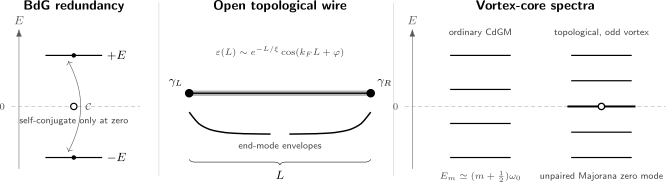
Three diagnostics that must not be conflated. Particle–hole redundancy pairs every finite-energy BdG state with a state at ; a topological open wire can leave self-conjugate modes and near zero with exponentially small overlap; and an ordinary vortex has a half-shifted Caroli–de Gennes–Matricon ladder, whereas an appropriate topological vortex can carry an unpaired zero mode.
Two- and Three-Dimensional Phases
Section titled “Two- and Three-Dimensional Phases”Chiral superconductors
Section titled “Chiral superconductors”A minimal continuum model for a spin-polarized chiral superconductor is
where . After a physically necessary ultraviolet regularization, the negative-energy BdG band has Chern number
The weak-pairing regime is topological, with for one chiral species; the strong-pairing regime is trivial. The transition at closes the bulk gap. This is the Read–Green distinction: two states with the same broken symmetries can differ by their BdG topology.
A boundary of a class-D phase with Chern number carries net chiral Majorana central charge
In the ideal low-temperature limit its thermal Hall response is
The factor of one half relative to a chiral complex fermion is characteristic of a Majorana channel. BdG quasiparticles do not carry a conserved charge, and the electromagnetic response also includes the condensate. Thus fixes the ideal chiral-Majorana thermal response, but it does not fix an analogous universal quantized electric Hall conductance.
Time-reversal-invariant superconductors
Section titled “Time-reversal-invariant superconductors”Class DIII preserves spinful time reversal with . Its protected boundaries appear in dimension-dependent forms:
- a one-dimensional phase has a Kramers pair of Majorana end modes;
- a two-dimensional phase has a helical Majorana edge;
- a three-dimensional phase can have a gapless Majorana surface cone.
After flattening a three-dimensional chiral-symmetric BdG Hamiltonian into an off-diagonal unitary block , one convention for the integer winding number is
Sign conventions depend on the orientation and block definition, but counts the stable surface-cone multiplicity in the minimal free description. Superfluid -B is a benchmark class-DIII topological neutral superfluid. It demonstrates the phase structure without being an electronic superconducting material.
For a centrosymmetric, fully gapped, time-reversal-invariant superconductor, odd-parity pairing and the pattern of Fermi surfaces around time-reversal-invariant momenta can provide a useful sufficient topological criterion. It is not a substitute for determining the pairing symmetry: uncertainty about the order parameter propagates directly into uncertainty about the topological label.
Vortices and Zero Modes
Section titled “Vortices and Zero Modes”A vortex carries condensate phase winding
The order parameter is suppressed in its core, so subgap states are expected even in a conventional superconductor. In the semiclassical regime , an ordinary singly quantized vortex has Caroli–de Gennes–Matricon levels of order
with integer in a simple spinless notation. These levels can lie very close to zero when is small. A near-zero vortex peak is therefore not automatically a Majorana mode.
In a two-dimensional chiral topological superconductor with odd Chern parity, an odd-vorticity defect can bind an unpaired Majorana zero mode. Spectral flow effectively removes the half-level offset for one branch, leaving a state pinned to zero by particle–hole conjugation unless it couples to another Majorana or the protecting assumptions fail. A proximitized topological-insulator surface provides another route: spin-momentum locking plus ordinary -wave pairing yields an effective spinless pairing structure, and a vortex can bind a Fu–Kane Majorana mode.
For a finite collection of vortices, zero modes hybridize pairwise:
The amplitudes depend exponentially and oscillatory on separation in a clean system. Disorder, anisotropy, nearby surfaces, other vortex-core levels, and three-dimensional vortex-line dispersion complicate the spectrum. A credible vortex claim should therefore establish localization, particle–hole structure, robustness over a parameter region, separation from ordinary core levels, and consistency with the bulk topology.
Engineered Platforms
Section titled “Engineered Platforms”Spin–orbit nanowires
Section titled “Spin–orbit nanowires”An ideal single-band model for a Rashba nanowire with Zeeman energy and induced -wave pairing is
At , the ideal bulk gap closes when
The single-band topological regime lies on the side
provided a reopened gap survives. Spin–orbit coupling converts the spin-singlet proximity effect into an effective odd-momentum pairing channel in the helical band.
This criterion is a model result, not a device certification. Real devices have several transverse bands, electrostatic inhomogeneity, orbital magnetic effects, field-dependent parent pairing, interface disorder, smooth quantum dots, finite length, dissipative leads, and interactions. A large Zeeman field can satisfy the algebraic inequality while simultaneously destroying the induced gap.
Other routes
Section titled “Other routes”| Route | Intended mechanism | What has been demonstrated | What remains decisive |
|---|---|---|---|
| Semiconductor–superconductor nanowires and planar junctions | Spin–orbit coupling, Zeeman splitting, and induced pairing | Hard gaps, subgap states, end spectroscopy, nonlocal transport, parity-sensitive measurements | A robust topological gap tied to nonlocal end modes, controlled fusion, and braiding |
| Topological-insulator surface or nanowire hybrids | Spin-momentum locking plus proximity pairing | Josephson and Andreev phenomena, induced gaps, vortex and bound-state candidates | Unambiguous Majorana identification and scalable control |
| Magnetic atom chains on superconductors | Helical or ferromagnetic order, spin–orbit coupling, and proximity pairing | End-localized zero-energy spectral weight and increasingly controlled atom-by-atom chains | Bulk-gap and end-mode consistency, exclusion of trivial Shiba states, and manipulation |
| Iron-based superconductors | Topological surface bands combined with intrinsic pairing | Vortex-core zero-bias candidates and surface-state spectroscopy | Reproducible topological bulk/defect ledger and non-Abelian operations |
| Odd-parity and chiral candidate materials | Intrinsic unconventional pairing | Evidence for unconventional order in several compounds | Settled pairing symmetry, a full protecting gap, and boundary response matching one invariant |
| Quantum-dot Kitaev chains | Tunable crossed Andreev and elastic tunneling | Two- and three-site spectra resembling short Kitaev chains | Scaling to a long gapped chain and demonstrating topological, rather than sweet-spot, protection |
| Quantum simulators | Encoded Kitaev or Majorana Hamiltonians | Controlled spectra and dynamics of target models | These validate a simulator, not an intrinsic electronic topological superconductor |
The categories should not be collapsed. An engineered proximity device, an intrinsic bulk material, and a quantum simulator answer different scientific questions. A short quantum-dot chain can test the Kitaev Hamiltonian beautifully while remaining too small to establish asymptotic topological protection. A candidate intrinsic material can exhibit unconventional pairing while its topological invariant remains unknown.
Experimental Evidence
Section titled “Experimental Evidence”No single local conductance curve measures a bulk invariant. The strongest case combines a bulk-gap diagnosis, a boundary or defect response, nonlocal consistency, parameter evolution through a transition, and controls that exclude known trivial mechanisms.
| Observation | Ideal topological expectation | Important alternatives or caveats |
|---|---|---|
| Zero-bias end peak | Resonant Andreev reflection from an isolated Majorana can approach at zero temperature | Smooth-confinement Andreev states, quantum dots, disorder, heating, dissipation, and peak merging |
| Gap closing and reopening | Required when a one-parameter path changes a bulk invariant | A local probe can miss the bulk gap; ordinary level crossings and electrostatic rearrangements can mimic reopening |
| Correlated signals at both ends | Separated end Majoranas arise from one nonlocal topological segment | Extended trivial states and inhomogeneous multi-dot spectra can correlate the ends |
| Nonlocal conductance | Can reveal an extended bulk gap and distinguish local from nonlocal processes | Elastic cotunneling, crossed Andreev reflection, disorder, contacts, and charge redistribution require a full conductance matrix |
| Fractional Josephson response | Fixed-parity branches can be periodic | Parity relaxation restores periodicity; Landau–Zener transitions and nonequilibrium occupation can mimic missing Shapiro steps |
| Vortex-core zero mode | An appropriate topological vortex binds an unpaired Majorana | Ordinary Caroli–de Gennes–Matricon states, impurity states, finite resolution, and vortex-line dispersion |
| Thermal boundary transport | A chiral Majorana edge contributes a half-integer channel | Phonons, additional edges, domains, contact thermalization, and non-topological neutral modes |
| Fusion or braid protocol | Outcomes depend on fermion parity and braid order as predicted for Ising anyons | Requires initialized separated modes, a maintained gap, parity control, and controls against ordinary coherent dynamics |
Fractional Josephson effect and 4π periodicity
Section titled “Fractional Josephson effect and 4π periodicity”The fractional Josephson effect is also described as 4π Josephson periodicity, or as 4pi periodicity in plain-text literature searches. The notation refers to a parity-resolved spectral branch, not automatically to the equilibrium free energy.
For a topological Josephson junction with two coupled Majoranas, the fixed-parity energies can take the form
Following one parity branch through changes its sign, so that branch returns only after . In thermal equilibrium, however, the system can switch parity at the crossing and recover a -periodic free energy. The phrase “ Josephson effect” must therefore specify the drive frequency, parity lifetime, occupation dynamics, and alternative nonequilibrium mechanisms.
Current status and the topological gap protocol critique
Section titled “Current status and the topological gap protocol critique”The experimental literature has advanced well beyond the first zero-bias peaks. Hybrid devices have been tested with a multistep topological-gap protocol, interferometric parity readout, three-terminal conductance, and short artificial Kitaev chains. Those are significant control achievements. They do not yet amount to a consensus demonstration of protected Majorana braiding.
The status is also actively contested. A 2023 study reported InAs–Al devices passing a specified topological gap protocol, and a 2025 experiment reported single-shot parity-sensitive interferometry in protocol-selected devices. A 2026 published critique argued that the underlying operating regions were substantially disordered and apparently gapless, challenging the topological interpretation. This disagreement is precisely why raw gap, locality, and calibration evidence must accompany the phase label.
The defensible hierarchy is:
- Ingredient demonstrated: proximity pairing, spin–orbit coupling, Zeeman control, a hard gap, or tunable Andreev processes.
- Candidate Majorana-compatible state: a zero mode with some expected stability or localization.
- Candidate topological phase: bulk and boundary evidence pass a declared protocol.
- Non-Abelian operation demonstrated: initialized modes exhibit fusion or braid-order statistics with trivial explanations excluded.
- Protected logical operation demonstrated: error suppression scales with separation, gap, or code distance in the intended architecture.
Claims should state the highest completed rung without borrowing the language of the next one.
Common Mistakes
Section titled “Common Mistakes”Treating every BdG eigenvalue as an independent quasiparticle. The and branches are related by Nambu redundancy. Independent excitations may be counted using positive energies with zero modes handled separately.
Calling particle–hole conjugation ordinary charge symmetry. A BdG quasiparticle is generally a coherent electron–hole mixture, and electric charge is not the conserved quantity represented by .
Equating a zero-energy state with a Majorana zero mode. Any tuned Andreev level can cross zero. A topological Majorana requires self-conjugacy plus a protecting bulk or defect invariant and suitable localization.
Applying the gapped tenfold-way table to a nodal spectrum. Nodal superconductors require invariants on loops or surfaces surrounding the nodes and may have different boundary phenomena.
Inferring topology from unconventional pairing alone. Odd parity or broken time reversal can be helpful, but the Fermi surfaces, full gap, dimensionality, and symmetry representation still matter.
Claiming quantized electric Hall conductance from a BdG Chern number. BdG quasiparticles do not carry a conserved charge, and the condensate contributes to electromagnetic response. A BdG Chern number fixes ideal chiral-Majorana thermal response, not a universal quantized electric Hall coefficient.
Calling an artificial few-site chain an intrinsic material realization. It may be a precise Hamiltonian emulator and an important device milestone without establishing a long-chain topological phase.
Calling a Majorana pair a protected qubit. Fixed total parity removes the two-state freedom of a single pair, and poisoning, finite overlap, control errors, and above-gap excitations remain.
Exercises
Section titled “Exercises”1. Verify BdG particle–hole conjugation
Section titled “1. Verify BdG particle–hole conjugation”For
where and is real, verify particle–hole conjugation with . If has energy , construct its partner.
Solution
The Hamiltonian is real, so
Using and gives
Meanwhile,
so the relation holds. If
then
is an eigenvector of with energy . It represents the creation operator of the same positive-energy quasiparticle, not a second independent excitation.
2. Locate the Kitaev-chain transition
Section titled “2. Locate the Kitaev-chain transition”Use
to classify , , , and for . Where must the bulk gap close?
Solution
For ,
For ,
Both are topological. For , the product is , so and the phase is trivial. The sign changes at
At those values the normal term vanishes at or , respectively, while the odd pairing term also vanishes. The BdG gap must therefore close.
3. Build one fermion from two Majoranas
Section titled “3. Build one fermion from two Majoranas”Given , prove that
obeys the canonical fermion algebra and derive .
Solution
Self-adjointness gives
Using and ,
The number operator is
Rearranging yields
The bilinear measures the parity of the complex fermion, up to the stated convention.
4. Estimate finite-size protection
Section titled “4. Estimate finite-size protection”Suppose
after tuning to an oscillation maximum. How long must the wire be for ?
Solution
Since , the condition is
Therefore
This estimates only overlap splitting. It says nothing about poisoning, disorder-induced states, lead broadening, or whether a hard topological gap exists.
5. Explain the half thermal channel
Section titled “5. Explain the half thermal channel”A two-dimensional class-D superconductor has . Find its chiral central charge and ideal low-temperature . Why is the coefficient not ?
Solution
Each chiral Majorana mode has central charge , so
Thus
The larger proposed coefficient would count three chiral complex fermions. A complex channel contains two real Majorana channels, so it carries twice the thermal central charge of one Majorana mode.
6. Derive the nanowire phase boundary
Section titled “6. Derive the nanowire phase boundary”At , the Rashba term vanishes. Show that the positive excitation energies are
and find the gap-closing condition.
Solution
At ,
The spin operator commutes with the Nambu matrices. In an eigenstate with eigenvalue , the Nambu block has eigenvalues
Taking positive magnitudes gives the two displayed branches. The smaller branch reaches zero when
or
The derivation locates an ideal bulk transition; it does not prove that a finite disordered device has entered a robust topological regime.
7. Compare a vortex level with zero
Section titled “7. Compare a vortex level with zero”A conventional superconductor has and . Estimate the Caroli–de Gennes–Matricon spacing. Could a spectrometer with resolution distinguish the lowest ordinary level from zero?
Solution
The characteristic spacing is
The lowest half-shifted level is of order
That is well below the stated resolution, so it can appear as a zero-bias feature. Spatial structure, temperature dependence, field evolution, higher levels, and a bulk topological diagnosis are needed before assigning a Majorana interpretation.
8. Audit an experimental claim
Section titled “8. Audit an experimental claim”A finite nanowire shows a stable zero-bias peak at one end over a range of magnetic field. No second end contact is available, the induced gap softens continuously with field, and no gap reopening is resolved. The peak is labeled “proof of braidable Majoranas.” Evaluate the claim and propose four stronger checks.
Solution
The observation is compatible with a Majorana end mode, but it is far below proof of a topological phase and says nothing direct about braiding. A partially separated Andreev bound state, a smooth quantum dot, disorder, or a dissipative near-zero level can produce similar local conductance. The absence of a resolved reopened gap and of a second-end measurement removes two central consistency checks.
Stronger tests include:
- map the bulk or nonlocal gap through a closing and reopening;
- add a second end contact and test correlated end behavior while ruling out extended trivial states;
- quantify peak height and temperature scaling against resonant-Andreev theory;
- vary length or segment boundaries to test exponential end-mode overlap;
- measure parity lifetimes and controlled fusion outcomes;
- implement a braid-order protocol with initialized modes and ordinary coherent controls;
- repeat across devices with a preregistered analysis and disorder diagnostics.
The justified label is “a robust local zero-bias feature compatible with several mechanisms,” not proof of a braidable excitation.
Connections
Section titled “Connections”- Unconventional Superconductivity owns pairing representation, nodes, relative signs, and time-reversal-breaking evidence; this page begins only when a BdG invariant, protecting gap, boundary or defect mode, and topological evidence are the claim.
- BCS Theory develops Cooper pairing, coherence factors, thermodynamics, and conventional superconducting observables before topology is imposed.
- Vortex Matter, Pinning, and Flux Flow owns entry, barriers, pinning, creep, collective order, and driven vortex motion; none of those material responses supplies the BdG invariant or Majorana evidence required here.
- Pair-Density Waves and Exotic Orders distinguishes finite pair momentum and sign modulation from a protected Bogoliubov topological invariant.
- Superconducting Proximity Effect owns the nontopological bulk induced correlations, inverse suppression, and spatial gap profile that must be established before a heterostructure is assigned a BdG invariant.
- Proximity and Andreev Physics owns the ordinary NS-interface, BTK, few-mode Andreev-level, and hybrid-device baselines that candidate Majorana devices must exceed.
- Symmetry Classification Preview owns the general tenfold-way vocabulary and explains the difference between physical time reversal and BdG particle–hole conjugation.
- Topology in Quantum Matter gives the general bulk-gap, deformation, and evidence framework used here.
- Topological Insulators is the charge-conserving comparison; proximity to its spin-momentum-locked boundary provides one route to effective topological pairing.
- Edge and Surface States compares charged and neutral chiral boundaries, helical modes, Dirac cones, finite-size gaps, and the probes that can or cannot identify them.
- Bulk–Boundary Correspondence explains stable boundary indices, removable mode pairs, regulator dependence, and the interacting limits of a free BdG count.
- Symmetry-Protected Topological Phases explains stable interacting equivalence and the reductions for class BDI and for class DIII.
- Operator Identities collects the fermionic parity and Majorana-bilinear identities used in low-energy descriptions.
- Superselection Sectors Preview explains why coherent control is restricted by total fermion parity.
- Entanglement Spectrum develops a virtual-boundary diagnostic for free and interacting topological phases.
- Topological Quantum Computation Bridge turns Majorana modes and parity measurements into an explicit encoding, gate, protection, and experimental-milestone ledger.
- Topological Qubits expands that encoding into a complete tetron or anyon module with readout, reset, controller, outer code, universal-gate resources, and dated device evidence.
Further Reading
Section titled “Further Reading”- M. Sato and Y. Ando, “Topological Superconductors: A Review,” Reports on Progress in Physics 80, 076501 (2017), doi:10.1088/1361-6633/aa6ac7.
- J. Alicea, “New Directions in the Pursuit of Majorana Fermions in Solid State Systems,” Reports on Progress in Physics 75, 076501 (2012), doi:10.1088/0034-4885/75/7/076501.
- C. W. J. Beenakker, “Search for Majorana Fermions in Superconductors,” Annual Review of Condensed Matter Physics 4, 113–136 (2013), doi:10.1146/annurev-conmatphys-030212-184337.
- B. A. Bernevig and T. L. Hughes, Topological Insulators and Topological Superconductors, Princeton University Press, 2013.
References
Section titled “References”- N. Read and D. Green, “Paired States of Fermions in Two Dimensions with Breaking of Parity and Time-Reversal Symmetries and the Fractional Quantum Hall Effect,” Physical Review B 61, 10267–10297 (2000), doi:10.1103/PhysRevB.61.10267.
- A. Y. Kitaev, “Unpaired Majorana Fermions in Quantum Wires,” Physics-Uspekhi 44, 131–136 (2001), doi:10.1070/1063-7869/44/10S/S29.
- A. P. Schnyder, S. Ryu, A. Furusaki, and A. W. W. Ludwig, “Classification of Topological Insulators and Superconductors in Three Spatial Dimensions,” Physical Review B 78, 195125 (2008), doi:10.1103/PhysRevB.78.195125.
- A. Kitaev, “Periodic Table for Topological Insulators and Superconductors,” AIP Conference Proceedings 1134, 22–30 (2009), doi:10.1063/1.3149495.
- X.-L. Qi, T. L. Hughes, S. Raghu, and S.-C. Zhang, “Time-Reversal-Invariant Topological Superconductors and Superfluids in Two and Three Dimensions,” Physical Review Letters 102, 187001 (2009), doi:10.1103/PhysRevLett.102.187001.
- L. Fu and C. L. Kane, “Superconducting Proximity Effect and Majorana Fermions at the Surface of a Topological Insulator,” Physical Review Letters 100, 096407 (2008), doi:10.1103/PhysRevLett.100.096407.
- L. Fu and E. Berg, “Odd-Parity Topological Superconductors: Theory and Application to ,” Physical Review Letters 105, 097001 (2010), doi:10.1103/PhysRevLett.105.097001.
- R. M. Lutchyn, J. D. Sau, and S. Das Sarma, “Majorana Fermions and a Topological Phase Transition in Semiconductor–Superconductor Heterostructures,” Physical Review Letters 105, 077001 (2010), doi:10.1103/PhysRevLett.105.077001.
- Y. Oreg, G. Refael, and F. von Oppen, “Helical Liquids and Majorana Bound States in Quantum Wires,” Physical Review Letters 105, 177002 (2010), doi:10.1103/PhysRevLett.105.177002.
- C. Caroli, P. G. de Gennes, and J. Matricon, “Bound Fermion States on a Vortex Line in a Type II Superconductor,” Physics Letters 9, 307–309 (1964), doi:10.1016/0031-9163(64)90375-0.
- K. T. Law, P. A. Lee, and T. K. Ng, “Majorana Fermion Induced Resonant Andreev Reflection,” Physical Review Letters 103, 237001 (2009), doi:10.1103/PhysRevLett.103.237001.
- V. Mourik et al., “Signatures of Majorana Fermions in Hybrid Superconductor–Semiconductor Nanowire Devices,” Science 336, 1003–1007 (2012), doi:10.1126/science.1222360.
- S. Nadj-Perge et al., “Observation of Majorana Fermions in Ferromagnetic Atomic Chains on a Superconductor,” Science 346, 602–607 (2014), doi:10.1126/science.1259327.
- D. Wang et al., “Evidence for Majorana Bound States in an Iron-Based Superconductor,” Science 362, 333–335 (2018), doi:10.1126/science.aao1797.
- M. Aghaee et al., “InAs–Al Hybrid Devices Passing the Topological Gap Protocol,” Physical Review B 107, 245423 (2023), corrected 2024, doi:10.1103/PhysRevB.107.245423.
- Microsoft Azure Quantum et al., “Interferometric Single-Shot Parity Measurement in InAs–Al Hybrid Devices,” Nature 638, 651–655 (2025), doi:10.1038/s41586-024-08445-2.
- H. F. Legg, “On the Robustness of Topological Gap Detection via Transport,” Nature 654, E22–E26 (2026), doi:10.1038/s41586-026-10567-8.
- S. L. D. ten Haaf et al., “Observation of Edge and Bulk States in a Three-Site Kitaev Chain,” Nature 641, 890–895 (2025), doi:10.1038/s41586-025-08892-5.
- J. Feng et al., “Long-Range Crossed Andreev Reflection in a Topological Insulator Nanowire Proximitized by a Superconductor,” Nature Physics 21, 708–715 (2025), doi:10.1038/s41567-025-02806-y.
- H. Jang et al., “Robustness of Majorana Modes to a Disorder Potential in Atomic Chains on a Superconducting Rashba Alloy,” Nature Physics (2026), doi:10.1038/s41567-026-03322-3.